Review: To See Farby Jeff Foust
|
| Those programs brought with them plenty of technical problems, but they often seemed to pale in comparison to the challenges of learning to work with the Russians as well as within the agency itself. |
That scale, along with the station’s continuing operations, makes it difficult to document its history. For now, we’re left with the documentation of those ongoing operations as well as slices of the past from various accounts, looking at its development from specific, often individual, perspectives.
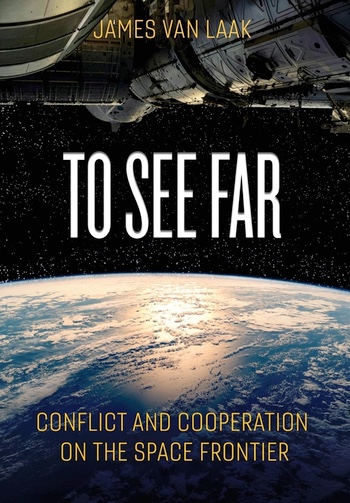
An example is To See Far, a new book by James Van Laak. A former Air Force fighter pilot, he joined NASA in the late 1980s, first at a safety office in NASA Headquarters and later at the Johnson Space Center. For more than a decade, he was a key manager on the Space Station Freedom, the Shuttle-Mir program, and the ISS, dealing with technical, programmatic, and even cultural challenges.
Most of the book is about his time at JSC working on those programs. He was brought in to handle maintenance and logistics planning for Freedom, issues that some working on the program feared were being overlooked. Later, he was involved in assessments and redesigns of Freedom as the program was facing cancellation, spared only by bringing in the Russians to create the ISS. Soon frustrated with the management of the ISS program, he moved over to Shuttle-Mir, helping manage the series of shuttle missions to Mir and the NASA astronauts who spent time on the Russian station. When that program ended, he returned to the ISS program to lead operations as NASA was moving into its assembly phase, with a rapid cadence of missions planned.
Those programs brought with them plenty of technical problems, which Van Laak recounts in the book. Those problems, though, often seemed to pale in comparison to the challenges of learning to work with the Russians as well as within the agency itself. NASA is not immune to office politics and strife among officials, and he puts that on full display in the book.
Van Laak offers unvarnished views of those programs in the 1990s, discussing what went wrong and why. That includes sharp criticism of some of the leaders of the shuttle and station programs in that time, including Randy Brinkley, Tommy Holloway, and Frank Culbertson. Even Bill Gerstenmaier, aka “Gerst,” who later became an almost revered leader of human spaceflight programs at NASA before joining SpaceX, does not escape criticism: “His total mastery of the engineering details was an enormous asset, but his tendency to hoard information for his own use quickly became a liability,” Van Laak recalls of Gerst when working on Shuttle-Mir.
| “Engineers live to tackle technical challenges, but these issues also come burdened with very human dimensions,” he notes . |
In the book, Van Laak depicts himself as one of the few voices of reason with the station and Shuttle-Mir programs, trying to make progress within NASA and build relationships with the Russians while increasingly feeling overworked, underappreciated, and undercompensated. “My biggest challenge was human behavior,” he says in one chapter about working on ISS, as both Russians and Americans learned to shake off decades-old ways of work to cooperate on the station. (He notes that working on shuttle, ISS, and Freedom over less than a decade made it easier for him to accept change.) But by the end of 2001, he felt burned out and stepped away from the ISS program, later leaving JSC.
“Engineers live to tackle technical challenges, but these issues also come burdened with very human dimensions,” he notes near the end of To See Far. The book makes those challenges clear, at least from Van Laak’s perspective. The issue, of course, is that others involved in those programs likely have different perceptions and recollections, as well as different records of events. (Van Laak notes in the book that the dialogue he includes in the book “may not be exactly accurate” but are based on his memories and notes “to ensure that the meaning and intent of the conversation was preserved.” That may explain why much of that dialogue seems oddly stilted and formal.)
Few decisions are truly irrational or irrational; instead, it reflects a lack of a shared logic and rationale. What seems unwise or vindictive to one person can seem logical and benign to another person with a different perspective. To See Far offers valuable insights by one person deeply involved in the early years of the ISS program, but it is only one step towards a greater understanding of the program. That will gradually emerge, but it may take as long to develop as the station itself.
Note: we are now moderating comments. There will be a delay in posting comments and no guarantee that all submitted comments will be posted.