The Solar System Internet: Envisioning a networked future beyond Earthby Scott Pace and Yosuke Kaneko
|
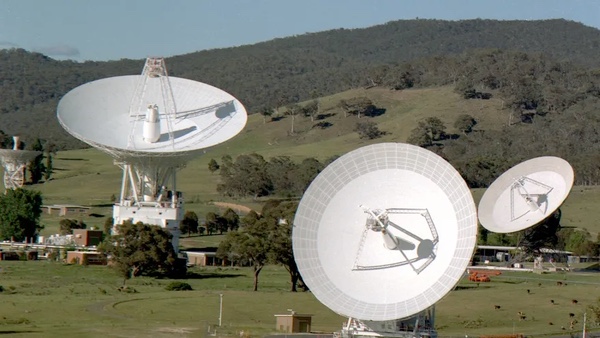
| You can think of the terrestrial Internet as driving from Washington to New York. You get on the I-95 freeway and head north, getting off at your exit and arriving at a desired address. The interplanetary Internet is like going from Washington to Jakarta. |
In preparation for the first Artemis landing of humans on the Moon, a new generation of communications and navigation services are being created for cislunar space. LunaNet is an international framework for a lunar Internet, developed by NASA, ESA, and JAXA, providing communications, navigation (PNT), and data services for future Moon missions, featuring interoperable standards, delay-tolerant networking, and a scalable architecture for orbiters, landers, and surface assets to support sustained lunar exploration.
The key idea and technology: DTN and the Bundle Protocol
The SSI is not a single, monolithic network but an interoperable overlay designed to “federate” all kinds of distinct space assets—spacecraft, relays, rovers, and ground stations—into a “store-and-forward” fabric tolerant of the solar system’s unforgiving communication environment. The linchpin is DTN, a protocol suite initiated in 1998 by engineers at NASA’s Jet Propulsion Laboratory (JPL), formalized through the Internet Engineering Task Force (IETF) and the Consultative Committee for Space Data Systems (CCSDS). DTN addresses the problem of a “challenged network,” where end-to-end connectivity cannot be assumed, by decoupling data transport from delivery.
You can think of the terrestrial Internet as driving from Washington to New York. You get on the I-95 freeway and head north, getting off at your exit and arriving at a desired address. The interplanetary Internet is like going from Washington to Jakarta. You drive to the airport, get on a scheduled flight, make some stops in transit with layovers, arrive in Jakarta, and then get a local ride to your destination. The SSI uses the Bundle Protocol, which is distinct from the terrestrial Internet’s use of TCP/IP protocols. TCP/IP’s continuous acknowledgment model falters under multi-minute delays, which are typical in deep space communications. Instead, BP uses a store-and-forward mechanism in which intermediate nodes hold bundles until forwarding opportunities arise.
BP can operate across a wide range of communication protocols, from CCSDS-based space protocols to the familiar TCP/IP used on the Internet. It also functions well in “communication-resource-poor” infrastructures, and can operate under opportunistic (e.g., rover encounters) contacts without requiring constant end-to-end paths.
| The scalability of SSI is a force multiplier. BP’s overlay nature integrates legacy assets; for example, the Europa Clipper could leverage Mars Odyssey relays via DTN gateways to increase communications opportunities. |
Technical demonstrations have validated this architecture. ESA’s 2023 interoperability test, involving NASA JPL, Morehead State University, and the open-source D3TN implementation, showed reliable data delivery across disrupted links and independently developed DTN nodes. DTN data and video transmission have been tested at the Moon on the current Korean Pathfinder Lunar Orbiter (KPLO) mission. Earlier NASA mission studies, including Europa Clipper, also found that DTN could reduce operational complexity by abstracting complex links into uniform network endpoints.
Why it is important: reliability, scalability, and access in space operations
The importance of SSI transcends incremental improvements; it fundamentally shifts space communications from siloed, mission-specific pipelines to a reusable, multi-stakeholder infrastructure, mirroring the terrestrial Internet’s “network once, use many” ethos. Current systems—epitomized by NASA’s Deep Space Network (DSN) or ESA’s ESTRACK—rely on pre-planned, point-to-point sessions, incurring high latency in scheduling: days for contact windows. DTN’s store-and-forward paradigm, with its planned routing via contact graphs (precomputed link schedules), increases potential efficiency. Moreover, SSI enhances mission resilience and innovation. In high-disruption scenarios (e.g., solar conjunctions blacking out Mars-Earth links), bundles persist across regional outages, enabling autonomous operations.
The scalability of SSI is a force multiplier. BP’s overlay nature integrates legacy assets; for example, the Europa Clipper could leverage Mars Odyssey relays via DTN gateways to increase communications opportunities. ESA’s Moonlight initiative envisions lunar DTN services over Ka-band, where bundles enable dynamic path selection amid gateway constellations, supporting terabit-scale downlinks for Earth observation missions. Some analyses estimate that SSI could amortize infrastructure costs across more than 100 missions by 2035, fostering commercial ecosystems like data relay leasing from Starlink-like megaconstellations extended to cislunar orbits.
SSI lowers barriers for participation in space, particularly for developing countries. Traditional space communications demand multimillion-dollar ground stations and custom interfaces that exclude all but major space agencies. DTN’s open standards enable “plug-and-play” interoperability. A low-cost DTN node (e.g., software on Raspberry Pi-class hardware) can carry bundles from shared relays, as demonstrated in Morehead State’s university-led ESA tests. DTN’s resilience to “resource-poor” environments can also be translated to terrestrial applications, such as rural mesh networks in sub-Saharan Africa, creating dual-use knowledge transfer.
The SSI could democratize space access but global coordination is needed, as with the terrestrial Internet. For example, all BP traffic terminates on physical layers governed by recommendations and regulations by the International Telecommunication Union (ITU). Speeches by the ITU Secretary-General have explicitly flagged interplanetary networking as a horizon issue, warning of interference risks from new cislunar constellations. The DTN’s use of shared bands. e.g., aggregating lunar gateways, could strain existing allocations for space services and require dynamic spectrum access protocols that would have to be international coordinated.
Similarly, BP’s dual standardization (CCSDS for space profiles, IETF for overlays) could prompt discussions with ITU working groups. For example, ITU-T Study Group 13’s work on future networks could include DTN extensions, ensuring interoperability with 6G terrestrial backhauls. Multistakeholder forums—mirroring WCIT (World Conference on International Telecommunications) processes—could be used to reconcile CCSDS Blue Books with ITU Recommendations and prevent proprietary forks that disadvantage smaller actors and balkanize networks. A key insight of the multistakeholder approach that made the Internet successful was to build “bottom-up” and avoid top-down designs that stifle innovation.
Actions needed to make the Solar System Internet a reality
The technical foundations for the SSI have been demonstrated and open international standards are available and documented. Programs like LunaNet are in work to create a new cislunar architecture for communications and navigation. However, there are hundreds of actions necessary to make the SSI a reality and little time to do so. There is a large gulf between today’s four- to five-node bespoke networks and making BP-DTN into an actual operational network with network monitor and control systems, management systems, security, and more.
| For the scale of human and robotic space activity being contemplated today, we will need to manage hundreds of nodes in a networked environment and we only have a few years to learn how to do so. |
As a terrestrial analogy, just because you have TCP/IP doesn’t mean you have the Internet. While there has been good progress in getting BP-DTN accepted in LunaNet, there has not been as much attention to systematically managing DTN clients that will use a combination of NASA and commercial ground stations and relay satellites. A basic NM&C (Network Management and Control) system is needed to provide the tools, applications, and processes to monitor, configure, troubleshoot, and secure network infrastructure. We should not wait for exponential growth in DTN nodes in LunaNet and involvement of ground stations from multiple countries, government and commercial, to start working out how to make a DTN network system.
For the scale of human and robotic space activity being contemplated today, we will need to manage hundreds of nodes in a networked environment and we only have a few years to learn how to do so. We cannot afford a large number of IT specialists to care and feed every DTN node. This does not scale (nor do current systems) and users need an SSI that “just works” in the background as we have come to expect with the terrestrial Internet.
The Solar System Internet, powered by DTN and the Bundle Protocol, heralds a paradigm where space becomes a networked continuum, resilient and inclusive. Its technical elegance, using store-and-forward transfers over heterogeneous adaptors, delivers tangible gains in efficiency and access, while governance foresight ensures broad participation. Today, with LunaNet prototypes orbiting, the SSI is no longer speculative—it’s the architecture for humanity’s coming multi-planetary epoch if we decide to build it. If we do not, others will.
Note: we are now moderating comments. There will be a delay in posting comments and no guarantee that all submitted comments will be posted.