Review: Webb’s Cosmosby Christopher Cokinos
|
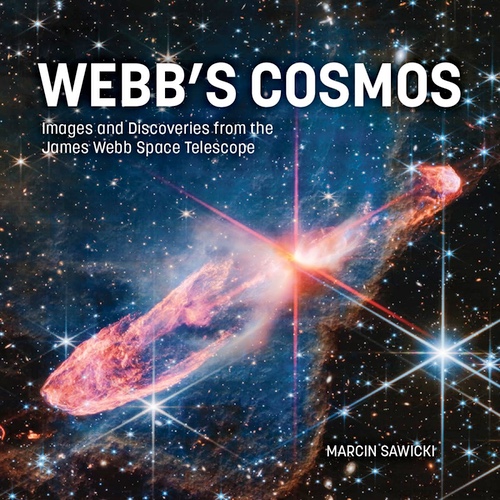
| The book is a keeper, and the prose is so approachable and photos so exquisite I think it would make a great gift for younger readers whose interest in science and astronomy might be cultivated by such a volume. |
Sawicki’s first-person account of working on the JWST, watching the nerve-racking launch, the deployment of its delicate sunshield, and his recounting the telescope’s longer history and future operations is engaging. The prose here and throughout the book is crisp and clear.
As he writes, “All of it—every pixel of every image—is grounded in science, data, and in decades of dreaming and building. But every Webb image also inspires wonder. Because beyond the technical achievement, beyond the scientific discoveries, Webb invites us to seek answers to timeless questions: Where did we come from? How did the cosmos around us evolve? What is our place in it? Are we alone?”
Readers will savor those questions individually as they savor the imagery. You’ll find stunning images of stars looking like exploded flowers, like something from a futurist landscape. There are classics like the Cosmic Cliffs of Carina and the Pillars of Creation. But you will encounter, of course, many images new to you, including, perhaps, the blue mists of the Chamaeleon 1 molecular cloud and Earendel, the most distant sun yet observed and photographed within the Sunrise Arc, “the most strongly gravitationally magnified galaxy from the early universe currently known.” Even the feature names are poetic.
Several photographs overlay Hubble Space Telescope and JWST imagery to create new ways of looking at galaxies, for example, and yet the book’s most potent images, for me, are those of planets in our own Solar System and the “snapshots” of exoplanets like little lit gems. You’ll find favorites too.
The book excels as well at infographics that explain, among other things, the scale of the cosmos and the expansion of the universe. These are easy to grasp and useful in helping to remind the reader of the sublime scale of photos that one can just easily turn to, page by page. With short, clear chapter introductions, the book functions as a beginner’s guide to astronomy as well.
The book is a keeper, and the prose is so approachable and photos so exquisite I think it would make a great gift for younger readers whose interest in science and astronomy might be cultivated by such a volume. Awe and wonder have long been hallmarks of deep space imagery. Webb’s Cosmos reminds us why—and shows us that our quest for future JWST discoveries is just beginning.
Note: we are now moderating comments. There will be a delay in posting comments and no guarantee that all submitted comments will be posted.