Tame the wolf, release the panda: The case for US-China space cooperationby Jimin Park
|
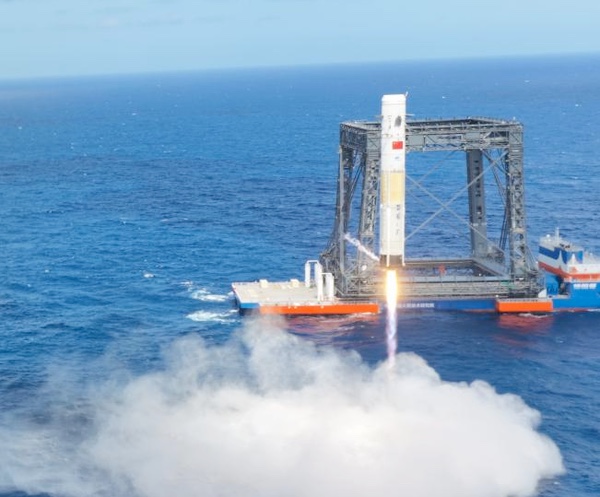
| The Wolf Amendment’s restrictions on space engagement disadvantage the US. Instead, the US should leverage China’s growing financial and technical capabilities to complement NASA’s efforts. |
Beijing perceives the Wolf Amendment as a deliberate US effort to deny Chinese legitimacy as a space power. Space achievements are deeply tied to China’s economic growth, technological innovation, and domestic legitimacy.[3] As a result, the Wolf Amendment reinforces nationalist narratives in China that depict the West as unwilling to accept China’s rise.[4] Such perception of status denial can heighten insecurity and increase the likelihood of aggressive and confrontational behaviors by China.[5] To counter this dynamic, the US should pursue status recognition by repealing the Wolf Amendment and engaging China as an equal partner in space cooperation, thereby promoting stability and mutual respect.
The Wolf Amendment’s restrictions on space engagement disadvantage the US. While America’s space exploration slowed, China’s program has advanced rapidly and independently.[6] Despite being excluded from the ISS, China successfully developed its own space station, Tiangong. Continued isolation will push both countries to develop separate technologies without information exchange or coordination. Instead, the US should leverage China’s growing financial and technical capabilities to complement NASA’s efforts.[7] Cooperation could begin with pragmatic steps such as deconflicting lunar activities, maintaining dedicated communication channels, and establishing equipment standardization.[8] By prioritizing feasible and less controversial issues, both countries can build trust and lay the foundations for deeper collaboration.[9]
Responding to key critiques of repealing the Wolf Amendment
Critique 1: China’s authoritarianism and revisionism
Representative Frank Wolf (the amendment’s original sponsor) justified the policy on moral grounds, expressing concern about cooperating with China. However, even proponents of the amendment have conceded that it has done little to influence Beijing’s space ambitions or human rights practices.[10] Simply identifying problems with China’s behavior does not constitute a sufficient basis for rejecting space cooperation. Critics often warn that China seeks to revise the global order.[11] These scholars argue that space advances fuel China’s ambitions and economic growth.[12] Yet this interpretation overstates China’s ambitions. Rather than being a revisionist power, Beijing primarily operates as “a status quo power with limited global aims.”[13] Moreover, the importance of space to China’s prestige underscores why space cooperation could serve as a valuable tool for leverage and improved bilateral relations.
Critique 2: Espionage and PLA technological development
Opponents of space engagement argue that space cooperation could inadvertently enhance the People’s Liberation Army’s (PLA) capabilities through China’s military-civil fusion.[14] However, this concern does not justify rejecting space engagement. In 2014 testimony before the US Senate Commerce Committee’s space subcommittee, former astronaut Leroy Chiao stated that fears of espionage were exaggerated.[15] Rather than relying on the Wolf Amendment, the US should mitigate technology-transfer risks through International Traffic in Arms Regulations and Export Administration Regulations, which cover nearly all space technologies and offer more effective safeguards.[16]
Even critics of space engagement acknowledge that the amendment has failed to deter China’s espionage or slow Beijing’s space ambitions.[17] Instead, restrictions on cooperation have accelerated Beijing’s independent space development.[18] Advocates of the amendment often assume that the US gains nothing from engaging with China, but this assumption is misguided. Cooperation provides insights into China’s decision-making processes and institutional structures, which contain “valuable information in accurately deciphering [China’s] intended use of dual-use space technology.”[19]
| Continued isolation only reinforces China’s perception of status denial and risks accelerating Beijing’s independent space development. |
Space engagement can address concerns of China’s military-civil fusion and espionage. Although the PLA is connected to China’s space program, cooperation may strengthen the civil space sector and limit the influence of military hardliners.[20] Repealing the Wolf Amendment would reduce China’s incentive to develop space technologies independently. Current restrictions push Beijing toward alternative partners, diminishing US influence over China’s space development and broader diplomatic leverage.[21] Given Beijing’s pragmatic tendencies, China may be willing to agree to limits on espionage in exchange for space cooperation.[22]
Critique 3: Other avenues for cooperation
Supporters of the Wolf Amendment often note that the amendment does not explicitly prohibit all forms of space cooperation with China.[23] While technically correct, this view overlooks the amendment’s practical consequences. The amendment discourages direct bilateral engagement and creates a “chilling effect” that deters collaboration even between US and Chinese companies.[24] By limiting civil space cooperation, the amendment obstructs future joint efforts in space exploration, human spaceflight, and technology transfer.[25] These restrictions—though aimed at civil collaboration—still reinforce Chinese perceptions of status denial.
Conclusion
Repealing the Wolf Amendment would enable a constructive and strategically beneficial approach to Sino-American space relations. By engaging China as an equal partner, the US can address Beijing’s pursuit of prestige while capitalizing on the mutual benefits of space engagement. Continued isolation only reinforces China’s perception of status denial and risks accelerating Beijing’s independent space development. Although national security concerns remain valid, space cooperation presents a pragmatic path for advancing bilateral relations and scientific progress in space.
References
- Robert Hines, “A Place in the Stars: Prestige and Legitimacy in China’s Quest for Space Power,” Cornell Theses and Dissertations, 177.
- Gregory Kulacki and Jeffrey G. Lewis, A Place for One’s Mat: China’s Space Program, 1956–2003 (American Academy of Arts and Sciences, 2009), 3.
- John Klein, Space Warfare: Strategy Principles and Policy (Routledge, 2025), 72–75.
- Anand V., “China’s Science and Technology Capabilities: The Case of the Outer Space Sector,” Nepal Institute for International Cooperation and Engagement, August 21, 2020.
- Michelle Murray, The Struggle for Recognition in International Relations: Status, Revisionism, and Rising Powers (Oxford University Press, 2020), 207–215.
- Alvin Hoi-Chun Hung, “Did Exclusion Ignite China’s Drive to Compete in Space Station Technology? An Analysis of the Techno-Legal Implications of the Wolf Amendment,” Journal of Law, Technology, and Policy, 2022.
- “Pathways to Exploration—Rationales and Approaches,” National Academy of Sciences, 2014
- Aaron Bateman, “The prospects for United States–China space cooperation are limited,” The Bulletin, June 12, 2023.
- Bin Li, “Space Won’t Be Safe until the U.S. and China Can Cooperate,” Scientific American, May 9, 2022.
- Dan Hart and Dean Cheng, “Should the Wolf Amendment Be Repealed?” The Aerospace Company, July 29, 2025.
- Elle Lu and Alex Stephenson, “Space: The Final Frontier of U.S.-China Competition.” The National Interest, July 5, 2022.
- Dean Cheng, China and the New Moon Race (Space Policy Institute, 2024), 8–30.
- David Kang, “What China Doesn’t Want,” Foreign Affairs, September 19, 2025.
- “The Chinese Communist Party’s Military-Civil Fusion Policy,” U.S. Department of State.
- Andrew Johnson, “An Agreement to Disagree,” In Chen Lan and Jacqueline Myrrhe. “Go Taikonauts. All about China’s space programme,” Issue 12. May 2014: 21–26.
- Hart and Cheng, “Wolf Amendment.”
- Hart and Cheng, “Wolf Amendment.”
- Makena Young, “Bad Idea: The Wolf Amendment (Limiting Collaboration with China in Space),” Defense360, December 4, 2019.
- Michael Listner and Joan Johnson-Freese, “Commentary | Two Perspectives on U.S.-China Space Cooperation,” SpaceNews, July 14, 2014.
- Marco Aliberti, When China Goes to the Moon… (Springer, 2015), 233–234.
- Peter Harrell, “China’s Non-Traditional Espionage Against the United States: The Threat and Potential Policy Responses,” CNAS, December 12, 2018.
- James Lewis, “Space Subcommittee Hearing – Are We Losing the Space Race to China?,” Committee on Science, Space, and Technology, September 27, 2016.
- Hart and Cheng, “Wolf Amendment.”
- Paul Bolt, “American Sanctions on China’s Space Program: Effective Economic Statecraft?,” Space and Defense 15, no. 1 (2024): 149–63, DOI: 10.32873/uno.dc.sd.15.01.1037.
- Young, “Bad Idea: Wolf Amendment”
Note: we are now moderating comments. There will be a delay in posting comments and no guarantee that all submitted comments will be posted.