We can build cities on the Moon—but who will govern them?Amid a global lunar rush, will we land peaceful norms alongside our spacecraft?by Rachel Williams and Jatan Mehta
|
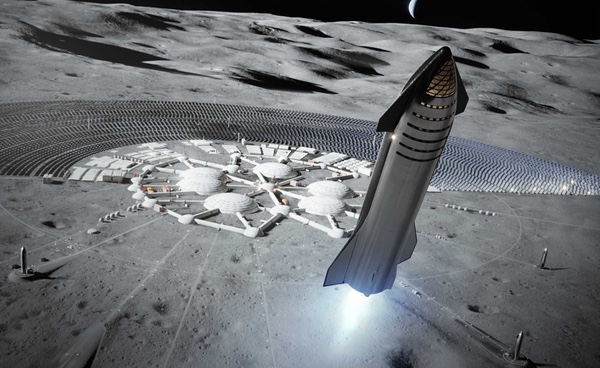
| Amid such heated competition and accelerating timelines of humanity’s future, early precedents could shape global lunar activity for decades to come. |
Even though elements of these visions remain speculative, such ambitious announcements carry real repercussions on lunar governance and global policy. SpaceX’s move is neither self-driven nor made in isolation. Last year, seeing China’s steady strides towards landing humans on the Moon by 2030, the US government sought to accelerate its delayed Artemis efforts to land astronauts before China. NASA reopened the Artemis 3 landing contract, and Jeff Bezos-owned Blue Origin bid for it and also decided to pause other internal projects to focus the company’s resources and efforts on the Moon. Industry momentum toward the Moon is part of a broader global trajectory.
This development is significant. The last decade has seen a global interest in lunar exploration, with multiple countries sending diverse missions. Many more are in the pipeline, with the majority of them converging at the lunar south pole with its potential water ice deposits and in low lunar polar orbit. Continued mission successes by China and renewed focus from the US and its partners will likely accelerate activity further. The economic and scientific implications of any sustained lunar infrastructure could be immense. Regardless of the near-term feasibility, just the fact that public commitments of large-scale lunar development are being made by players with theoretical capacities to reach the Moon in substantial forms is enough to affect and alter international policy and regulatory landscapes on Earth.
Amid such heated competition and accelerating timelines of humanity’s future, early precedents—how actors share information, access resources, understand land usage and rights, and regulate infrastructure—could shape global lunar activity for decades to come. These practices could either enable broad participation or gate future access. It could also gravely affect fundamental lunar science in the process, which is tied to understanding the solar system itself.
To counter the many consequences of unilateral large-scale lunar activities by any party, peaceful governance norms and practical coordination mechanisms must develop alongside technological progress. The US has historically favored de facto practices over multilateral agreement in space. Norms set through the Artemis Accords by the US or its Artemis partners would not apply to a non-signatory like China. The opposite is also true. In such low-trust environments, it’s critical that operating parties share minimum viable information and coordinate their activities through the UN and complementary neutral platforms to avoid operational overlaps and disputes over lunar areas and its resources.
Middle space powers, including India and Japan, can play crucial swing roles by intentionally shaping norms through their capabilities and partnerships. Two such upcoming missions have exactly such potential: India’s Chandrayaan 4 sample return and the joint ISRO-JAXA LUPEX rover, both heading to the south pole. In such ways, we can begin to place mutually beneficial governance frameworks early enough, gradually building trust through transparency for a peaceful future in our skies.
The Moon is an object of hope for cultures all around the world. Retaining that shared meaning requires that governance evolves alongside technological progress.
Note: we are now moderating comments. There will be a delay in posting comments and no guarantee that all submitted comments will be posted.