Prometheus bound: The legacy of the Jupiter Icy Moons Orbiterby Dwayne A. Day
|
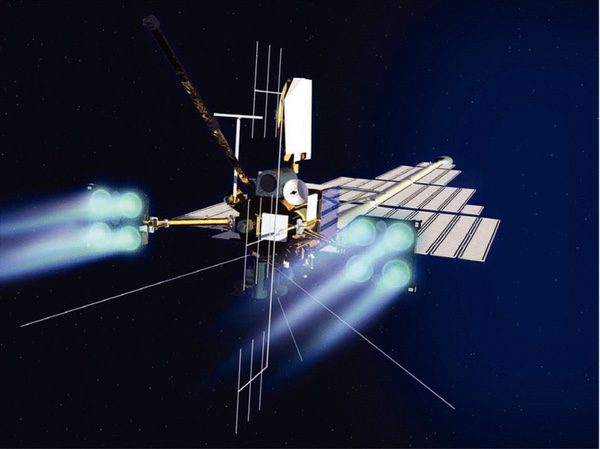
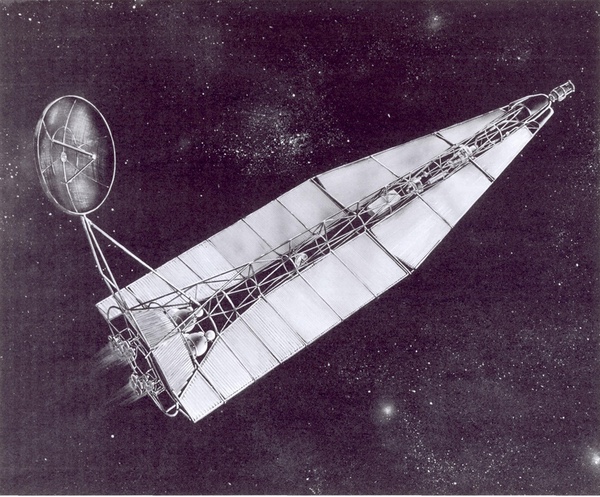 The basic concept of a nuclear-powered, electric propulsion spacecraft has been around a long time. In 1963, JPL studied the ”Electric Space Cruiser” that used the same concepts and overall design that NASA considered again forty years later. (credit: JPL) |
JIMO emerges
JIMO was approved by NASA administrator Sean O’Keefe and was widely considered to be his personal initiative rather than a priority for the planetary science community. In 2002, NASA canceled plans to pursue a Europa orbiter mission, which was a high priority for the planetary science community. Later that year, in August 2002, at O’Keefe’s urging, an “Eight Day Study” was held at NASA Headquarters outlining a possible new mission to the outer planets. The project was initiated outside the normal process for developing large planetary missions and was conducted with limited science community input. By September, the Jupiter Icy Moons Tour Studies were started, and two months later the Jupiter Icy Moons Orbiter pre-project commenced at O’Keefe’s directive. This resulted in a presentation to O’Keefe in January 2003. Soon the Tour Studies were completed and a JIMO new start was authorized by Congress.
| JIMO was technically ambitious. The United States had not flown a space nuclear reactor since 1965, when SNAP-10A operated at very low power in low Earth orbit for 43 days. |
The concept of a nuclear-powered, electric propulsion spacecraft was not new. In 1963, the Jet Propulsion Laboratory had studied the “Electric Space Cruiser” for missions to Jupiter and beyond. But the discovery of gravity-assist trajectories negated much of the need for the technology. As Voyager 2 demonstrated in the 1970s and 1980s, planetary gravity, particularly Jupiter’s gravity well, could be used to send a spacecraft farther out into the solar system.
JIMO would have the same basic layout as JPL’s early sixties design, with a reactor at one end of a long boom, as far as possible from the rest of the spacecraft to protect the electronics from radiation. Electric propulsion thrusters would be mounted at the other end of the boom. In between would be the scientific instruments and radiators to dissipate the heat of the reactor.
Early in 2003, as the JIMO initiative progressed, NASA created Project Prometheus, the technology development program for JIMO. NASA formed a science definition team and released a request for proposal for industry studies. Industry contracts were let by April 2003. In June 2003, NASA held a science forum and a budget workshop. The first industry studies were received by December 2003.
JIMO was technically ambitious. The United States had not flown a space nuclear reactor since 1965, when SNAP-10A operated at very low power in low Earth orbit for 43 days. Numerous American space reactor development projects such as SNAP-8 and SP-100 had been canceled in the decades since without ever producing flight hardware. Even the Soviet Union, which had developed and flown many space nuclear reactors, had never operated one for more than a year. JIMO would have to operate for a decade in space, in a harsh radioactive environment around Jupiter. The program also had to determine how to convert the heat from the reactor into electricity using the most efficient and reliable technology. In addition, the electric propulsion system would have to be significantly higher power than any yet developed. This required not only new thruster technology, but new electronic control systems to handle the high power levels. These were all serious technological challenges to overcome.
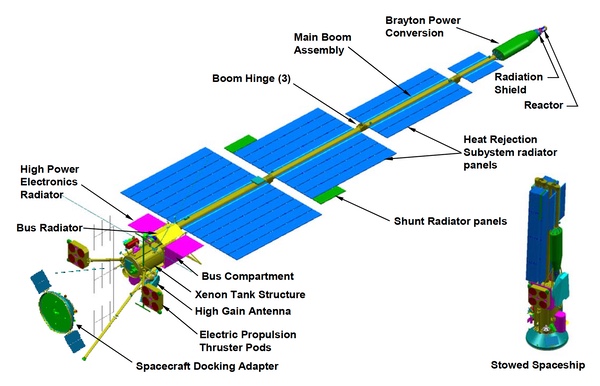 The Jupiter Icy Moons Orbiter spacecraft would have had to unfold in space, with the reactor at one end and the propulsion system and instruments at the other end. (credit: JPL) |
Changing policy environment
JIMO was started just before NASA entered a dark and tumultuous phase. In February 2003, the Space Shuttle Columbia broke up during reentry, killing its crew. The accident not only forced a reevaluation of the shuttle program, but led to a high-level policy review of the goals of the American space program. This would eventually affect Prometheus and JIMO.
President George W. Bush announced the Vision for Space Exploration in January 2004. The VSE, as it was often called, established the goal of returning humans to the lunar surface. The policy would require the ending of the shuttle program and the International Space Station. Without a significant increase in NASA’s budget, it would require cuts to other NASA programs, including space science programs. Democrats in Congress, although not inherently opposed to JIMO, sought information on how much it would cost. NASA refused to provide cost estimates, claiming that it was too early to do so. But there were plenty of indications that JIMO would likely be the most expensive robotic spacecraft ever built.
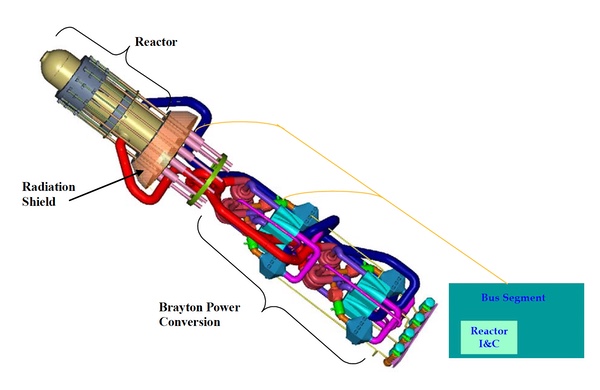 The United States had only flown a single, low-power, reactor in space in 1965. JIMO would have required a powerful reactor and a system for converting its heat to electricity. It would have had to operate in space for up to ten years. (credit: JPL) |
Expanding scope
NASA created the Exploration Systems Mission Directorate (ESMD) to enact the Vision for Space Exploration. Prometheus and JIMO were transferred to ESMD. In March 2004, NASA assigned responsibility for developing the nuclear reactor to Naval Nuclear Reactors. Administrator O’Keefe had briefly served as Secretary of the Navy in the first Bush administration and knew of Naval Nuclear Reactors’ ability to develop advanced systems. NNR was the most experienced organization in the nuclear reactor field in the world.
What had started out as JIMO in early 2003 was expanding throughout the year to include other possible missions. Whereas Prometheus was a logical programmatic move to develop the technology for the actual JIMO mission, it soon became clear that a separate flight test of the reactor and electric propulsion system would be required before the JIMO mission could be launched. The test flight eventually became known as Prometheus-1. By 2004, JIMO added “Task 2A” for follow-on applications of JIMO spacecraft to the study contracts. Other possible missions after JIMO included the exploration of Uranus and Neptune.
| “JIMO was in my opinion too ambitious to be attempted,” Griffin said. “It was not a mission in my opinion that was well formed.” |
The reactor could be launched “cold,” meaning that it would not be active and pose limited radioactive danger during launch. It would be turned on once in orbit. When O’Keefe first announced JIMO, he referred to the high velocities of the nuclear electric spacecraft for opening the outer solar system to exploration. But electric propulsion systems achieve high velocity gradually, after months or even years of operation. Once the program was underway and scientists and engineers began studying the mission, it became clear that JIMO would spend a substantial amount of time in Earth orbit, spiraling outwards while increasing velocity. This raised concerns about operating a nuclear reactor in Earth orbit for a lengthy period, something that was against US space policy at the time. Chemical propellant transfer stages would be necessary to push the spacecraft out of Earth orbit before its reactor would be activated.
By May 2004, NASA determined that the mass estimates for JIMO exceeded available launch vehicles. One possibility was that NASA would need to develop a new heavy-lift launch vehicle exclusively to launch JIMO. Three launches would be required to assemble the vehicle in low Earth orbit, which added technological complexity because robotic assembly in orbit had not yet been demonstrated. The launches were planned to take place in 2015, with the spacecraft reaching Jupiter in 2021. JIMO would have spent two or three months each exploring Ganymede and Callisto, and a month exploring Europa. It might have also been possible to explore Io, completing the mission in 2025. One proposal was for a Europa lander to be included in the mission.
In September 2004, NASA awarded a letter contract to Northrop-Grumman Space Technologies. By October, NASA signed a formal Memorandum of Agreement with Naval Reactors.
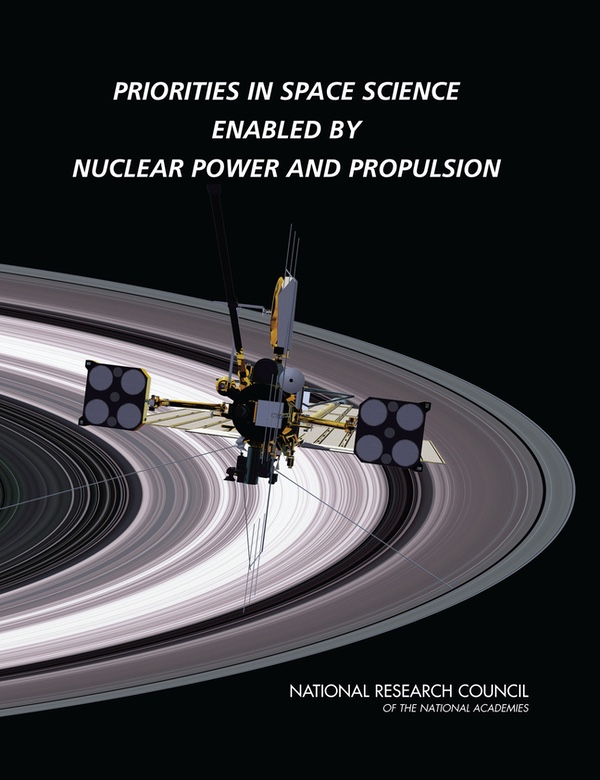 JIMO proponents at NASA believed that the technology could be used for other deep space missions. But JIMO alone would have wiped out the NASA space science program. (credit: National Academies of Sciences, Engineering, and Medicine) |
Setbacks and cancellation
In November 2004, the fiscal year 2005 JIMO budget was cut 26% and the JIMO launch was delayed to 2017. The overall program objectives started to conflict. Whereas the original plan had been to build JIMO, now NASA was considering building Prometheus-1 and launching and testing it before launching JIMO. This increased the overall program cost, but NASA officials also realized that if both Prometheus-1 and JIMO were developed at the same time, any design flaws discovered during the Prometheus-1 flight test would already be incorporated into the JIMO hardware and it would be too late to modify the design. The program schedule would inevitably require restructuring, with JIMO’s launch being further delayed.
In February 2005, Administrator O’Keefe departed NASA and the following month Michael Griffin was confirmed by the Senate as his replacement. Griffin had extensive technical and managerial experience with space systems. Soon thereafter, Griffin canceled Prometheus and the JIMO program. “JIMO was in my opinion too ambitious to be attempted,” Griffin said. “It was not a mission in my opinion that was well formed.” By May, he indicated that he believed that NASA should pursue a mission to Europa, a welcome indication to scientists that JIMO had not permanently damaged the Europa goal. The Prometheus project was redirected toward the development of nuclear power for a lunar surface base, but it atrophied and died.
Scientific dilemma: gift horse or white elephant?
JIMO had posed an uncomfortable dilemma for the American planetary science community. The 2001 planetary science decadal survey had established a Europa mission as its top science priority, but that mission had been rejected by NASA as too expensive. Now NASA was pursuing a far more expensive and ambitious outer planets mission. But JIMO was not a Europa mission, and would spend only a short time exploring Europa—ironically, it would spend far less time exploring Europa than the other Galilean moons of lesser interest to planetary scientists. For the science community, JIMO was not the mission they wanted, and it was way too expensive to afford.
| During the slightly more than two years it existed, NASA spent $463 million on JIMO, which in the 2000s would have been sufficient to fund at least a Discovery-class planetary mission. |
Nobody wanted to publicly repudiate the gift. On the one hand, NASA was spending significant amounts of new money on an outer planets mission, and members of that community were benefitting from the spending. But on the other hand, many members of that community expected that JIMO would be cancelled, collapsing due to its own immense cost. Within the outer planets science community, some believed that they should not publicly question the program while the money was flowing, whereas others grimly believed it was a program so big that it was inevitably delaying more realistic plans for a Europa mission.
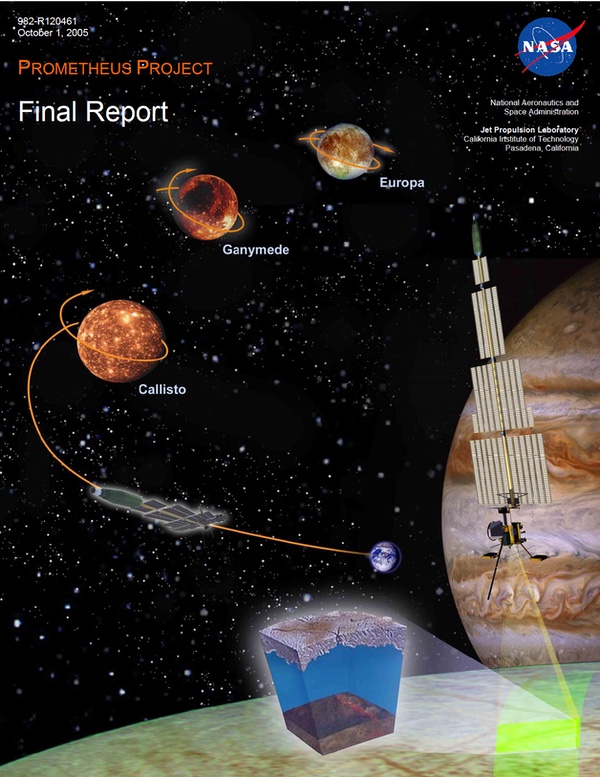 JThe Prometheus Project Final report was released long after the program was canceled and revealed the overall cost estimate for JIMO: $22.5 billion dollars. (credit: JPL) |
JIMO’s legacy?
Throughout the program, NASA officials refused to reveal cost estimates for JIMO, claiming that it was too early to produce such estimates. But the agency was holding cost workshops during the program, they were just not releasing the results.
According to one space scientist, the inside joke at the Jet Propulsion Laboratory was that JIMO was a “20-20-20 mission”—it would weigh 20,000 kilograms, take 20 years to build, and cost $20 billion. The spacecraft dry mass grew to over 22,000 kilograms.
But that was not the real shocker.
It was months after the program was canceled when the Prometheus Project Final Report was quietly released that it became clear that the JIMO program had developed a cost estimate. JIMO would cost nearly twenty-one and a half billion dollars to build and launch. That did not include the cost of the precursor mission. It was a staggering amount of money that would have consumed the entire space science budget for several years. JIMO would have cost more than twice as much as the controversial James Webb Space Telescope (JWST).
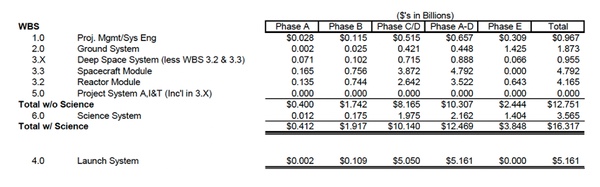 JIMO final cost estimate produced in late 2005 |
During the slightly more than two years it existed, NASA spent $463 million on JIMO, which in the 2000s would have been sufficient to fund at least a Discovery-class planetary mission. The primary recipient of JIMO funding at the time was the Jet Propulsion Laboratory in California, which received over $200 million, although $75 million also went to the Johnson Space Center, which had no experience with robotic science missions. Some of the JPL money was used to study power conversion technologies, and when the program was canceled, it was no longer needed.
 JIMO actual costs |
JPL scientists later stated that significant amounts had gone into modelling the radiation environment of Jupiter and how to shield the JIMO spacecraft’s electronics from intense radiation. That knowledge was applied to the Juno mission to Jupiter which launched in 2011 and continues today. The data was also applied to a later study program, the Europa Jupiter System Mission (EJSM). However, EJSM was deemed too expensive to fund, with an estimated cost of $5–7 billion, and was canceled in 2011. NASA later selected the Europa Clipper mission, for a more focused study of Europa. Although intended to cost less, Europa Clipper is now expected to cost $5.2 billion. It launched in 2024 and is scheduled to arrive at Europa in 2030.
It has been over two decades since JIMO’s cancellation, and the program remains under-examined and mostly forgotten.
Note: we are now moderating comments. There will be a delay in posting comments and no guarantee that all submitted comments will be posted.