Artemis via the ISS? A breakout opportunity for kickstarting a sustainable cislunar economyby Madhu Thangavelu
|
| Can the US continue to lead humanity in cislunar activities based on assets already certified and commissioned for human spaceflight with minimum investment in new technologies? |
Having been the heart of the human spaceflight endeavor for more than a quarter century, the International Space Station (ISS) is set for retirement by 2030, and commercial space stations are being pursued to replace the ISS. Several constellations of communication satellites are operational in low Earth orbit or being commissioned, and large orbiting Internet data servers are expected to lighten the energy needs of their terrestrial counterparts as artificial intelligence networks evolve globally.
It is in this environment that the new NASA administrator has been assigned the charter to steer the agency, to maintain US leadership in human spaceflight with the ultimate goal of expanding free world values from the Earth orbital regime to the cislunar domain.
While sustainability and economic feasibility are foremost on our minds, some have raised the issue of evolving and establishing a permanent cislunar infrastructure. Architects and city planners and builders, who have centuries of experience in building, maintaining, and evolving human dwellings and colonies, know that the foundational elements of sturdy communications and redundant logistics channels are the essential precursors of any sustainable infrastructure, and the space domain is no exception.
System architects, civil architects trained in space architecture in particular, know that there are different phases of cislunar spaceflight that require different adaptations: launch to orbit, cislunar injection and coasting, and lunar lander and surface activities. They all demand different swift and adroit responses. They are extremely sensitive to the alien space environment in which astronauts are inserted and tasked with operating complex spacecraft systems during a mission.
Can the US continue to lead humanity in cislunar activities based on assets already certified and commissioned for human spaceflight with minimum investment in new technologies? This was central to the exercise in the fall 2025 Quo Vadis Artemis Astronautical Engineering studio, with the primary aim to quickly create alternative concepts that warrant further investigation.
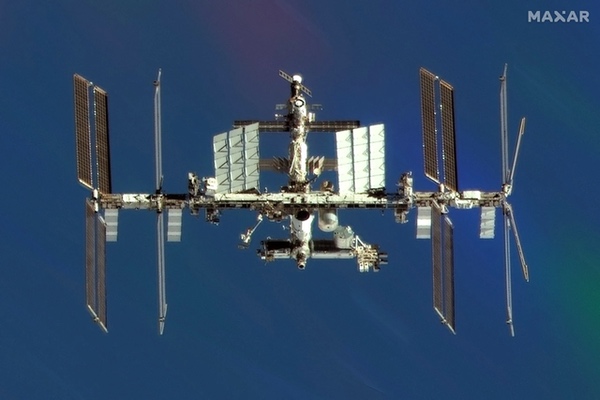
| The initial concept of the ISS was to serve as the human-tended platform to integrate large vehicles for deep space missions to the Moon and beyond. |
While follow-on mission outlines using the SLS and Orion are being carefully evaluated and revised for increased cadence, workforce efficiency, and agility, activities all seem to be based on returning humans to the south polar region. Since the lunar surface elements are still several phases from certification, the USC project chose to look at new and original ways to accelerate lunar return using an open architecture that could easily evolve to accommodate a range of technologies and assets in development while kickstarting missions right away with certified assets.
“Artemis via ISS” has emerged as an option to consider that touched on several of the current administration directives, such as opening new horizons for commercial, sustainable human spaceflight to and beyond Earth orbit.
The International Space Station, the largest assembly of habitat modules ever integrated that also has provided the longest continuous service of any habitable spacecraft, is set for retirement at the end of this decade. While the agency has been advancing plans to deorbit this very large orbiting structure, debate rages on alternatives. They include mothballing the facility and preserving it on-orbit for generations to come; the first international Space Artifacts Museum that could serve as the nucleus for other historic space assets upon retirement as well, like those orbiting telescopes that continue to provide deeper understanding of our universe.
It is good to see Congress revisiting and reviewing NASA’s earlier assessment to scuttle ISS after retirement that was clearly based on shifting budgets to support new programs, all in an unsustainable effort to prop up “welfare for engineers” in various constituencies without paying attention to preservation our species’ heritage.
This truth was laid bare during the first nomination hearing for the new administrator when very few questions were raised about NASA’s Artemis mission goal, with most focusing on pet projects in various districts that had nothing to do with the stated goals of the Artemis return to the Moon program. Hopefully the reduction in force at NASA and the talents of the new administrator have the potential to change NASA culture swiftly enough to mesh gears with the private sector to align and execute projects at the speed of commerce.
The initial concept of the ISS was to serve as the human-tended platform to integrate large vehicles for deep space missions to the Moon and beyond. Several critical technologies like docking large modules and clustering propulsion systems in low Earth orbit have been studied, like the Module Assembly in Low Earth Orbit (MALEO) thesis that was first conceived at the International Space University summer session at MIT, presented at the International Astronautical Congress in 1988, and evolved to partially fulfill the author’s graduation requirements at USC. In addition, human physiology and human factors studies were conducted and conclusive long-duration data gleaned during the quarter-century the ISS has bene occupied continuously. ISS is deemed a national laboratory, on par with other such terrestrial facilities that maintain US leadership in science and technology.
Since the ISS has five more years of service, and since the US administration has set a space policy mandate to accommodate commercial missions on ISS, this provides the opportunity to explore the possibility of enhanced commercial use of ISS, and by extension, cislunar orbital tourism in the current context.
While the ISS is not in a favorable inclination for a much preferred and routine lunar equatorial access, the facility offers several advantages. LEO is accessible now by many nations besides the established partners. Nodal precession of the ISS orbit makes for lunar alignment and departure more than three times a month, offering crew some time to adjust to the weightless environment onboard the ISS that is known to cause temporary discomfort for crew, as they get over the effects of space adaptation syndrome and prepare for lunar transit. Most of all, staging in LEO allows integration of fully fueled upper stages, providing ample energy to carry out a variety of missions, circumventing the need for orbital fueling, a technology that is still in development.
Earth-orbiting constellations have already changed the way free-world values and freedom rings around the globe today. Enhanced telerobotics can assist ISS crew in this commercial Artemis stack buildup supervision, while broadband, secure high-fidelity laser communications and synthetic aperture technology assisted by space-based atomic clocks and related phased-array applications can vastly expand our situational awareness encompassing the cislunar regime. It is now becoming possible with commercially available LEO assets.
These activities listed above can begin now, with existing assets and minimal technology development efforts with firm delivery schedules right now, using in-house agency expertise to help accelerate our national security goals swiftly. Contracting opportunities favor many technologies and their maturation. But mission readiness is based on tried and tested, operational space-qualified assets. Technologies and heavy lift launch capabilities like the Starship and New Glenn launch vehices, and lunar surface elements like the reusable landers, rovers, and spacesuits that still need certification and flight qualification among other rigorous and time-consuming procedures and protocols before commission can proceed in parallel, with more flexible delivery timelines.
| Staging in LEO allows integration of fully fueled upper stages, providing ample energy to carry out a variety of missions, circumventing the need for orbital fueling, a technology that is still in development. |
Observing current missions, as well as the pace and cadence of upcoming missions and lunar activities, the USC graduate Astronautics Quo Vadis Artemis theme of the last fall suggests transferring much of ongoing mission operations and personnel to agile and well-established private space companies, many in the southern California region, maximizing the commercial space sector. The 20th century governmental “welfare for engineers” paradigm is being aggressively replaced in the homegrown private space sector by a “winner’s” attitude offered by the ingenuity of commerce, that rewards agility and creativity, all with the agility of well-oiled commerce.
Commerce is sustainable because of profit motive. Profit = Revenue – Cost. While governments are expected to use taxpayer funds to derisk useful technologies like nuclear power and propulsion and help lay down critical infrastructure, true sustainability is the goal of commerce.
What might the top architecture for space tourism look like and what might it cost? In the first phase, tourists can access the ISS on direct flights to the facility, as crew access station today, for two-week stays in Earth orbit for $50 mission. Assuming four seats are available to ISS tourists every month, $2 billion annual revenue seems viable.
Extending this to a two-week cislunar orbital mission, the four tourists and two crew would transfer to a fully integrated and modular-cluster fueled cislunar stack co-orbiting ISS comprising of a much lighter Orion or Crew Dragon capsule with departure and return to ISS and ferry back to Earth. An annual revenue of $4 billion for a $100 million ticket seems a conservative figure.
Storytelling is an art form that NASA could pay more attention to. While the Artemis storyline seems rather dry, synthetic, and inadequate to inspire the masses, connecting the dots coherently with our rich and real human spaceflight related assets, cultural tradition, and history will surely help remind our people, to resonate and inspire a new generation of explorers.
| Space commerce is paving the way for global cooperation that allow new and aspiring nations to partner with established spacefaring nations at an unprecedented scale. |
If the ultimate goal is to truly kickstart a permanent and self-sustaining cislunar economy that does not depend on the “on again, off again” whims and fancies of Congress that has straitjacketed the agency for decades, then developing cislunar tourism before ISS decommissioning may offer the low-hanging breakthrough that would pay and continue to pave the way for the US to remain the preeminent spacefaring nation, ensuring and extending free world values in the cislunar regime.
Commerce is the lifeblood of civilization. Space commerce is no exception. Good commercial activity coexists with good and progressive governance practice that the US is capable of and has demonstrated in past projects. As we approach the 250th anniversary of our great republic, space commerce is paving the way for global cooperation that allow new and aspiring nations to partner with established spacefaring nations at an unprecedented scale.
The current administrator is a proven technology and business leader who has a vision to break out of the past government funded program mindset to kickstart a sustainable cislunar economy that evolves from space stations in Earth orbit. Artemis 2 is setting the stage for evolving a truly sustainable cislunar economy in a public and private partnership model, starting with ISS tourism, followed by cislunar orbital tourism.
Using synergies of both governmental and private space assets, it is possible to accelerate the permanent establishment of an open architecture for cislunar infrastructure that establishes a sturdy communications network and logistics channel in the immediate term. The SLS is being readied for the Artemis 2 mission, and along with existing and certified global space assets, could be the pilot project to realize this first phase vision for establishing the foundation for a permanent and fully sustainable cislunar infrastructure.
Note: we are now moderating comments. There will be a delay in posting comments and no guarantee that all submitted comments will be posted.