The next phase of space ambitions in Texasby Jeff Foust
|
| “There was a helluva demand signal,” said Lueders. “I don’t think any of us realized we were going to get 280 grant proposals.” |
That first phase of the commission’s work is now complete. Last month, the commission’s board of directors approved a $14.15 million award to the Rice Space Institute at Rice University to create a Center for Space Technologies. The center would work on technologies for sustainable human lunar exploration and in situ resource utilization.
That award was the last of the $150 million allocated by the legislature. (Rice’s application was actually for $16 million in funding; the commission said it would work with the university to refine the scope of the project to fit into the available funding.) The $150 million went to 24 projects intended to support the state’s space industry, from factories and test facilities to a study of an inland spaceport in West Texas.
The demand for the funding was far greater than what the legislature appropriated: there were 280 proposals from 140 organizations with a combined value of $3.4 billion. “There was a helluva demand signal,” said Kathy Lueders, vice chair of the commission, at the SpaceCom Expo in Orlando in late January. “I don’t think any of us realized we were going to get 280 grant proposals.”
With an average grant size of a little more than $6 million, and none bigger than $20 million, the grants are relatively small compared to the hundreds of millions to billions of dollars needed by companies to develop spacecraft, launch vehicles, and other space capabilities. But companies that received grants say they have been enabling in ways beyond the money itself.
Venus Aerospace, a Houston company developing rotating-detonation rocket engines for use on hypersonic vehicles and orbital launch vehicles, received $3.9 million to build a test stand.
“We'll be able to do six-minute runs in the middle of the city,” said Sassie Duggleby, CEO and co-founder of Venus Aerospace, during a panel at the AIAA ASCENDxTexas conference in Houston last month. “That asset has then allowed us to go raise another round of venture capital funding.” (Duggleby is on the board of directors of the commission but noted she was recused from consideration of her company’s grant application.)
Firefly Aerospace, in the Austin suburb of Cedar Park, received $8.2 million to help build a spacecraft development center. It came as the company was ramping up production of lunar landers.
“We start seeing that our infrastructure is starting to get strained with trying to get to rate on our missions,” said Shea Ferring, Firefly’s chief technology officer. “We already had the contracts, we already had the momentum to move forward. This is just a bonus that helps us perform on contracts we already have.”
Other companies have used the grants to develop new products. Intuitive Machines received $10 million to work on a reentry capsule designed to return experiments and products from orbit.
The grant will mature the design of that reentry vehicle through a critical design review, said Tim Crain, chief technology officer of Intuitive Machines. “That investment has allowed us to go and have some very interesting conversations with a customer base that, otherwise, would have considered us just PowerPoint.”
He added it took a little time to figure out how to best work with the state. “It's not overly onerous, which is different than what most of us in the space business who work with the federal government are used to. It just took an iteration of my business processes to align this way.”
| “We'll be able to do six-minute runs in the middle of the city,” said Duggleby of a Venus Aerospace test stand funded by the commission. “That asset has then allowed us to go raise another round of venture capital funding.” |
The grants have also helped bring companies to the state. One of the awardees is Interlune, a Seattle-based company with plans to extract helium-3 from the Moon. It received $4.84 million to create a “Lunar Simulant Center of Excellence” near the Johnson Space Center to create more accurate simulated regolith for testing mining equipment.
Rob Meyerson, CEO and co-founder of Interlune, said the company wanted to establish a presence to tap into the expertise of JSC and its astromaterials division. Interlune recently signed a Space Act Agreement with JSC for that collaboration.
“It shouldn't go without saying, of course, the Texas Space Commission and the visionary leadership there, and bringing the vast resources the state of Texas to recruit companies like Interlune and encourage us to grow, is another very important reason as well,” he added.
Barrios, a Houston company that has long been a JSC contractor, did not a get a grant from the Texas Space Commission but has seen other benefits. Kelly Page, president of Barrios, said her company has had conversations with others interested in working together on grant projects.
“It’s igniting innovation,” she said. “We're privately held with no venture capital, and so we haven’t had a ton of money to go and do some of these really cool ideas. And so we'll definitely be having grant submissions in this next round.”
Building the Texas A&M Space Institute
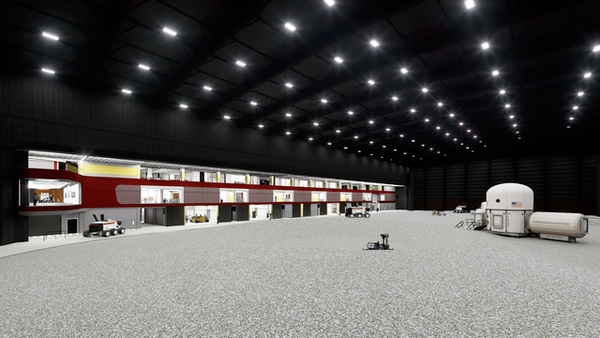
The other $200 million appropriated by the state in 2023 for space went to develop the Texas A&M Space Institute. That facility is nearing completion in Exploration Park, a business park on JSC property.
Construction of the sprawling facility is on budget and schedule, with a grand opening planned for this fall, said Robert Ambrose, associate director of the center, at ASCENDx Texas.
The building’s defining characteristics are simulated lunar and Martian landscapes, each covering 2.5 acres. They will be the largest indoor lunar and Martina landscapes, he said. Between then will be a central spine of offices and garages that companies and universities can use for testing rovers, habitats, and other equipment.
Two companies developing lunar rovers, Astrolab and Intuitive Machines, will lease space in the institute when it opens, seeing it as an ideal place to test rovers next door to JSC.
“It’s going to be really important for our future,” said Jaret Matthews, founder and CEO of Astrolab. The company, based in Southern California, currently has more than 100 people in the area working on the first phase of its NASA Lunar Terrain Vehicle award.
| “We’re building this building for the next 60 to 100 years,” Ambrose said. “I can’t relaly imagine what might get built in this building or get done in this building.” |
He said the institute will provide a more convenient testing environment compared to its past field tests of rovers in Death Valley, California. “It’s going to be a phenomenal asset,” he said, including the potential to collaborate with other companies there. “We’re planning to have our rover operating out of the facility, out of our garage, on opening day.”
The institute’s adjacency to JSC is valuable, said Intuitive Machines’ Crain. “That proximity where human spaceflight is centered for the surface of the Moon is going to be critical.”
While the focus is on testing Moon and Mars hardware, Ambrose suggested there will be some flexibility about what the building can support in the future. “We’re building this building for the next 60 to 100 years,” he said. “I can’t relaly imagine what might get built in this building or get done in this building.”
The next round
With the initial set of grants awarded and the space institute nearing completion, both the state government and companies are thinking ahead about what comes next. In the most recent legislative session, the state appropriated another $300 million for a new round of grants.
The second round may go faster than the first. “We have been building and flying the plane at the same time in the last year,” Norm Garza, executive director of the Texas Space Commission, said at ASCENDxTexas, as the commission has to stand up policies and procedures for awarding those initial grants.
The second round of grant applications will be able to use those procedures, but may also be more structured. Gwen Griffin, chair of the commission’s board of directors, said that a review of the applications showed five themes emerged: low Earth orbit, lunar, launch and reentry, national security, and workforce development.
| “People come up and talk to me about the Texas Space Commission and what it’s doing,” said Duggleby. “I’ve had other states say, ‘I wish our state would get their act together and do something similar.’” |
“Those five topic areas have really been emerging as subject matter for what do we do to be the best stewards of taxpayer dollars from the State of Texas with grant applications for this next round,” she said. That is shaping the rules the commission is developing for the next round of grant applications, including white papers expanding on those five themes.
Companies say that definition can be helpful. “These white papers are going to help us,” Crain said. “We understand that if we're going to put our time and energy into a grant, we're more aligned with where the state’s interests are.”
Firefly’s Ferring said that larger grants would be helpful, as well as other financing tools. “Loans would be something that’s very helpful to a lot of us, because cash is important, and if we can do stuff via loans that really helps us extend our reach.”
The commission and its large coffers have become a source of envy among other states. “People come up and talk to me about the Texas Space Commission and what it’s doing,” said Duggleby. “I’ve had other states say, ‘I wish our state would get their act together and do something similar.’”
She cautioned, though, against complacency. “Texas should not ever be losing an aerospace company, and I know one that left recently, because they got such incredible packages,” she said. “With Venus, I mean, I am getting calls from states all the time.”
“There's some other states that are getting very creative with incentive plans for them to relocate to those states, and so I think Texas needs to stay ahead of the game when it comes to that,” added Page.
That involves issues beyond the remit of the Texas Space Commission. Companies on the panel talked about the need to invest in infrastructure and education, as well as dealing with increasing housing costs and high property taxes. All those factor into the ability of companies to attract workers from out of state and retain its existing workforce.
However, Texas has some attributes that may be difficult for others to copy. Ferring noted that Firefly decided to start up in Texas because it would be easier to test rocket engines there than in California.
“Regulatory wise and cost wise, you can't go buy 200 acres of land and start firing rocket engines out there, but in Texas, you can,” he said. “It allows you to get work done, especially in an environment where we're doing some pretty dangerous things that would both bother neighbors and scare people, and Texas allows us to do that.”
Note: we are now moderating comments. There will be a delay in posting comments and no guarantee that all submitted comments will be posted.