If China returns to the Moon first, will Americans care?by Dante Sanaei
|
| Since the beginning of China’s rise to a space power, US policy has leaned—implicitly and sometimes explicitly—on the power of a renewed “Space Race,” a narrative reminiscent of America’s technological competition with the Soviet Union. |
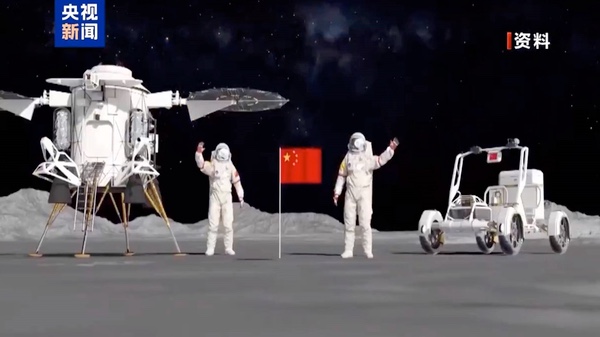
China has publicly targeted a crewed lunar landing by 2030 and a Mars sample return soon after, two ambitious milestones that have shaped NASA policy for decades. If China reaches them first, the geopolitical symbolism will be unmistakable: the nation that once defined the modern space age has been overtaken.
But here is the uncomfortable question: would the American public actually care?
Since the beginning of China’s rise to a space power, US policy has leaned—implicitly and sometimes explicitly—on the power of a renewed “Space Race,” a narrative reminiscent of America’s technological competition with the Soviet Union in the 1960s and 1970s billed as a great battle between two rapidly advancing nations in space. Competition drives innovation, leadership in space reflects leadership on Earth, and national prestige is at stake. For that reason, the United States has been pushing aggressively to return astronauts to the Moon before China can plant its flag there. If all goes to plan with the Artemis program, we will succeed—but just barely.
Today, this competition is very real inside Washington. The White House has made Artemis a national priority; not just a science mission, but a strategic response. But concerningly, public perception is far less certain.
America has already walked on the Moon. Six times. NASA has landed rovers on Mars and sent probes to every planet in the solar system. These achievements are historic, but they now fight for public attention against economic pressures and polarized politics.
Public perception is not trivial. It determines the funding Congress provides for these missions. If voters are less concerned about spaceflight, politicians are less interested in appropriating the required funding to accomplish such lofty goals. This is a core feature of democracy, and one that communist China does not need to worry about.
Congress has already demonstrated how fragile political support can be. This year, NASA’s Mars Sample Return mission was effectively canceled by Congress as projected costs climbed past $11 billion. Artemis remains funded, but critical hardware, including the lunar lander, is not yet operational.
Space advocates should ask a difficult question: If China reaches the lunar surface before Artemis, will many Americans simply shrug and say, “We’ve already been there”?
From 2011 to 2020, the United States relied on Russia’s Soyuz to send astronauts to orbit. For nearly a decade, America had no domestic crew launch capability. The public reaction was muted.
If a rival nation plants a flag on the Moon and the response is indifference, the consequences will not be psychological—they will be structural. When space no longer feels urgent, it becomes easier to delay and deprioritize. Over time, that instability weakens industrial capacity and drives talent elsewhere.
Space leadership is not maintained by hardware alone. It is sustained by national will.
| Americans are dealing with rising costs, political division, and global conflict. But a country that intends to lead the 21st century cannot treat space exploration as optional. |
Why should the public care about space exploration? US dominance in space has delivered tangible benefits: GPS, weather forecasting, telecommunications, and a strong national security infrastructure. These advancements have placed US companies at the forefront of a rapidly expanding commercial space economy. Americans have cared about space for decades, but comfort can breed complacency.
Apathy is understandable when NASA missions are framed as scientific projects for the “good of society.” Americans are dealing with rising costs, political division, and global conflict. But a country that intends to lead the 21st century cannot treat space exploration as optional.
The answer is not periodic hype around launches. Space leadership requires sustained national commitment that survives political cycles and signals reliability to industry and allies alike. It cannot be treated as a discretionary science project, but as a core element of national strategy. When China advances, Americans must understand what is at stake: not flags and headlines, but the foundation of the US space economy, the strength of its alliances, and its geopolitical leverage. Space leadership is not optional prestige. It is long-term power.
The real risk is not losing to Chinese lunar astronauts. It’s not caring if we do.
In 1969, America looked up. In 2030, it is not guaranteed that anyone will.
And if they don’t, the consequences will be far more damaging than simply coming in second.
Note: we are now moderating comments. There will be a delay in posting comments and no guarantee that all submitted comments will be posted.