The legal aspects of outer space settlers and settlementsby Dennis O’Brien
|
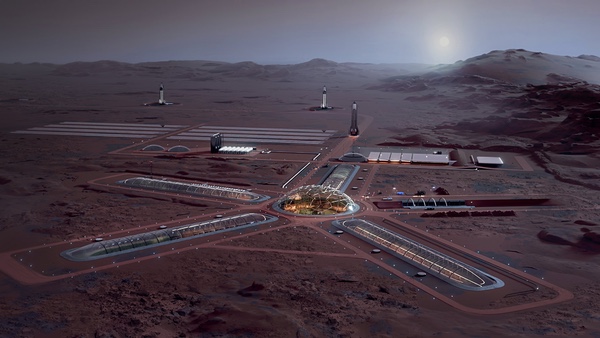
| Outright ownership of land will probably need to wait until a settlement becomes independent, at which time it must be made available to individuals. |
Because of Article II’s ban on appropriation, neither countries nor their nationals can claim outright ownership of any location in outer space, though their jurisdiction and control will extend over objects, stations, and facilities (Articles VIII, XII). In addition, Article IX prohibits harmful interference, so there will be a de facto right of noninterference for any occupied location. COPUOS is currently considering the adoption of a principle that removing a resource from in place is not inherently appropriation (an issue unaddressed in the OST), even if it is regolith that is removed from the surface to build a lunar shelter or facility. Thus, buildings will be owned (and marketable), even if the location is not, and will be protected from interference.
Human rights and the right to development
In addition to the OST, there are two international declarations that are relevant to outer space settlers and settlements: The Universal Declaration of Human Rights of 1948 (UDHR) and the Declaration of the Right to Development (1986). The UDHR has two provisions of interest:
- Art. 14: “Everyone has the right to seek and to enjoy in other countries asylum from persecution”;
- Art.17: “Everyone has the right to own property alone as well as in association with others.”
It is important to acknowledge the right to asylum, as OST Article VIII states that “A State Party… shall retain jurisdiction and control over… any personnel… while in outer space or on a celestial body.” Most space-faring countries have already signed the Refugee Convention (1951) or Protocols (1967), with India and many Middle East countries notable exceptions.
Although the ban on appropriation in the OST does not explicitly mention private entities, Article VI requires countries to assure that activities of their nationals conform with the Treaty. But we should nevertheless acknowledge that individual settlers will have the same property rights that are available to any country, such as ownership of resources removed from in place and ownership of the right of non-interference, which will protect locations in use. Outright ownership of land will probably need to wait until a settlement becomes independent, at which time it must be made available to individuals.
Article 1 of The Declaration of the Right to Development states:
- The right to development is an inalienable human right by virtue of which every human person and all peoples are entitled to participate in, contribute to, and enjoy economic, social, cultural and political development, in which all human rights and fundamental freedoms can be fully realized.
- The human right to development also implies the full realization of the right of peoples to self-determination, which includes… the exercise of their inalienable right to full sovereignty over all their natural wealth and resources.
Although these Declarations are not binding, they have established principles that have guided both national and international governance for decades. We must take them with us as we leave the home planet.
Self-governance and autonomy
Some in the private sector are already planning the details of settlement self-governance. The efforts of SpaceX are perhaps the most ambitious: its Starlink terms & services agreement states that “The parties recognize Mars as a free planet and that no Earth-based government has authority or sovereignty over Martian activities". However, this clause directly contradicts OST Article VI and would not be enforceable. [1]
| Those who support self-governing settlements should promote national laws that facilitate such growth. |
A clearer path to autonomy is the development of self-governance as the need and opportunities arise. Although almost every minute of activity on the ISS is controlled by Earth-based authorities, a time will come when settlers want to decide their own schedules and how they work and live with each other. Such devolution of governance is common on Earth; many countries have federal systems, with political subdivisions like states and territories responsible for most functions other than foreign policy and defense.
Until a settlement is ready to become independent, seeking autonomy within the legal framework of the authorizing and supervising country or organization is the only legal path available for the development of self-governance. Those who support self-governing settlements should promote national laws that facilitate such growth.
Independence
Becoming an independent sovereign state will be more difficult. A settlement will at least need to meet the four standards established by the Montevideo Convention, which has been widely accepted as customary international law:
- a permanent population;
- a defined territory;
- a government; and
- the capacity to enter into relations with other states.
Although Article 3 of the Convention states that “the political existence of the state is independent of recognition by the other states,” such recognition is important as a practical matter. Any new sovereign state will not be bound by the OST and will be able to claim territory. It could then offer to adopt the OST and be subject to customary international law in return for other countries recognizing its claims. [2]
Note that the prohibition against appropriation in OST Article II actually favors independent settlements: it keeps the current world powers from claiming land while preserving it for future settlements. Those who support future settlers and settlements hereby declare their intention to seek independence and call upon the state members of COPUOS to do nothing at this time—politically, economically, or environmentally—that would interfere with their future interests.
Conclusion: A call for support
At every session of COPUOS, more than a hundred delegates from around the world gather to represent their own country’s present and future interests. But there is no one to represent the future interests of the settlers.
This is not to say that the countries and their delegates are wrong or uncaring. It is proper for representatives of a sovereign state to give the interests of their country and its people the highest priority. That is how institutions of international governance function. There is an assumption that such a process, and the requirement for consensus decisions, will ensure that the interests of all humanity will be served.
But will they?
Humanity is more than just the sum of its national interests. We have dreamed about the heavens since before countries existed. We wrote about traveling in outer space before we could fly. In October 1957, most of humanity stood outside at sunset, looking to the west to watch a blinking light pass high overhead, the tumbling upper stage booster of Sputnik, the world’s first artificial satellite. Some felt an increase in Cold War anxiety, but most of us felt awed and inspired. All the dreams of the writers and the poets—indeed, of all humanity—suddenly seemed within reach.
| Humanity’s departure from the home world offers a rare opportunity, a clean slate, a chance to restore hope. |
Then came the Space Race, as the Earth’s two great powers, and the two dominant ideologies, sought to prove that their system was the best to lead humanity to the to the New Frontier. Although people still dreamed, almost all space activity was controlled by national governments. Even after we reached the Moon, governments maintained their monopolies. When the Space Shuttle began service, the US government required all domestic satellites to use it for launches. Even though other countries joined in—most notably China and the member states of the European Space Agency—the dream of civilians building a new life in space seemed unattainable.
But in January 1986, the shuttle Challenger exploded on liftoff. After a thorough review, the US government decided that it must open the launcher market to private industry. But it kept the monopoly on human spaceflight, as did other governments. The Soviet, and later Russian, government focused on space stations, the first settlements in space. Other governments followed suit, culminating in a joint venture (without China) to build the International Space Station. In November 2000, humanity began its continuous presence in outer space with the arrival of Expedition 1.
Human spaceflight remained a government monopoly until two events occurred. In February 2003, the shuttle Columbia disintegrated on its return to Earth. In response, the US government finally decided to relinquish its monopoly on human space flight. But it would still be the major funding source and mission controller, as the private sector had not yet developed the technology and financing needed for an economically sustainable human presence in space.
All of that changed in 2015. On December 22, SpaceX, a US corporation, successfully landed a reusable booster from Earth orbit after deploying satellites there.
Do you remember where you were that day? More importantly, do you remember what you felt the moment the booster touched down safely? Once again, humanity’s dreams seemed achievable. Despite the war, suffering, and neglect that dominated the world, humans looked to the skies and began to believe that they really could build a better world.
Humanity’s departure from the home world offers a rare opportunity, a clean slate, a chance to restore hope. It is not too early to begin to consider the settlers and settlements as we develop outer space policies, to protect their rights and to chart a path to self-rule and independence. They are counting on us. In many ways, we are the settlers. Let us do our best to create that shining city on the hill that will light the way for all.
Refrrences
- Cristian van Eijk, Sorry, Elon: Mars is not a legal vacuum – and it’s not yours, either, Völkerrechtsblog, 05.11.2020, doi: 10.17176/20210107-183703-0.
- See, e.g., Adele Ankers-Range, Apple's Beloved Sci-Fi Series Returns in Epic Season 5 Trailer, Movieweb, February 24, 2026.
Note: we are now moderating comments. There will be a delay in posting comments and no guarantee that all submitted comments will be posted.