Convair’s Manned Astronomical Research Station (MARS)by Hans Dolfing
|
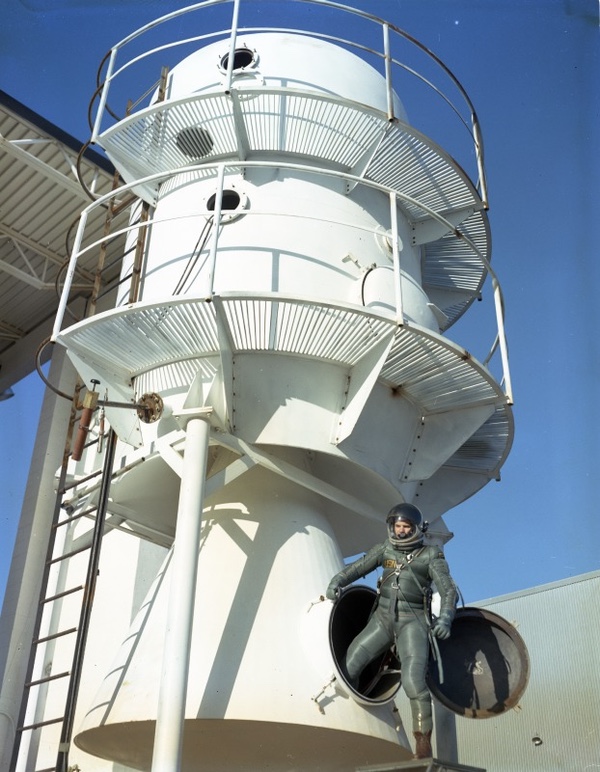
| Many documented 1960s space stations were only paper concepts but this project “bent metal” and hardware was built for a full mockup space station. |
The name of this space station was the Manned Astronomical Research Station (MARS).[1-4] A series of more than 100 Convair GD/A archival photos plus a movie shed new light on this early American military and civilian episode to prepare man for life in space stations.[1,2] No paper reports were located but photos show these existed.[1,3,21]
The US Air Force, with its military space efforts, was already heavily engaged in the transition from aviation medicine to space medicine, and project Mercury would be the first American space laboratory where humans could be evaluated in weightlessness, severe g-forces, and radiation tolerance. Bioastronautics would apply equally in the military and civilian domains and NASA was quite willing to make maximum use of the USAF superior biomedical research resources.[19]
Many documented 1960s space stations were only paper concepts but this project “bent metal” and hardware was built for a full mockup space station to evaluate on the ground as shown in Figures 1 to 6.
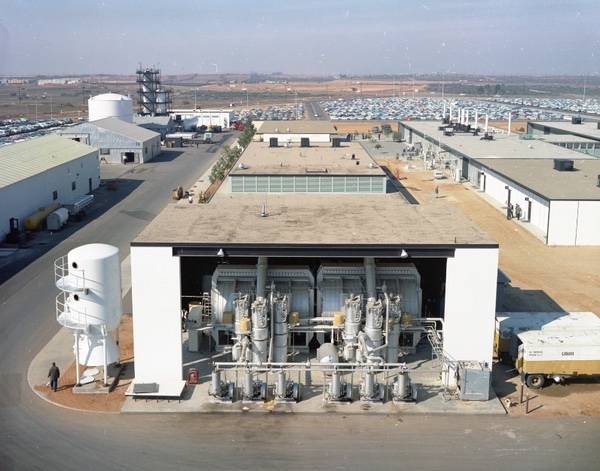 Figure 2: Overview of Convair GD/A San Diego with MARS at building 28, February 1961. [1,4] |
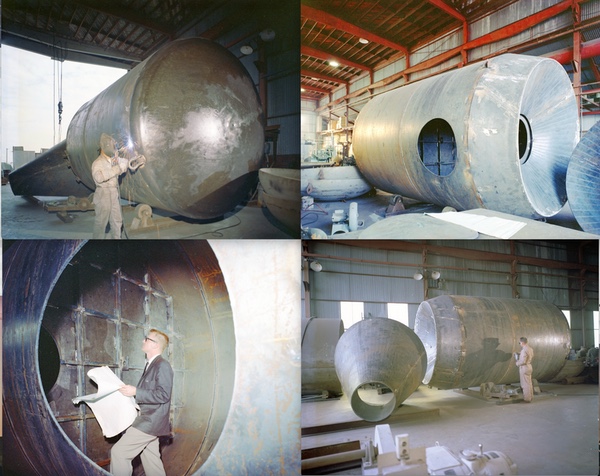 Figure 3: MARS construction, January 19, 1961. [1] |
All the construction images in Figure 3 are labeled with the same date, which indicates a MARS construction period between late 1960 and early 1961.
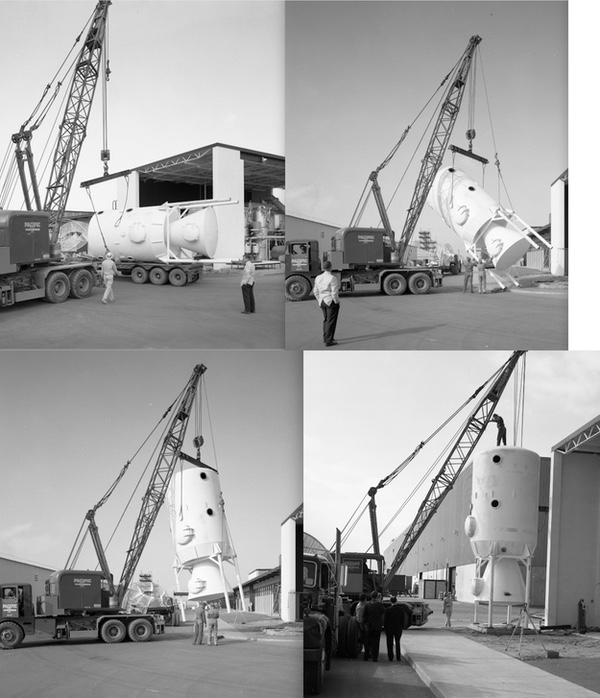 Figure 4: MARS placement outside Building 28, February 7, 1961. [1] |
As shown in Figure 2 and 4, MARS was placed outside of Building 28, the Astronautics space research building. At first glance, it might look like a water tower or large boiler but this was a full-scale mockup for a multi-man space station. MARS was planned to be made available to other companies to study and encourage life support system research in the private industry. The station had a diameter of ten feet (three meters) and was about 14 feet (4.3 meters) tall. The inverted cone beneath the station is not an engine but a mockup for a Mercury-style re-entry capsule. Overall, the mockup was 28 feet (8.6 meters) tall as shown in Figure 5.[2-4]
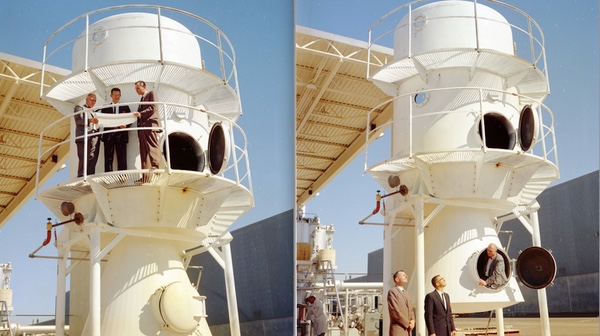 Figure 5: MARS February 27, 1961. On the left (L-R) W. Kudenov, F. D’Vincent, J. Tearnen. [1] |
MARS had two floors. The upper floor was a working compartment and the lower floor was used for housekeeping, cooking, and sanitary facilities. Figure 6 shows a glimpse of the interior. Sleeping was planned in the reentry module. Obviously, the mockup station was not a zero-G facility, but it allowed testing of oxygen supply systems, contaminant monitoring, water regeneration, and similar systems. A vacuum chamber was nearby for additional testing. [2-4]
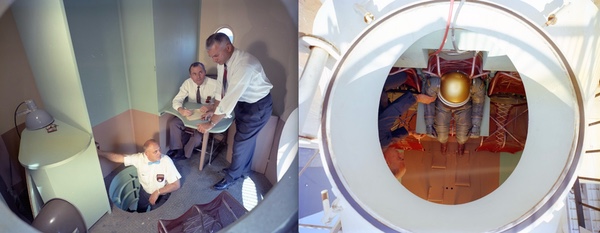 Figure 6: MARS interior, April 12, 1961 with (L-R) W. Kudenov, Tiernon, R.C. Armstrong. [1] |
MARS was closely related to earlier Convair concepts. Krafft Ehricke at Convair worked on the multi-man “Outpost” space station during 1958 and 1959. [15-17]. Immediately after that in 1959 and 1960, Convair designed the Three Man Space System Experimental Laboratory (TASSEL), shown in Figure 7. TASSEL was designed by Krafft Ehricke and Freeman Vincent as a three-man laboratory to be placed in a 200-nautical-mile (530-kilometer) orbit. As an early but post-Mercury space station, it would be launched by Atlas Centaur and conduct two- to three-week missions. The customer was ambiguous: civilian or military or both. The station allowed for research with artificial gravity. The report was submitted in July 1960 based on work earlier in the year.[11-14]
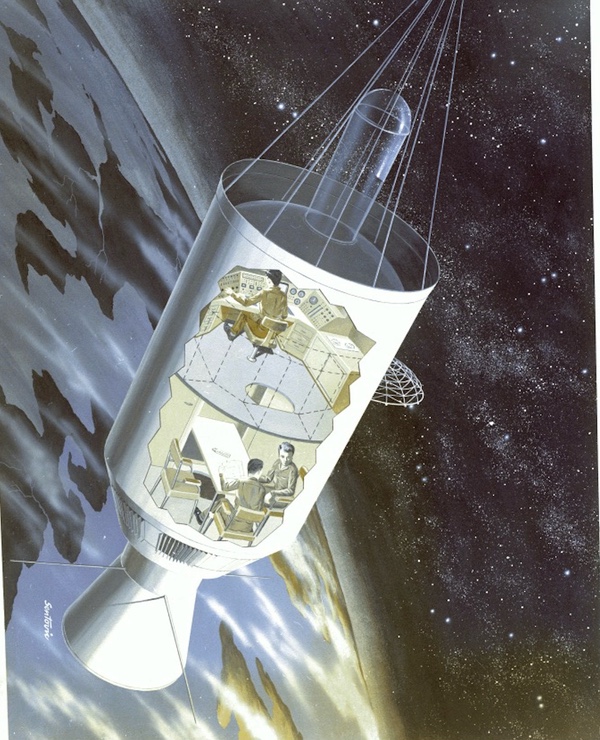 Figure 7: TASSEL Laboratory [11] |
To demonstrate the close relation between MARS and TASSEL, note the photos in Figure 8 of the MARS laboratory. These are undated, but probably are from late 1960. While still under construction, there was a TASSEL poster next to the MARS hardware. The TASSEL poster is in the left part of Figure 8 to the bottom left of the mockup, to the left of the engineer at the base. The right part of the Figure 8 is just an enlarged version to demonstrate it is the same picture as in Figure 7.[1,11,12]
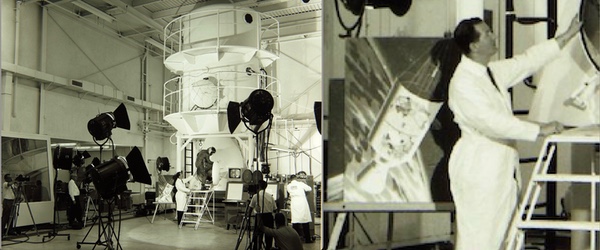 Figure 8: TASSEL, example for MARS. [1] |
By April 1961 MARS was part of the Convair GD/A Life Science section headed by R.C. Armstrong who, since 1956, served as Convairs’ flight surgeon [3,4] MARS was coordinated with the human factors section under W. E. Woodson and the Convair life support section under John O. Tearnen. One objective was to design the instruments for effective human-machine interfacing under all circumstances.
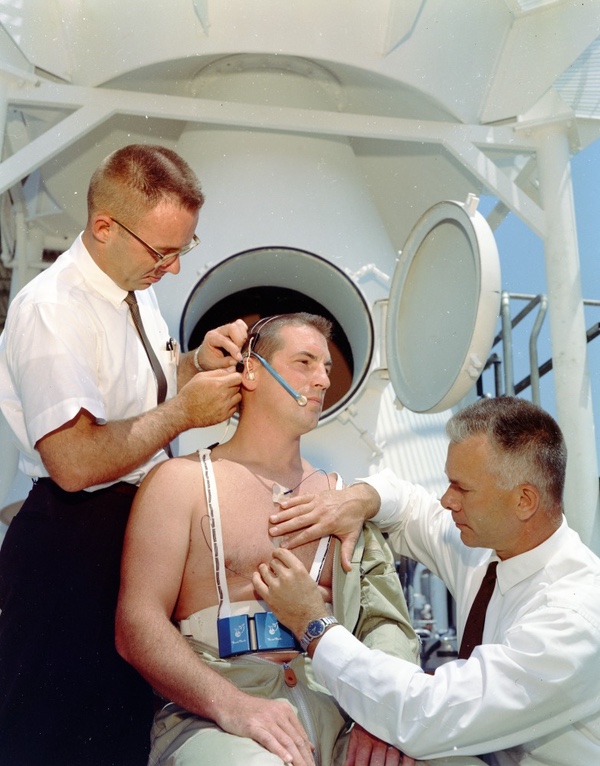 Figure 9: Bio-astronautical instrumentation. [1] |
Figure 9 shows one example of the type of physiological tests conducted at MARS. Later in 1962, crews were evaluated inside MARS for up to 30 hours.[2] Figure 10 demonstrates some of the MARS command module mockups.[1,2]
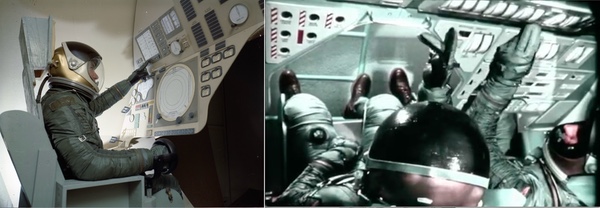 Figure 10: MARS Command Module June 15, 1961. [1,2] |
On February 1, 1961, McDonnell Aircraft proposed the civilian “One-man Space Station” as the flip side of the military one-man MTSS, an example of how companies designed multipurpose space stations.[9] Did the Convair GD/A MARS have mostly civilian customers at NASA or also military customers in the Air Force?
There are two pieces of evidence that clearly show that MARS had a military customer. First, there was a presentation by Col. Lowell B. Smith on December 10, 1963, at NASA Ames Research Center on the topic of the Military Test Space Station (MTSS) study, SR-17527, which was extensively discussed in an earlier article.[6-8]
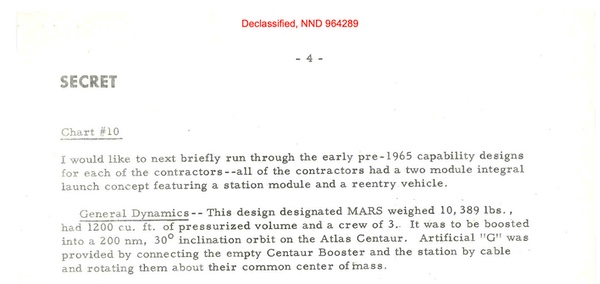 Figure 11: Quote from MTSS presentation. [6] |
The quote in Figure 11 clearly demonstrates that Convair GD/A submitted the MARS concept and laboratory to the US Air Force as their entry for the Phase-1, pre-1965 MTSS. [6] The 1200-cubic-foot (34-cubic-meter) volume fits very well with the earlier given MARS size of 10-foot diameter and about 14-foot height. The MARS mockup built in early 1961 is also a good fit for the MTSS timeline. The presentation by Col. Smith has no image of this MARS submission but the quote with “crew of 3” matches the TASSEL crew size of three. In addition, the description of artificial gravity in the quote matches exactly what TASSEL proposed to do including a tether stability study. [2,11,12]
| Did the Convair GD/A MARS have mostly civilian customers at NASA or also military customers in the Air Force? |
To recap the MTSS history, the USAF SR-17527 MTSS study was started January 1960, followed by an RFP in April 1960, the selection of five contractors in August 1960, and a final report on the six month study “Phase 1 MTSS - Early capability” in February 1961. “Phase 2” Advanced MTSS reports were due in July 1961 after another roughly six months. [8]
The thinking of Convair GD/A might have been that many of the 27 planned MTSS biomedical tests could be prototyped in the MARS mockup on the ground. Simple checks like oxygen consumption or “does it fit” could be done on the ground. [7,8]
The second piece of evidence is that most of the MARS photos are annotated by the San Diego Air and Space Museum (SDASM) with “MTSS/MARS” in their detailed descriptions. [1] Why MTSS was added to MARS is never explained but, from the evidence, it seems clear that this was the Convair GD/A submission to the MTSS study. The Convair GD/A MTSS hardware was hiding in plain sight, which is very exciting as the technical reports by Convair GD/A are still not released.[1,5,8]
MARS was offered to the private industry for space station evaluation in 1961.[3] How this Convair shared space station mockup and training related to other bio-astronautical work in the USAF is an open question. In 1963, there were at least eight studies titled “The Centralized Space Training Facility Study”.[20] That work was done in 1963 at the Aerospace Medical Research Laboratories at Wright-Patterson Air Force Base (WP-AFB), Ohio. Part III was titled “Training for the Military Test Space Station”.[20.iii] This is a tantalizing connection to the Convair GD/A MARS work but a better understanding will have to wait till more reports are declassified.
The foresight by Convair GD/A to record their work with photos and a movie as historical records is appreciated just like the work by SDASM to publish these records from NARA.[18]
In conclusion, the Convair GD/A MARS space station mockup was derived from TASSEL and largely overlapped with their MTSS concept offered to the USAF in August 1960. Photos from the station construction, the interior, command console and other details show in color that this was a high-fidelity mockup for both civilian and military space stations. To have the mockup must have been a big advantage in Convair GD/A space proposals. The photos also show in color the first interior details of any of the five MTSS contractor studies.
References
- “Manned Astronomical Research Station (MARS)” photos from Convair General Dynamics/ Astronautics, Atlas Negative Collection, published by SDASM via NARA.
- “Convair Space Station Development Program 10/17/62 HACL Film 00188”, San Diego Air and Space Museum Archives, 1962.
- “Astronautics Life Science Center Will Serve All Convair Divisions”, Convairiety, San Diego Edition, page 8, April 12, 1961.
- “Space Station Mockup Will Include Kitchen”, Convairiety, San Diego Edition, page 4, March 1, 1961.
- General Dynamics/Astronautics (GD/A), San Diego, Calif., Contr. AF 33(600)-42457, Rept. no. AE 61-0570, ASD TR 61-208, Dated: 15 Jul 1961.
- SR-17527, “MILITARY TEST SPACE STATION. VOLUME I. SUMMARY (U)”, AD 328 351L, AE61-0570-Vol-1, vol. 1, 75 pages.
- SR-17527, “MILITARY TEST SPACE STATION. VOLUME II, PART I, PRE-1965 SPACE STATION (u)”, AD 328 352L, AE61-0570-Vol-2-Pt-1, vol. 2, part 1, 166 pages.
- SR-17527, “MILITARY TEST SPACE STATION. VOLUME II, PART I, PRE-1965 SPACE STATION (U)”, AD 328 353L, AE61-0570-Vol-2-Pt-2, vol. 2, part 2.
- SR-17527, “MILITARY TEST SPACE STATION. VOLUME III. ADVANCED SPACE STATIONS (U)”, AD 328 354L, AE61-0570-Vol-3, vol. 3, illus. tbl. refs.
- “Presentation on MTSS SR 17527 by Col. Lowell B. Smith”, “Presentation on SLOMAR SR-79814 by Maj. Jack W. Hunter”, 10 Dec 1963, 19 pages, RG 255.4.1, NACA Ames Aeronautical Laboratory and NASA Ames Research Center, Series 24, Box 3, Central Files - research correspondence, 1943-1965, National Archives and Records Administration (NARA), Pacific Region (San Francisco), San Bruno, California.
- “MTSS experiments”, RG 255, NACA Langley Memorial Aeronautical Laboratory and NASA Langley Research Center Records, A200-4 Manned Space Stations, Series II: Subject Correspondence Files, 1918-1978, Box 421, 422, Sep. 1963 - Nov. 1964, National Archives and Records Administration (NARA), Philadelphia.
- Dolfing, H., “The Military Test Space Station (MTSS)”, August 2024./li>
- Dolfing, H., “McDonnell’s Military Test Station (MTSS)”, March 2026.
- Dolfing.H, “Satellite bombs, gliders, or ICBMs? Krafft Ehricke and early thinking on long-range strategic weapons”, December 2022.
- Ehricke, K.A., Vincent, F., “TASSEL - Space Laboratory (Three Astronaut Space System Experimental Laboratory)”, Convair Astronautics, GD/A, San Diego, CA, AE-600228, 91 pages, AD0851662, NASA NTRS 19690091102, July 1960.
- Pengelley, C.D., “Preliminary survey of dynamic stability of a ‘tassel concept’ space station”, General Dynamics/Convair, San Diego, CA, AE63-0125, NASA NTRS 19650082879, March 1963.
- “Proposed Three-man station”, Missiles and rockets, July 3, page 41, 1961.
- Shayler, D.J., Godwin, R., “Outpost in Orbit”, page 26, ISBN 9781-989044-03-2, 2018.
- “Convair plans Four-man Space Station”, Aviation Week, pp 26-28, April 28, 1958.
- Ehricke, K.A, “Hearings before the Select Committee on Astronautics and Space Exploration”, Eight-Fifth Congress, 2nd Session H.R. 11881, pp. 613-646, April-May 1958.
- Ehricke, K.A., Accession 2003-0025, National Air and Space Museum (NASM), Smithsonian Institution, Box 6, Folder 1, “Space Station for Development and Orbital Flight Training”, KE59-2, Convair GD/A, San Diego, CA, 25 pages, May 12, 1959.
- RH 50173-15, “To support a project to process approximately 165,000 images from the Convair/General Dynamics collection of the Atlas rocket program from its inception in the 1950s through the mid-1980s. Approximately 50,000 images will be digitized and available online”.
- Berger, C., “The Air Force in Space. Fiscal Year 1962”, USAF Historical Division Liaison Office, ADA 606606, 1966.
- “The Centralized Space Training Facility”, Reports, 6570th Aerospace Medical Research Laboratories, Wright-Patterson Air Force Base (WP-AFB), Ohio, March 1963,
- “Part I. Summary, Conclusion, and Recommendations”, P-30-I, AD 339 342L,
- “Part II. Training for the Global Surveillance System”, P-30-II, SR-178,
- “Part III. Training for the Military Test Space Station”, P-30-III, SR-17527, AD 339 343L
- “Part IV, Training for Space Logistics, Maintenance, and Rescue System”, P-30-IV, SR-79814 SLOMAR, AD 339 571L,
- “Part V. Training for the Earth Satellite Weapon System”, P-30-V, SR-79821 ESWS, AD 341 367,
- “Part VI. Training for Space Plane Recoverable Booster”, P-30-VI, SR-89774, AD 339 645L,
- “Part VII, Training for Lunar Systems”, P-30-VII,
- “Part VIII, CSTF Training Concepts”, P-30-VIII.
- “Convair II-6 Instrumentation Design Laboratory”, piction ID: 45174753, catalog ID: 14_016812, March 1961.
Note: we are now moderating comments. There will be a delay in posting comments and no guarantee that all submitted comments will be posted.