A little more light in the shadows: the NRO and the Space Shuttle in 1976by Dwayne A. Day
|
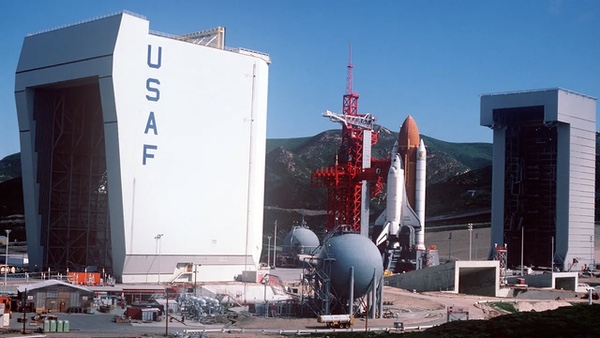
| What we are now learning is what the NRO considered doing with the shuttle in the years before it flew, when they were essentially throwing ideas at the wall, evaluating what new capabilities shuttle might provide beyond simply replacing the NRO’s existing fleet of expendable launch vehicles. |
In early March, the NRO declassified several significant documents as part of the annual government-wide “Sunshine Week.” NRO policy has been to declassify documents from 50 years ago, and the NRO is now releasing documents from the mid-1970s. This was an important transitional period for the NRO in many ways. It was a time when the super-secretive organization finally had to submit itself to regular budget review and scrutiny by Congress after mostly avoiding that for over a decade. This was also a period when “national” level satellite reconnaissance systems were beginning to be made available to tactical-level military forces. And it was a time when the NRO was preparing to start using the Space Shuttle, and NRO officials were asking what the shuttle could do and how it could benefit the satellite intelligence effort. Whoever chose the documents to declassify smartly provided a great insight into a key transitional period for the intelligence space program.
By 1976, NRO payloads constituted 30–35% of the total Department of Defense payloads designated for the shuttle. But in some ways the NRO had even more influence than the rest of the DoD, because they were considered so vital to national security and understanding what the Soviet Union was doing. They also carried a mystique due to their highly secretive activities.
The Space Shuttle entered service in 1981 and was declared “operational” a year later. It served until 2011, with notable gaps following the 1986 Challenger and 2003 Columbia accidents. During the shuttle’s lifetime, seven classified NRO shuttle missions flew—all within the first 11 years of shuttle operations—and little has been revealed about them. What we are now learning is what the NRO considered doing with the shuttle in the years before it flew, when they were essentially throwing ideas at the wall, evaluating what new capabilities shuttle might provide beyond simply replacing the NRO’s existing fleet of expendable launch vehicles. NRO officials did this with significant skepticism.
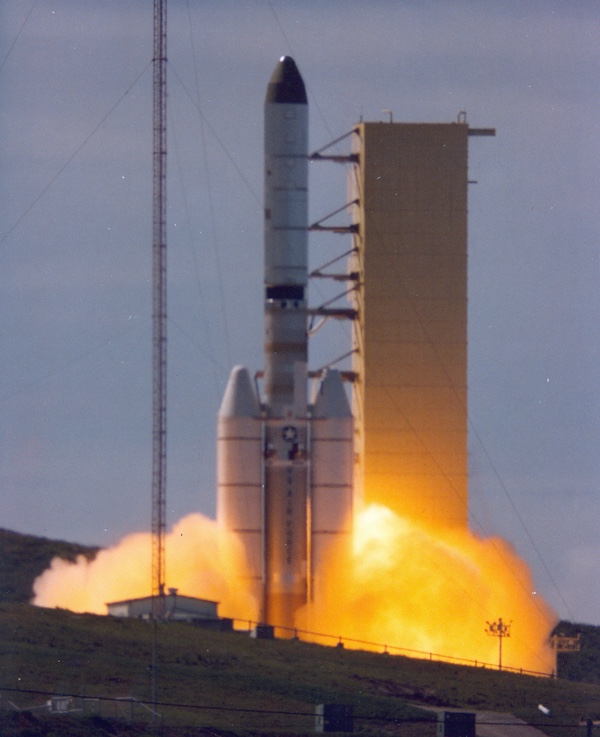 Launch of a Titan-IIID rocket in the late 1970s carrying a classified payload. The Titan was then the most capable rocket in the American inventory. Shuttle offered more payload mass and volume, but it was controlled by NASA. (credit: Peter Hunter Collection) |
Before the change
According to a July 1976 NRO report to the Committee on Foreign Intelligence, an early idea proposed for the shuttle was to fly “covert piggyback reconnaissance packages with might be carried routinely on shuttle flights.” There is no indication what they would be, but the most likely candidate would be an electronic intelligence sensor to determine if the shuttle was being tracked by radar during its flight. Similar sensors had been regularly mounted on NRO satellites since the early 1960s. However, mounting a classified sensor to an unclassified vehicle that would presumably be maintained by NASA personnel and contractors without security clearances, and would also carry non-American astronauts, would have been risky, and there is no evidence that the NRO ever pursued this concept. The NRO was also studying “the potential benefits of the Spacelab capability” to support its activities.
The report stated that the NRO’s policy on the shuttle was “to accomplish the Shuttle transition as early as is practical without degrading mission accomplishment, while maintaining the security of the NRP and considering the overall cost-effective operation of the programs.” (NRP stood for National Reconnaissance Program.) But this was not easy “because of continuing changes to the vehicle design and deployment strategies of NRO spacecraft systems.”
The shuttle did provide new capabilities: more lift capability than the Titan III rocket and a wider payload bay than existing Titan III fairings. Other documents refer to the shuttle’s large payload bay and its ability to carry satellites with large diameter optics, presumably larger than the 2.4-meter-diameter mirror of the KENNEN reconnaissance satellite then entering operation. The shuttle’s payload bay was 4.6 meters wide, meaning that it could have handled a spacecraft with optics up to approximately four meters. Earlier in the decade, NASA had abandoned plans for a space telescope with a three-meter-diameter mirror apparently because the 2.4-meter diameter mirror for the KENNEN was already in development, and it would make it easier for NASA to build what became the Hubble Space Telescope. Now the NRO was considering larger optics.
The shuttle’s large payload bay, according to one document, could also be used to carry large antennas, larger than those already carried by the NRO’s existing Titan III rocket. There are some indications that the NRO ultimately did this for a pair of satellites launched in the 1980s.
| The newly declassified documents occasionally imply a certain reticence about using the shuttle but couched in bureaucratic language. |
In congressional testimony in 1976, Director of Central Intelligence George H.W. Bush stated that all NRO payloads would be transitioned to the shuttle by the early 1980s and predicted that the NRO costs would be around $250 million (see “The spooks and the turkey – Intelligence Community involvement in the decision to build the space shuttle,” The Space Review, November 20, 2006; and “The NRO and the Space Shuttle,” The Space Review, January 31, 2022.) But those costs were increasing, and highly dependent upon what assumptions were used about the transition.
A November 1977 top secret report by the House Appropriations Committee noted that the NRO’s transition to the shuttle would have “extremely high costs.” There were multiple reasons for this, including the NRO’s insistence on maintaining a backup launch capability until the shuttle had demonstrated a high confidence level, and “that stringent security requirements be maintained.” The NRO had projected that its 1975–1982 transition costs were $467.1 million, of which $266.9 million was for expendable launch vehicles to back up the shuttle. This was more money than the development costs of an entirely new satellite program.
The report noted that “some knowledgeable officials have expressed reservations concerning the feasibility of optimizing intelligence payloads for the STS. The concept of recovering, refurbishing, and reusing intelligence satellites was viewed as most questionable.” NRO officials believed that their satellites were too complex, and intelligence requirements were constantly evolving, making this impractical.
The mid-1970s documents do not discuss the shuttle’s ability to service satellites in orbit like NASA later did with the Hubble. However, in 1973, the NRO commissioned a study about using the shuttle with the HEXAGON reconnaissance satellite and that study evaluated multiple options, including servicing a HEXAGON satellite that had been specially modified to have its consumables, including film for its cameras, replaced in orbit. But there were people in the NRO who were wary of such proposals, especially for satellites carrying film, which had to be carefully threaded through a complex path inside the camera. Doing this on the ground would have been extremely difficult; on orbit it would have been nearly impossible (see “Black ops and the shuttle (part 1), On-orbit servicing and recovery of the HEXAGON reconnaissance satellite,“ The Space Review, February 13, 2017.)
The newly declassified documents occasionally imply a certain reticence about using the shuttle but couched in bureaucratic language. NRO officials did not enthusiastically embrace the shuttle throughout much of the 1970s. This reluctance is probably the most fascinating, important, and difficult historical aspect of the NRO’s relationship with the shuttle. To date, we have few declassified interviews with NRO officials from this era about their views on shuttle.
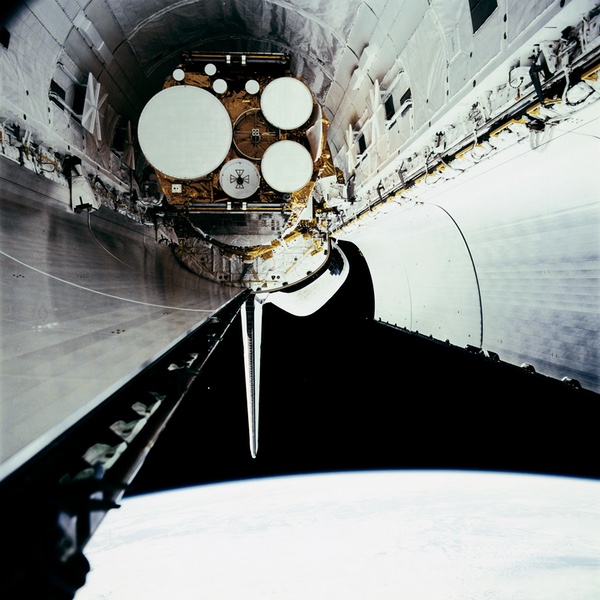 Two DSCS-III satellites were carried into space on a classified shuttle mission. This was not an NRO mission, but is the only declassified shuttle mission. (credit: USAF) |
The big push
In January 1977, Charles Cook, the deputy NRO director, updated NRO’s guidance for use of the shuttle. He identified 12 planning objectives, including having sufficient control over operations involving NRO payloads as well as designing no payloads as shuttle-only. Cook stated: “No NRP [National Reconnaissance Program] spacecraft will be designed in a space shuttle-only configuration prior to the demonstrated capability and reliable operation of the STS,” a reiteration of the “fly-before-buy” policy. Cook also indicated that the DoD should maintain an expendable launcher capability. This was also necessary in case using a shuttle on a mission during heightened world tensions was undesirable, or if a shuttle was, in his words, “neutralized.” Later on, as plans for launching shuttles from Vandenberg Air Force Base in California were formalized, one of the requirements was to store multiple external tanks near the launch site, in case enemy action closed the Panama Canal and prevented them from being shipped to the West Coast.
| “I was very anxious to get the military involved in the shuttle because it was in fact the most capable launch vehicle that we were building at the time,” Mark explained in a 1997 interview. |
Cook also wanted the NRO to be able to take advantage of the shuttle’s capabilities in a stepping-stone fashion. All new NRO spacecraft or major block changes to existing systems entering design subsequent to fiscal year 1976 “will be designed in a modular configuration (provided the additional weight capability of the Space Shuttle would be advantageous to mission accomplishment) so that when the Space Shuttle has demonstrated its reliability, improvement modules can be added to the NRP spacecraft. This will allow us to take maximum advantage of the increased Space Shuttle capability.”
This period from mid-1976 to mid-1977 was when the anti-shuttle holdouts at the NRO were starting to lose the battle. In summer 1977, Hans Mark became director of the NRO, serving from August 3, 1977, to October 7, 1979, and then becoming Secretary of the Air Force. Mark heavily pushed the NRO to use the shuttle.
In a 1987 book, without mentioning the still-classified National Reconnaissance Office, Mark wrote:
During my service in the Pentagon from 1977 to 1981, I tried to modify the policies of the Air Force toward the Space Shuttle. One thing I tried to do was to urge people to design their spacecraft in such a way that full advantage would be taken of the capability of the Space Shuttle. I was partially successful in doing this, and certain spacecraft were designed to take full advantage of the payload capacity of the shuttle and of the volume of the payload bay. (It is interesting that seven years earlier the design of the shuttle was, of course, developed in such a way that just these things could be done.) In addition, I also succeeded in getting some of the people in the Air Force to think about the possibility of building their spacecraft in such a way that they could be retrieved and then refurbished and used again. There was even the possibility of repairing, replenishing, and maintaining spacecraft on orbit by using the ability of the shuttle crews to go out and perform extravehicular activities.
Ten years later, Mark provided more of his rationale. “I was very anxious to get the military involved in the shuttle because it was in fact the most capable launch vehicle that we were building at the time,” Mark explained in a 1997 interview. “I was very anxious to have the military take advantage of the human capability in orbit to check out satellites before you dump them” in orbit, Mark explained, “then later on to repair them on orbit. We were going to launch satellites out of the West Coast so that you could repair and fix polar orbiting birds too.”
 Hans Mark was Director of the National Reconnaissance Office from summer 1977 to fall 1979 and pushed for increased NRO use of the Space Shuttle. (credit: USAF) |
The newly declassified documents indicate that the shuttle’s larger payload bay could carry larger antennas. Mark pushed for a large signals intelligence satellite that could only use the shuttle, arguing that it was vital for arms control. The shuttle eventually launched two of these during the 1980s.
Many details remain classified, although it is also known that Mark was the primary advocate for the Wide Area Surveillance Payload studies about using the shuttle to host a camera that could image large portions of the Earth. This later transformed into a system named DAMON to fly a converted HEXAGON satellite reconnaissance camera in the shuttle bay, essentially using the shuttle like an SR-71 spy plane. This would have required two or three dedicated reconnaissance missions per year. (DAMON was “Nomad” spelled backwards, a name apparently chosen by some NRO Star Trek fans in reference to an episode of the original series.) DAMON was later canceled by Congress after Mark left the NRO (see “Top Secret DAMON: the classified reconnaissance payload planned for the fourth space shuttle mission,” The Space Review, July 1, 2019.)
To his credit, in his 1987 book, Mark admitted that the NRO’s shuttle critics probably had a point:
On balance, I believe that the conservative attitude of the Air Force toward the Space Shuttle at the time was probably justified. We were to encounter delays and problems in the Space Shuttle program that would indeed call for a cautious approach. Perhaps the most articulate exponent of the Air Force position at that time was Mr. Jimmie D. Hill, who was then a member of the undersecretary’s staff and who would later become the deputy undersecretary of the Air Force for space systems. Hill had an encyclopedic knowledge of Air Force space systems as well as a first-class intelligence that he applied to the problems at hand. By taking positions that were generally opposed to mine, we usually arrived at workable compromises that could be implemented.
Slowly, ever so slowly, we are getting closer to a time when NRO will begin revealing one of the important remaining eras of American space history, when the intelligence community reluctantly climbed on board the Space Shuttle.
Dwayne Day is always researching the NRO’s interest in using the space shuttle. He can be reached at zirconic1@cox.netNote: we are now moderating comments. There will be a delay in posting comments and no guarantee that all submitted comments will be posted.