Review: Return to Launchby Jeff Foust
|
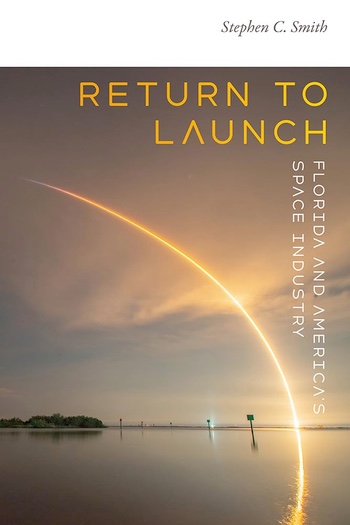
| It is now the private sector that is driving the activity at Cape Canaveral, one that insulates the region and its economy from the vagaries of policies and appropriations. |
Launches are increasingly commonplace on Florida’s Space Coast, with more than 100 orbital launches in 2025 (see “The dominance of Cape Canaveral and Vandenberg”, The Space Review, February 9, 2026.) It’s a far cry from 15 years ago, when the retirement of the Space Shuttle brought with it an economic downturn, the latest boom-and-bust cycle the region has seen.
Such boom-and-bust cycles predate the Space Age in Florida’s Brevard County, Stephen Smith notes in the new book Return to Launch. In 1940, the US Navy opened a naval air station on the coast, bringing in thousands of servicemen, only for the base to close a couple years after the war. The race to the Moon in the 1960s resulted in a much bigger boom followed by bust as Apollo wound down, with the shuttle creating another cycle.
Smith argues in the book that this latest boom is different, with the federal government—the military and NASA—no longer the driver. It is now the private sector, notably SpaceX, that is driving the activity at Cape Canaveral, one that insulates the region and its economy from the vagaries of policies and appropriations.
The book charts that transition, which is decades in the making. In the 1980s, local and state officials attempted to develop a commercial space industry through commercial launch sites. For years, those efforts struggled, in part because of what Smith describes as “pettiness and parochialism” among people and agencies, which he covers in great detail in the books’ early chapters.
However, similar efforts in other states also struggled to attract commercial space business, from the limited launches at Virginia’s Mid-Atlantic Regional Spaceport to New Mexico’s $200 million gamble on Spaceport America and Virgin Galactic. So, Florida’s struggles may not be that surprising.
What changed Florida’s fortunes, he argues, is the arrival of SpaceX and Elon Musk. The Space Coast has seen many launch companies and concepts come and go, but SpaceX persevered and started launching from SLC-40 in 2010. That came at the same time as the Obama Administration proposed a shift in space policy, cancelling the Constellation program just as the shuttle was ending and proposing a more commercial approach.
| While local and state officials spent decades trying to enable that change, the book suggests that the success is linked more to federal policies and private efforts. |
Smith puts a particular emphasis on the Obama policies: several chapters cover the 2008 presidential race, the Obama Administration’s proposals, and the “grand compromise” with Congress that enabled commercial crew alongside SLS and Orion. While SpaceX certainly benefited from that policy, its inflection point arguably came earlier with winning a commercial cargo award in the final months of the Bush Administration. That contract gave SpaceX stability in a financially perilous time. Without commercial crew, SpaceX may have still grown, perhaps at a slower pace; without commercial cargo, the company could have failed.
Regardless, Florida has made the best of the rise of SpaceX, and with it a growing commercial space industry. That has, Smith argues, broken the boom-and-bust cycles of government funding that the region had relied on since the mid-20th century. While local and state officials spent decades trying to enable that, the book suggests that the success is linked more to federal policies and private efforts.
What is clear is that the Space Coast today has transformed in the last 15 years. SpaceX is constructing a towering “Gigabay” building for Starship at KSC, vying with the iconic Vehicle Assembly Building. Just outside the gates, Blue Origin’s sprawling campus continues to grow for work on New Glenn and lunar landers, across the street from where the US subsidiary of Airbus builds satellites. They’re located on Space Commerce Way, an aspirational name when it was built nearly 25 years ago as a two-lane road. It’s now a four-lane divided highway with a new, and suitable, route number: State Road 321.
Note: we are now moderating comments. There will be a delay in posting comments and no guarantee that all submitted comments will be posted.