Thirty years later, Mars 96 has not been foundUnprecedented scientific collaboration, catastrophic failure, and an uncertain final resting placeby Dante Sanaei
|
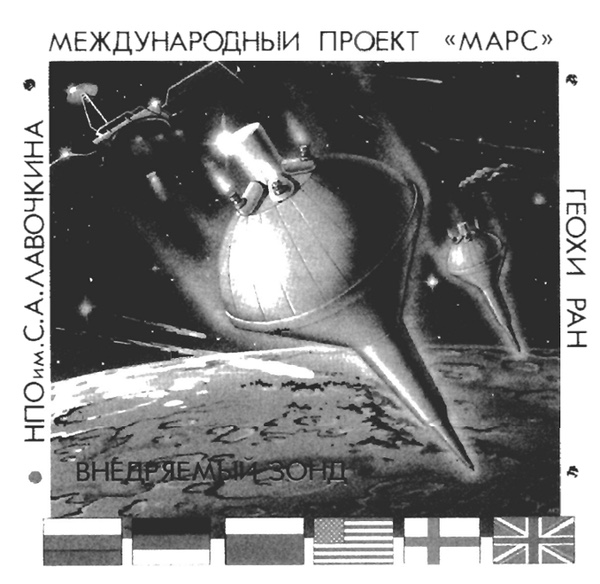
| In the new political landscape of the early 1990s, some began to imagine a different future, one in which the next great attempt to reach Mars might be undertaken not in rivalry, but together. Maybe old foes could become friends. |
Among those who witnessed the passage was John VanderBrink, an electronics specialist at the European Southern Observatory near La Serena, who was camping in the mountains of southern Chile at the time. He later recalled that he “had no illusions that it was anything other than a piece of space debris.” That same night, thousands of miles away, scientists and engineers in Moscow were confronting a different burning realization. A spacecraft they had launched only hours earlier, bound for Mars, was missing.
This is the story of Mars 96.
A new era of interplanetary collaboration
Nearly five years earlier, the Soviet Union had dissolved, ending the decades-long Cold War that had defined the first half-century of the Space Age. From Sputnik’s sudden shock in 1957 to Neil Armstrong’s steps onto the lunar surface in 1969, exploration beyond Earth had grown up in an environment of Soviet-American rivalry. With the emergence of the Russian Federation, an uncertain question emerged: what would become of the space race that had shaped modern planetary exploration?
Mars in particular had long represented unreachable opportunity. For decades, American and Soviet spacecraft attempted flybys, orbit insertions, and landings with uneven success. The Soviet Mars-3 probe achieved the first soft landing on the planet in 1971, though contact was lost after just 20 seconds. NASA’s Mariner and Viking missions later secured sustained orbital observations and the first long-lived surface operations. Between 1960 and 1988, the two nations launched more than two dozen missions toward Mars. In the new political landscape of the early 1990s, some began to imagine a different future, one in which the next great attempt to reach Mars might be undertaken not in rivalry, but together. Maybe old foes could become friends.
Very quickly this hoped-for collaboration began to take institutional form. Bilateral agreements signed in 1992 opened the way for joint US-Russian human spaceflight, and in 1993 Russia was invited into the redesigned station program that would eventually become the International Space Station. The following year, Shuttle-Mir began in earnest, pairing American astronauts with Russian cosmonauts and turning the aging Mir station into a laboratory for post-Cold War partnership.
Mars 96 was born in that atmosphere of cautious optimism. The mission was Russian-led but unmistakably multinational in character: its scientific payload drew on contributions from Germany, France, Italy, Poland, Spain, Belgium, Finland, Austria, and the United States. NASA’s Jet Propulsion Lab would excitedly describe their contribution of two science payloads as “part of the expanding U.S.-Russian cooperation effort in space exploration.”
Mars 96 was not merely another probe bound for a distant planet, but a statement about what the post-Cold War space age might become: an era of interplanetary collaboration.
Built for another world
The Russians had built a highly ambitious mission. Mars 96 contained two surface landers, two surface penetrators, and an orbiter. At more than 6,500 kilograms, the payload was the largest interplanetary spacecraft humans had ever launched. The Proton-K rocket would carry more than 40 science instruments to the Red Planet. Their purpose was to study the atmosphere, the surface, the climate, the magnetic field, and search for water and potential life: just about everything there is to do on Mars. The spacecraft represented not just a return for Russia, but one of the most complex planetary expeditions ever attempted.
Mars 96 was to explore the planet simultaneously from above, on the surface, and beneath it. The three-axis-stabilized orbiter was intended to operate for approximately two Earth years in a highly elliptical, near-polar orbit, gradually mapping nearly the entire surface of Mars. Two small autonomous stations (Malaya avtonomnaya stantsiya) were to be released ahead of orbital insertion, descending to the surface cushioned by inflatable shells that would split open after touchdown. Once deployed, their instruments would photograph the surrounding terrain and analyze local soil and atmospheric conditions. A similar airbag-assisted landing concept would gain public recognition just a year later with NASA’s Mars Pathfinder mission.
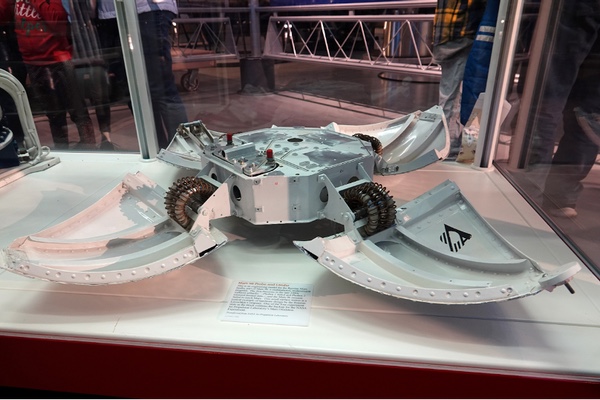 Engineering model of one of two Mars 96 surface landers on display at the Smithsonian’s Udvar-Hazy Center. (credit: Sanjay Acharya / CC BY-SA) |
Even more unusual were the mission’s two hardened penetrators: long, cylindrical probes intended to strike the ground at high velocity and bury themselves several meters below the surface. From this protected position they would measure seismic activity and subsurface heat flow, forming part of a distributed scientific network that could continue transmitting data for up to a year. If successful, Mars 96 would have produced one of the most comprehensive datasets on the planet since the Viking era.
In mid-November 1996, after years of design, delay, and renewed international coordination, final launch preparations were underway at the Baikonur Cosmodrome. Engineers, mission operators, and visiting scientists gathered as the fully assembled vehicle stood poised for departure.
The next stop was Mars.
The long fall back home
Shortly after midnight on November 16, 1996, the engines ignited and Mars 96 began its ascent into space. The spacecraft first entered a temporary parking orbit roughly 160 kilometers above Earth, completing its initial critical burn about 20 minutes after liftoff. As it crossed the Pacific within range of both Russian and American tracking stations, controllers prepared for the next stage of the carefully choreographed escape sequence. A second firing of the upper stage was meant to accelerate the probe toward interplanetary velocity, after which it would separate and ignite its own engine to complete the departure for Mars.
| If successful, Mars 96 would have produced one of the most comprehensive datasets on the planet since the Viking era. |
At this point, something went seriously wrong. The upper stage either failed to ignite properly or shut down almost immediately, leaving the spacecraft trapped in Earth orbit. Yet the onboard autopilot continued executing its programmed sequence, separating from the stage and firing its own engine as if the mission were proceeding normally. Solar panels unfolded, telemetry was transmitted, and for a brief moment engineers at the main Russian tracking center in Crimea believed that Mars 96 was successfully on its way to another planet. Only when orbital data began to arrive did the realization set in: the spacecraft had never escaped Earth’s gravity. It would soon be returning home—quite rapidly, in fact.
Early assessments by US Space Command suggested that the spacecraft, carrying small quantities of plutonium heater material, might reenter over remote regions of Australia. Concern quickly reached the highest levels of government. President Bill Clinton held a telephone conversation with Australian Prime Minister John Howard to offer full American support for any search and recovery operation that might become necessary. As additional tracking data arrived the projected impact zone shifted repeatedly. By Sunday evening in Washington, analysts concluded that the debris had most likely burned up west of Chile near Easter Island, ending the immediate concern.
But this would not be the end of the story. In the weeks that followed, reentry tracking data, notoriously difficult to predict with precision, underwent further analysis. US Space Command gradually refined its estimates, suggesting that debris from Mars 96 may have fallen within a broad elliptical corridor stretching across the eastern Pacific and into parts of northern Chile and Bolivia.
White House spokesman David Johnson later told reporters that this updated information had been shared with regional governments “as soon as we concluded that there was a possibility of something falling there.”
The uncertainty persisted. The following March, US Space Command acknowledged that it was aware of eyewitness reports from Chile. “We were aware of a number of eyewitness accounts of the re-entry event via the media several weeks after the re-entry occurred,” wrote Major Stephen Boylan, Chief of the Media Division at the command’s headquarters in Colorado Springs. “Upon further analysis, we believe it is reasonable that the impact was in fact on land.”
A search was never performed. Nobody went looking for Mars 96.
Designed to survive impact
No matter the eventual landing site, Mars 96 certainly did not reenter Earth’s atmosphere in the elegant manner they had been designed for at Mars. Interestingly enough, it remains within the realm of possibility that the mission’s two surface penetrators survived. Built to strike the rocky Martian surface at roughly 70 to 80 meters per second and continue operating underground, they were constructed with thick, compact casings intended to endure violent impact. The chaotic aerodynamic forces of atmospheric breakup may well have destroyed them before reaching the ground, but it is equally conceivable that one or both endured the descent and came to rest largely in one piece.
| It remains within the realm of possibility that the mission’s two surface penetrators survived. |
Another possible surprise for the Andes involves the spacecraft’s 18 radioisotope heater units (RHUs). The small plutonium-238 powered radioisotope heater units were specifically engineered to survive catastrophic events, such as launch accidents or an atmospheric reentry over South America. Similar incidents had occurred before. In 1978, fragments of the Soviet nuclear-powered satellite Cosmos-954 were scattered across remote regions of northern Canada after an uncontrolled descent.
There is a strange irony in the possibility that hardware built to endure the violence of arrival at Mars may instead have proven its worth in an accidental descent back to Earth.
The wrong planet
There is something quietly absurd about the fate of Mars 96.
A spacecraft engineered to be tracked from hundreds of millions of kilometers away may instead have vanished somewhere on Eart, a world mapped in exquisite detail by satellites, aircraft, and increasingly by ordinary people carrying cameras in their pockets
Three decades later, its final resting place remains unknown.
It is possible that fragments were scattered across the Pacific, broken apart by the violence of reentry. It is also possible that more durable components survived largely intact, coming to rest in remote terrain rarely visited by humans. Somewhere in a dry valley, across the windswept Altiplano, or among the salt flats and volcanic slopes of the high Andes, hardware built for another planet may still lie quietly under open sky. Above such places, Mars appears no closer than it did on the night the spacecraft fell back to Earth.
Today, it does seem that the Russian Mars exploration program ended on a sour note. To date, Russia has not successfully sent an independent Mars mission to the Red Planet.
Elements of Mars 96’s scientific legacy endured. Many of the instrument science teams would contribute to future successful spacecraft such as the Mars Express orbiter launched in 2003. The lander’s Alpha Proton X-ray Spectrometer, developed by the University of Chicago, would reach Mars just months later aboard NASA’s Mars Pathfinder mission, where a closely related unit began returning chemical readings from the surface of another world. One instrument was fulfilling its purpose on Mars, quietly carrying forward the work its lost sibling would never perform.
There is a Russian proverb: “One beaten person is worth two unbeaten ones.”
Still waiting
Thirty years have passed with no definite conclusion. One day, a hiker, miner, or researcher may come upon an object that does not belong: compact, metallic, and unmistakably built for another world. Or maybe not.
| Somewhere on the wrong planet, Mars 96 may still be waiting. |
Mars 96 was, above all, a mission of extraordinary collaboration and ambition. Conceived in Russia but carrying instruments and scientific hopes from across Europe and the United States, it reflected a brief moment when planetary exploration felt shared rather than divided. Its failure was swift and largely unceremonious, and in the decades since, it has survived mostly in technical literature and the fading recollections of those who helped build and launch it.
Its ultimate resting place remains genuinely uncertain. Whether its surviving fragments lie somewhere in the remote Andes, deep beneath ocean waters, or lost in ways that will never be known, nobody will ever go looking for it. What endures is the idea it once carried: that ambitious cooperation can be set into motion even in fragile circumstances. Like the spacecraft itself, collaboration was launched but never quite arrived.
Somewhere on the wrong planet, Mars 96 may still be waiting.
Sources
Siddiqi, A. A., Beyond Earth: A Chronicle of Deep Space Exploration, 1958–2016, NASA History Division, 2018.
Oberg, J., “The Probe That Fell to Earth,” New Scientist, 1999.
Clinton, W. J., “The President’s News Conference,” Weekly Compilation of Presidential Documents, 25 November 1996.
United Nations Office for Outer Space Affairs, Report on the Re-entry of the Russian Mars-96 Spacecraft.
Perminov, V. G., The Difficult Road to Mars: A Brief History of Mars Exploration in the Soviet Union, NASA SP-4515, 1999.
NASA Office of Inspector General, NASA’s International Partnerships, 2016.
NASA, “Space Station 20th: Launch of Mir 18 Crew,” 2020.
NASA Jet Propulsion Laboratory, Mars-96 Press Kit.
NASA Jet Propulsion Laboratory, “U.S. Soil Experiment Ready to Launch Aboard Russia’s Mars-96.”
NASA Jet Propulsion Laboratory, “NASA Mars Orbiter Images May Show 1971 Soviet Lander.”
Malin Space Science Systems, “Mars 96 Penetrators.”
Rieder, R., Wänke, H., and Economou, T., “An Alpha Proton X-Ray Spectrometer for Mars-96 and Mars Pathfinder,” Bulletin of the American Astronomical Society, 1996.
Note: we are now moderating comments. There will be a delay in posting comments and no guarantee that all submitted comments will be posted.