Pinning the tail on the Moskva: POPPY and the dawn of satellite ocean surveillanceby Dwayne A. Day
|
| As the satellites became more sophisticated and their operators more skilled, they were soon detecting signals that were from moving targets as well as stationary ones. The NRL, also being a part of the Navy, was naturally interested in ships. |
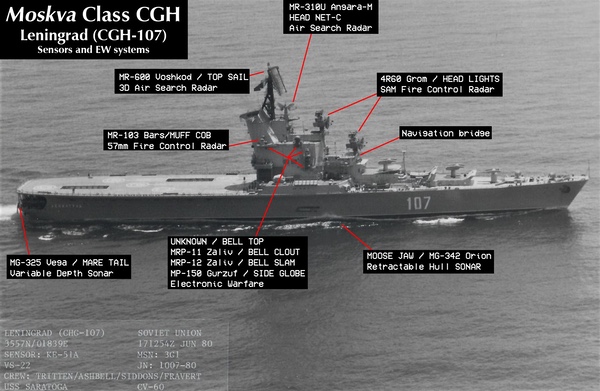
The ship bore a resemblance to the French helicopter carrier Jeanne d’Arc, with missiles mounted forward, a large, tall superstructure amidships, and a large rear flight deck for carrying multiple helicopters. Over time, intelligence analysts learned that the ship was named the Moskva, and concluded that it was most likely intended to launch helicopters to hunt American submarines, and was ill-suited to serve as an amphibious assault ship. American satellites spotted the helicopters that were assigned for the ship (by noting where they were based) and identified them as sub-hunters. The Moskva lacked the ability to carry many helicopters or ground assault troops, and the ship’s elevators were too small for rapid flight operations. American analysts also suspected that Moskva’s large superstructure created bad turbulence over the rear flight deck, limiting helicopter operations. The 1966–67 edition of “Jane’s Fighting Ships” accurately noted that the Soviet Union had built a helicopter carrier, although this was misreported in the general press as an “aircraft carrier.” As Moskva was tooling around the Black Sea, satellites photographed a second ship under construction.
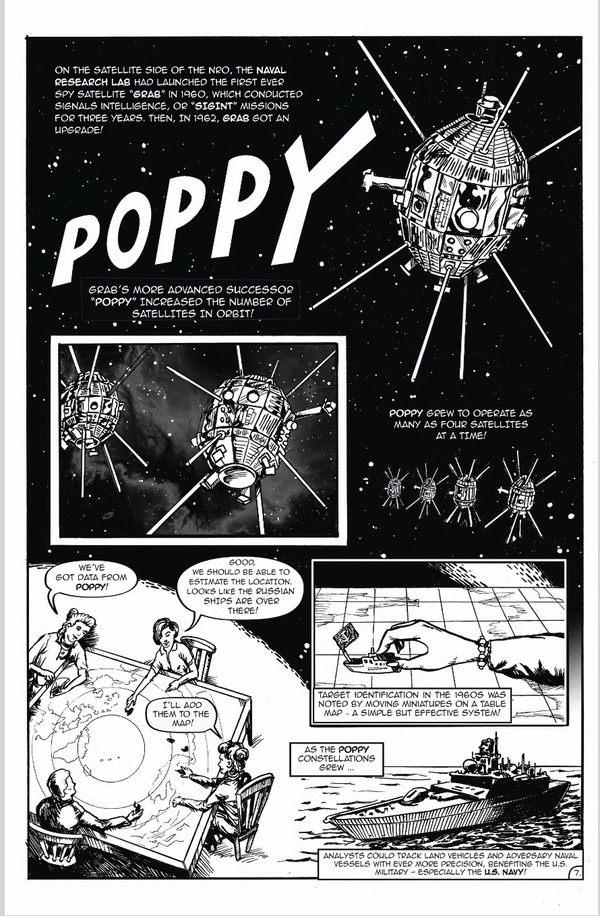 A page from a comic book produced by the National Reconnaissance Office depicting a POPPY satellite surveilling the oceans. (credit: NRO) |
Collecting whispers from above
The United States had multiple intelligence satellites peering down on the Soviet Union. In addition to the photographic satellites, the secret National Reconnaissance Office (NRO), which managed the United States’ fleet of intelligence satellites, also had signals intelligence satellites that listened for the emissions from various types of radars on the ground. Some of the satellites were designed, built, and operated by the Naval Research Laboratory (NRL) for the NRO. NRL’s satellites were known as POPPY. POPPY satellites could intercept radar signals coming from the ground and immediately beam that information to a ground station within view of the satellite. As the satellites became more sophisticated and their operators more skilled, they were soon detecting signals that were from moving targets as well as stationary ones. The NRL, also being a part of the Navy, was naturally interested in ships.
Reid Mayo was the head of the specific part of the NRL that developed the POPPY satellites. In 1981 he gave a lengthy interview about the NRL’s work on developing signals intelligence. That interview was classified top secret and only declassified in March 2026. It provides a wealth of information on the early development of signals intelligence satellites, and space-based ocean surveillance, and the key role the Moskva played in initiating that intelligence mission.
By spring 1968 about 30 to 50 ships at sea had been located by POPPY, Mayo recounted in 1981. “Some of them were known, and some of them were highly suspect,” Mayo said. “The ones that were most important were those that they [signals analysts] could not put any signature to.”
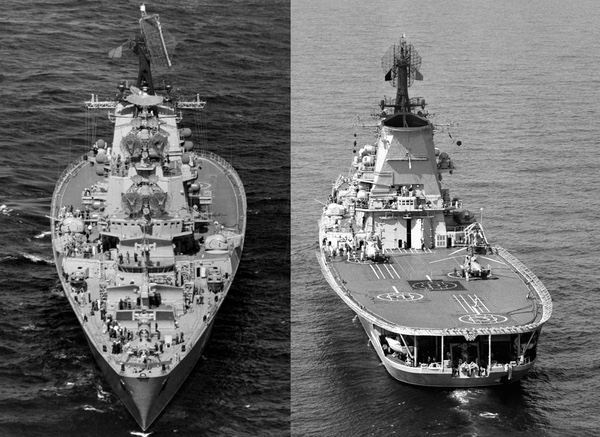 The Soviet Union built two Moskva-class helicopter carriers in the 1960s to hunt American Polaris ballistic missile submarines. They had a distinctive design with a large helicopter deck aft. (credit: US Navy) |
Moskva sets sail
The signals analysts at NRL were very attuned to the new data they were gathering. “Once they saw a ship leave Sevastopol and go out into the Black Sea, tour around for 4-5 days, then come back into Sevastopol, and be at dockside for three weeks and go out again,” Mayo said. “Finally, this unique emitter headed for the Bosporus, went past Istanbul, and out into the Mediterranean. All the cameras and eyeballs we could convene on that occasion were watching, and what we saw was the new helicopter carrier Moskva on its first tour outside the inland waters of the Soviet Union. We then recognized that we had observed its TOP SAIL radar signal for four or five months. We saw it in September, again in December in the Black Sea, then, finally, in the spring, it went out into the Mediterranean.”
| Moorer blew up at them. “What Navy do you work for?!” he yelled. “He really was rather irate about it,” Mayo recalled. |
This was, to put it mildly, a big deal. Moskva was designed to hunt American Polaris ballistic missile submarines in the Mediterranean. But more importantly, the wizards at the NRL had finally identified a specific ship based on its radar emissions. “We were able to pin the tail on the donkey,” Mayo recalled. “We were able to say this ELINT signature is that emitter on that ship.”
“It was a new family of emitters, it had never been deployed before,” Mayo explained. “Some months later, the same radar was put on another helicopter carrier, and a year later on a cruiser. Each time, those signals were detected in Soviet waters, deep inside their interior, before the ships came out where you could really be sure of what they were.”
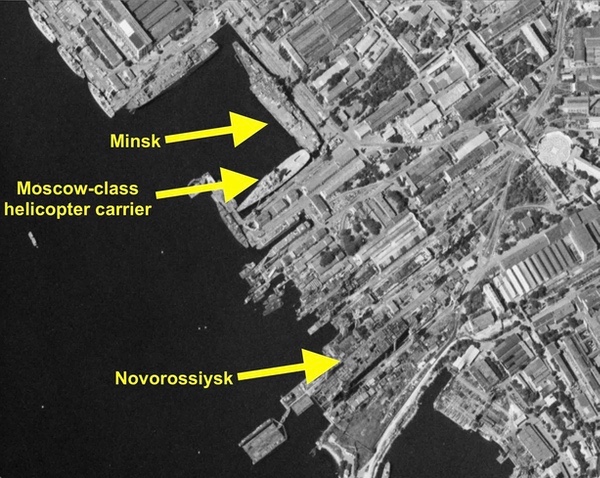 A US reconnaissance satellite of a Black Sea port in 1977 shows one of the two Moskva-class ships at dockside. (credit: Harry Stranger) |
The dawn of ocean surveillance
In April 1968, Admiral Thomas Moorer, the Chief of Naval Operations—the most senior officer in the US Navy—was going to have lunch with a top intelligence advisor to discuss signals intelligence. Moorer’s staff believed that he should receive a briefing about the POPPY satellite program. Three top officials from the NRL—Harold Lorenzen, Captain Weldon, and Reid Mayo—went to brief Admiral Moorer. They took some large briefing charts and a notebook filled with information on POPPY. They did not know what kind of meeting they were going to have with the CNO.
Due to an interruption, Moorer asked for a quicker, less-formal briefing. Rather than the briefing charts, they started thumbing through a three-holed notebook they had brought, telling him how the POPPY satellites had tracked the Moskva for three or four months before it came through the Bosporus, showing him the ship’s track in the Black Sea.
Moorer blew up at them. “What Navy do you work for?!” he yelled. “He really was rather irate about it,” Mayo recalled. “Well, yours, sir, why do you ask?”
Moorer said that Lyndon Johnson had been pressuring him about foreign ships at sea and wanted to know where they were heading. Were they heading for Cuba? Could they be carrying missiles to Cuba? “Admiral Moorer said he did not have enough aviation fuel and aviator eyeballs to position them in all the areas where they might have been, and he just could not find them,” Mayo recalled. Moorer then said, “And you mean, we have a capability here of locating a ship in hours?” He could use that information to get a P-2 Neptune patrol plane over a ship and answer the president’s question. “He wanted to know why he had not heard of this capability before. In fact, he wanted to have a briefing on our results, and as we began to exploit this, he wanted a briefing every week!” Mayo exclaimed.
“So that’s how ocean surveillance began,” Mayo concluded.
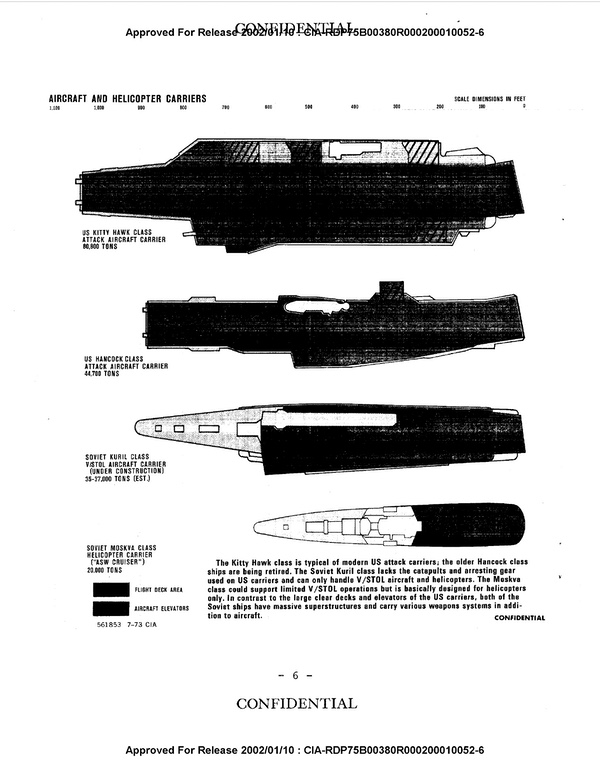 Declassified 1973 CIA comparison of several aircraft carriers as well as the unique Soviet ships such as the Moskva. (credit: Harry Stranger) |
Mayo thought that Moorer might have been vaguely aware of POPPY’s capabilities. “He might have known there was a Navy program doing national work for the NRO, but he didn’t have the realization that it could locate ships.”
The NRL began trying to detect moving emitters with much more urgency. “Ships were the majority of them,” Mayo explained. “Oh, we located a few aircraft, too. We even tried to optimize the location by varying altitude on one aircraft intercept, and we could show that it was some 3,000 or 4,000 feet in the air. It was a rough optimization.”
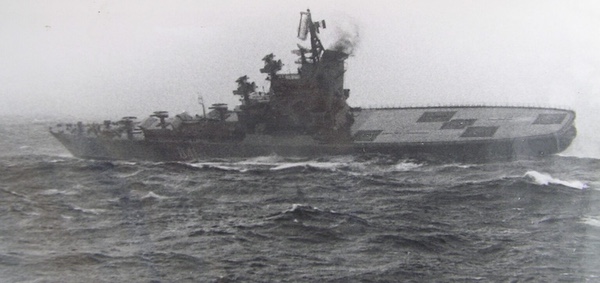 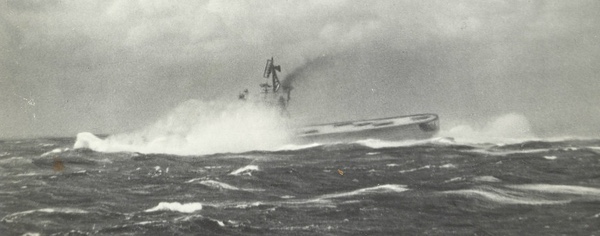 The Soviet Union built two Moskva-class helicopter carriers. They rolled badly in heavy seas. (credit: airbase.ru) |
They also detected a submarine. Although the details remain classified, this was a major deal. Soviet ballistic missile submarines had to get relatively close to American shores to launch their missiles. When they stuck an antenna out of the water to report back to base, a satellite could intercept the signal and report the location and direction of movement. That could be used to send submarine-hunting aircraft, or other submarines, to find the Soviet vessel.
Eventually, space-based ocean surveillance became a major development effort for the NRL and the National Reconnaissance Office, leading to POPPY’s follow-on program, named PARCAE. But the details and the breadth of this work is only now becoming known.
As for the Moskva and its sister ship, Leningrad, they were probably less menacing to the US Navy’s submarines than the Soviets intended. The ships handled badly in rough weather, due primarily to their wide beam compared to their relatively short length. They rolled sickeningly in heavy swells, limiting their helicopter operations and undoubtedly making their sailors miserable. The Soviet Union only built two before focusing on other designs. The NRL sought to track them too.
Note: we are now moderating comments. There will be a delay in posting comments and no guarantee that all submitted comments will be posted.