Artemis 2, Apollo 8, and the problem with historyby Dwayne A. Day
|
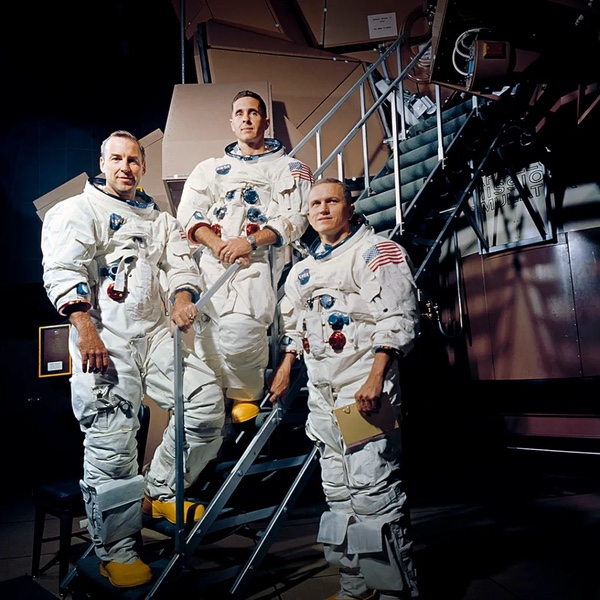
| The simple, and mostly correct, explanation as to why the United States sent astronauts to land on the Moon in 1969 was to beat the Soviet Union there. |
But had John F. Kennedy not been assassinated in November 1963, it is possible that he might have backed out of his Apollo commitment, which was starting to become a financial—and thus political—liability. Kennedy’s death turned Apollo into a memorial, possibly giving it enough support to ensure its completion. There is no way to truly know, but there is enough evidence to raise that possibility. (See: “Murdering Apollo: John F. Kennedy and the retreat from the lunar goal,” part 1 and part 2, The Space Review, The Space Review, October 30, 2006.)
The Artemis 2 mission has been compared to the December 1968 Apollo 8 mission. Whereas Apollo 8 orbited the Moon, Artemis 2 looped around it. But the Integrity spacecraft has greater capabilities than Apollo 8 did, including the ability to carry four astronauts amid greater comfort. Artemis 2 was really justified as an engineering test mission to prove the spacecraft, and the mission itself lacks a political impetus independent of the overall Artemis program, unlike Apollo 8.
Politics and Apollo 8
Apollo 8 was a bold and risky decision by NASA officials to send them on that journey, the first ever beyond low Earth orbit. Over the decades, many historians have focused on the decision to send Apollo 8 around the Moon. The two major drivers were the availability of the Lunar Module—which had fallen behind schedule—and unmanned Soviet space missions that were clearly tests of their circumlunar spacecraft, called Zond.
According to his autobiography, Apollo 8 commander Frank Borman in early August 1968 received orders to go to Houston immediately. “I flew a T-38 to Houston and walked into Deke’s office. I knew something was up when he asked me to close the door,” Borman wrote. “We just got word from the CIA that the Russians are planning a lunar fly-by before the end of the year,” Deke Slayton told him. “We want to change Apollo 8 from an earth orbital to a lunar orbital flight. I know that doesn’t give us much time, so I have to ask you: Do you want to do it or not?”
Yes, Borman replied.
“I found out later that the Soviets were a hell of a lot closer to a manned lunar mission than we would have liked. Only about a month after I talked to Slayton, the Russians sent an unmanned spacecraft, Zond 5, into lunar orbit and returned it safely to earth.”
Borman’s account is dramatic, but not inaccurate. It’s also not the full story.
| But were Soviet actions the trigger for NASA’s decision to send Apollo 8 around the Moon? Other available historical evidence does not fully support that conclusion. |
In the 1960s the CIA, the NSA, and other intelligence agencies were closely monitoring the Soviet space program, trying to discern what they were doing. A declassified CIA memo from October 1968 reported on the activities of the CIA’s Foreign Missile and Space Analysis Center, FMSAC, pronounced “foomsac” in the intelligence community at the time. FMSAC was established in late 1963 to give the CIA the ability to perform technical analyses of foreign—primarily Soviet—missiles and spacecraft. FMSAC became very good at trajectory analysis, taking radar and other data on the flights of foreign missiles and rockets collected from ground stations and determining the capabilities of those rockets and missiles based upon their flight path (see “Dancing in the pale moonlight: CIA monitoring of the Soviet manned lunar program,” The Space Review, June 10, 2019, and “Apollo’s shadow: the CIA and the Soviet space program during the Moon race,” May 13, 2019.)
The declassified October 1968 CIA memo is a general account of FMSAC’s activities over the previous year. It stated: “In the space area, FMSAC has the exclusive lead over all elements of the intelligence community and on an almost daily basis provides direct intelligence support, including many personal briefings, to the senior officials of NASA, the National Aeronautics and Space Council and the Presidential Science Advisory Council.”
Carl Duckett, the CIA’s Deputy Director for Science and Technology wrote that among the Center’s accomplishments in 1968, “The likelihood that the U.S. will conduct a manned circumlunar flight with the Apollo-8 vehicle in December is a result of the direct intelligence support that FMSAC has provided to NASA on present and future Soviet plans in space.”
But were Soviet actions the trigger for NASA’s decision to send Apollo 8 around the Moon? Other available historical evidence does not fully support that conclusion.
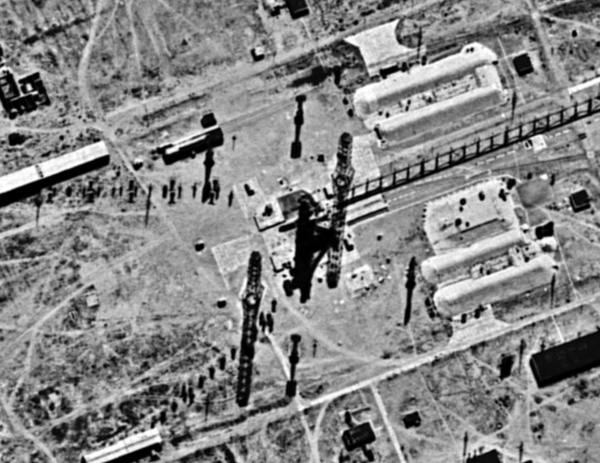 A Proton launch pad photographed by an American reconnaissance satellite in 1984. The Proton was the vehicle the Soviet Union planned to launch the Zond spacecraft around the Moon in 1968/69, and monitoring launch activities was key to understanding when they might do that. (credit: Haryr stranger) |
The spooks are watching
The best and most comprehensive historical account of the Apollo 8 lunar decision is contained in Charles Murray and Catherine Bly Cox’s 1989 book Apollo: the Race to the Moon. Murray and Cox devoted ten pages to the subject. They clearly stated that the decision to send Apollo 8 on a circumlunar mission was overwhelmingly determined by Apollo’s aggressive schedule and not Cold War competition. In those ten pages they did not mention the Soviet lunar activities.
Apollo officials started initial discussion of a circumlunar mission in spring 1968, primarily as a theoretical option, long before concern about the Soviet Union sending cosmonauts around the Moon. A circumlunar mission without a lunar module had first been mentioned a year earlier to make up time lost due to the Apollo 1 fire, so the basic concept for what became the Apollo 8 mission had been percolating for a while.
The proposed mission was more seriously evaluated by NASA officials in early August when it became clear that the Lunar Module originally scheduled for the upcoming mission was delayed. George Low, the director of the Apollo Spacecraft Program Office, explained that the Lunar Module “had what we call ‘first ship problems.’ It always takes the first ship longer to get through.” The Lunar Module would not be ready until March 1969.
To stay on schedule for testing both the Saturn V and the Command and Service Modules, NASA would have to launch a mission into high Earth orbit without the Lunar Module. George Low argued that in place of a high Earth orbit mission, NASA should instead fly a circumlunar mission. During several days in August, Low discussed this with various senior officials before taking it directly to NASA Administrator James Webb. Webb tentatively agreed to the plan but withheld final approval until after Apollo 7 flew in low Earth orbit in October and proved the Apollo spacecraft.
It was a gutsy decision for NASA officials to make.
None of the official NASA records on this subject, or George Low’s diary, mention Soviet plans to conduct a circumlunar flight. Low and other NASA officials were certainly aware of Soviet circumlunar efforts, but there are no official NASA records indicating that it was even considered in their decision-making. Although intelligence information on Soviet activities was classified at the time and would not have been mentioned in unclassified NASA records, the Soviet activities were also mentioned in public news sources, and therefore NASA officials could have at least referred to those accounts.
| Even if the CIA did provide extensive information to NASA about Soviet circumlunar plans, that does not necessarily mean that, as the memo indicates, NASA’s decision was a “result” of CIA information. |
The CIA and the National Security Agency had both been monitoring Soviet space activities throughout the year. In April 1968, the CIA produced a “Memorandum to Holders” supplement to an earlier 1967 National Intelligence Estimate (NIE) on the Soviet space program. Although the CIA was producing NIEs on the Soviet space program every two years, enough had happened in the past year that they wanted to update recipients of their 1967 report. The Memorandum to Holders included a table of space launches that mentioned the March 1968 Soviet Zond 4 mission, which it designated a “Circumlunar Simulation.” According to the memo, the mission was a “partial success,” which was explained in a footnote as “all phases of this mission appeared successful except reentry/recovery.” Zond 4’s mission had also been covered in the press at the time, so it certainly would have been well-known even to NASA officials without access to classified intelligence reports. George Low could have mentioned it in his unclassified diary.
The April CIA memo also specifically addressed Soviet circumlunar plans: “The Soviets will probably attempt a manned circumlunar flight both as a preliminary to a manned lunar landing and as an attempt to lessen the psychological impact of the Apollo program. In NIE 11-1-67, we estimated that the Soviets would attempt such a mission in the first half of 1968 or the first half of 1969 (or even as early as late 1967 for an anniversary spectacular). The failure of the unmanned circumlunar test in November 1967 leads us now to estimate that a manned attempt is unlikely before the last half of 1968, with 1969 being more likely. The Soviets soon will probably attempt another unmanned circumlunar flight.” An accompanying bar chart made the same point, with the last six months of 1968 shaded as “earliest possible” for a manned circumlunar flight, and all of 1969 shaded as “more likely.”
It is possible the CIA obtained new information after producing that April memo that led their experts to believe that a Soviet manned circumlunar flight was more likely in early 1969 or even late 1968 than they had assumed in April, increasing the pressure on NASA to do something. Perhaps in June or July the CIA somehow learned about the upcoming Zond 5 flight and informed NASA. The Zond 5 flight took place in September, after the Apollo 8 decision was essentially made. It is also possible that FMSAC was exaggerating its role in NASA’s circumlunar decision, or at least assuming that FMSAC had played a greater role in convincing NASA’s leadership to attempt the Apollo 8 mission around the Moon than it actually had. Without more details, it is still not possible to know.
Even if the CIA did provide extensive information to NASA about Soviet circumlunar plans, that does not necessarily mean that, as the memo indicates, NASA’s decision was a “result” of CIA information. Only the NASA officials who made the Apollo 8 decision knew what factors influenced them most. That was primarily George Low, whose records point to the Apollo schedule being the primary influence.
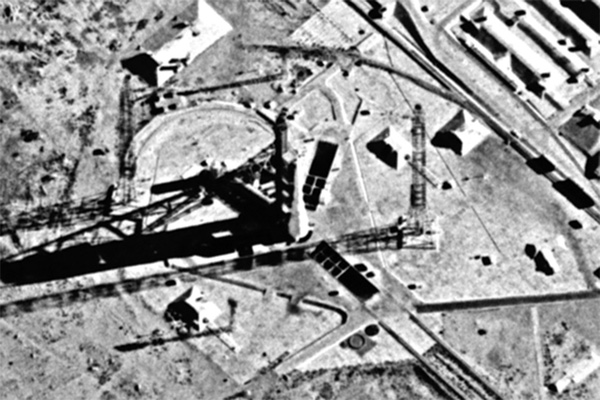 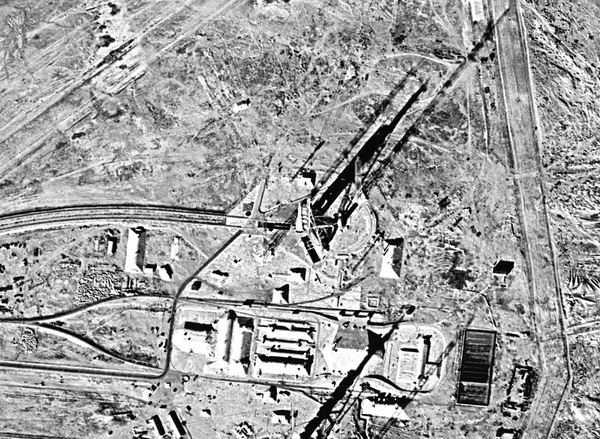 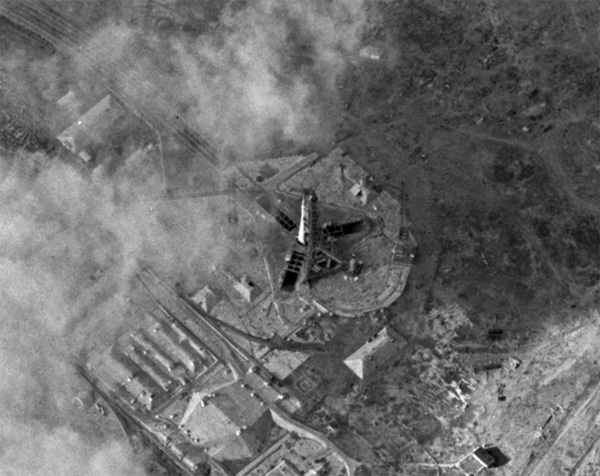 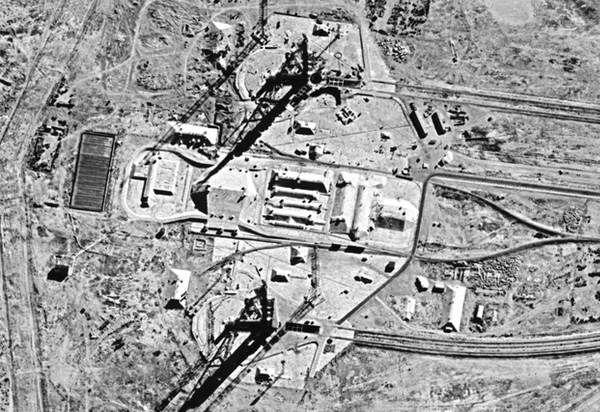 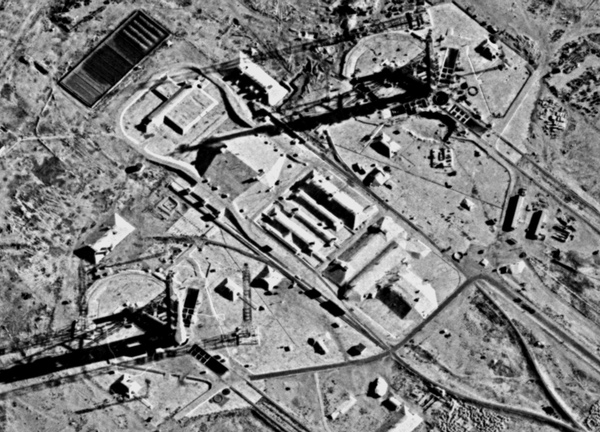 The US intelligence community kept close tabs on the Soviet space program during the 1960s, including taking many reconnaissance photos of the sprawling launch complex for the N1 Moon rocket at Baikonur. Sometimes rockets were photographed on the launch pad. (credit: Haryr stranger) |
Photos and signals
American intelligence assets focused on the Soviet Union were getting increasingly capable. CIA and NSA listening posts around the world were gathering up signals from Soviet spacecraft as well as monitoring the movements of ships used to track spacecraft and recover them from the water. Much of the information on this intelligence remains classified, although it is slowly coming out. (See “A taste of Armageddon (part 1),” The Space Review, January 3, 2017, and “A taste of Armageddon (part 2),” The Space Review, January 9, 2017.)
| We can be certain that the intelligence community is monitoring the Chinese lunar program, and providing their best assessments to NASA officials. |
In July 1966, the Air Force launched the first of the National Reconnaissance Office’s KH-8 GAMBIT-3 reconnaissance satellites, and by early November 1968, 17 of them had been launched, with one failing to reach orbit. The GAMBIT’s powerful camera could reveal amazing detail about Soviet submarines, missile silos, and rockets. GAMBIT’s photos revealed details on the ground 30 centimeters or better, and they could have shown spacecraft hardware being prepared at the Soviet launch site. But most Soviet activities were indoors and their rockets spent little time at the pad. It is unlikely that the CIA had good intelligence about an impending Soviet circumlunar flight until shortly before it occurred.
Certainly the race to the Moon with the Soviets established the larger context in which all NASA decisions were made. The preponderance of evidence still supports the conclusion that it was the Apollo schedule that drove the decision, not specific Soviet actions.
There are comparisons between Apollo and Artemis. We can be certain that the intelligence community is monitoring the Chinese lunar program, and providing their best assessments to NASA officials. But the Chinese have also been far more open about their plans than the Soviets were about theirs. It is a good bet that when they plan to send their own taikonauts to the Moon, they will tell the world.
Note: we are now moderating comments. There will be a delay in posting comments and no guarantee that all submitted comments will be posted.