When the orbital layer is the kill chainAI and drones are getting all the credit. Space is doing most of the work.by Bharath Gopalaswamy
|
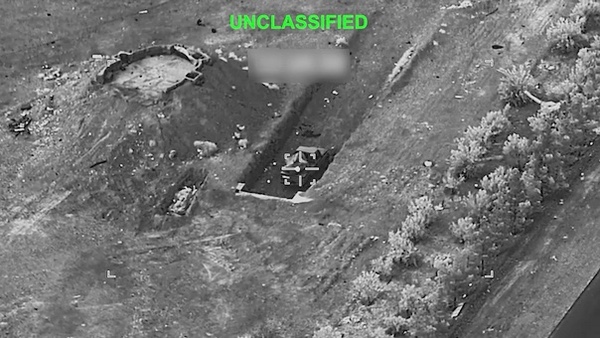
| This is the point that the AI-in-warfare debate consistently misses: the targeting cycle is not an AI system enabled by some satellites. It is a space architecture with an AI processing layer on top of it. |
The real story is not the software. It is the orbital layer that makes the software possible: the infrastructure that guides drones, feeds satellite imagery into targeting interfaces, synchronizes precision munitions, and times strike packages across multiple theaters simultaneously. That layer has been almost entirely absent from the public debate. Its absence matters because without understanding it you cannot understand what made Epic Fury possible, or what would unmake the next operation like it.
Three clicks and an orbital architecture
When Cameron Stanley, the Pentagon's Chief Digital and AI Officer, demonstrated Maven publicly in March 2026, he described the targeting process with deliberate simplicity: left click, right click, left click, and a detection becomes a formal strike package. What the demonstration did not show was the chain of orbital infrastructure that makes those three clicks operationally meaningful.
| What surprised me was the speed and completeness with which the orbital and terrestrial layers fused into a single operational system with no meaningful seam between them. |
Maven does not see targets on its own. It processes what satellites show it, fusing drone feeds, satellite imagery, signals intelligence, and radar data into a single targeting interface. Every one of those data streams depends on orbital infrastructure: imaging satellites providing the visual picture, communications satellites carrying the data, signals intelligence satellites intercepting the electronic environment, and GPS timing and positioning synchronizing the entire architecture in real time. The artificial intelligence in Maven is genuinely impressive. It is entirely downstream of the space layer. Remove the satellites and Maven is processing nothing. The drones navigate blind and precision munitions revert to ballistic trajectories.
This is the point that the AI-in-warfare debate consistently misses: the targeting cycle is not an AI system enabled by some satellites. It is a space architecture with an AI processing layer on top of it. The distinction matters enormously for how we think about both the capability and its vulnerabilities.
What Epic Fury revealed that earlier conflicts did not
I spent years researching the militarization of space, and the argument I made repeatedly in that work was that the most dangerous vulnerability in modern military power was not the dramatic one, not the kinetic antisatellite strike that generates headlines, but the quiet degradation of the orbital infrastructure that underpins nearly everything else. A jammer costs less than a used car and can deny a GPS signal that runs a multi-trillion-dollar global economy.
What surprised me about Epic Fury was not that space proved decisive in the way I had long argued it would. What surprised me was the speed and completeness with which the orbital and terrestrial layers fused into a single operational system with no meaningful seam between them. In previous conflicts space enabled the fight. In Epic Fury the space layer and the AI systems it feeds operated as a single integrated architecture in which the sensor, the processor, and the weapon were not three separate capabilities coordinated by human analysts but a continuous cycle refreshing and executing at speeds that human deliberation cannot match.
This compression is the genuinely new development. Understanding it requires placing the AI conversation inside the space conversation rather than treating them as parallel developments that happened to coincide.
The Iranian lesson and the Chinese calculation
Iran understood the centrality of the space layer before most Western analysts were prepared to acknowledge it publicly. Its transition from GPS to BeiDou was not improvised under pressure but a decade-long program rooted in a strategic calculation made after the 1996 Taiwan Strait Crisis, when Beijing concluded that dependence on American orbital infrastructure was not a vulnerability to be managed but an existential threat to be eliminated. By the time Operation Epic Fury began, Iran's military navigation was running on Chinese satellites, its precision strike capability depended on Chinese timing and positioning data, and the kill chain that struck American and allied assets across the Gulf was built on orbital infrastructure provided by a third party who bore no legal accountability for the strikes it enabled.
China was not a passive observer. Beijing's Jilin-1 commercial satellite constellation documented strike patterns, aircraft deployments, and logistics cycles throughout the conflict, feeding a surveillance architecture that amplified Iranian targeting precision. The intelligence flowing from Chinese satellites to Iranian ground stations represents something the laws of armed conflict are entirely unequipped to address: great power proxy warfare conducted entirely through the space domain, with no Chinese soldiers, no Chinese aircraft, and no formal Chinese involvement that would trigger alliance obligations or escalation thresholds. The drones get the headlines. The AI gets the controversy. The satellites made both possible on both sides of the battlefield simultaneously.
This is the model Beijing has now validated. It does not need to fight the next conflict directly to degrade American military effectiveness. It needs only to ensure that its adversaries have access to the orbital alternatives it has spent 20 years building.
The contested orbital environment nobody has fought in yet
The debate about AI in warfare has correctly focused on accountability and the laws of armed conflict. But there is a prior question that has been almost entirely absent from the conversation, and it is the more consequential one for the next decade of great power competition: what happens to AI-enabled warfare when the orbital layer it depends on is genuinely contested rather than merely disrupted at the margins?
The United States currently enjoys a substantial advantage in military space assets, and that advantage is what enabled the targeting tempo of Epic Fury. But China has been closing that gap methodically. Its BeiDou constellation now covers the globe with military-grade precision. Its direct-ascent antisatellite capability is the most advanced outside the United States. Its co-orbital satellite program has demonstrated the ability to maneuver near, inspect, and theoretically disable American assets in geosynchronous orbit. And as the Iran conflict has demonstrated, China does not need to fight directly to benefit from the erosion of American space dominance. It simply needs to give its partners access to the alternatives it has built.
| Preserve the orbital layer and the AI retains its eyes. Lose it and the AI is processing stale data in an environment it can no longer see, with high confidence and zero situational awareness. |
The next conflict in which the orbital layer is genuinely contested—not jammed commercially but targeted kinetically, or denied through sustained electromagnetic warfare at scale—will look nothing like Epic Fury. The three-click kill chain that ran above Iran required specific orbital conditions: an imaging constellation that could see the target, a communications architecture that could carry the data, and a positioning system that could synchronize the weapon. Each of those conditions can be degraded. Each of those degradations is something China has invested seriously in being able to impose. The lesson being drawn in Beijing from Epic Fury is almost certainly not the lesson being drawn in Washington.
What comes next
The Iran conflict has validated three things simultaneously. Space is now the first domain of conflict rather than the enabling domain. AI targeting at operational scale is deployed and decisive. And the combination of these two capabilities has created a military architecture whose most significant vulnerabilities lie almost entirely in the space layer rather than in the software.
The companies, governments, and militaries that understand this will invest in GPS-independent positioning, in resilient space architectures designed to survive active contest rather than merely passive disruption, and in intelligence pipelines that continue to function when the imaging satellite is blinded and the communications satellite is jammed. The AI is downstream of all of this. Preserve the orbital layer and the AI retains its eyes. Lose it and the AI is processing stale data in an environment it can no longer see, with high confidence and zero situational awareness.
The kill chain that ran at three clicks per target over the skies of Iran will not always have the orbital conditions that made it possible. The adversary that figures out how to deny those conditions before the United States has built the resilience to survive their denial will win the next conflict regardless of how sophisticated the targeting software has become. The drones are the story that everyone is watching. The satellites are the story that will determine who wins the war that comes after this one.
Note: we are now moderating comments. There will be a delay in posting comments and no guarantee that all submitted comments will be posted.