Commercial space station developers make their business case to NASAby Jeff Foust
|
| “The RFI said, ‘Show us your evidence,’” said Smith. “We put in 390 pages of independent analysis, research studies, data, contracts, those types of things.” |
That mood extended beyond NASA. Military leaders at the conference also played up the mission, highlighting their roles in supporting it. The same was true of officials from other space agencies. Walther Pelzer, head of the German Space Agency at DLR, noted he had met with NASA just before his appearance on stage to discuss the performance of the European-built service module, assembled in the German city of Bremen. “They underlined that it’s really working like a Swiss clock,” he said, then found a more appropriate comparison: “Or like a German automotive engine.”
NASA had more to celebrate than Artemis 2. Space Symposium gave it an opportunity to restate its revised exploration plans, including a lunar base and nuclear propulsion (see “Igniting a new vision for NASA,” The Space Review, March 30, 2026). At the conference, Michael Kratsios, director of the Office of Science and Technology Policy, formally announced a new space nuclear power implementation plan, building up on NASA’s plans announced last month.
Not everyone, though, was in a fully celebratory mood. While many came into the conference riding the high of Artemis 2, commercial space station developers showed up after just submitting a homework assignment: responses to a NASA request for information (RFI) that effectively asked them to justify there was a market for those stations.
That RFI was tied to NASA’s proposed plans for changing the Commercial Low Earth Orbit Destinations, or CLD, program, citing what agency officials believed was a lack of a commercial market for them. At the Ignition event last month, NASA proposed major changes to the CLD program, including commissioning a “core module” for the International Space Station that commercial modules could dock to.
“The RFI said, ‘Show us your evidence,’” said Marshall Smith, CEO of Starlab Space, on a conference panel largely devoted to commercial stations. “We put in 390 pages of independent analysis, research studies, data, contracts, those types of things.”
That evidence, he said, showed that there were commercial markets for its Starlab space station. Voyager Technologies, the company that owns the majority of the Starlab Space joint venture, announced last month that the commercial payload space on Starlab was “fully reserved” three years before the station’s launch.
| “We’re going to see that evolve as we move forward: sovereign nations wanting to fly their astronauts,” Cirtain said. “That is a market. There is revenue there.” |
Smith didn't discuss the evidence his company submitted in detail but noted the business case for the station was strong enough to attract investment: besides the support from the joint venture’s partners, such as Voyager, Airbus, Mitsubishi, and MDA Space, the company has been raising outside investment. “Private capital, private investment is very much on the page that there is a future here,” he said.
He was on a panel that included CEOs of two other space station developers, who made similar arguments. Jonathan Cirtain, CEO of Axiom Space, noted his company already has knowledge about the market from the four private astronaut missions it has flown to date to the International Space Station. While it started off flying private citizens, it has shifted to so-called “sovereign astronauts,” or those representing national space agencies.
“We’re going to see that evolve as we move forward: sovereign nations wanting to fly their astronauts, get them trained, get them prepared for a role in Artemis,” he said. “That is a market. There is revenue there.”
Axiom is flying a fifth private astronaut mission (PAM) to the ISS in early 2027, but the other commercial space station companies are also getting involved. Vast won a NASA award in February for a mission later in 2027 and, moments before the Space Symposium panel took place, Voyager announced it had been selected by NASA for its own PAM to the ISS in 2028.
“With three providers now selected for private missions, NASA is doing everything we can to send more astronauts to space and ignite the orbital economy,” NASA’s Isaacman said in a statement about the Voyager award. “Each new partner brings fresh capabilities that move us closer to a future with multiple commercially operated space stations and a vibrant, sustainable marketplace in low Earth orbit.”
Vast is preparing not just for its ISS PAM mission but also building Haven-1, a single-module space station that will host several short-duration missions, giving the company experience to support its larger Haven-2 station it plans to offer to NASA for the CLD program. Haven-1 is, after some delays, scheduled to launch as soon as the first quarter of 2027.
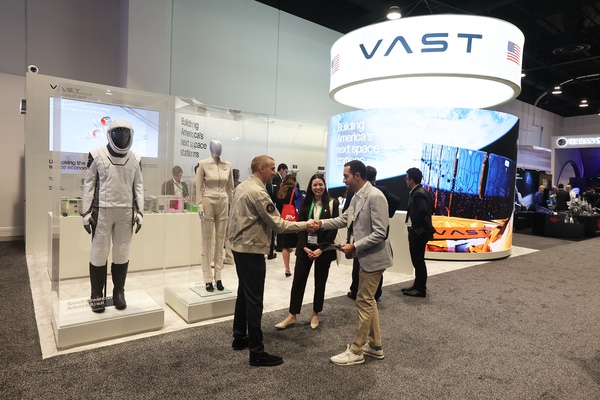
Like Axiom, Vast is focusing on sovereign astronauts for Haven-1 and its PAM flight. In an interview in the company’s large exhibit at the conference, Vast CEO Max Haot said the Haven-1 flights offered several advantages, including the “very different” aesthetics of that new station when compared to the ISS as well as the selling point of being among the first astronauts to go to a commercial station.
Others, though, may prefer the ISS PAM flight. “There are government actors that want to choose the established, simpler decision,” he said.
Haot agrees that there are markets for commercial space stations like Vast’s, but also understands why NASA argues there isn’t. The difference in opinion is what they consider markets.
“What they were meaning when they said there’s no market, they were talking about tourism, in space manufacturing, media and entertainment and sponsorship,” he said. “To us, that’s the upside. That’s very uncertain. We agree that’s not here today.”
The market that does exist, he said, is supporting astronauts from NASA and other Western ISS partners as well as other space agencies. “There's a very clear market, and the only change to that market would be if NASA withdraws itself from the market,” he said.
Haot made the same case on the conference panel alongside Cirtain and Smith. He noted that NASA’s fiscal year 2027 budget proposal released earlier this month, which includes outyear budget projections through 2031, included $1.5 billion for CLDs in 2031, reflecting a $1 billion transfer from ISS operations as the station is retired.
“If CLDs have a low-cost commercial approach, we believe that not only can we be ready by 2030,” he said, “we also believe that we can be profitable on the current market.”
In the interview, Haot said Vast’s business case closed if it received 40% to 60% of NASA CLD development funding and one six-month mission a year from the agency, along with a 30-day mission from other customers. “With that alone, and with zero dollars from in-space manufacturing, sponsorship, and tourism, Vast can be profitable,” he said, adding those funding projections suggested there is enough demand to support a second commercial station company
At another event during Space Symposium, Cirtain said that Axiom provided feedback in the RFI on both continuing the current CLD plan as well as the alternative NASA proposed last month. “Frankly, both of them have positives relative to our concepts of operations that we’ve been architecting to all along,” he said.
| “If CLDs have a low-cost commercial approach, we believe that not only can we be ready by 2030,” Haot said, “we also believe that we can be profitable on the current market.” |
He urged NASA, though, to follow the model of the commercial cargo and crew programs in developing and supporting commercial capabilities. “The agency demonstrated courage in 2006 through the COTS program with commercial resupply and onward with commercial crew missions. They showed how they can sponsor the development of a market and the development of a capability,” he said. “I think they should stick with that.”
Haot said that another flaw with NASA’s revised approach is the time and expense of building that core module. “We estimate it would take seven to ten years” to build, he said, pushing it out until years after the projected ISS retirement date. “And we definitely believe that the CLD budget is absolutely inadequate to achieve this because now the taxpayers will be paying 100% of it.”
NASA’s plans have injected new uncertainty into the commercial space station market just as companies are scaling up work on their proposed stations. “Investors and our customers are calling us and saying, ‘Hey, what’s going on?’” said Starlab’s Smith.
They are hopeful, though, that the RFI is just that: a request for information that NASA will use to assess a potential change, one that companies in the sector hope the agency ultimately rejects.
“I think the RFI is a request for information. I don’t think it’s a definitive statement of a process, a plan, whatever,” Cirtain said. “I think the agency was saying, ‘Hey, what do you think about these various options?’ We’re giving them the feedback.”
“We believe that logic and reason will prevail,” said Haot. “We’ll have a collaborative dialogue and that we’ll end up with something that we have confidence in and our investors have confidence in.”
Note: we are now moderating comments. There will be a delay in posting comments and no guarantee that all submitted comments will be posted.