Strategy is easy, but logistics is hard. Golden Dome proves it.by Bharath Gopalaswamy and Daniel Dant
|
| Golden Dome will not fail because the architecture is flawed; it will fail if logistics are treated as a secondary consideration. |
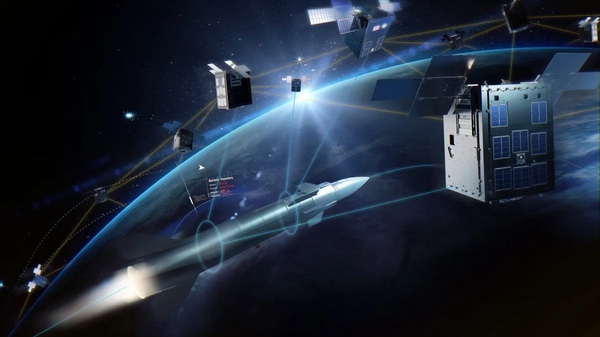
Golden Dome’s strategic ambition is unmistakable. The architecture envisions space-based sensors, including left-of-launch capabilities; proliferated satellite constellations; ground- and space-based interceptors; and integrated command and control. The technology exists or is within reach. The problem is not imagination or design. It is whether the United States possesses the industrial capacity to build, sustain, and replenish such a system under real world conditions of disruption and conflict.
That concern is not theoretical. Lt. Gen. Philip Garrant, commander of Space Systems Command, has been explicit that supply chain risk is among his command’s top priorities. He has publicly identified microelectronics, software, propulsion, and ground infrastructure as the most fragile points, before Golden Dome places demand on the system at a scale never previously experienced.[1] Golden Dome will not fail because the architecture is flawed; it will fail if logistics are treated as a secondary consideration.
Demand at a scale the industrial base has never seen
The United States is entering an era of unprecedented demand on the space industrial base. The Space Development Agency is fielding Tranches 1 and 2 of its proliferated low Earth orbit architecture while the Department of the Air Force reassesses the future of data transport, with Tranche 3 on hold and requirements migrating toward the Space Data Network supporting Golden Dome. Space Systems Command is advancing missile-warning satellites in medium Earth orbit. Commercial providers are simultaneously deploying global communications and sensing constellations at historic rates. Meanwhile, China’s announced plans for massive sovereign constellations, regardless of their ultimate scope, signal intent that cannot be ignored.
The problem is not the number of satellites. Instead, it is the concentration of demand on a surprisingly small set of suppliers. Reaction wheels, star trackers, radiation-hardened processors, propulsion systems, optical crosslinks, and traveling wave tube amplifiers all come from a narrow, overburdened industrial base. As Garrant has bluntly noted, radiation hardened microelectronics remain, and will remain, the single greatest supply chain risk facing US space systems.[2]
Golden Dome multiplies this problem. It assumes not only initial fielding at scale, but also sustained operations, resilience under attack, and the ability to replenish losses at speed. That assumption is not matched by present-day industrial realities.
The efficiency trap
Over the last decade, commercial space has delivered extraordinary cost reductions and accelerated innovation. Those gains made proliferated architectures viable and attractive to the Space Force. But they came with a tradeoff: consolidation.
Production has been concentrated in fewer facilities, with fewer suppliers, optimized for efficiency rather than surge capacity or wartime resilience. Workforce skills, capital investment, and specialty manufacturing have followed the same path. Efficiency has produced vulnerability.
| Golden Dome relies heavily on commercial firms whose business models are optimized for growth markets, predictable demand, and peacetime economics, not for prolonged conflict or rapid replenishment under fire. |
Industry analyses have warned that many space components now rely on three or fewer qualified domestic suppliers, often with long lead times and little or no surge capacity. In a contested environment, disruption is not hypothetical. The relevant question is not whether something will break, but whether the system can absorb shocks without losing mission effectiveness. Independent analyses by RAND and the Aerospace Corporation on proliferated LEO resilience underscore the same conclusion: redundancy on orbit means little if replenishment on the ground cannot keep pace.[3,4]
Capital structure meets strategic reality
Golden Dome relies heavily on commercial firms whose business models are optimized for growth markets, predictable demand, and peacetime economics, not for prolonged conflict or rapid replenishment under fire. This mismatch cannot be solved through contract language alone.
The Center for a New American Security has warned that the US defense industrial base is at an inflection point, unable to meet the pace and scale of modern conflict without substantial investment.[5] Recent history reinforces the stakes. In the opening hours of Russia’s invasion of Ukraine, a cyberattack on Viasat’s KA-SAT network disrupted Ukrainian military communications across Europe, demonstrating that space infrastructure is now a first strike target.[6] Both China and Russia have demonstrated kinetic antisatellite capabilities. Cyber and kinetic threats to space systems are no longer theoretical. They are proven.
Innovation without industrial resilience is a liability. Golden Dome must be built not only to perform, but to endure.
Europe’s signal and America’s hesitation
Some US allies have already internalized this lesson. European governments increasingly treat space infrastructure as essential infrastructure, backing that view with long term funding, sovereign manufacturing initiatives, and explicit demand signals. The EU’s €10.6 billion IRIS² constellation was designed from inception around resilience and redundancy, with a 12-year funding horizon. France has made direct investments in domestic propulsion and optical terminal manufacturing.
The United States, by contrast, remains constrained by short-term budget cycles and uncertain demand signals, conditions ill-suited to the decade-long investments required to expand production capacity. A supplier deciding whether to build a second production line for optical terminals or propulsion systems is not reading strategy documents. It is reading order books.
The questions that actually matter
Golden Dome’s success will ultimately hinge on questions that rarely dominate program reviews: What happens if a single source supplier goes dark for 18 months? How many anomalies can the architecture absorb before service degrades? What does replenishment look like if losses occur during a demand spike rather than a peacetime trough?
Gen. Michael Guetlein, the former Vice Chief of Space Operations and now direct reporting program manager for Golden Dome, has described the challenge as “a heavy lift across all the organizations that are going to be participating,” underscoring that integration across services, agencies, and industry, not technology alone, will determine whether Golden Dome succeeds.[7]
From diagnosis to action
The path forward is neither mysterious nor inexpensive. Three concrete steps would materially reduce Golden Dome’s risk.
| Golden Dome will not endure unless it rests on an industrial base built for resilience, not efficiency alone. |
First, the Department of Defense and Congress should formalize long-term demand signaling as procurement policy. A published ten-year demand forecast from the Space Development Agency and Space Systems Command, backed by multiyear block buys for critical components, would give industry the planning horizon required to justify capital investment. Strategy papers do not drive manufacturing decisions. Orders do.
Second, the Space Force should establish a formal space industrial base readiness framework. Aircraft fleets are measured by readiness rates, but the satellite industrial base has no equivalent. The Department needs a classified, systematic methodology to track single-source risk, lead times, and surge capacity across critical components. Without it, program managers are operating blind, repeating lessons learned decades earlier in airpower.
Third, where single source risk is unavoidable, such as radiation-hardened processors, reaction wheels, and optical crosslinks, the government should fund the qualification of second domestic suppliers. The precedent exists in propulsion and avionics. Maintaining second sources is expensive, but far less so than fielding a constellation that cannot be replenished when it matters most.
Bradley was right. Strategy is the easy part. Golden Dome will not endure unless it rests on an industrial base built for resilience, not efficiency alone. Creating that base is not a supporting task of strategy. It is the task.
Endnotes
- Calvin Biesecker, “Space Force Assessing Supply Chain Ahead of Potential Tariff Concerns,” Via Satellite, April 10, 2025. Lt. Gen. Philip Garrant identifies microelectronics, ground entry points, software, and propulsion tanks as the biggest risk areas in the Space Force supply chain.
- Sandra Erwin, “Pentagon Underestimated Supply Chain Fragility, Now Racing to Fix Gaps,” SpaceNews, November 25, 2024. Garrant on systemic industrial base concerns and the Space Development Agency as a revealing case study of demand ramping on a narrow supplier base.
- Jonathan P. Wong, Yool Kim, et al., Leveraging Commercial Space Services: Opportunities and Risks for the Department of the Air Force, RAND Corporation, RR-A1724-1, 2023. RAND analysis of commercial space market maturity, industrial base stability, and resilience considerations for the Department of the Air Force.
- Andrew Berglund, Strengthening the Industrial Base to Deliver Proliferated Defense Space Systems, Center for Space Policy and Strategy, The Aerospace Corporation, Space Agenda 2025, October 2024. On the necessity of rebalancing from efficiency to resiliency across raw materials, parts, components, and manufacturing capacity to support proliferated DoD space architectures.
- Becca Wasser and Philip Sheers, From Production Lines to Front Lines: Revitalizing the U.S. Defense Industrial Base for Future Great Power Conflict, Center for a New American Security, April 2025. CNAS assessment that the defense industrial base is at a critical inflection point, with current capacity insufficient to meet the demands of modern warfare.
- Patrick Howell O’Neill, “Russia Hacked an American Satellite Company One Hour Before the Ukraine Invasion,” MIT Technology Review, May 10, 2022. See also Viasat, KA-SAT Network Cyber Attack Overview, corporate incident report on the February 24, 2022 attack against the KA-SAT network coincident with the opening of Russia’s invasion of Ukraine.
- Courtney Albon, “‘Golden Dome’ Success Will Require National Buy-In, Official Says,” Military Times, March 6, 2025. Guetlein remarks at the National Security Innovation Base conference, Washington, D.C., March 2025.
Note: we are now moderating comments. There will be a delay in posting comments and no guarantee that all submitted comments will be posted.