Deep Black on the West Coast: honoring the Secretary of the Air Force Office of Special Projects and the Star Catchersby Dwayne A. Day
|
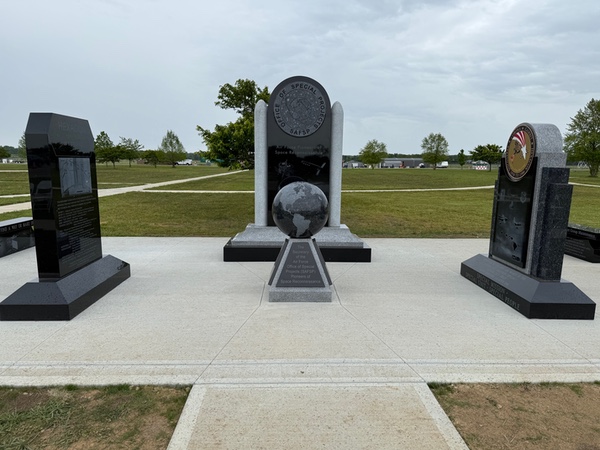
 (credit: Pat Pressel) |
SAFSP was a key component of the National Reconnaissance Office (NRO), which itself was highly classified and not formally declassified until 1992. The NRO had four main components, known as Programs A, B, C, and D, each responsible for developing and managing hardware. Program B was the CIA component located at CIA Headquarters. Program C was the Navy component located at the Naval Research Laboratory in Washington. Program D managed the NRO’s aerial reconnaissance projects and shut down when the NRO gave up its aircraft. Program A was the Air Force component, at SAFSP, and managed and developed numerous intelligence satellite programs as well as overseeing launch operations for all NRO missions. The NRO was reorganized in the 1990s and the program offices eliminated in favor of a new structure intended to reduce interagency rivalries.
 (credit: Pat Pressel) |
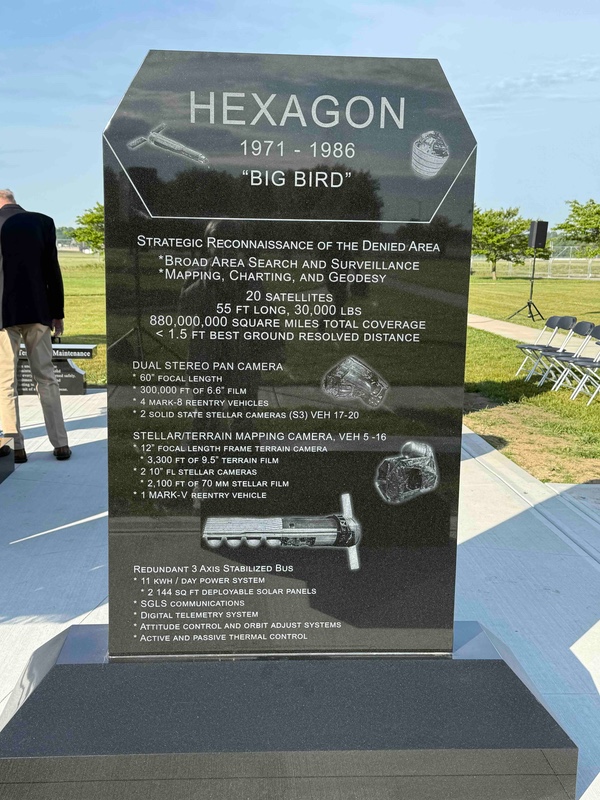
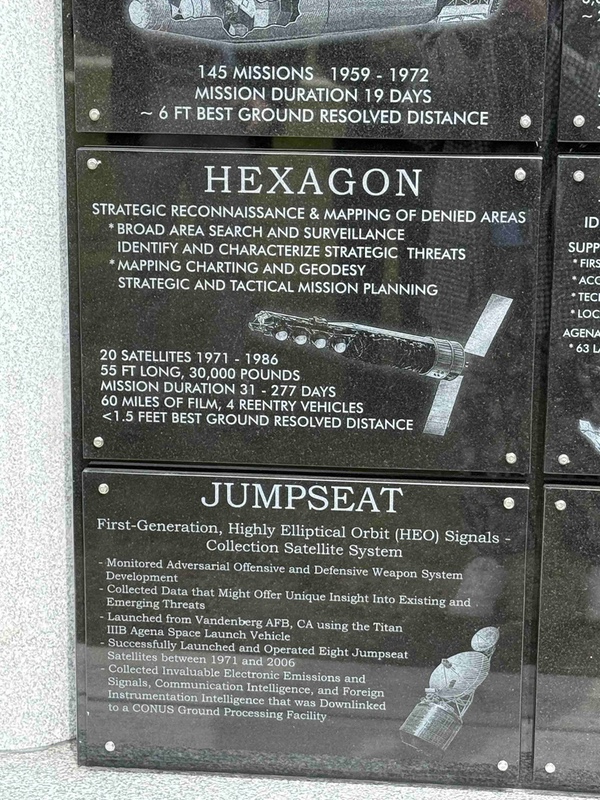
SAFSP grew out of the Air Force’s early ballistic missile programs. By the late 1950s, the Air Force’s space programs were becoming increasingly divided into “white”—i.e. acknowledged—and “black”—i.e. covert—operations. When SAFSP was formally stood up, it became responsible for Air Force intelligence space programs, under the direction of the NRO in Washington. These included the GAMBIT photo-reconnaissance satellites as well as many low Earth orbit signals intelligence satellites throughout the 1960s, and the high-altitude JUMPSEAT signals intelligence program of the 1970s. SAFSP also supported CIA payloads such as the CORONA reconnaissance satellite. A major program for SAFSP in the 1960s was the Manned Orbiting Laboratory, which was eventually cancelled in 1969.
 (credit: Pat Pressel) |
Most of the people who worked for SAFSP were Air Force officers and civilians, although there were a few CIA and Navy personnel detailed to work there as well. Special Projects was a secretive organization, and even though other Air Force space programs such as communications and missile warning satellites were managed nearby, the SAFSP personnel had limited interaction with them. Working at SAFSP posed problems for its personnel, because it created a black hole on their service record—if they went back to the regular Air Force, they could not explain what they did. The NRO compensated for this by taking care of its own, but a job at SAFSP could limit military career opportunities. The mission often had to be its own reward.
 (credit: Pat Pressel) |
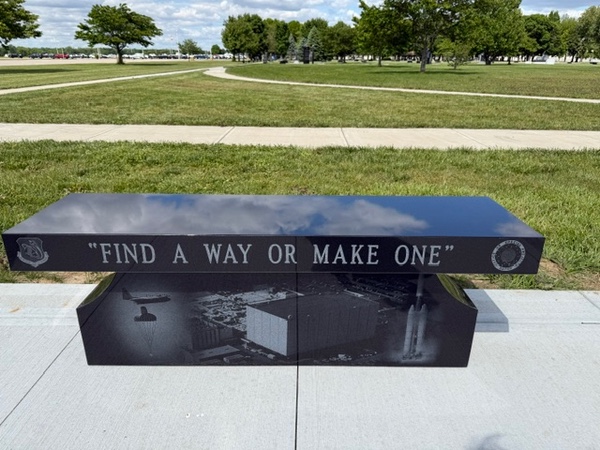
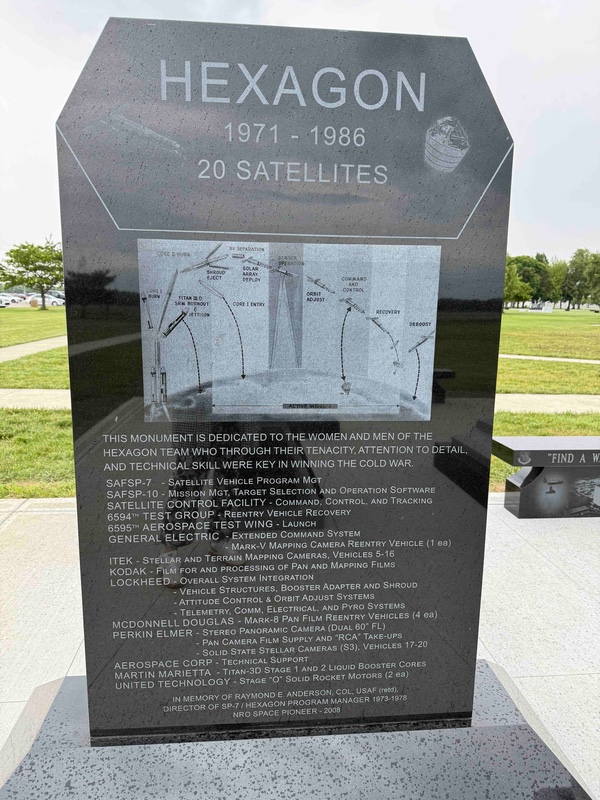
Several hundred people attended Friday’s dedication ceremony, and some events continued over the weekend. The memorial primarily emphasizes the early photo-reconnaissance satellite programs managed by SAFSP. It also mentions the JUMPSEAT program, and there is extra space on the memorial to include other programs when they are declassified. The National Museum of the United States Air Force has long underrepresented and undervalued Air Force space programs, and there is little information inside the museum about satellite intelligence history.
 (credit: Pat Pressel) |
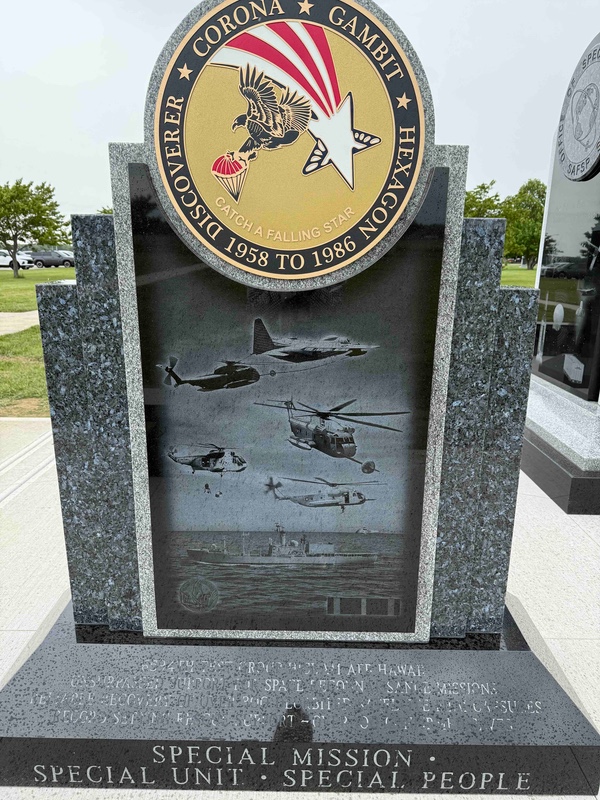
Part of the memorial also honors the 6594th Test Group. The 6594th operated a fleet of transport aircraft flying from Hawaii from the late 1950s into the 1980s that were used to catch returning spacecraft carrying reconnaissance film while they hung under a parachute over the Pacific Ocean. The Test Group maintained a high readiness rate due to the high priority of their mission. The CORONA, GAMBIT, and HEXAGON spacecraft used film that had to be returned to Earth and processed to reveal its information, and each mission involved tremendous effort and cost. If the recovery went wrong, all the intelligence data would be lost. The Test Group was vital during the Cold War, and never received much recognition due to secrecy requirements. They referred to their operation as “Catch a Falling Star.”
 (credit: Pat Pressel) |
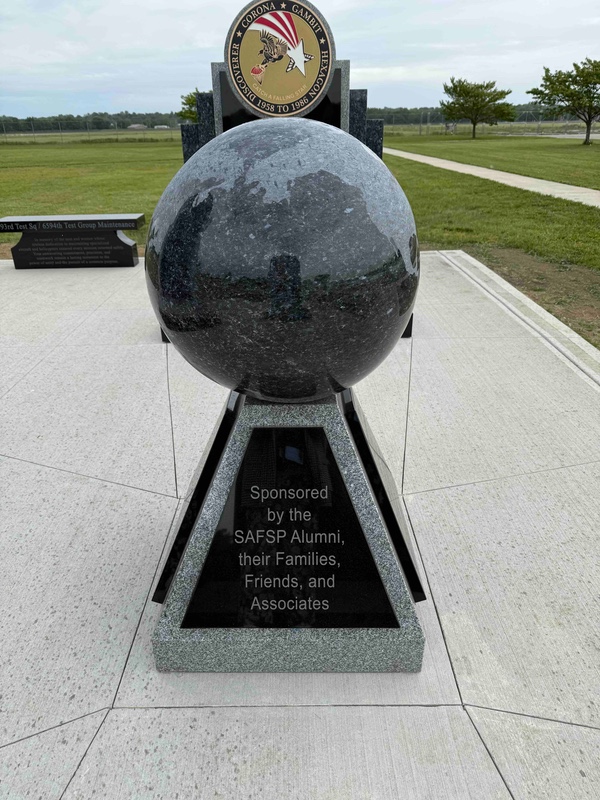
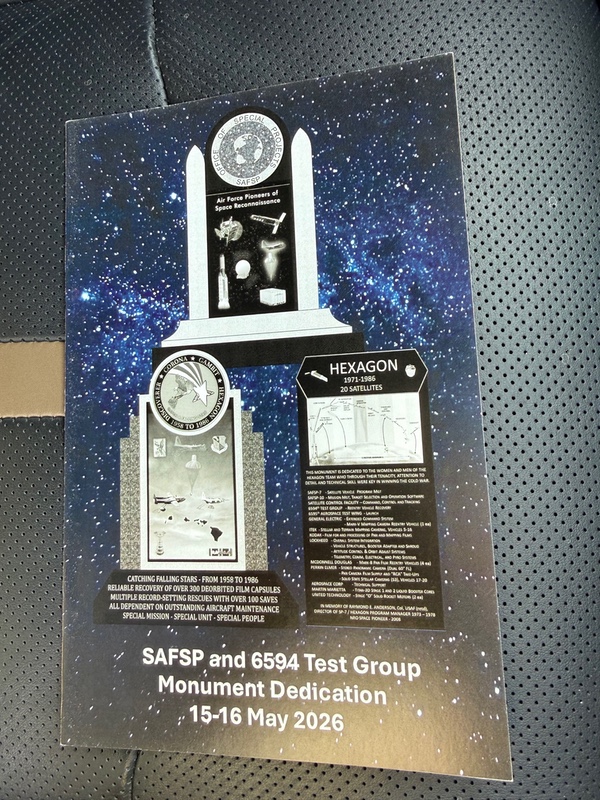
The dedication of the plaques and memorial is an effort by members of the SAFSP Alumni Association and the 6594th Test Group Alumni to ensure that their legacy is remembered. Now people who worked for that organization can visit the museum and show their family members “I worked on that.”
 (credit: Pat Pressel) |
Special thanks to Pat Pressel for the photos.
Note: we are now moderating comments. There will be a delay in posting comments and no guarantee that all submitted comments will be posted.