Critiquing and defending the Overview Effectby Frank White
|
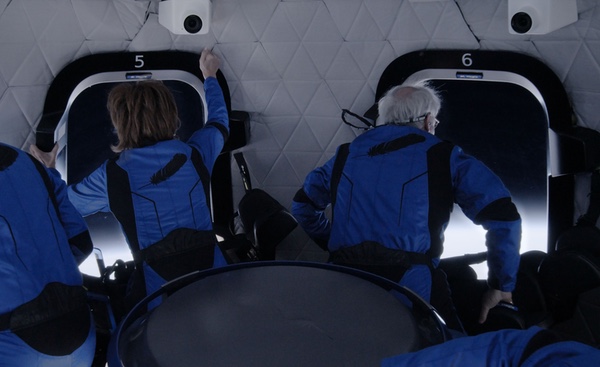
| So, we agree that the phenomenon is real, but the issue that divides us appears immediately, which is the implications of the experience. |
He writes, for example: “Since the dawn of human spaceflight, some astronauts have described a profound cognitive shift upon viewing Earth from orbit—an experience termed the ‘Overview Effect’ (White, 1987). This phenomenon is frequently associated with desires for global unity, environmental awareness, and the perceived insignificance of political boundaries. From this vantage point, the Earth appears to be a single, borderless system…” [1]
We are on the same page with that part of his statement, but he goes on to say: “…seemingly reinforcing the notion that divisions among peoples and nations are artificial constructs of limited importance.”[2]
So, we agree that the phenomenon is real, but the issue that divides us appears immediately, which is the implications of the experience. However, that divide is not as wide as it might seem. More on that later.
(2) We also agree that the experience of the Overview Effect will not automatically result in a change in how we perceive borders and boundaries.
He compares the example of how airplane flights seemed to hold out the promise of a new paradigm of perception, but aircraft technology has been used as much for warfare as for commercial purposes. It also does not seem to have shifted people’s attitudes toward borders and boundaries. For example, he writes:
The optimism surrounding the Overview Effect is not without precedent. In the early 20th century, the advent of aviation inspired similar claims that technological advancement would render war obsolete and foster global unity. The ability to transcend geographic barriers was seen as a means of dissolving political divisions.[3]
I can’t verify that “the advent of aviation inspired similar claims,” but I can verify that spaceflight produces a much more powerful experience than air travel, so I am not sure the analogy holds. However, I would agree with Stone that it was clearly not inevitable that “technological advancement would render war obsolete and foster global unity,” and, by extension, it is not inevitable that it will do so in the current context. What is clear, however, is that the Overview Effect results in people seeing the futility of war, and that this experience can therefore be used as a compelling argument for creating a more peaceful planet.
Areas of disagreement (or misunderstanding)
(1) Mr. Stone focuses most of his argument on the notion that, while borders are invisible from outer space, the astronauts (and I) consider borders to be unimportant because they cannot be seen.
On the contrary, I would agree that borders and boundaries are very important to what I call “Surface Thinking.” It’s just that I believe they are too important. Moreover, we should avoid, if possible, killing one another over these mental constructs. As noted previously, Stone implies that I believe the Overview Effect will automatically bring about a change in how people and nation-states on Earth interact. I do not believe that. Rather, I have suggested that an understanding of the Overview Effect could lead to changes in how people and nation-states on Earth behave toward one another. Also, I do not believe I have ever argued that borders are irrelevant because they are invisible, only that once we realize they are not real, we don’t need to take them to be immutable.
(2) Mr. Stone contrasts the experiences of the astronauts as “phenomenological,” as opposed to the “objective reality” of strategy.
He says, for example:
While compelling, such interpretations [by astronauts, presumably] risk conflating subjective perception with objective strategic reality. The absence of visible borders from space does not imply their irrelevance, just as the invisibility of gravity or atmospheric dynamics does not diminish their decisive role in shaping life on Earth. Strategic reality is not determined by what can be seen, but by what exerts power and influence.
Borders remain foundational to the international system. They define sovereignty, regulate movement, structure economic systems, and delineate the scope of political authority (Mearsheimer, 2001). Their importance derives not from visibility, but from enforcement and recognition within the international order. [4]
Comparing the perception of borders to the reality of gravity is a conflation. Borders shift and change over time, based on human decisions. Gravity is a physical law of the universe. Its influence does change to some extent, depending on whether one is on the Earth, in orbit, or on the Moon. However, the change cannot be enacted by human decisions, whereas borders can be, and are, redrawn by legislators or conquerors.
| It is objectively true that you cannot see borders or boundaries from off-world, and it has been confirmed again and again by multiple observers. Those same borders and boundaries are only “real” in the minds of human beings. |
He is right, however, in asserting that borders define “sovereignty, regulate movement, structure economic systems, and delineate the scope of political authority.” This is, of course, true. Nevertheless, it ignores whether that sovereignty is legitimate, the regulation of movement is fair, the economic systems are equitable, and the political authority is democratic or totalitarian. It also ignores the question of how cross-border relations are conducted.
This distinction is at the heart of my disagreement with Stone’s understanding of the Overview Effect. It is objectively true that you cannot see borders or boundaries from off-world, and it has been confirmed again and again by multiple observers. Those same borders and boundaries are only “real” in the minds of human beings.
Therefore, I would say that “Surface Thinking,” as exemplified by Mr. Stone, is phenomenological, and “Overview Thinking,” as exemplified by the astronauts, is objectively real.
Stone goes on to reference Colin Gray with what Gray apparently sees as “enduring realities.”:
Gray consistently argued that strategy is anchored in enduring realities of human behavior and political organization, not in transient perceptions or emotional responses. The Overview Effect may alter how individuals feel about the world, but it does not alter the strategic structures that govern it. The leap from perceived unity to political irrelevance of division is therefore not an analytical conclusion, but a normative assertion lacking empirical foundation.[5]
The “leap” is indeed a normative assertion! It asserts that the world would work better if we adopted “Overview Thinking” instead of “Surface Thinking,” if we saw the unity of the planet, rather than human-constructed divisions.
He goes on to quote Gray in more detail:
Here, Gray’s distinction between the nature and character of strategy is decisive. The Overview Effect mistakenly elevates a change in character—a shift in human perception resulting from technological vantage point—into a claim about the nature of strategic reality. Yet the nature of strategy, as Gray argues, is rooted in enduring human conditions: fear, honor, interest, and the pursuit of political objectives. These do not disappear despite one’s subjective views from orbit.[6]
Does Stone believe that “fear, honor, interest, and the pursuit of political objectives” are the only enduring human conditions? On the contrary, humans also display courage, altruism, cooperation, and many other behaviors. Moreover, the pursuit of political objectives clearly changes over time. It seems that strategic reality is not such solid ground on which to build a theory.
For example, the nation-state is not an immutable means for organizing a political system. City-states and empires dominated in past eras, as did tribal cultures. Germany and Italy became unified relatively recently, and the “United States” only became united after the nascent nation had long existed as separate colonies.
| The astronauts are not naive. While they see the unity of the planet when it is viewed from a distance, they also know that there is great diversity, even chaos, on the surface. |
Moreover, while nation-states compete with one another, they can cooperate when it is in their interests. If this were not so, the European Union would never have come into existence. Germany and France were once bitter enemies, and strategic reality apparently caused them to fight two World Wars. However, they are now part of the European Union. They, and the other member states, still have borders, but they are no longer barriers, as they once were.
The astronauts are not naive. While they see the unity of the planet when it is viewed from a distance, they also know that there is great diversity, even chaos, on the surface. The goal of Overview Thinking is to honor difference but understand that it exists in a context of unity, or oneness.
In fact, I considered the question raised by Stone in a paper that I wrote several years ago. “Space Diplomacy and ‘the Overview Effect’” was published in the Hague Journal of Diplomacy, and it addresses Stone’s concerns directly.
In this paper, I asked whether the fact that astronauts do not see borders and boundaries when they view the Earth from a distance means that we should have a “borderless world.” I concluded that it did not mean that. As I put it:
“Astronaut awareness” can, of course, be understood as an argument for “open borders,” a situation in which people move freely from one country to another, without hindrance.
The borders and boundaries are in our minds, but not within the planet’s ‘mind.’ In this way, the Overview Effect could lead us to a world in which national borders remain intact, but our leaders fully understand that they must transcend this perspective to confront the challenges we face as a civilization. As the Overview Effect experience becomes more widespread, through virtual reality or commercial spaceflight, leaders of the future may well communicate, bargain, and persuade with a very different worldview.[7]
For example, imagine a diplomat from the United States and her peer from the People’s Republic of China negotiating a climate change agreement. Perhaps both had experienced the Overview Effect on different suborbital flights. They would still advocate for their individual country’s self-interest, but with a vision of the common good that the agreement might engender. Would it cause their negotiations to be fundamentally different? We don’t know, because this is not an example of a real negotiation, but more of a thought experiment.
Ultimately, we are engaged in a global experiment to see if “bringing the Overview Effect down to Earth” will change the behaviors of individuals, nations, and international institutions. If we keep an open mind, the result will be plain to see.
Summary
I would like to end where I began, i.e., by thanking Mr. Stone for his critique of my work. It is through thoughtful dialogue that new ideas are born, tested, and either adopted or discarded.
I believe that the Overview Effect offers humanity a new paradigm and that “Overview Thinking” will improve life on “Spaceship Earth.” For me, it is like the shift from a geocentric to a heliocentric view of the solar system. It took thousands of years for that to happen in the past. Do we have that much time?
References
- C. Stone, “The fallacy of the Overview Effect: perception, power, and strategic reality in space,” The Space Review, 5/4/26
- Ibid.
- Ibid.
- Ibid.
- Ibid.
- Ibid.
- F. White, “Space Diplomacy and ‘the Overview Effect,’” The Hague Journal of Diplomacy, Volume 18, Brill, Issue 2-3: Special Issue: “Space Diplomacy: The Final Frontier of Theory and Practice,“ edited by Mai’a K. Davis Cross and Saadia M. Pekkanen, 2023
Note: we are now moderating comments. There will be a delay in posting comments and no guarantee that all submitted comments will be posted.