Deep Black on the West Coast (part 2): Honoring the Air Force Special Processing Facilityby Dwayne A. Day
|
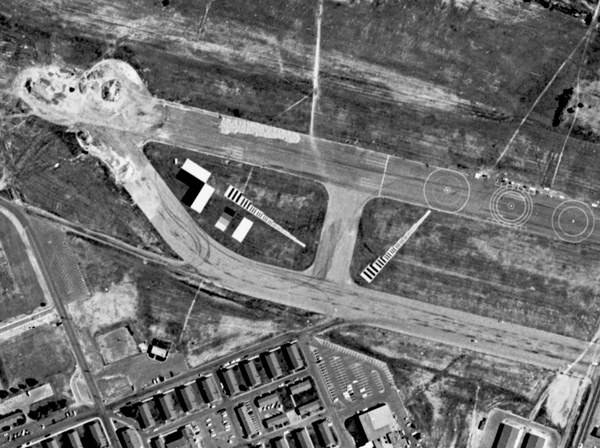 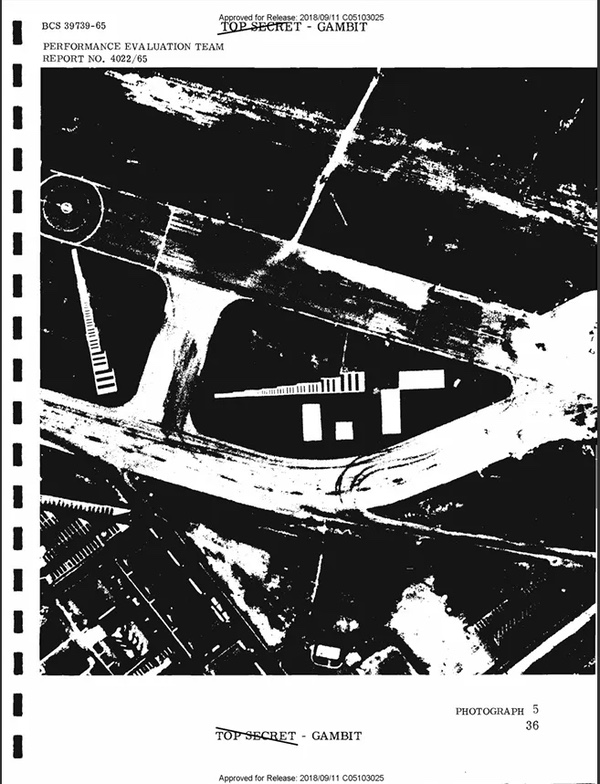 Photocopy and photo from a Performance Evaluation Team (PET) report on a late 1965 GAMBIT reconnaissance mission. The image shows a CORN reconnaissance target at a USAF base in the United States. The PET reports evaluated the camera performance for reconnaissance missions so that they could be improved in the future. They were produced by the AFFSPF in Massachusetts, and as were the teams that managed the CORN targets. (credit: NRO via Harry Stranger) |
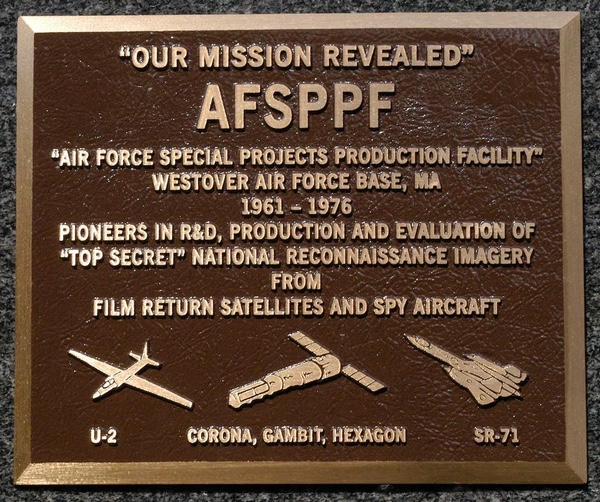
The AFSPPF was an imagery facility and had three divisions that directly supported the National Reconnaissance Program. These were production, evaluation, and R&D.
The production division had an original negative and duplicate film photo processing facility that handled CORONA, GAMBIT, HEXAGON, U-2 and D-21 TAGBOARD drone missions. Eastman-Kodak in Rochester, New York was the primary site for original negative production, with AFSPPF serving as backup. But AFSPPF also provided the bulk of dupe production for all US military and government mapping, charting, and geodesy organizations. Over its 15-year history the facility produced over 180 million feet (54.9 million meters) of film. The film was carefully inspected by highly trained Air Force quality control personnel for physical defects and image quality.
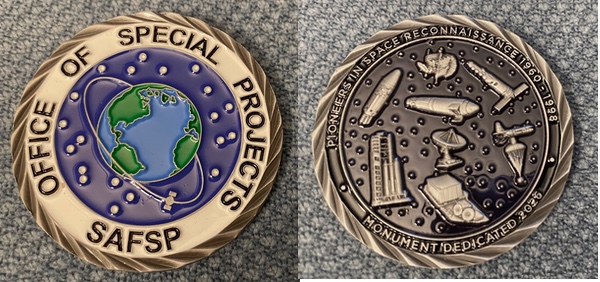 A "challenge coin" presented at the recent dedication of the SAFSP memorial dedication. (credit: Pat Pressel) |
After each top secret satellite mission, a community Performance Evaluation Team (PET) would convene at AFSPPF to review and document system performance. They assessed the mission’s resolution, image quality, camera performance, and other mission aspects like the use of different film types. The PET produced a comprehensive report, and many such reports have now been declassified. Whereas intelligence reports indicated what was seen by the satellites, the PET reports indicated how well the mission performed in terms of the imagery, so that future missions could be improved. In addition, the Controlled Range Network (CORN) program deployed teams with resolution targets to various locations within the continental United States to provide image quality baselines during passes by satellites and was managed and directed by AFSPPF.
AFSPPF was also designated and funded to seek out and evaluate emerging technologies in film processing, printing, and image quality evaluation. Promising technologies, materials, and chemistries were introduced into the facility and other processing facilities.
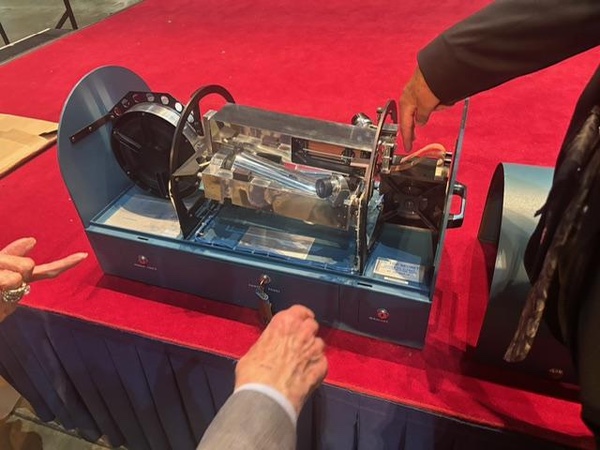 A working model of the HEXAGON reconnaissance satellite camera system was shown at the recent dedication of the SAFSP memorial dedication. It is nicknamed “Fido.” |
Although it was left out of the new memorial, in 2014 a plaque mentioning AFSPPF was dedicated at the National Museum of the United States Air Force. The mission of the unit was partially revealed in 1995, and more completely in 2015. It may be the subject of a future article.
Note: we are now moderating comments. There will be a delay in posting comments and no guarantee that all submitted comments will be posted.