Reassessing NASA procurement strategy: A hybrid approachby Eli Lichtenstein
|
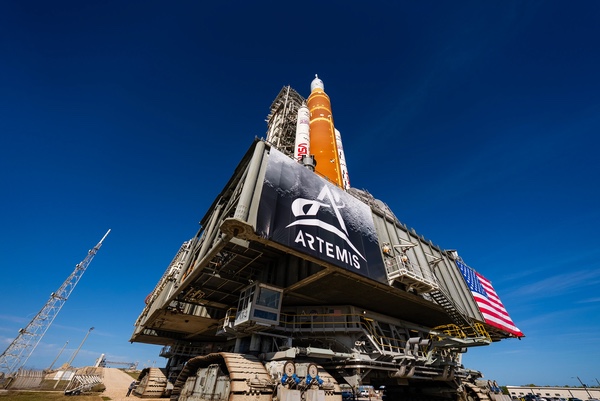
| Funded through traditional cost-plus procurement, SLS began experiencing the same bloat and overruns as its Constellation predecessor. |
After decades of relegation to low Earth orbit, a refocus on more complex and long-term crewed missions is to be applauded. But each of these goals requires NASA to procure vehicles and other hardware, a detail NASA has yet to decide on. “The procurement method, how we would do it, I think that’s still open,” said NASA Associate Administrator Amit Kshatriya.[1] As noble as NASA’s goals are, history shows that how NASA intends to achieve them is just as important.
NASA leadership undertook a similarly radical rethink of its plans not long ago. Along with the Space Shuttle, the then-successor Constellation program was controversially scrapped, abandoning goals of crewed Moon missions amid ballooning costs and unfeasible deadlines. In its stead came two nimbler, yet diametrically opposed, successor programs.
The first was SLS, born of a political compromise in the 2010 NASA Authorization Act. Built from legacy components on pre-existing production lines, SLS was billed as a natural low-cost successor to the shuttle. But funded through traditional cost-plus procurement, SLS began experiencing the same bloat and overruns as its predecessor. In a funding scheme where every dollar spent is a dollar reimbursed, contractors have little incentive to control costs. The effects on SLS are clear. Per-vehicle production costs have reached $2.5 billion, not even including Orion or ground systems, and this is only expected to increase over time.[2]
And SLS fares no better in launch cadence. While the three-year gap between its first two flights may be partially excused by Orion capsule development issues, the program still is realistically capable of producing at most one vehicle per year.[3] In the face of ever-increasing cost overruns and delays, missions like Europa Clipper have turned elsewhere, prompting growing calls from within the White House and beyond to phase out the vehicle.
But this was not NASA’s only path forward. Beginning with the George W. Bush Administration, NASA experimented with a new procurement method focused on cost reduction, and NASA would turn to this now in the same reauthorization bill. In an initiative spearheaded by the agency’s deputy administrator at the time, Lori Garver, NASA bolstered funding for space services purchased from private companies at fixed prices. No longer would the government give a traditional company all the funding it needed and more to build a government-owned design. Now, private companies were tasked with providing services, be it transfer of cargo or even crew to the International Space Station, with the companies designing, owning, and operating their vehicles. Under a fixed-price contract, if the company could complete the service for less than the contract price, it could keep the spare change.
The results have exceeded all expectations. SpaceX has now launched and returned more than 30 cargo flights, in addition to over a dozen crew flights, all at record-low prices. Alongside this, the flight-proven, company-owned Dragon capsule would be used for commercial flights, including the Polaris and Axiom missions hosting private astronauts. The conviction that fixed-price could solve all the ills of cost-plus was quickly adopted by agency leadership, and new fixed-price procurement programs were instituted for everything from crewed vehicles to lunar spacesuits. But the road ahead would be rockier.
The limits of fixed-cost
While SpaceX thrived in its symbiotic partnership with NASA, other companies using fixed funding have failed to demonstrate comparable results. Boeing’s Starliner, Dragon’s direct competitor, has to date failed to perform. Its first test flight to the station suffered from an internal clock failure, precluding a docking with the ISS. The next attempt succeeded, but only after experiencing thruster problems. Most infamously, the first crewed flight again experienced thruster failures, this time preventing the crew from returning to Earth on the vessel. Instead, SpaceX ferried the two Starliner pilots back on a Crew Dragon, to great media attention and speculation about stranded astronauts in the interim. Plagued by so many problems unforeseen, Boeing is reportedly considering exiting the commercial space market entirely—with the significant exception of cost-plus-funded SLS—due to losses of $2 billion incurred by exceeding fixed-price caps.[4]
In addition, Sierra Space, more recently selected for cargo services under another fixed-price contract, is also reducing planned cargo resupply flights to the station as it faces development issues.
The problems continue in other programs. As part of Artemis, NASA selected two companies to develop lunar spacesuits. But one company has backed out as development costs eclipsed fixed-price funding, leaving Axiom alone to shoulder this critical element of NASA’s crewed return to the moon.[5]
| Ultimately, cost forecasting is an educated guess. A company that anticipates completing a mission on a fixed budget can find itself financially exposed when developing hardware for the first time. |
And failures are not confined to crewed programs. By apportioning small amounts to multiple emerging companies, the Commercial Lunar Payload Services (CLPS) program seeks to enable low-cost lunar access through competitive funding of simple landers via fixed-cost contracts. The agency hopes to seed a new market for lunar transportation as it did for LEO, even if some missions fail. But the funds are truly limited, averaging less than $130 million each.[6] By comparison, NASA’s low-cost Discovery class of planetary science probes has a cost cap of $500 million per mission.
Yet CLPS has yielded one failure, two partial failures, two cancellations, and one success —poor odds even by NASA’s own risk-tolerant standards.[7] The private industry was simply not mature enough to take on lunar exploration with minimal oversight and funding, concluded NASA’s Office of Inspector General.[8] The problem is the gap between estimated and actual costs. Ultimately, cost forecasting is an educated guess. A company that anticipates completing a mission on a fixed budget can find itself financially exposed when developing hardware for the first time. Fixed-price procurement excels for acquiring additional copies of known products but can be equally problematic for developing novel capabilities. There is no free lunch in procurement strategy.
What about SpaceX?
Should, then, NASA merely continue to turn to SpaceX for its launch needs? The company seems to have solved all of NASA’s problems, responding to every agency request cheaply and reliably.
But as beneficial as this partnership has been, this reliance risks creating an unhealthy dependency on the company for future success. SpaceX is, ultimately, an independent private company, one at the whims of its leader, funders, and regulators. Concerningly for national space interests, SpaceX is now pivoting toward space-based data centers, even merging with xAI.[9] What if SpaceX decided to discontinue support for Dragon or lunar Starship to focus on data centers? NASA would be stranded.
There is another growing risk in the future, a regulatory one. SpaceX is now cornering multiple markets, from launch to satellite Internet services. While many proponents view this as a just result of efficient and innovative business practices, this administration included, future administrations may not look toward SpaceX as kindly. Rather than viewing services like Starlink and AI compute service as subsidiary funding sources for long-term Starship funding, they may view SpaceX as encroaching too many markets for the economy to bear. This is especially the case if SpaceX is seen as overly partisan. If SpaceX were to be separated from its revenue sources, it might be forced to focus on short-term commercial missions, at the expense of ambitious exploratory programs.
For better or worse, there is evidence of monopolistic activity already, as SpaceX grows in dominance. The Falcon 9, despite its cost-efficiency, is still priced at roughly two to four times its estimated internal cost.[10] With Starliner’s struggles reducing competition, seat costs to the ISS have increased on Crew Dragon, outpacing inflation,[11] as have rideshare costs on Falcon.[12] Contractors achieving low internal costs don’t automatically pass savings to customers, including NASA.
NASA’s partnership with SpaceX has safeguarded the nation’s presence in space. When Northrop Grumman lost its launch vehicle to supply disruptions and Boeing’s Starliner couldn’t return its crew, SpaceX was there to save the day. But if NASA is to be the premier space agency in the world, it cannot be dependent on any one company.
A hybrid approach
Thus, NASA must continue to foster a space services economy in which multiple companies can participate. To do so, the agency must commit to providing upstart companies the funds they need to break out of development, all while not incentivizing companies to run up costs. How can NASA do this? With smart contract structuring.
A fixed-price-plus-partial-cost (FPPC) program would combine the best of both incentive structures. The contract would be divided into two components. First, a fixed price would be set, allowing cost-efficient contractors to earn profit should their production costs fall below this. But if not, the second component kicks in. A partial-cost reimbursement will provide a fraction—perhaps 50%—of costs back to the contractor. This mitigates insolvency by providing a financial lifeline, but also requires the contractor to contribute a share of excess costs. It also encourages companies to provide accurate cost estimates upfront, rather than lowballing to undercut other offers while being unable to complete production themselves. Importantly, any cost overruns would preclude the company from profiting on the mission at all: there is still every incentive to keep costs below the initial fixed price ceiling.
Applying FPPC to Isaacman’s vision
The effects of FPPC are best realized when applied to block purchases of hardware. The work to design the bulk of a vehicle only has to be done once; starting a production line of standardized landers or satellite buses, coupled with custom scientific instruments, will always be cheaper than designing new spacecraft for each mission. The Perseverance rover, for instance, cost $300 million less than its predecessor, Curiosity, by reusing the same design and spare parts.[13] Contractors will be incentivized to move beyond the cushion of cost-plus contracting if they know they can apply lessons from the development article to later, more profitable replications.
| NASA’s goals are ambitious. How it achieves them must be equally so. |
This is especially important as NASA pivots toward a rapid increase in flight cadence. For CLPS, for instance, Administrator Isaacman seeks to launch a new mission each month,[14] amortizing development costs and reducing institutional knowledge losses via a more consistent stream of flight sorties. While science payloads will change and improvements will be made incrementally, the most efficient approach here is to contract companies to produce batches of standardized robotic landers upfront.
This is also true of repeat crewed flights to the Moon. Isaacman has hinted at replacing SLS’s flight capability with commercial offerings for later Artemis missions.[15] If NASA opens future launches to the commercial industry, they will likely procure in-development super heavy vehicles like SpaceX’s Starship and Blue Origin’s New Glenn 9x4, and again it is most sensible to procure these vehicles in multiple for repeated Artemis missions.
NASA’s goals are ambitious. How it achieves them must be equally so. History shows that neither extreme of procurement has yielded the intended result, either breeding complacency long after development or depriving funding even before its completion. A hybrid approach, one that rewards efficiency while mitigating the inevitable costs of innovation, gives NASA the best chance of making monthly lunar missions and a permanent surface base a reality.
Endnotes
- SpaceNews, “NASA considering sharp increase in robotic lunar landings.”
- GAO, “Space Launch System: Cost Transparency Needed to Monitor Program Affordability”. “Based on our analysis of the contract, the cost to produce successive core stages is increasing over time.”
- NASA OIG, “NASA’s Transition of the Space Launch System to a Commercial Services Contract”
- Wall Street Journal, “Boeing Explores Sale of Space Business”.
- SpaceNews, “Collins Aerospace pulls back from NASA spacesuit contract”
- Payload Research, “The Ultra Low-Cost Economics of NASA’s CLPS Lunar Program”
- Sky and Telescope, January 2026, “Fly Me to the Moon”
- NASA OIG, “Final Report - IG-24-013 - NASA’s Commercial Lunar Payload Services Initiative”
- Reuters, “SpaceX acquires xAI in record-setting deal as Musk looks to unify AI and space ambitions”
- SpaceX’s estimated internal launch cost for Falcon 9 is $15–26 million (2020 dollars), or approximately $16–28 million adjusted to 2022 dollars. See Ryan Whitwam, “SpaceX: Elon Musk Breaks Down the Cost of Reusable Rockets,” Inverse, November 2020. The listed commercial price is $67 million (2022 dollars). See “SpaceX Increases Launch and Starlink Prices,” Payload Space, March 2022.
- Payload Research, “Starliner by the Numbers”
- Payload, “The Promise Of A World of Low Launch Prices Is Still Far Off”; see also here.
- The Planetary Society, “The Cost of Perseverance, in Context”
- SpaceNews, “NASA considering sharp increase in robotic lunar landings.”
- Bloomberg, “Boeing’s Moon Rocket Faces Uncertain Future Under Trump’s NASA”
Note: we are now moderating comments. There will be a delay in posting comments and no guarantee that all submitted comments will be posted.