Zarya: the three lives of the propulsively landed Super-Soyuzby Maks Skiendzielewski
|
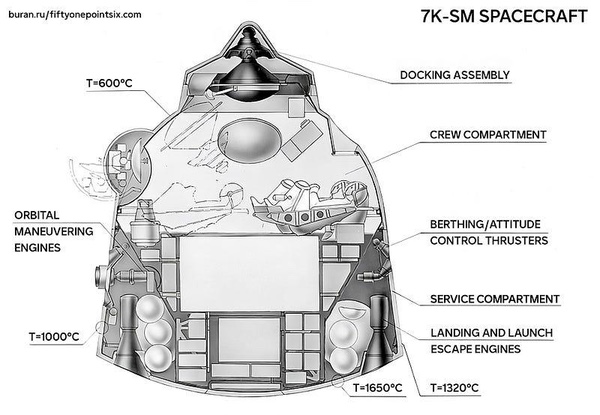
| As it happened, NPO Energia had already been working on the 7K-SM, a similar project for an advanced crew ferry based on Soyuz technology. |
In the late 1980s, with the development of the first modules of Mir nearing its end and their launches on the horizon, NPO Energia started work on the station’s successor; another generational step after Salyut-6, which introduced multiple docking ports allowing continuous crewed operation and resupply missions; and Mir, which became the first truly modular station, drastically expanding the available volume and bringing specialized modules to the mix.
Initially, Mir-2 was just the backup to the Mir base block that would have replaced its original in orbit or have been used to build another Mir-type complex, but by the early ’80s, the focus had shifted to a massive orbital complex utilizing a large truss as its backbone — likely conceived with the American Space Station Freedom in the back of the designers’ minds. By 1991, that concept was abandoned in favor of the more modest “Mir-1.5” plans and later a cozy DOS-8-based station with a compact truss, photovoltaic cells, and solar concentrators, but it’s that mid-to-late-80s period where a need arose to match the next-generation station with a next-generation crew ferry. [1]
As it happened, NPO Energia had already been working on the 7K-SM, a similar project for an advanced crew ferry based on Soyuz technology, so when a resolution of the Military Industrial Commission in January 1985 directed the ex-Korolev bureau to develop a crewed vehicle worthy of its lofty Mir-2 plans, the technically ambitious 7K-SM was abandoned and a new spacecraft was conceived based on the same basic concept.
And that spacecraft was the Zarya.
Back to the beginning: 7K-SM
Zarya’s esoteric predecessor, the 7K-SM, was based on hardware developed for the 7K-ST — also known as Soyuz-T — and officially began development in 1982, although within Energia the idea can be traced back as early as 1970, when Chief Designer Vasily Mishin directed a trio of specialists at the bureau to start researching reusable spacecraft based on the Soyuz descent module. [2]
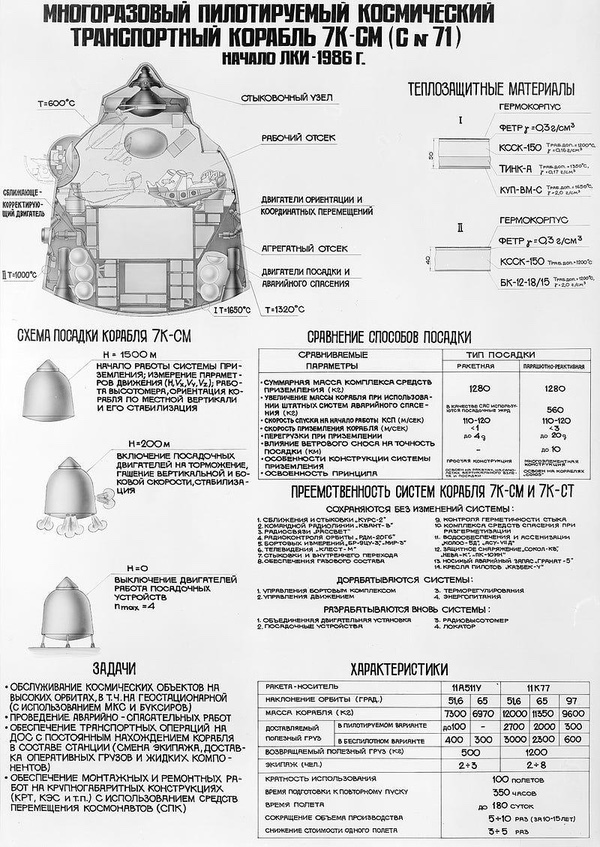 Energia poster with the general characteristics of the 7K-SM. (Image: Vadim Lukashevich/buran.ru, full-resolution version available on buranarchive.space) |
Officially a member of the Soyuz 7K-S-series, the 7K-SM was assigned the 7K-S serial number range starting at №71. It was intended to be a multipurpose reusable spacecraft, capable of ferry flights to Salyut and Mir-class space stations, supporting crewed in-space construction missions and serving as a rescue vessel. Each capsule would have a certified service life of 100 missions of up to 180 days’ duration with turnaround times between flights as short as 350 hours and a targeted three-to-fivefold reduction in launch cost over the Soyuz. Flight testing was due to begin in 1986.
Under the hood
Instead of the separate orbital, descent, and service modules of the Soyuz, the new capsule would launch and land as one piece. Its shape was a scaled-up version of the Soyuz descent module, 3.5 meters in diameter, with a lift/drag coefficient of 0.26 at speeds over Mach 6. Within this volume, a shallower pressurized crew compartment was placed with a cylindrical cargo section below. Orbital maneuvering would be taken care of by a pair of 300-kgf maneuvering engines running on kerosene (RG-1) and hydrogen peroxide (0–30VK). [3]
The capsule would land propulsively on eight 6,500-kgf engines placed at the bottom of the capsule in the ring-shaped service compartment, and rest on four landing legs that extended through openings in the heat shield, though at least initially a conventional parachute version was also studied. With the landing engines on double duty as the launch escape system, the concept is similar to the early plans for a crewed capsule developed by the California startup Space Exploration Technologies in the early 2000s, and later the perennially five-years-away Oryol spacecraft pursued by Roscosmos.
Up to eight crew in Sokol-KV suits were seated in horizontally mounted Kazbek-U couches, identical to the ones in use on the Soyuz-T. In fact, most of the onboard hardware was carried over from the Soyuz-T, like the communication, life-support, and sanitation systems, or borrowed from the in-development Soyuz-TM, like the Kurs docking system. The electrical system, onboard computer, and thermal control system were upgraded versions of the Soyuz-T units and most of the hardware used for landing was newly developed, like the landing engines and legs and the radio altimeter.
Protecting the spacecraft from the heat of reentry was a suite of thermal protection tiles, each approximately 300 by 300 millimeters in size, rated for 100 flight cycles without refurbishment.
Just like the Soyuz descent module it was derived from, 7K-SM was rotationally symmetrical in shape, but had an offset center of gravity, which stabilized the capsule during reentry and allowed it to perform crossrange maneuvers. With that offset, the heat load during reentry was biased toward one side of the capsule, requiring heat shield tiles of two distinct specifications.
| Instead of the separate orbital, descent, and service modules of the Soyuz, the new capsule would launch and land as one piece. |
On the cooler leeward side of the capsule’s backshell, the tiles were 40 millimeters thick and were machined from a crystalline silica (quartz) fiber KSSK-0 foam and topped with a BK-series high-emissivity coating, which served a similar function to the reaction-cured glass on Shuttle and Buran tiles, improving the radiation of excess heat away from the tiles while protecting the delicate foam from surface damage.
Tiles on the hotter windward side and the bottom of the capsule—also called the Frontal Heat Shield (LTE)—were 50 millimeters thick and had a two-layer core made of KSSK-0 and a TINK-series quartz foam. These high-temperature tiles were coated with a reinforced carbon-carbon material from the KUP line. Until 1978, the KUP-VM variant was considered for the nose cap and wing leading edges of the Buran orbiter, but it was ultimately abandoned in favor the new GRAVIMOL material due to difficulties in manufacturing the nose cap in a single piece. [4]
As the Frontal Heat Shield would transfer significant loads to the spacecraft’s structure, tiles mounted to it were supported by additional brackets and standoffs made from KUP and AFT-2P reinforced carbon-carbon materials.
In both tile types, the KSSK layer was milled out and filled with either a low-density silica foam or Ritm-branded asbestos foam to save weight. The tiles were attached with adhesive to ARIMID S-30-based felt isolation pads, which were in turn adhered to the spacecraft’s skin panels. The skin panels were isolated from the capsule’s pressure vessel by a grid of special ribs.
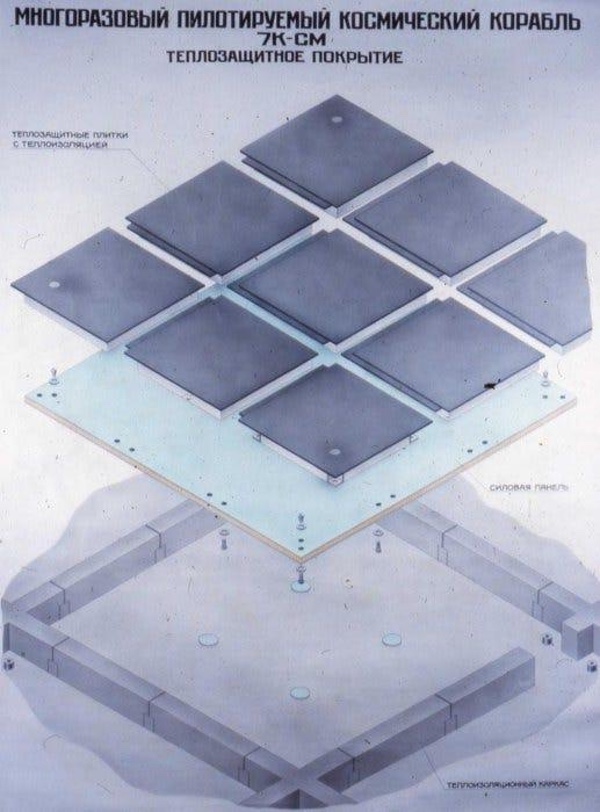 Thermal protection system tile layout of the 7K-SM spacecraft. Image: Novosti Kosmonavtiki, 2014 №8 |
As a consequence of the capsule’s all-in-one design, numerous apertures in the heat shield were required for engine nozzles, landing legs, hatches, portholes, and navigation instruments; they were lined or edged with KUP-VM reinforced carbon-carbon inserts to protect the structure from the intrusion of hot gas during reentry.
In-orbit thermal management was handled by a 10-square-meter titanium-clad radiator on an aluminum substrate, mounted flush with the heat shield on the leeward side.
Operations and destinations
The 7K-SM could launch on both the Soyuz-U and Zenit (11K77), though in different configurations due to the payload mass limits of the Soyuz. In Zenit trim, the capsule could seat between two and eight crew in Sokol KV pressure suits in a fully reclined position. On crewed missions to a 51.6° inclination orbit, the spacecraft could carry 2,700 kilograms of cargo, increasing to 3,000 kilograms when uncrewed, with a return payload of 1,200 kilograms for both. At its heaviest, the Zenit-launched 7K-SM would mass 12,000 kilograms.
On Soyuz-U flights, the 7K-SM could only carry between two and three crew, with just 100 kilograms of cargo to a 51.6° inclination orbit when crewed and 400 kilograms uncrewed, and a return payload of 500 kilograms. Consequently, the Soyuz-launched version massed 7,300 kilograms at its heaviest, right at the limit of what the Soyuz-U could lift to orbit.
Interestingly, both propulsive landing and conventional parachute recovery were considered for the capsule at some stage of development. The landing systems for both options massed 1,280 kilograms, but the parachute version required an additional 560 kilograms for a launch abort tower, which the propulsively landed design did not need.
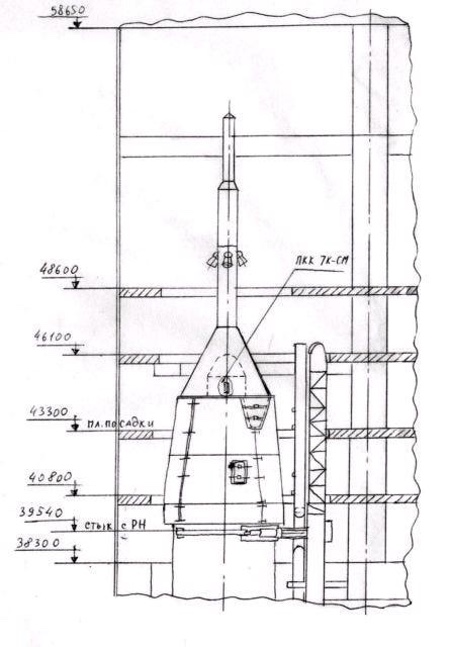 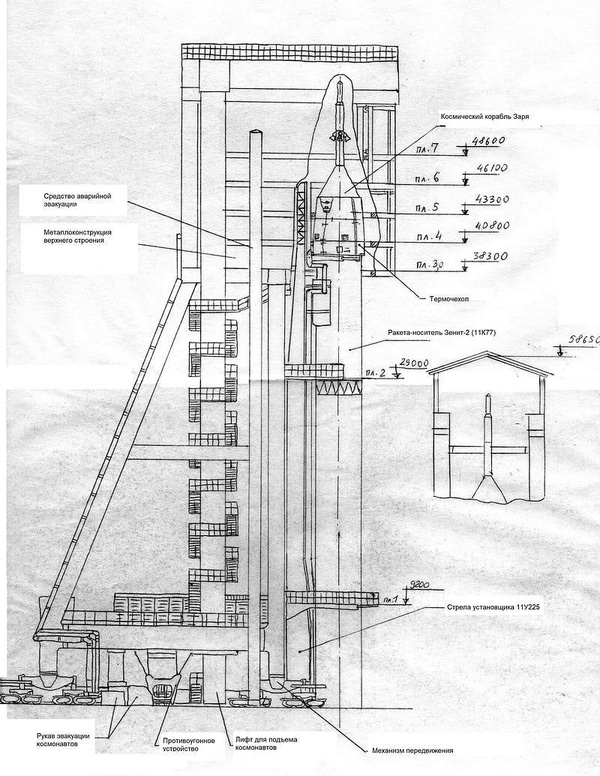 The 7K-SM and Zenit in the parachute recovery variant with the launch abort tower in the Manned Spacecraft Servicing Unit. Images: Vladimir Antipov and HausD |
Before military tensions eased significantly in the ’90s, NPO Energia had been working on a number of spaceborne weapons, some of them crewed or crew-tended.
One such weapon was a modular space station for attacking “high value ground targets”. A DOS-7K-series module would be its core — just like on Mir — but instead of FGB-based science modules, the station would use “autonomous modules” based on the Buran airframe. Wingless orbiters with docking ports in the nose would separate from the station, maneuver to their strike positions and deploy ballistic weapons or BOR-based dive bombers. The 7K-SM spacecraft (and later Zarya when the 7K-SM was cancelled) would be used to crew the station. [5]
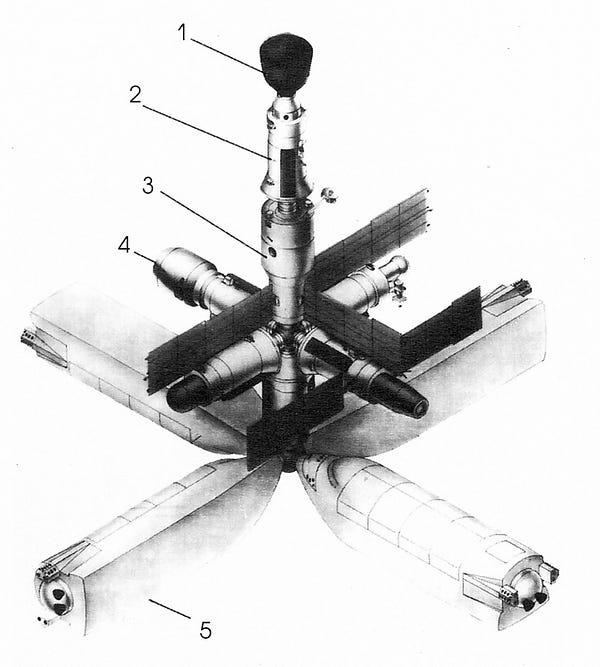 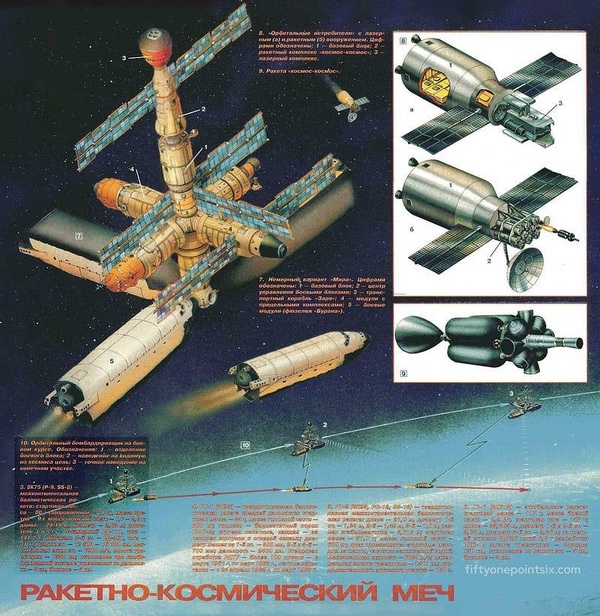 Top: “Space station for hitting ground targets 1. Transport ship 7K-SM 2. Command module 3. Base station unit 4. Target station module 5. Combat module”. Bottom: Mir-type combat station with the Zarya spacecraft and Buran-derived combat modules; Skif and Kaskad stations.Images: Semyonov (ed.), 1996; Tekhnika Molodyozhy №4, 1998 (processing by the author). |
An illustration of the station first appeared in the 1996 company history of RKK Energia; later color illustrations, mostly found in late ’90s issues of magazines such as Tekhnika Molodyozhy (Technology for the Youth), were usually based on the 1996 illustration whose caption explicitly mentioned the 7K-SM, but the capsule started gaining features of the later 14F70 design and being captioned as Zarya.
At least one source mentions that the 7K-SM would also be used to ferry crew to the DOS-based Kaskad and Skif combat stations, carrying crews of two for up to seven days. [6]
By 1985, the 7K-SM project was abandoned in favor of an evolved, slightly larger design.
Reconfiguration: 14F70 “Zarya”
Development of the new 14F70 spacecraft, given the “Zarya” project name, was approved by a January 27, 1985, resolution of the Military Industrial Commission. Department 178 of NPO Energia, headed by I.L. Minyuk was tasked with the work, with Konstantin Feoktistov as the project lead. NPO Energia’s General Designer Valentin Glushko personally supervised the project. [7]
| The increase in performance and size over the Soyuz allowed the designers to draw up a larger 4.1-meter diameter descent module, but this time around the crew size was limited to four, all sitting in ejection seats. |
By December 22, 1986, preliminary drawings were created, followed by the release of the preliminary design in the first quarter of 1987, and adjustments to the design in May 1988. Test flights were due to begin in 1991–92 according to early plans.
Under the hood
The redesigned spacecraft was to take full advantage of the then-new Zenit; a standalone two-stage version of the mighty Energia’s Blok A strap-on booster. The increase in performance and size over the Soyuz allowed the designers to draw up a larger 4.1-meter diameter descent module, but this time around the crew size was limited to four, all sitting in ejection seats. The orbital maneuvering system was relocated to an expendable Service Module (NO) which separated from the Crew Module (VK) before reentry. The total length of the spacecraft was around five meters with a launch mass approaching 15 tonnes and a hypersonic lift/drag coefficient of 0.25.
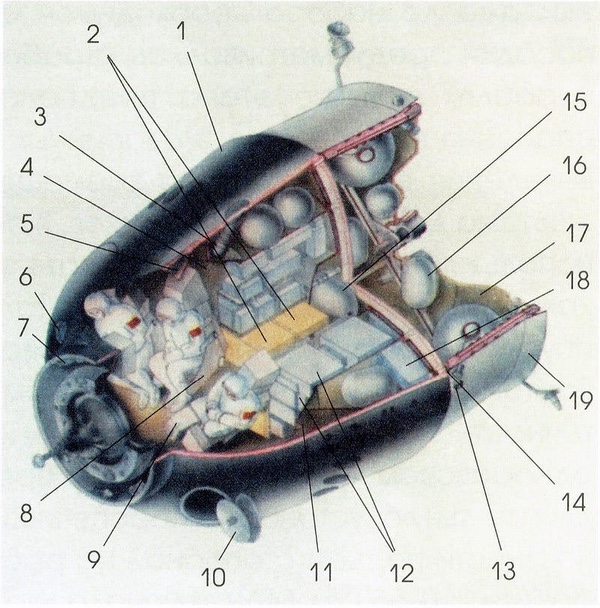 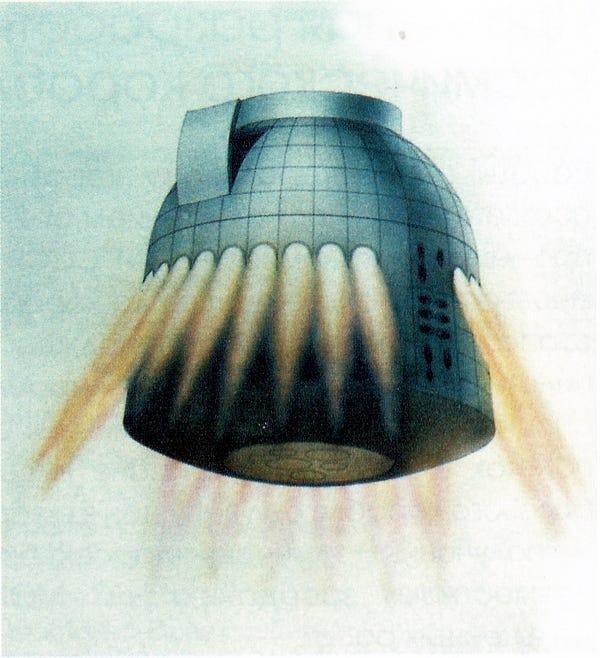 Top: “Reusable manned spacecraft Zarya: 1. Reentry capsule 2. Cargo 3. Landing engine 4. Work compartment 5. Pressure vessel 6. Porthole 7. Star sensor 8. Ejection seat 9. Control panel 10. Antenna of the rendezvous equipment 11. Engine compartment 12. On-board equipment 13. Docking and orientation engines 14. Heat shield shock absorber 15. Doppler velocimeter 16. Refueling and propulsion system 17. Expendable compartment 18. SEP and EKhG 19. Wall-mounted radiator”. Bottom: landing of the Zarya spacecraft. Semyonov (ed.), 1996, processing by the author. |
The capsule was designed to ferry between two and four crew with cargo, with a certified on-orbit life of at least 195 days (later increased to 270 days). It could also be configured for uncrewed cargo missions, including the return of payloads from orbit, rescue missions to space stations and Buran orbiters, and specialized Ministry of Defense and Academy of Science missions. At a later stage, the spacecraft was to be developed further into a versatile multi-mission vehicle for up to eight crew without ejection seats and capable of operating uncrewed in orbits as high as geostationary and inclinations up to 97° when aided by a tug.
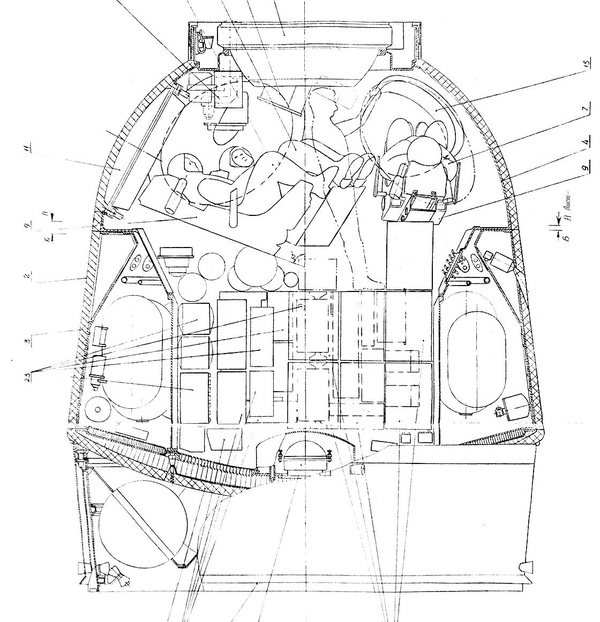 November 1987 blueprint of the Zarya capsule signed by Konstantin Feoktistov. Image: Vadim Lukashevich/buran.ru |
Inside the spacecraft, the pressurized volume was divided into the wider crew compartment at the top and a narrower cylindrical cargo compartment beneath its “floor”. Three of the four Zvezda K-36L ejection seats were mounted in a fan pattern, with the commander in the rightmost seat and the flight engineer in the leftmost seat; the first “cosmonaut-scientist” sat between them. The fourth crew member—the second “cosmonaut-scientist”—sat completely sideways at the trio’s feet. A pyrotechnically separated ejection hatch was mounted above every seat; the commander’s and engineer’s seat hatches featured inset portholes pointing forwards and the middle seat hatch contained the drogue parachute behind a retractable panel. Opposite the fourth, blank hatch, a blister with the retractable Kurs docking antenna was mounted.
Smaller sensors like the star tracker were located inside the thermal protection “ring” around the capsule’s docking port, which could be either the traditional SSVP “probe-and-drogue” docking assembly, or the APAS-89 system developed for the Buran program — presumably with a small payload penalty, as the APAS system was 120 kilograms heavier . The docking assembly was protected during launch by a jettisonable cover.
The equipment onboard was a mix of Soyuz-TM hardware and newly developed units, with the control systems taking full advantage of 1980s computer technology.
The Energomash-built landing engines of the Integrated Propulsion System (initially also used as the launch abort system before a Soyuz-style escape tower was chosen) were arranged in a circle in the ring-shaped Instrument Compartment around the cargo section, each engine rated for 1.5 tonnes of thrust on a mix of hydrogen peroxide and kerosene. To improve engine-out capability, the number of landing engines grew from 8 to 24 and they were moved outwards laterally and upwards until they were almost level with the center of gravity, increasing the corrective moment the engines can exert on the capsule during the landing burn. This would also help counteract the effects of the center of gravity being shifted to one side in both designs to improve reentry stability and allow crossrange maneuvers.
Together with 16 62-kgf monopropellant orientation thrusters, the engines would be used to land the spacecraft in the Kazakh steppe with an accuracy of 2.5 kilometers. Before the ignition of the landing engines, a drogue chute would be deployed to stabilize the capsule and bleed off speed. [8]
The landing engines and fuel were located inside the descent module, so a non-toxic propellant mix was chosen for crew safety. Nevertheless, as one can imagine, the acoustic load level on the crew during landing was described as “high”. The acceleration limit was also set rather high at 10G when compared to the modern Soyuz’s 6G of (although the contemporary TM-series still subjected its passengers to a hefty 12G.) [9]
Orbital maneuvering duties were taken care of by a set of two 300-kgf maneuvering engines and a number of smaller docking and orientation thrusters, located in the expendable Service Module and fueled with a more conventional mix of nitrogen tetroxide (N2O4) and unsymmetrical dimethylhydrazine (UDMH). Radiators were also relegated to the Service Module, mounted flush with the compartment around its perimeter.
| One of the first appearances of the new Zarya spacecraft in space station plans that have been made public since was as part of a Mir-2 variant proposed in mid-1985. |
To ensure a service life of 30 to 50 missions for each capsule, Zarya was covered in silica heat protection tiles similar to the ones on 7K-SM, but only on the sides of the capsule—the backshell. Instead of a fully reusable suite of tiles, Zarya would trade some reusability for simplicity and lower cost, replacing the landing legs and the tiled Frontal Heat Shield with a single-use heat shield panel with a honeycomb core that protected the capsule from the brutal heat of reentry and was designed to crumple on touchdown to absorb the force of landing.
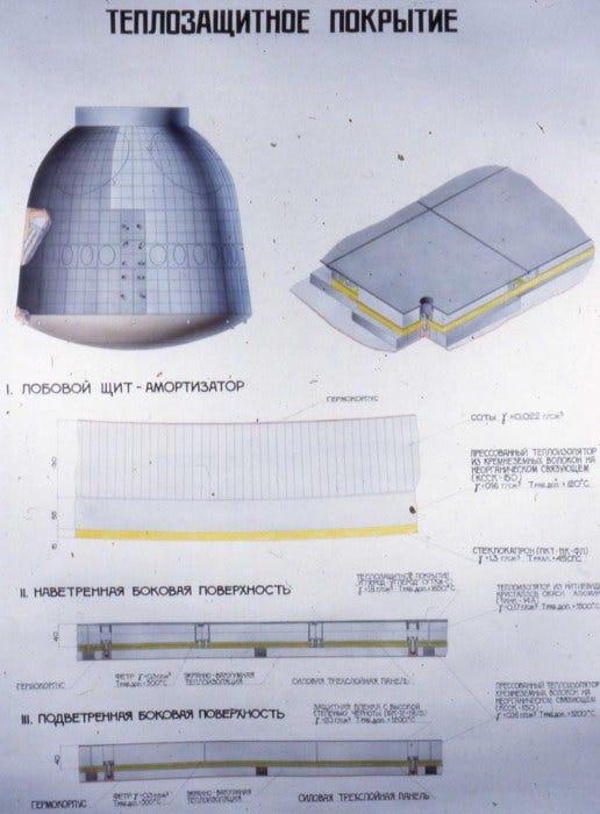 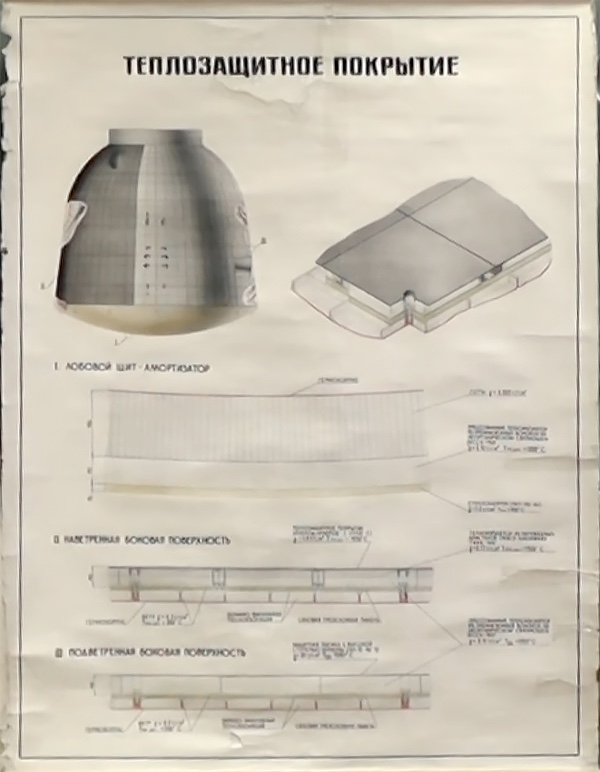 Thermal protection system tile layout of the Zarya spacecraft in two specifications, likely to be the baseline variant with ejection seats on the left and the evolved version with no ejection seats and a higher crew capacity on the right. Legend: I. heatshield-clad honeycomb crumple panel, II. tile mounting on the windward side, III. tile mounting on the leeward side. Images: Novosti Kosmonavtiki, 2014 №8, Tvoy Sektor Kosmosa on YouTube (lecture). |
The panel, bolted directly to the pressure vessel, was a 21-centimeter-thick sandwich of aluminum honeycomb, a layer of KSSK-150 quartz fiber foam and a top layer of PKT-11K-FL ablator—a laminate of silica cloth in a phenolic resin matrix, also used in the heat shield of the Soyuz descent module. Small apertures in the panel ensured line-of-sight with the ground for the radio altimeter, which was mounted centrally at the bottom of the cargo compartment. [10]
Each tile on the backshell was glued to a felt isolation pad and the combination was glued to the spacecraft skin panels, which were once again isolated from the pressure vessel by a series of ribs. Two tile specifications were used, both 40 killimeters thick, with KSSK-based tiles on the leeward side and tiles with a two-layer KSSK and TINK core on the hotter windward side. Both tile types were topped with high emissivity coatings.
Operations and destinations
In the 15-tonne configuration, the Zenit would deliver Zarya to a 190-kilometer 51.6° reference orbit. With two crew, the cargo capacity was 2.5 tonnes with 1.5–2 tonnes of return cargo; with no crew, 3 tonnes with 2–2.5 tonnes of return cargo.
The interior of a Zarya capsule would be easily reconfigurable between any of the four major mission types without affecting the general layout and flight systems:
- space station ferry with 2–4 crew and cargo launch and return
- rescue vessel launched empty or with 1–2 crew, returning 2–4 crew in the initial version and up to 8 crew in the later advanced variant
- in-space assembly or repair spacecraft with 2–3 crew
- uncrewed spacecraft for cargo launch-return missions to orbits as high as 36 000 kilometers altitude with a special tug.
Interestingly, the standard Zenit did not have quite the performance necessary to lift the heavy capsule, so instead of kerosene, the second stage tanks were to be filled with syntin, a synthetic hydrocarbon with a higher energy density than RG-1, to increase the impulse. A separate proposal was to activate the launch abort system tower before Zarya separated from the second stage and only jettison it after it gave the stack the extra push (or rather pull).
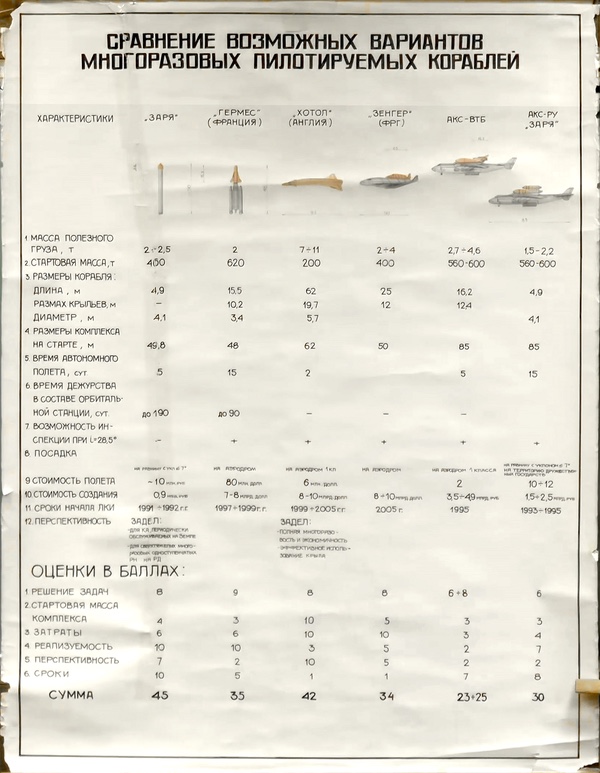 Various reusable crewed spaceflight projects, including Zarya on Zenit in the leftmost column and an air-launched variant in the rightmost column. Image: Tvoy Sektor Kosmosa on YouTube (lecture). |
Being the prospective replacement of the Soyuz, Zarya played an important role in the Mir-2 plans of the late ’80s. The long on-orbit life resource and larger crew capacity meant that the capsule was a very convenient crew ferry and lifeboat for the large next-generation orbital complex. While relatively few illustrations of either Mir-2 or Zarya have been made public, the even scarcer ones with them both show a version of the future, where instead of Shuttle-Mir-Soyuz we have Buran-Mir-2-Zarya.
One of the first appearances of the new Zarya spacecraft in space station plans that have been made public since was as part of a Mir-2 variant proposed in mid-1985, where the core module was based on Energia core stage tankage. The station would be serviced by Buran orbiters and the Zarya ferry.
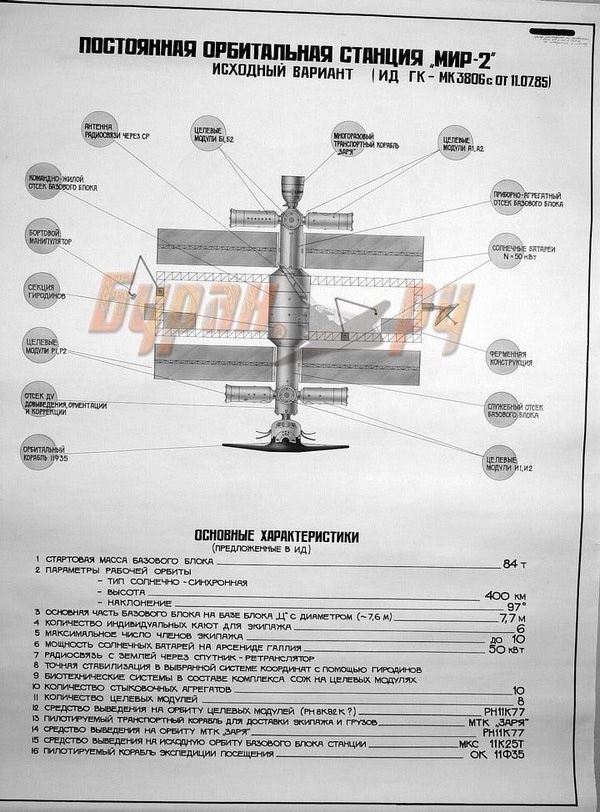 1985 Mir-2 variant serviced by Zarya capsules. Image: buran.ru |
In the 180GK design proposed in 1986 and approved a year later—perhaps the second-best known Mir-2 configuration as it clearly resembled the “dual-keel” Space Station Freedom—the Zarya capsule was once again employed as the crew ferry, with Buran orbiters tagging along as resupply vehicles. [11]
Preliminary estimates showed a requirement for two flights of Zarya to supply the 180GK station every year, along with three Progress M2’s and one to two Buran orbiters. In the 1987 draft design of Mir-2, a modified Soyuz-TM launched on Zenit or a standard Soyuz-TM launched on Soyuz-U2 were described as possible alternatives for Zarya, but Zarya remained the baseline crew vehicle until the project’s cancellation. [12]
As of 1987, Mir-2 was to begin construction in 1993 and reach completion in 1997. At that point, over the next three years the “standard” Mir-2 was to be expanded into the massive Orbital Assembly and Operations Center (OSEC), a direct response to Space Station Freedom, in development at Energia since 1984. While we do not have illustrations of Zarya at Mir-2, we do have two posters of the capsule docked to proposed OSEC configurations.
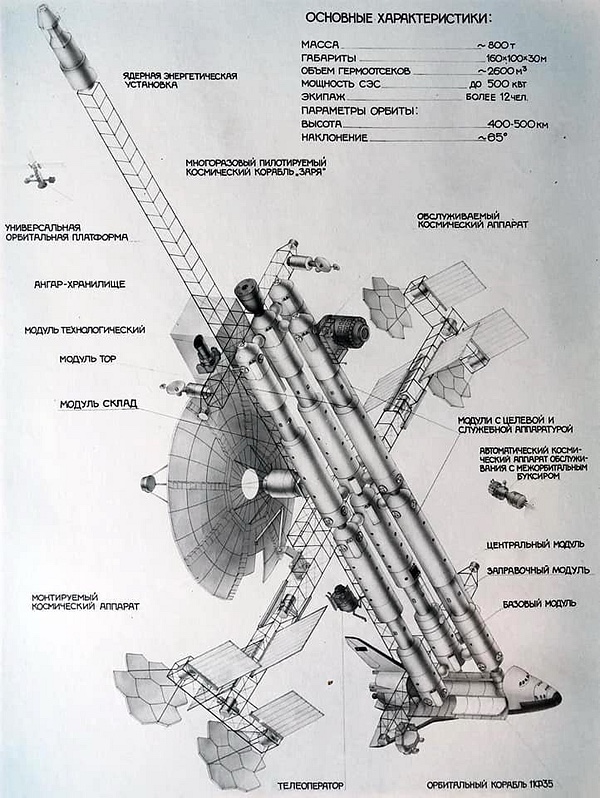 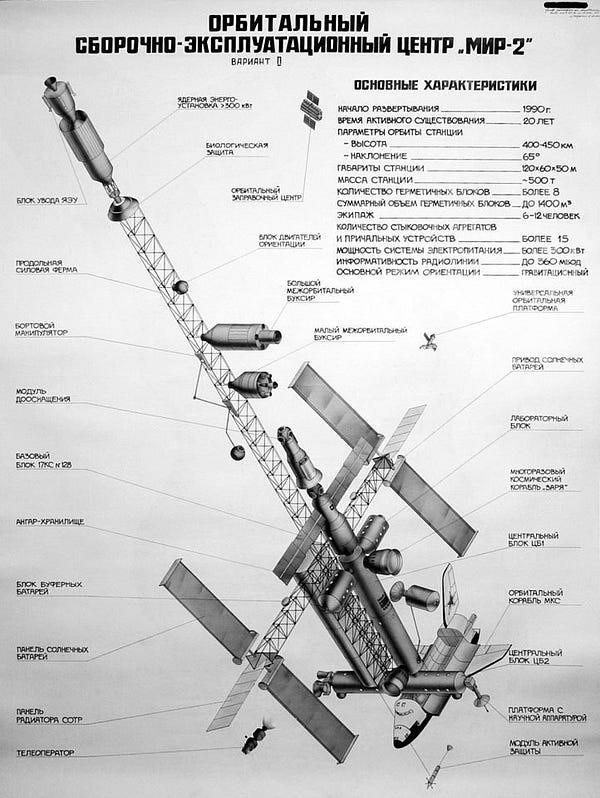 Zarya as part of two variants of the “Orbital Assembly and Operations Center” complex built around Mir-2, reminiscent of the Space Station Freedom “Power Tower” configuration. Images: Anton Kachinskiy and buran.ru
|
Program closure
In January 1989 work on the project stopped with a rift between the project’s main cheerleader within Energia, Konstantin Feoktistov, and the newly appointed chief designer of the bureau, Yuri Semyonov, in the background. By that time, the costs associated with the Buran program had started to come down after the 1985 peak, but 1.3 of the 6.9-billion-ruble space budget for 1989 was still allocated for the shuttle project, and the Zarya project did not receive the funding it needed. Similarly, the heavy workload associated with the Buran program within NPO Energia put the reusable capsule on the backburner. [13]
By then, “main design documentation was completed” at NPO Energia according to the company history book. Later that year, on October 5, the Scientific and Technical Council of the Ministry of General Machine Building and the USSR Academy of Sciences on the topic of Mir-2 officially “recognized the need to stop work” on Zarya. [14]
Throughout the 7K-SM and Zarya projects, there was some skepticism among NPO Energia employees about whether the propulsive landing systems can be made as safe and reliable as the tried and tested parachute landing. While the basic design of 7K-SM was to a large degree landing system-agnostic, the propulsively landed version offered no backup option in case of a landing engine malfunction. On Zarya, crew capacity was traded for the ability to rescue all crew during a landing mishap with ejection seats. Mind you, the ejection seats could be used only during the landing burn: the hatch above one of the crew member’s seats doubled as a container for the drogue chute and in the final version of the design, Zarya was encapsulated in a Soyuz-style fairing with an abort tower. That’s four ejection seats, an abort tower, 24 landing engines and a parachute (albeit small), all eating into the Zenit’s precious payload capacity.
Still, the design fell short of the later requirement for single fault tolerance for mission completion and double fault tolerance for the safe return on Zarya. Anecdotally, the increased number of engines was met with skepticism too, but due to fears that the high engine count would hamper reliability; an echo of the N-1 program’s four failed launches, all of which were catastrophic failures of the 30-engine first stage.
| According to one source, designs for the Zarya were among the items sold to China in the early ’90s when Sino-Russian relations warmed and Chinese officials visited a number of space enterprises in the former USSR. |
Feoktistov left Energia a year after Zarya was cancelled and would later call the project his mistake, saying that he should have pushed for a flatter shape of the capsule with a higher lift-to-drag coefficient to improve landing accuracy from the 2.5-kilometer value specified in the last iteration of the design, which forced a landing on the unprepared surface of the Kazakh steppe. Work on the landing system for the Energia rocket’s Blok A boosters showed that at those scales the landing engines caused significant cratering in the ground, risking the capsule tipping over after landing and damaging its delicate silica tiles. Feoktistov himself is reported to have proposed the construction of a concrete landing pad, though for that to happen either the landing accuracy would need to be improved or the landing pad would have an area more than 50 times larger than the already huge Buran landing facility. [15]
In documents available to the author, no contractor is specified for the landing engines of the 7K-SM, though Energia did have some experience with kerosene-oxygen engines of similar size developed in-house, e.g. the S1.5400 engine for the upper stage of the Molniya launcher. In 1986, NPO Energomash conducted studies on kerosene-peroxide landing engines and orientation thrusters for Zarya, but it is unclear how far that project got. When the company unveiled the self-funded RD-161 engine in 1993, followed two years later by the kerosene-peroxide RD-161P—both rated for 20 tonnes of thrust—it was noted that Energomash had “not been engaged in the development of a liquid propellant [engine] of this size for more than 30 years.” [16]
While the project never reached the production of flight hardware, some things were built and can still be seen today, namely the “Manned Spacecraft Servicing Unit”, also known as the “birdhouse”, for the Zenit at Baikonur’s Site 45, built to service the Zarya-Zenit stack. According to one source, designs for the Zarya were among the items sold to China in the early ’90s when Sino-Russian relations warmed and Chinese officials visited a number of space enterprises in the former USSR. [17]
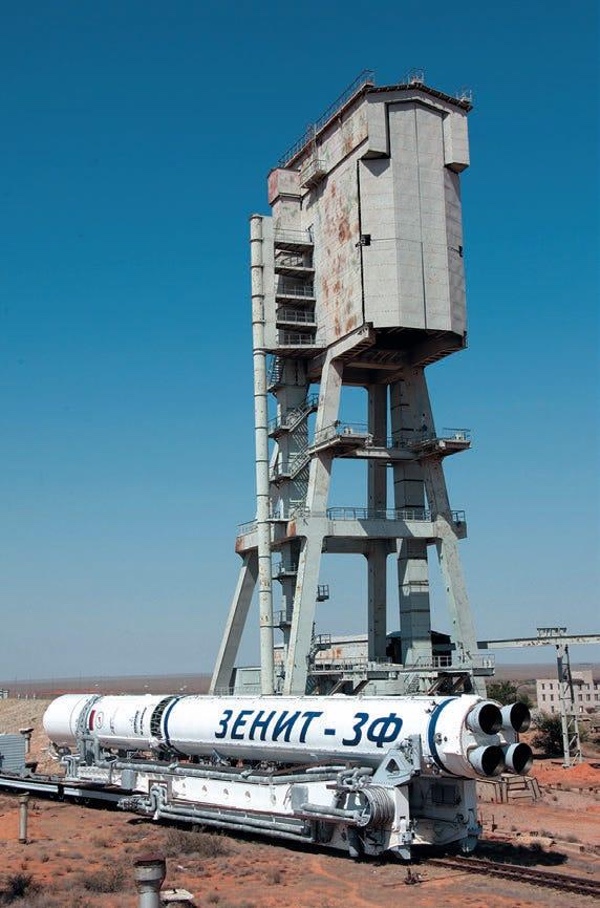 The “Manned Spacecraft Servicing Unit” at the Zenit launch site in Baikonur. Image: I. Marinin. |
Resurrection: Assured Crew Return Vehicle
The collapse of the Soviet Union coincided with dramatic delays in and eventual cancellation of the initial GK-180 variant of Mir-2 in mid-1991. The only way for the project to continue was to reconfigure the massive station into a smaller, Mir-1-sized affair or even only use the existing DOS-8 module to replace Mir’s core in orbit and extend the station’s lifespan. Meanwhile, Space Station Freedom and its budget had also been shrinking by the minute, with the station losing one of its iconic four solar array pairs in 1991. Throughout the project, there was a clear need for the development or procurement of a rescue vessel for the station : the Space Shuttle could only dock for two weeks and any crew that stayed on a long-duration mission would be stranded if anything went seriously wrong.
By 1992, multiple rescue vessel concepts had been investigated under the Assured Crew Return Vehicle (ACRV) project name; the program was just entering the “system definition” phase. The concepts were mostly home-grown designs — ranging from scaled-up Apollo command modules to lifting bodies — but some more exotic vehicles like the British “Multi-Role Recovery Capsule” also appeared in submissions to NASA tenders. At the time, the space station was due to start assembly in 1995 but only reach permanently manned capability in 1999 when the ACRV arrived at the station.
In October 1991, the head of NPO Energia Yuri Semyonov offered his company’s vehicles as the lifeboat for Freedom until the “proper” ACRV came online and repeated the offer on February 21, 1992, while appearing at a US Senate subcommittee hearing. At least three options were presented: the Soyuz-TM fitted with an APAS port, a clean sheet design resembling the Apollo CM (based on either the VA capsule or Energia’s 1987 Mars crewed spacecraft proposal), and a modified version of the cancelled Zarya spacecraft. The latter would be able to seat up to six or seven (depending on the source) astronauts and fly on Zenit or in the shuttle’s payload bay. [18]
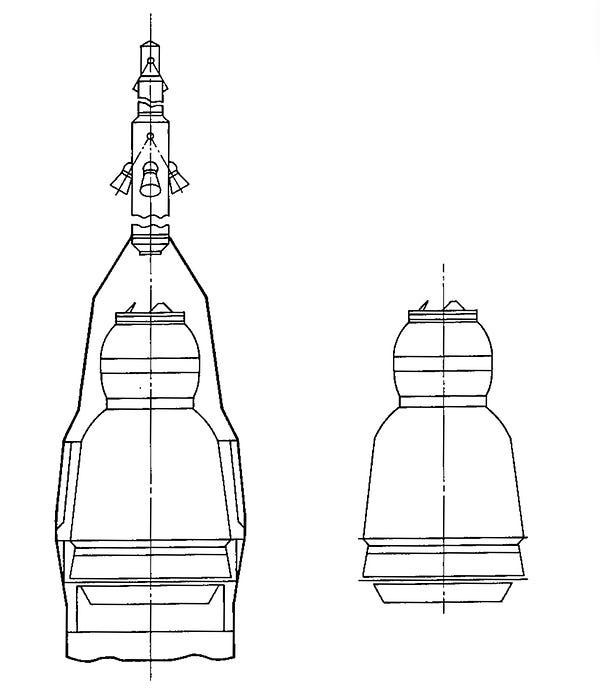 One of the three ACRV options proposed to NASA by NPO Energia. Image: Johnson, Rodvold, 1991. |
Technical details are extremely scarce, but it appears to have included a modified orbital module of the Soyuz and feature a separate service module; both would be jettisoned before reentry. Based on the available illustrations, this version was not, however, 4.1 meters in diameter, but a more compact 3.7 meters, with a mass of 10–12 tonnes. [19]
In March 1992, officials from both countries discussed cooperation in crewed spaceflight and a NASA delegation visited Moscow to “hold exploratory talks on the concept of using Soyuz as an ACRV” and the Soyuz-TM option was developed further. The 1993 agreement to form the International Space Station from the Freedom program and what remained of Mir-2 led to the ACRV program being put on hold until 1997.
In 1995, anticipating a tender from NASA, NPO Energia (which had by that time become RKK Energiya) resumed development of an ACRV, focusing on a Zarya-derived concept launched on the Space Shuttle. Rockwell International joined in on the project, followed by Khrunichev by the end of the year. [20]
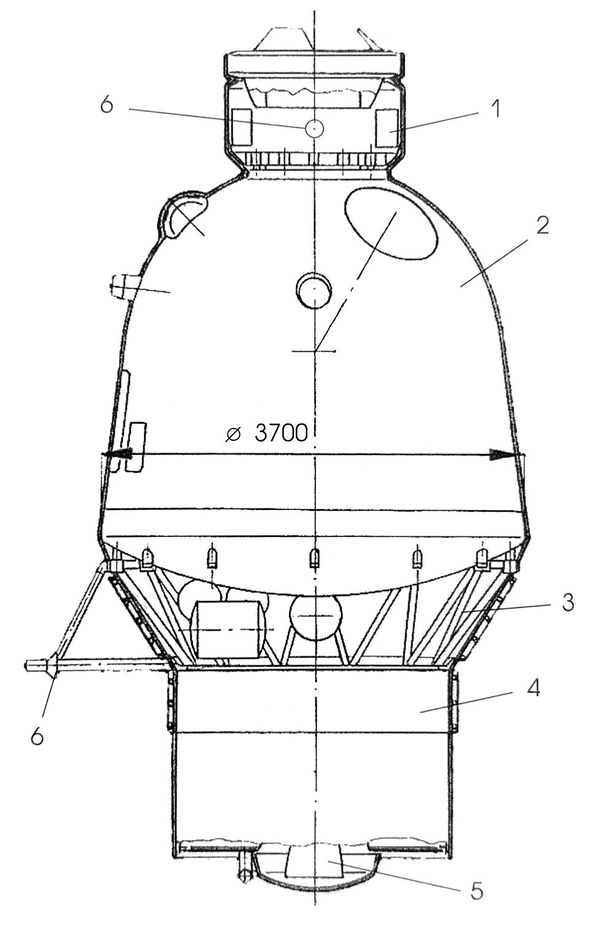 Russian ISS lifeboat based on the Zarya spacecraft. Semyonov (ed.), 1996 |
The new lifeboat had a launch mass of 12.5 tonnes, sat eight crew and was made up of three sections: the eight-tonne descent module, 3.7 meters in diameter; a short forward compartment with an APAS docking port; and the aft section, itself composed of the latticework transition compartment with its payload bay attachment structure and the service compartment, which housed the instruments, batteries, fuel tanks, control thrusters, and the main engine. The forward compartment could be used as an airlock in free flight if needed. The total length of the vehicle was 7.2 meters with the same 3.7-meter capsule diameter as the version offered in 1992; it would stay docked to the ISS for up to five years.
Work on the vehicle stopped after NASA switched to modified Soyuz-TM as a lifeboat for the first years of the ISS in June 1996. The ACRV program refocused on what would become the X-38, which was itself cancelled in 2001. The Soyuz ended up serving as the Station’s lifeboat until 2021, when it started sharing that duty with Crew Dragon.
Knowledge gained during the abortive 7K-SM and Zarya projects made several cameos in the 2000s as the ambition and funding levels for the now-Russian space program began climbing back up after the mid-90s slump. Over the course of several projects for “next-generation” crew spacecraft, enlarged Soyuz descent modules were proposed for the lunar ACTS spacecraft and its successor project, which is currently known as Oryol.
Epilogue
Up to 1996, NPO Energia seriously proposed or worked on spacecraft based on an enlarged Soyuz descent module with at least three different diameters: 3.5, 3.7, and 4.1 meters. It is unknown if any hardware was actually built in the process, despite murmurs on Russian spaceflight forums some two decades ago about “some elements” existing in the metal. As with any military-adjacent project—both the 7K-SM and Zarya were included in combat space station plans—the access to Soviet-era documentation is still complicated, although some information is slowly making its way into public view.
At least one source mentions that Zenit makers KB Yuzhnoe started work with NPO Energia to accommodate what became the Zarya as early as 1979. Together with a handful of other sources, it also uses the designation “7K-M” for the Zarya, but I haven’t been able to find a firm confirmation of that designation. [21]
Work on the reusable capsules was first made public in Igor Afanasyev’s 1991 book Neizvestnye korabli with a short chapter on Zarya. The company history of NPO Energia (under its new RKK Energiya name) published in 1996 contained a full two A4 pages on Zarya with two pretty illustrations and a separate section on the 1995 ISS rescue vessel. The earlier 7K-SM is mentioned exactly once, in the legend of a matchbox-sized illustration of the DOS and Buran-based combat station. At this scale, the capsule’s black thermal protection tiles morphed into a pitch-black silhouette of the spacecraft with no discernible details. In the late 2000s, posters showcasing the thermal protection system of the 7K-SM and Zarya surfaced on Russian forums (later reproduced in a 2014 issue of Novosti Kosmonavtiki) alongside drawings of the 7K-SM abort tower and fairing in the Zenit “birdhouse”. At least two more posters featuring Zarya appeared in the background of a 2015 series of recorded lectures by Energia veteran Viktor Minenko, the lead designer for the Soyuz descent module and a major participant in the Zarya project.
This spring, previously unreleased documentation on the 7K-SM and Zarya was shared by Vadim Lukashevich in response to the previous version of this article.
Bibliography
- Bart Hendrickx, “From Mir-2 to the ISS Russian Segment”, London, British Interplanetary Society, 2002.
- Conversations with Dmitry Vorontsov and Vadim Lukashevich; V.P. Mishin, “Diaries in 3 volumes/Voronezh”, Quarta Publishers, 2014, Vol. 2, p. 300
- The 7K-SM section is based on documentation graciously provided by Vadim Lukashevich, available at buranarchive.space
- G.M. Gunyaev, M.Y. Gofin, “Carbon-Carbon Composite Materials”, Aviatsionnye Materialy i Tekhnologii, Special Issue 2013, p. 64
- Yuri Semyonov (ed.), “Raketno-kosmicheskaya korporatsiya Energiya 1946–1996”, Moscow, 1996, pp. 420
- V.Yu. Karfidov, “Cosmonautics: A Brief Guide in 6 volumes. Volume 1. Cosmonautics of the USSR/Russia”, Onebook.ru, 2022, pp. 145, 327
- The Zarya section is based on Semyonov, pp. 423–424; Igor Afanasyev, Dmitry Vorontsov, “Nesostoyavshayasya «Zarya»“, Novosti Kosmonavtiki, 2014 №8; and documentation provided by Vadim Lukashevich, available at buranarchive.space
- Igor Afanasyev, “Chistaya perekis”, Novosti Kosmonavtiki, 2004 №12, p. 54
- “The Russian Soyuz spacecraft“, ESA, accessed 09.08.2025
- B.A. Davis, “ISS Soyuz Vehicle Descent Module Evaluation of Thermal Protection System (TPS) Penetration Characteristics”, pp. 2-3
- K. Lantranov, “Zvezda: put’ v kosmos”, Novosti Kosmonavtiki, 2000 №9, pp. 4-5
- Yuri Baturin, “Mirovaya pilotiruyemaya kosmonavtika: Istoriya. Tekhnika. Lyudi”, RTSoft Publishing House, Moscow, 2005, pp. 534–535
- V.S. Syromyatnikov, “100 Stories About Dockings and Other Adventures in Space and on Earth: Vol. 2”, M. University Book, Logos, 2010, pp. 206–208; Igor Afanasyev, “Neizvestnye korabli”, Znanie, Moscow, 1991; B. Hendrickx and B. Vis, “Energiya-Buran: The Soviet Space Shuttle”, New York, NY, USA, Springer/Praxis, 2007, p. 373
- V. Mokhov, “Modul dlya «Burana»“, Novosti Kosmonavtiki, 1998 №23–24
- Afanasyev, Vorontsov, 2014, op. cit., p. 57
- Afanasyev, 2004, op. cit.
- Rex D. Hall, David J. Shayler and Bert Vis, “Russia’s cosmonauts: inside the Yuri Gagarin Training Center”, Springer Praxis, 2006, p. 228
- Craig Covault, “Mir Cosmonauts Prepare For Reentry As NASA Holds Soyuz Talks in Moscow”, Aviation Week, March 23, 1992, p. 24
- N.L. Johnson, D.M. Rodvold, “Europe and Asia in Space, 1991-1992”, Kaman Sciences Corp., 1991, p. 76
- Semyonov, op. cit., pp. 521, Anatoly Zak, “Russia proposes lifeboat for a US space station“, Russian Space Web, accessed 09.08.2025
- S.N. Konyukhov (ed.), “Called by Time: From Confrontation to International Cooperation”, ART-PRESS, 2004, ch. 2
Note: we are now moderating comments. There will be a delay in posting comments and no guarantee that all submitted comments will be posted.