Fear and panic in orbit around the Red Planet: Missions to Phobos and Deimosby Dwayne A. Day
|
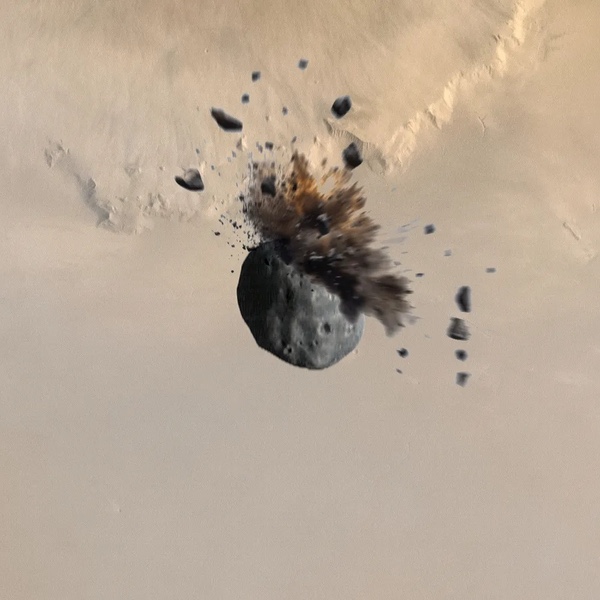
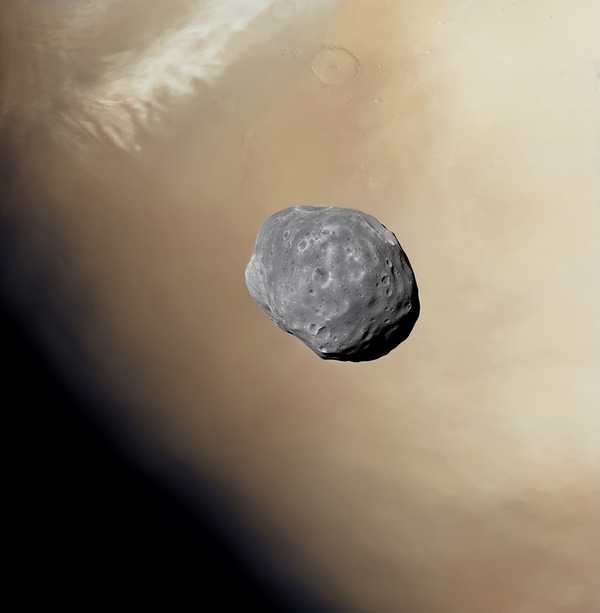 Phobos has been imaged numerous times by Mars orbiting spacecraft. (credit: ESA) |
Origins
The two moons of Mars were discovered in 1877 by Asaph Hall, an American astronomer. The larger moon, Phobos, is irregularly shaped and has a mean radius of 11 kilometers, orbiting only 6,000 kilometers above Mars. Phobos is much more heavily cratered than Deimos, including a large crater named Stickney, which is nine kilometers in diameter. Whatever hit Phobos and created Stickney Crater probably nearly shattered the tiny moon. Some scientists believe that Phobos could contain volatiles. Deimos is smaller and further from Mars. It has not been the focus of as much interest as its larger brother.
| Settling the mystery requires retrieving samples from one of the moons and bringing them back to Earth for analysis. |
In 1969, Mariner 9 photographed Phobos, followed by Viking 1 in 1977. In the 1980s, the Soviet Union sent two missions to study the moons, with one of them photographing Phobos in 1989. Phobos, and to a lesser extent Deimos, have since been imaged by numerous other orbiting spacecraft such as Mars Global Surveyor, Mars Express, the Mars Reconnaissance Orbiter, India’s Mars Orbiting Mission, as well as by rovers on the Martian surface, looking up. These spacecraft rarely get close to the moons, so high-quality images are produced only every few years. In 2025, Mars Express produced some spectacular images of Phobos with Mars in the background.
Scientists have two competing theories about the origins of Phobos and Deimos. One theory is that they are captured asteroids and fell into Mars’s gravity well and could not escape. Neptune’s moon Triton is also believed to be a captured object, although the evidence for Triton’s origin is stronger than for Phobos and Deimos. The other theory is that Phobos and Deimos are originally pieces of Mars, blown into space by a massive impact in the planet’s past.
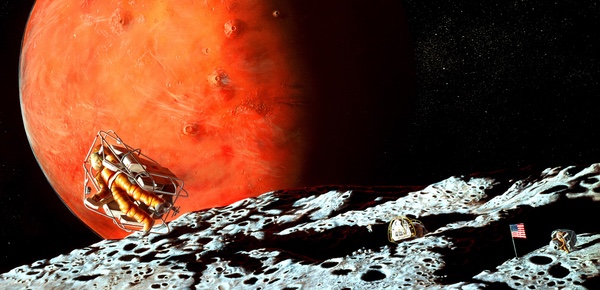 Because of Phobos' low gravity, astronauts cannot walk on its surface but would need some kind of mobility system. Space artist Pat Rawlings depicted a cage-like device in this 1990s illustration. (credit: Pat Rawlings) |
Although there are advocates for both origin stories for the Martian moons, the only scientific consensus is that the evidence is not overwhelming for either theory. Settling the mystery requires retrieving samples from one of the moons and bringing them back to Earth for analysis. Phobos is also covered in Mars dust sent into orbit by impacts, meaning that a sample return mission can also bring back Mars dust.
From a scientific standpoint, a robotic sample return mission could answer the mystery of the origin of the moons. From a human exploration standpoint, missions to the moons have been proposed for several reasons, including practice for an eventual Mars landing mission, as well as a potential water resource.
Fear and panic and flight
Phobos has featured in fiction many times, in English as well as French, German, Italian, and other languages. Edgar Rice Burrows included Phobos (named Thuria) in Swords of Mars, his eighth Barsoom series novel. Arthur C. Clarke wrote the short story “Hide and Seek” in 1949 about an astronaut who lands on Phobos to hide from aliens. In his 1951 novel Sands of Mars, Clarke featured a plot about turning Phobos into a second sun that will heat the red planet, an idea he later revisited in his novel 2010: Odyssey Two.
| Probably most famously, Phobos was the location of the popular 1990s video game Doom, as well as a forgettable movie by the same name, and several sequel games. |
The 1966 book Colossus, by Dennis Feltham Jones, spawned the 1970 movie Colossus: The Forbin Project, about a supercomputer that takes over the world. The book had two sequels where Phobos and Deimos were characters. In The Fall of Colossus, humans manage to shut down the Colossus computer, but when they do, they learn that the two moons of Mars are suddenly heading towards Earth, and are apparently alive. In the third book, Colossus and the Crab, humans discover that Phobos and Deimos are sentient machines, like Colossus, and they enslave humanity.
 In the 1977 novel Colossus and the Crab, Phobos and Deimos are depicted as intelligent machines that attack Earth. (credit: Berkley) |
Hard science fiction writer Alastair Reynolds set several of his novels on Phobos, such as his 2004 book Century Rain, which featured an underground base on Phobos with an alien portal to a distant galaxy. Ty Drago’s 2003 novel Phobos is set on that moon.
In the late 1970s, noted science journalist Jonathan Eberhart began writing the “Interplanetary Excursions” column for Starlog magazine. The column was a concept so great that it deserves to be revived (and has been by at least one author). Eberhart wrote from the perspective of a space explorer visiting the wonders of the solar system. In “Stickball at Stickney,” Eberhart recounted a game of stickball on Phobos where a hit could send the ball in a weird trajectory around the tiny moon.
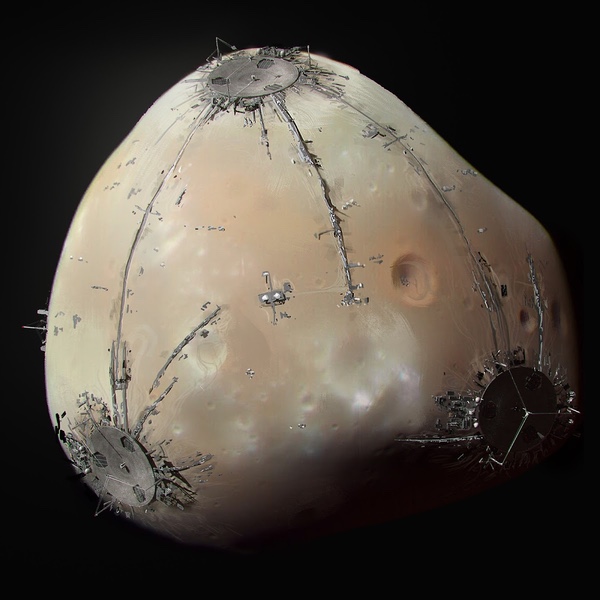 In "The Expanse" TV series, Deimos is the site of a military facility and is destroyed by Earth forces in retaliation for an earlier attack. This concept art was produced by Lee Fitzgerald for the series. (credit: Lee Fitzgerald ) |
In the television series “The Expanse” (based upon a series of novels) Deimos is the site of a Mars defense facility that Earth’s military blows up in retaliation for an attack on an Earth outpost. This results in the “Deimos Ring” around Mars.
 The early 1990s video game Doom depicted gameplay on Phobos. (credit: id Software) |
Phobos has been the setting for several video games. It first appeared in the 1986 video game Leather Goddesses of Phobos and a 1992 sequel. Probably most famously, Phobos was the location of the popular 1990s video game Doom, as well as a forgettable movie by the same name, and several sequel games. The 2014 video game Destiny included gameplay on Phobos. A 2020 update to the video game Warframe also included a location set on Deimos.
Human missions to Phobos
In 1981, scientist Fred Singer proposed what he labeled the “PhD Mission,” a human mission to visit Phobos and Deimos. Singer’s reasoning was that it could be a precursor to a human mission to Mars, akin to the Apollo 8 circumlunar mission before the Apollo 11 landing.
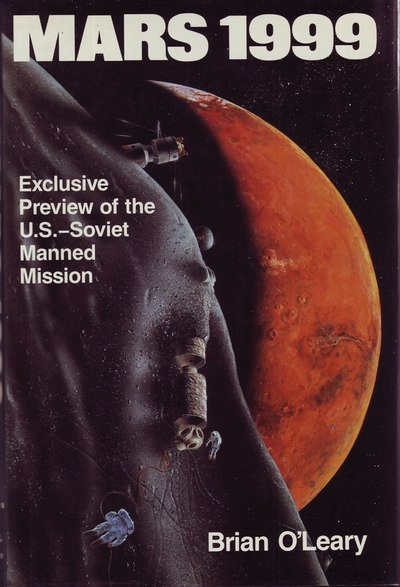 In the 1980s, Brian O'Leary published a book proposing a joint US-Soviet human mission to Phobos. (credit: Stackpole Books) |
After Singer’s proposal, there were numerous refinements on the concept. In 1987, former astronaut Brian O’Leary published Mars 1999, proposing a joint US-Soviet mission to Phobos (see “Forever Mars,” The Space Review, February 13, 2012.) Scientist Geoff Landis proposed an incremental approach to Mars exploration at the Case for Mars conference in 1993. In 2005, Pascal Lee along with several others proposed a Phobos mission, which they refined in 2007. In 2017, Francisco Arias proposed a novel method of landing on Mars using Phobos resources.
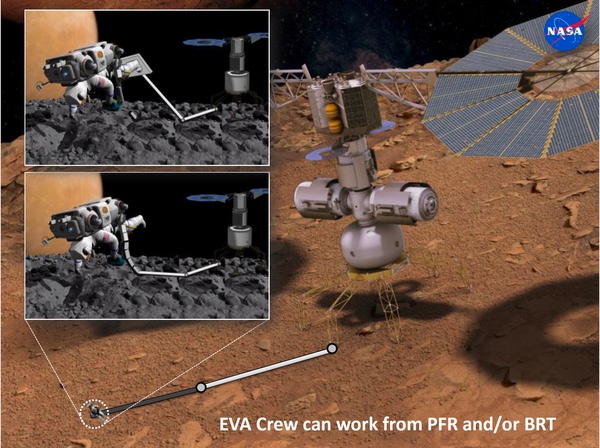 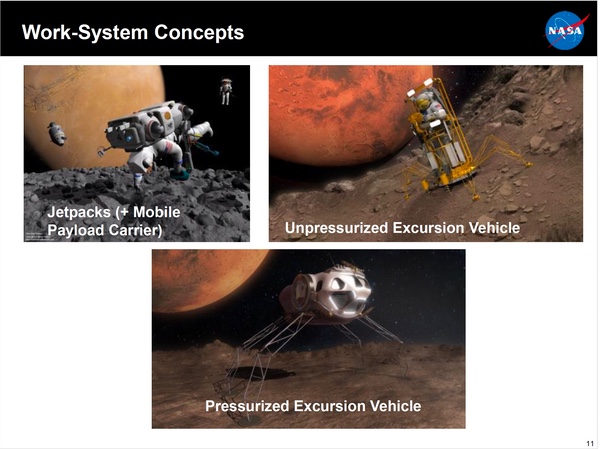 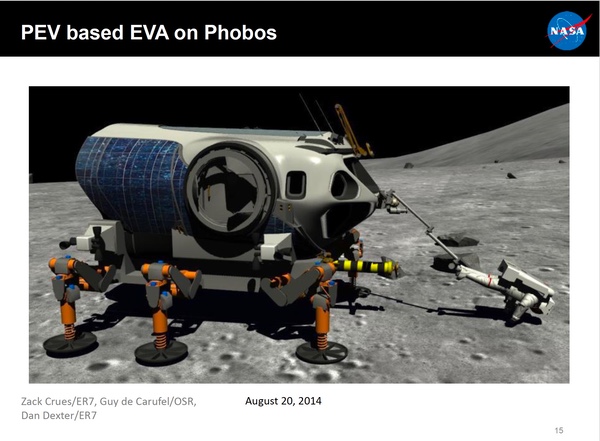 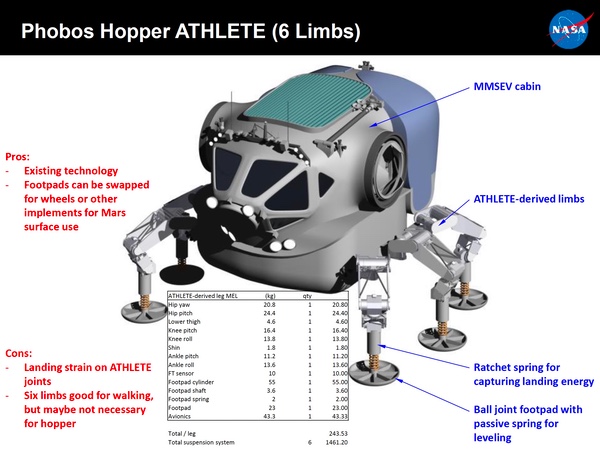 In 2015, NASA's Johnson Space Center conducted a detailed study of human operations at Phobos and what that would require. The participants looked at various ways to explore the surface, including using a pressurized vehicle. (credit: NASA) |
The most extensive recent study of a human mission to Phobos was done in 2015 and focused on astronaut operations at Phobos. The study, led by former NASA astronaut Mike Gernhardt at Johnson Space Center, considered how astronauts would move around a low-gravity surface, and how long it would take them to do so. The moon’s very low gravity makes human exploration tricky. The team determined that a spacecraft that could touch down on Phobos and enable astronauts to collect samples using robotic arms would be useful. Astronauts could also perform EVAs while still tethered to the spacecraft and using maneuvering units.
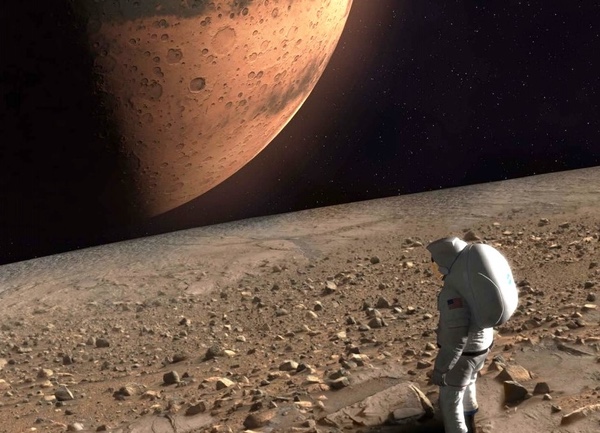 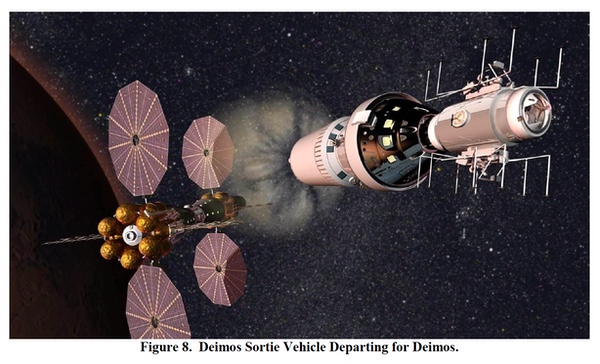 Around 2016, there were several proposals for human missions to Phobos, including a Planetary Society proposal, and a concept produced by Lockheed Martin as part of its Mars Base Camp study. (credit: The Planetary Society and Lockheed Martin) |
Around this same time, The Planetary Society proposed a concept for a human mission to Phobos. Lockheed Martin also published its “Mars Base Camp” concept that included a possible Demios visit as well.
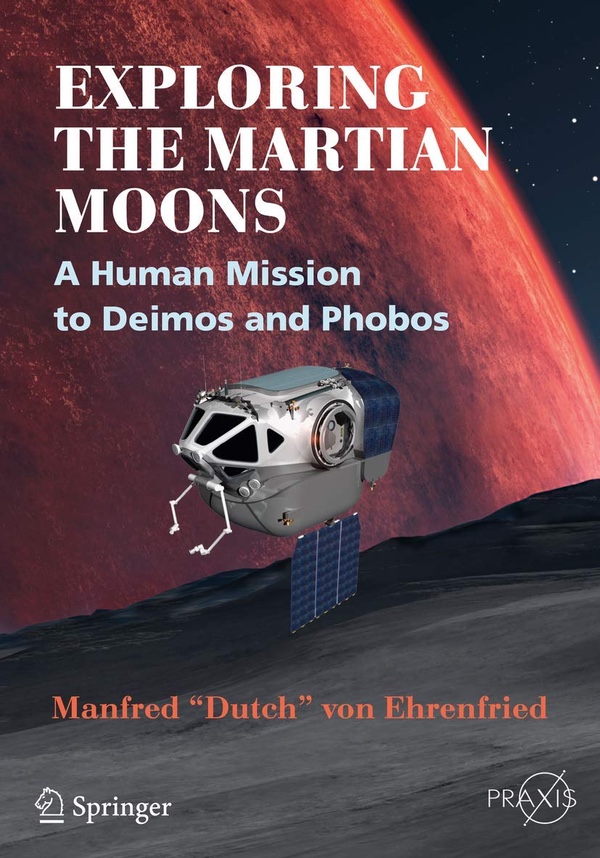 The book Exploring the Martian Moons discusses many proposals for exploring Phobos and Deimos. (credit: Springer) |
Manfred “Dutch” von Ehrenfried in 2017 published Exploring the Martian Moons: A Human Mission to Deimos and Phobos. The book discussed many of the previous Phobos exploration proposals.
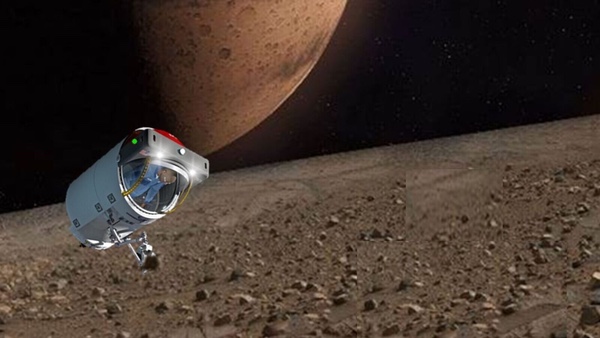 A 2025 proposal for a Phobos mission includes a small pressurized exploration craft for reaching the surface. (credit: Genesis) |
In 2025 at the AIAA’s ASCEND conference, a Boeing-led team proposed a nuclear-powered mission to Phobos. Whereas the 2015 JSC study included a spacecraft that would allow several astronauts to touch down on Phobos and collect samples, this newer proposal included a “Single-Person Spacecraft” to perform that task, illustrating it with a concept design that has been studied over decades.
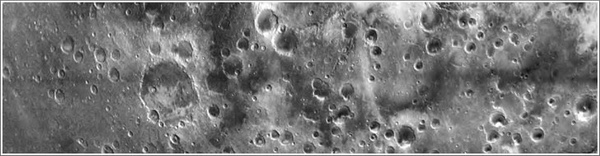 In the late 1980s, the Soviet Union launched two spacecraft to explore Phobos. One failed before reaching Mars, and the other failed soon after nearing Phobos. It produced this thermal image of Phobos' surface. (credit: Roscosmos) |
Russian missions to Phobos and Deimos
The Soviet Union launched numerous robotic missions to Mars during the 1960s and 1970s. In the 1980s, the country planned two ambitious missions to explore Phobos and Deimos. Phobos 1 and Phobos 2 were launched in July 1988 on Proton rockets from the Baikonur Cosmodrome in Kazakhstan. Unfortunately, an erroneous command from the ground shut down Phobos 1 in September 1988, while it was en route to Mars.
| Had it succeeded, it would have been a major scientific advance, not to mention an international political accomplishment. |
Phobos 2 arrived at Mars in January 1989. It began transmitting data and imagery. But it suddenly stopped transmitting before it could begin its examination of the moon’s surface. The failure was due to either the onboard computer or the radio transmitter. The Mars 96 mission, which failed in 1996, never even reaching Earth orbit, was based upon the Phobos spacecraft.
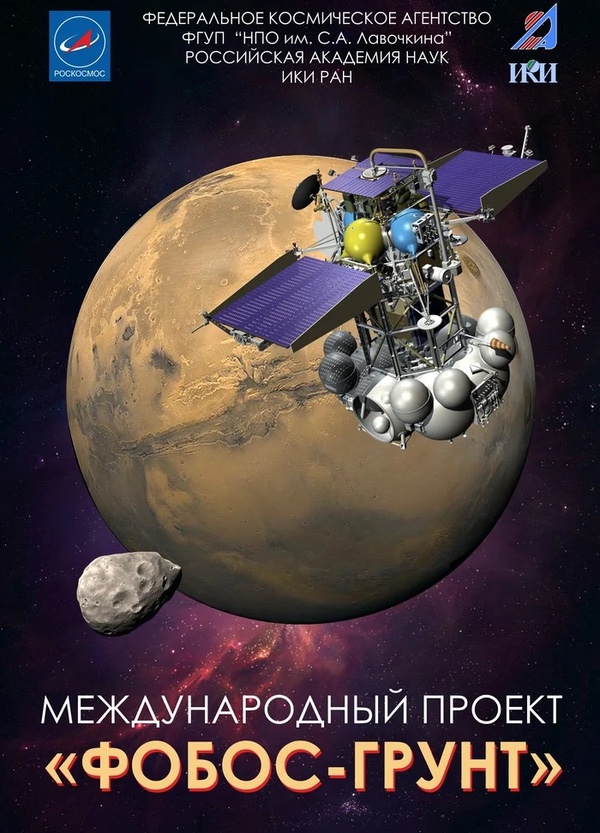 In 2011, Russia launched the ambitious Phobos-Grunt mission to return samples from Phobos, but the spacecraft never made it out of Earth orbit. (credit: Roscosmos) |
In November 2011, Russia launched the Phobos-Grunt mission to Mars from Baikonur atop a Proton rocket. “Grunt” means “soil” in Russian, and the mission was very ambitious. Not only would it rendezvous with Phobos and land on it, but it was planned to return a sample from the moon’s surface. Had it succeeded, it would have been a major scientific advance, not to mention an international political accomplishment. The spacecraft included the Chinese-built survey satellite Yinghuo-1, which would have orbited Mars.
Unfortunately, the Phobos-Grunt spacecraft failed in Earth orbit, without firing its rockets to send it to Mars. It reentered Earth’s atmosphere in January 2012. (See “Open issues with the Phobos-Grunt accident report,” The Space Review, February 27, 2012; “Red planet blues,” The Space Review, November 28, 2011; and “Red moon around a Red Planet,” November 7, 2011.)
Proposed robotic missions to Phobos and Deimos
There have been several proposed Phobos and Deimos robotic missions over the past few decades that never received funding. For the American planetary science community, the moons may have fallen victim to the perception by Mars scientists that they are subjects for the asteroid science community, and the view of asteroid scientists that they are subjects for the Mars science community.
In the late 1990s, NASA selected the Aladdin mission as a finalist in its Discovery program. The Aladdin spacecraft would visit both moons and launch projectiles at them, collecting ejecta as it performed a slow flyby. The spacecraft would then return the samples to Earth three years later. NASA instead selected the MESSENGER mission to Mercury.
In 2007, the European company EADS Astrium studied a Phobos mission as a technology demonstrator. This was a potential precursor to a European Mars sample return mission known as Aurora. The mission would have launched in 2016 and lasted three years. It would have used a main spacecraft equipped with electric propulsion and deployed a Phobos lander. The lander would gather samples and rendezvous with the main spacecraft.
Also in 2007, the Canadian Space Agency funded a study for a Phobos Reconnaissance International Mars Exploration (PRIME) mission. PRIME would have targeted a spot near Stickney Crater and would have consisted of an orbiter and lander, each carrying four instruments.
A year later, NASA’s Glenn Research Center began studying a Phobos and Deimos sample return mission using solar electric propulsion. This became known as the Hall mission, after Asaph Hall, who discovered the moons. It was a New Frontiers-class mission, bigger than the earlier Aladdin Discovery-class proposal. But a Phobos mission is not included in NASA’s list of acceptable New Frontiers-class targets. Thus, there was no way to get such a mission approved unless the New Frontiers target list was changed at that time.
| The MMX mission reflects Japan’s experience with two successful asteroid sample return missions, Hayabusa and Hayabusa2. JAXA has demonstrated that it can perform this type of sample return mission. |
After the OSIRIS-REx mission was selected in 2011 to recover samples from an asteroid, some researchers proposed an OSRIS-REx II mission that could perform the same mission at Phobos. The hardware was developed and worked successfully at asteroid Bennu. However, because OSIRIS-REx was also a New Frontiers-class mission, any successor would likely cost just as much, which is too expensive for an American Phobos mission.
In 2013, a Phobos Surveyor mission was proposed by Stanford University, JPL, and the Massachusetts Institute of Technology. It was not accepted by NASA.
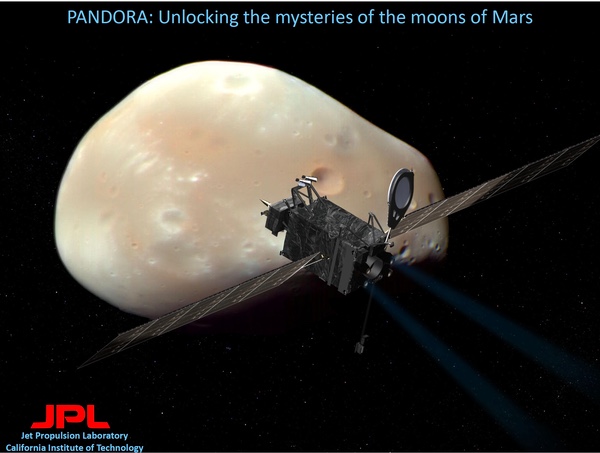 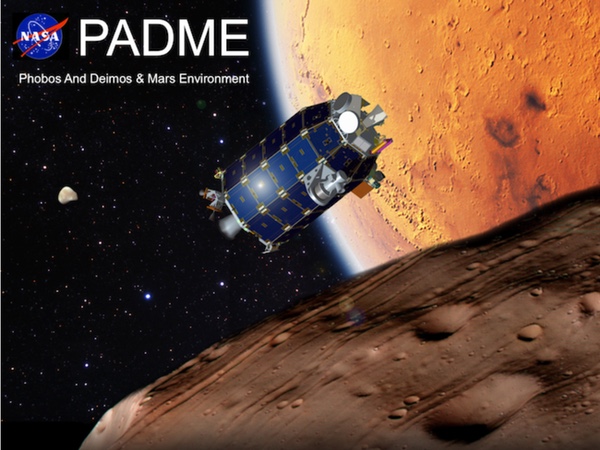 In the United States there have been many proposals for robotic missions to Phobos and Deimos, including the PANDORA and PADME missions, but none have been pursued. |
In 2014, the Phobos And Deimos & Mars Environment (PADME) mission was proposed as a Discovery-class mission. Merlin and Pandora were two other Discovery-class mission proposals at the same time. Merlin would fly past Deimos and orbit and land on Phobos, and Pandora would orbit both moons. None of the missions was selected for the Discovery program.
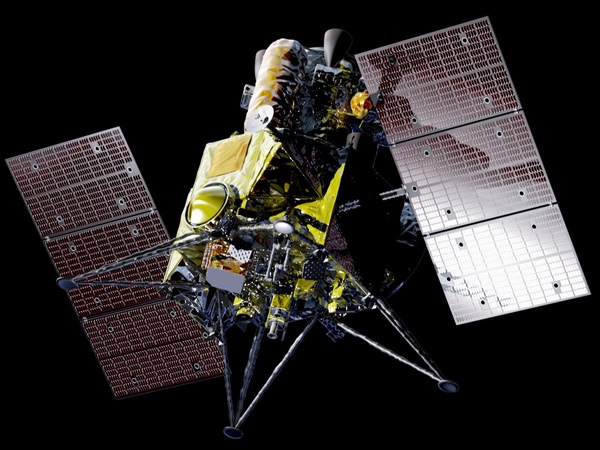 The Japanese MMX mission is scheduled to launch later this year. It will study both moons and bring back samples from Phobos. This will hopefully finally answer the mystery of whether the moons are captured asteroids or parts of Mars. (credit: JAXA) |
The MMX mission
The most exciting news about Phobos exploration comes from Japan. In 2015, the Japanese Aerospace Exploration Agency (JAXA) announced plans for a sample return mission to Phobos named the Martian Moons eXploration, or MMX. The MMX spacecraft will set down on Phobos multiple times, collecting samples. It will be equipped with a corer sampling mechanism with the goal of retrieving a minimum of ten grams of samples. NASA and the German and French space agencies are also participating in the mission. They are providing instruments and a rover named Idefix.
The original plan was to launch MMX in late 2024, but the H3 rocket it will use suffered a failure during its debut launch in March 2023. The investigation and recovery time pushed the MMX launch to the next launch window, in fall 2026. In December 2025, JAXA again experienced a problem with its H3 rocket. But fortunately, in late March, JAXA shipped the MMX spacecraft to the launch site. The launch window runs from October to November.
The MMX mission reflects Japan’s experience with two successful asteroid sample return missions, Hayabusa and Hayabusa2. JAXA has demonstrated that it can perform this type of sample return mission. MMX will be more complicated and extensive than the previous asteroid missions, which barely touched the surface. MMX includes the rover but also plans to collect samples from beneath the surface at multiple locations. The samples are scheduled to return to Earth in 2031, and if all goes to plan, we should finally have a definitive answer as to where these moons came from, but also undoubtedly new mysteries to solve.
Further reading:
“Human Exploration Of Phobos And Deimos: Robotic Precursor Measurements”
“Human Missions to Phobos and Deimos Using Combined Chemical and Solar Electric Propulsion”
“Impact of Utilizing Phobos and Deimos as Waypoints for Mars Human Surface Missions”
“Strategic Implications of Phobos as a Staging Point for Mars Surface Missions”
“Science exploration opportunities for manned missions to the Moon, Mars, Phobos, and an asteroid”
Landis, Geoffrey A.; "Footsteps to Mars: an Incremental Approach to Mars Exploration", in Journal of the British Interplanetary Society, vol. 48, pp. 367–342 (1995); presented at Case for Mars V, Boulder CO, 26–29 May 1993; appears in From Imagination to Reality: Mars Exploration Studies, R. Zubrin, ed., AAS Science and Technology Series Volume 91, pp. 339–350 (1997). (text available as Footsteps to Mars)
Lee, Pascal; Braham, Stephen; Mungas, Greg; Silver, Matt; Thomas, Peter C.; and West, Michael D. (2005), "Phobos: A Critical Link Between Moon and Mars Exploration", Report of the Space Resources Roundtable VII: LEAG Conference on Lunar Exploration, League City, TX 25–28 Oct 2005. LPI Contrib. 1318, p. 72. Bibcode:2005LPICo1287...56L
Oberg, Jamie (20 May 2009). "Russia's Dark Horse Plan to Get to Mars". Discover. Archived from the original on 12 August 2022. Retrieved 19 July 2021. The total delta-v required for a mission to land on Phobos and come back is low—only about 80 percent that of a round-trip to the surface of Earth's moon. (That is in part because of Phobos's feeble gravity; a well-aimed pitch could launch a softball off its surface.)
Arias, Francisco J. (2017). On the Use of the Sands of Phobos and Deimos as a Braking Technique for Landing Large Payloads on Mars. 53rd AIAA/SAE/ASEE Joint Propulsion Conference. Atlanta, GA. doi:10.2514/6.2017-4876. ISBN 978-1-62410-511-1. AIAA 201–4876.
Arias, Francisco J.; De Las Heras, Salvador A. (2019). "Sandbraking. A technique for landing large payloads on Mars using the sands of Phobos". Aerospace Science and Technology. 85: 409–415. Bibcode:2019AeST...85..409A. doi:10.1016/j.ast.2018.11.041. hdl:2117/127428. ISSN 1270-9638. S2CID 115285339.
Lee, Pascal (5–7 November 2007). Phobos-Deimos ASAP: A Case for the Human Exploration of the Moons of Mars (PDF). First Int'l Conf. Explor. Phobos & Deimos. LPI Contrib. 1377. NASA Research Park, Moffett Field, CA: USRA. p. 25 [#7044]. Retrieved 19 July 2021.
Note: we are now moderating comments. There will be a delay in posting comments and no guarantee that all submitted comments will be posted.