Starships are meant to eventually flyby Jeff Foust
|
| For all the focus on Starships and other rockets, the prospectus showed SpaceX today is a company that makes the majority of its revenue on telecommunications and spends most of its money on artificial intelligence. |
Yes, it was the singer whose claim to fame was the song “Starship,” recorded long before SpaceX publicly announced plans for a vehicle that would eventually become Starship. While this was the 12th test flight of Starship/Super Heavy, this was the first that Minaj attended—or any launch, for that matter, she said.
“This is a lot of fun. I'm excited,” she said, wearing a SpaceX Starship shirt. “Major shout out to Elon. Elon, thank you for everything that you're doing for humanity.”
Alas, on that day Starship was not meant to fly. The countdown got stuck in a cycle where it exited a hold at T-40 seconds only to stop and return to the T-40 mark several times before SpaceX scrubbed the launch for the day. The company later said a hydraulic pin that holds an umbilical arm on the launch tower in place failed to retract, keeping the arm from swinging away.
The scrub was an interlude between two key events for SpaceX that week. The day before, it released its long-awaited prospectus for its initial public offering, providing the first official, detailed look at the company’s finances and ambitions.
For all the focus on Starships and other rockets, the prospectus showed SpaceX today is a company that makes the majority of its revenue on telecommunications and spends most of its money on artificial intelligence. In 2025, SpaceX recorded $18.7 billion in revenue, with $11.4 billion coming from its connectivity business line, which includes Starlink, compared to $4.1 billion from space—launches and services like Dragon missions—and $3.2 billion from AI, which comes from the xAI acquisition earlier this year.
Starlink, as many expected, is a cash cow for the company. The connectivity business reported an operating income of $4.4 billion in 2025, up from $2 billion in 2024. Space has an operating loss of $657 million in 2025 because of Starship expenditures—$3 billion in 2025 alone—although that part of SpaceX broke even in 2024. However, AI has an operating loss of nearly $6.4 billion for the year. The company had an overall net loss in 2025 of $4.9 billion, counting interest and other expenses, but was profitable in 2024: a net income of $791 million.
What was also remarkable about the prospectus is the company’s vast ambitions. “We believe we have identified the largest actionable total addressable market (TAM) in human history,” it stated, with that market totalling $28.5 trillion worldwide. By comparison, the World Bank estimated the gross domestic product of the United States in 2024 at $28.75 billion.
The vast majority of that addressable market is in AI: $26.5 trillion, mostly in enterprise applications. Connectivity accounted for $1.6 trillion while space came in at just $370 billion: a little more than 1% of the overall market that Space envisions.
Yet the document made clear that without space, there is no massive SpaceX TAM. While the market for selling launches and related services might be tiny compared to connectivity and AI, it is essential to both of those markets since SpaceX needs those capabilities for its own products and services.
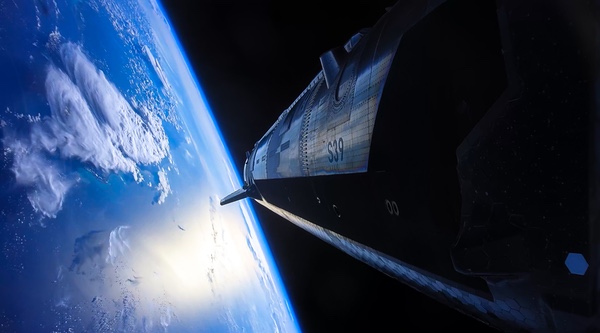 Starship during its brief time in space on Flight 12. (credit: SpaceX) |
And that future depends on Starship. “Any failure or delay in the development of Starship at scale or in achieving the required launch cadence, reusability and capabilities thereafter would delay or limit our ability to execute our growth strategy, including the deployment of next-generation satellites, global satellite-to-mobile connectivity, and orbital AI compute, which could materially adversely affect our business, financial condition, results of operations, and future prospects,” the company stated.
| “Achieving our targeted launch cadence will require significant progress on several key milestones and the continued investment of significant capital resources,” the company stated. |
While SpaceX has built up its connectivity business using Falcon 9 launches, it is depending on Starship to launch larger future-generation Starlink satellites with greater throughput and direct-to-device capabilities that will allow broadband connectivity directly to smartphones.
“Our current operational rockets, including Falcon 9 and Falcon Heavy, are not capable of deploying V3 satellites and V2 Mobile satellites,” the company said in the prospectus. However, a Starship will be able to carry 60 of the V3 broadband satellites and 50 of the V2 Mobile satellites.
Likewise, SpaceX’s ambitions for orbital data centers also require Starship. Moreover, the company said that while failing to achieve full reusability for Starship—yet to be demonstrated since the Starship upper stage has not been recovered on its test flights so far—would increase costs for Starlink, “AI compute satellites at scale need full Starship reusability to be economically compelling.”
“Achieving our targeted launch cadence will require significant progress on several key milestones and the continued investment of significant capital resources,” the company stated, adding it faces “a number of material challenges and uncertainties” to do so.
That was on display Friday when SpaceX made its second attempt to launch Starship. This vehicle is the first version 3 model of Starship, with significant upgrades to both the Super Heavy booster and Starship upper stage, including the introduction of new Raptor 3 engines.
For Super Heavy, the changes included an integrated “hot staging” ring at the top of the booster that remains attached after stage separation rather than detach as it had previously; the ring allows exhaust from the Starship upper stage’s engines to escape when the engines ignite before stage separation. The booster also has three, rather than four, grid fins that are larger and will also be used to catch the booster when it returns to the launch site.
The Starship upper stage has a redesigned propulsion system to address the fires seen on some V2 flights and also accommodate larger propellant tanks. Other upgrades include docking ports to allow Starships to dock with each other in orbit and transfer propellant, a key technology for missions beyond Earth orbit, including lunar landing missions.
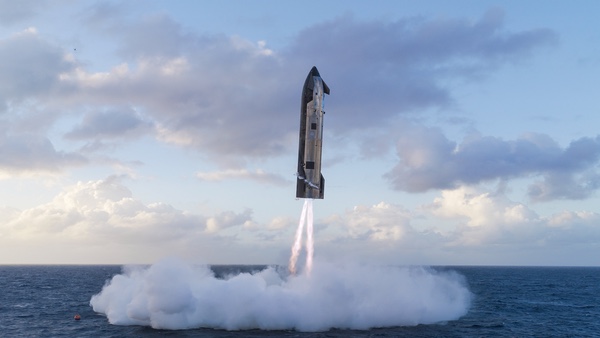 Starship making its “soft splashdown” in the Indian Ocean. (credit: SpaceX) |
Starship V3 is also intended to be the vehicle that SpaceX will put into service, carrying up to 100 tons of payload to low Earth orbit. Those flights could begin in the second half of this year, deploying Starlink satellites and carrying propellant for in-space transfer tests.
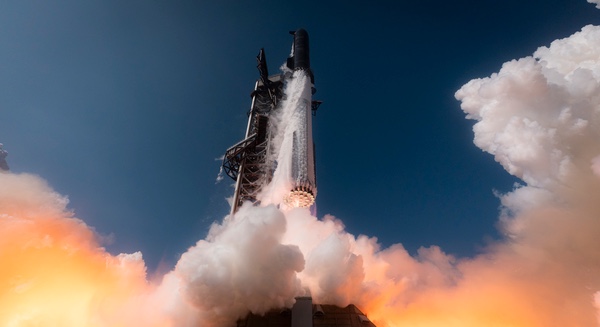
The countdown the second time around—this time, without a cameo by Minaj—went smoothly, and at 6:30 pm EDT the vehicle lifted off. The ascent appeared to go smoothly but was not without incident: one of the 33 Raptor engines shut down about 100 seconds into flight, but the vehicle continued to climb.
At stage separation, Super Heavy was supposed to perform a “boostback” burn: while SpaceX did not plan to return the booster to the launch site, they wanted to demonstrate maneuvers leading to a soft splashdown in the Gulf of Mexico. However, the booster appeared to suffer multiple engine failures—possibly an engine failure that took out neighboring engines—and the maneuver ended early. Super Heavy plummeted to Earth, with telemetry showing it traveling at nearly 1,500 kilometers per hour just before it hit the water.
One of the six Raptor engines on the Starship upper stage also shut down early in its burn. The other five engines continued to fire for about a minute beyond the scheduled shutdown time. “It does look like we are within bounds of what we analyzed” if an engine failed, said SpaceX’s Dan Huot during the webcast. “I wouldn’t call it nominal orbital insertion, but we’re on a trajectory that we had analyzed, and it’s within bounds.”
| SpaceX has invested $15 billon on Starship so far, including $3 billion last year and nearly $1 billion in the first quarter of 2026. |
It was good enough for one of the mission’s goals. While on its suborbital arc, Starship’s “Pez” payload door opened and the vehicle ejected 20 Starlink mass simulators. It also deployed two “Dodger Dog” spacecraft, so named because their cylindrical propellant tanks extended beyond their body. They were equipped with camera intended to inspect while in space.
SpaceX did not attempt a relight of a Raptor engine, as planned, but the spacecraft handled reentry with few issues. It made its “soft” splashdown under propulsion in the Indian Ocean, tipping over and exploding as expected to conclude the 66-minute flight.
Well before this Flight 12 mission, SpaceX officials had suggested that it might move ahead with an orbital launch attempt. However, the Raptor malfunctions suggest at least one more suborbital test flight might be needed before trying to do an orbital launch, let alone an orbital launch where both the booster and ship return to land at Starbase.
SpaceX has invested $15 billon on Starship so far, including $3 billion last year and nearly $1 billion in the first quarter of 2026, the company revealed in its prospectus. Despite the development struggles, there is no turning back now: the company’s future, including its trillion-dollar valuation as it goes public in the coming weeks, depends on Starship, even if launch is just small part of the company's business. Starships are meant to make SpaceX’s IPO fly.
Note: we are now moderating comments. There will be a delay in posting comments and no guarantee that all submitted comments will be posted.