Lost and found on the Pacific floor: the Nimbus SNAP-19 nuclear generatorsby Dwayne A. Day
|
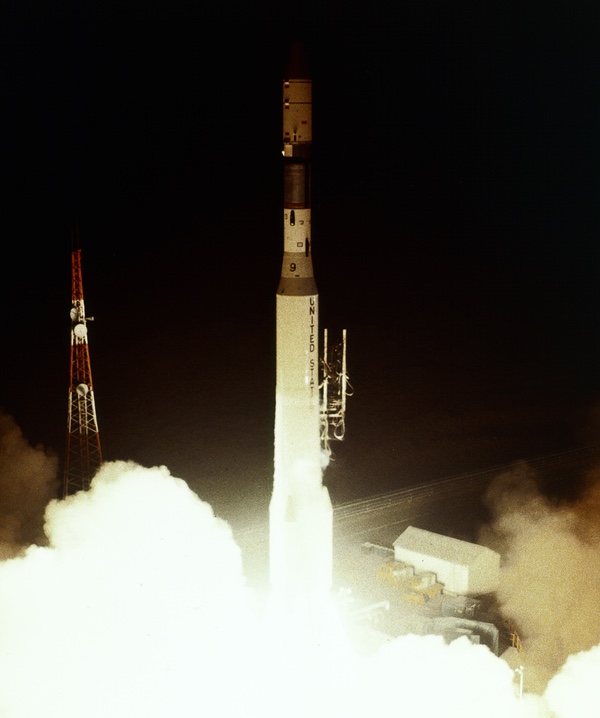 The May 18, 1968 launch of the third Nimbus satellite took place at night from Vandenberg Air Force Base in California. Two minutes after launch the range safety officer blew up the rocket after it strayed off course. Debris fell in the Santa Barbara Channel. (credit: Peter Hunter) |
Lost, found, lost
Immediately after the accident, government officials established radiation monitoring sites along the coast to detect any radioactivity from the mishap. No radioactive contamination was detected in any of the air, water, soil, plant, and fish samples they took.
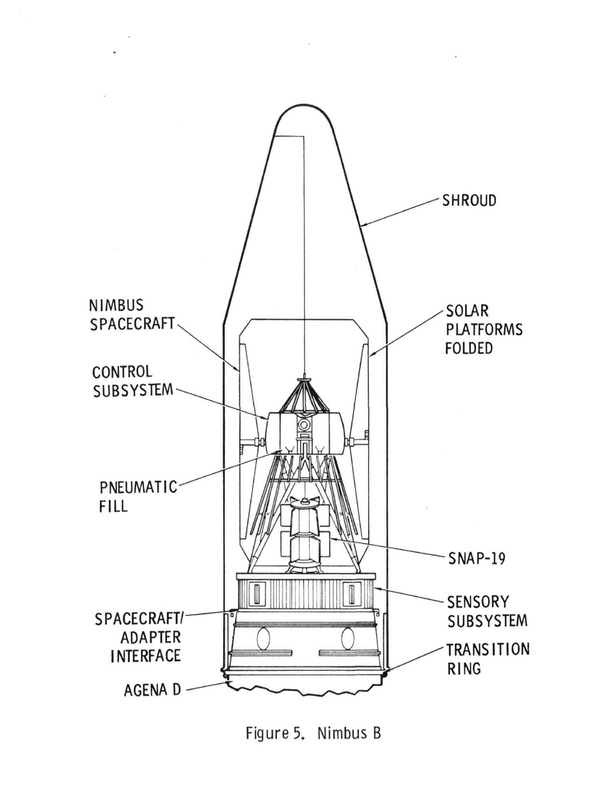 A diagram of the Nimbus satellite inside its payload fairing. Nimbus had a unique design that included a central lattice structure. (credit: Sandia) |
Trajectory data had been obtained from a transponder in the satellite, and an FPS-16 radar that skin-tracked the spacecraft. The impact point of the debris was calculated to be approximately 7.4 kilometers (four nautical miles) north of Harris Point on San Miguel Island.
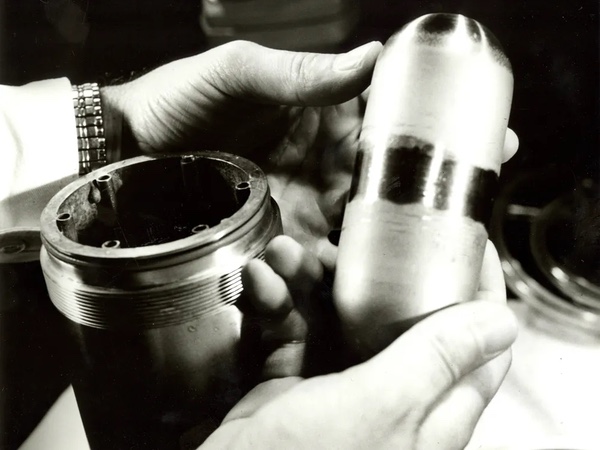 The SNAP-19 generators were relatively small. Two were carried on the Nimbus-B satellite. (credit: NASA) |
The Navy immediately set out to search the location. The Agena upper stage that carried the Nimbus was fitted with two water-actuated “pingers” designed to operate for ten days. But the search was hampered by weather and no sound contact was made. The first search was called off on May 29, 1968.
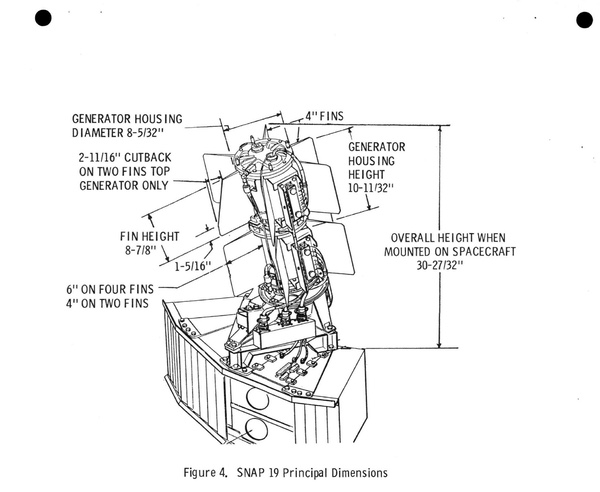 The two SNAP-19 generators were intended to provide power to the Nimbus satellite after its solar panels had degraded. (credit: Sandia) |
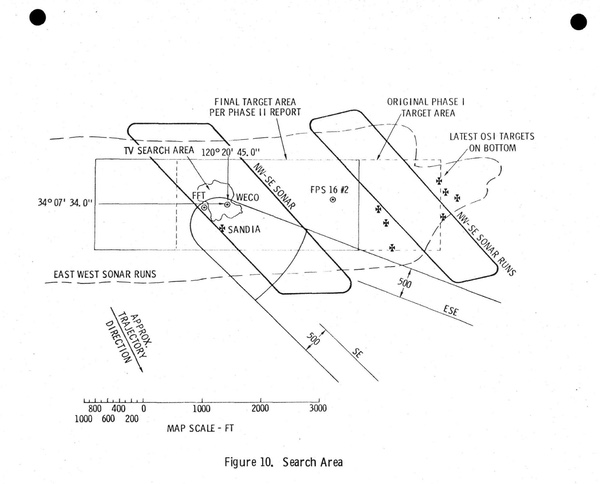 The search for the Nimbus debris went through several phases. Initial searches in May and July 1968 did not turn up any debris. It was later located in September, but then temporarily lost again before the SNAP generators were recovered in October. (credit: Sandia) |
Ocean Systems, Inc., under contract with the Navy, was requested to plan a second search operation. The oil supply boat Sea Tender was used as a support ship, carrying a side-looking sonar and an underwater television system and OSI diving equipment. The mission began on July 19, but did not arrive on station until July 24. The search was conducted in a “prime” area. But this search also did not identify any debris and was terminated on July 27.
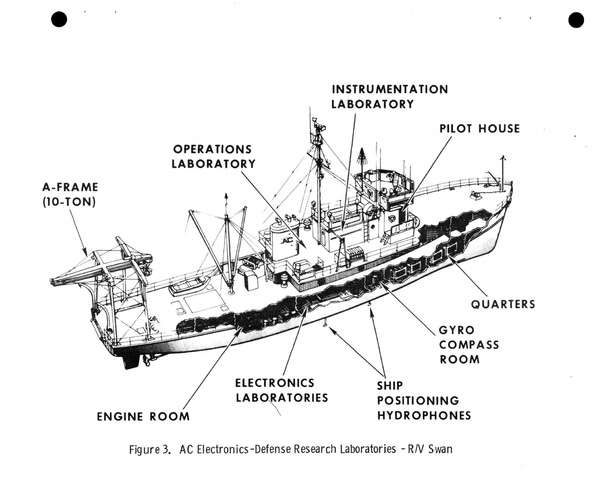 Swan was a recovery vessel operated by Sandia to deal with nuclear payloads lost in the ocean. The lab intended to start practicing with the ship and equipment in 1968 when it was pressed into an actual recovery of nuclear materials. (credit: Sandia) |
The Sandia nuclear laboratory was responsible for supporting underwater nuclear testing operations and had been developing a capability to search for and recover nuclear materials at sea. Sandia had already been planning to conduct a test search on a practice object near Santa Cruz Island in 1968, but the loss of the Nimbus payload now provided a real target.
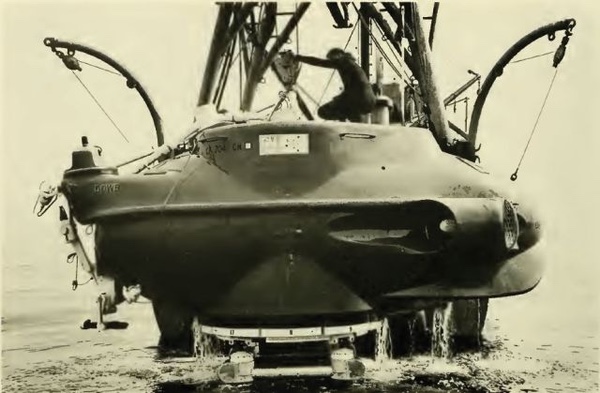 The Deep Ocean Work Boat, or DOWB, was a three-man deep submergence vehicle used in the search for the SNAP-19 RTGs. (credit: General Motors) |
Sandia’s resources included the support ship Swan. Swan could support a deep sea submersible. General Motors had built the unimaginatively named Deep Ocean Work Boat (DOWB) submersible, and the GM Automatic Ship Positioning System (ASPS), which were carried by Swan. The DOWB was a three-man deep submersible rated to 1,981 meters (6,500 feet). The waters near San Miguel were only about a hundred meters deep, which was not a challenge for the DOWB and could even be accessed by deep sea divers. The ASPS was a portable array consisting of three ship-mounted hydrophones and associated electronic gear. The ASPS was capable of continuously monitoring the position of the DOWB relative to the support ship.
On September 23, the Swan departed Santa Barbara Harbor and arrived on station in the early morning. On Tuesday, September 24, just as the DOWB was about to end its search for the day, it located a large section of the missile shroud. This was marked with a surface buoy that was referred to as “Delta I.” The debris was at a depth of 91 meters.
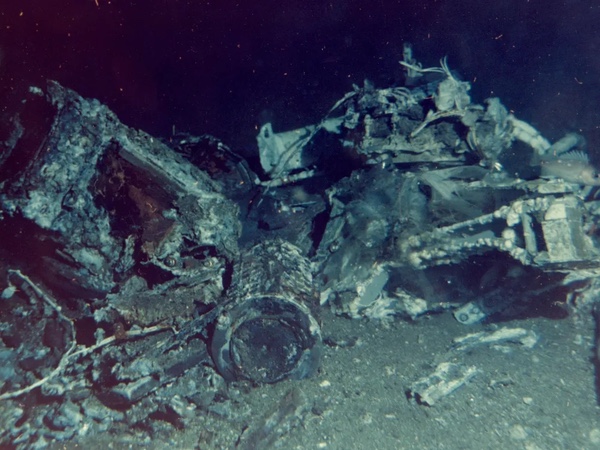
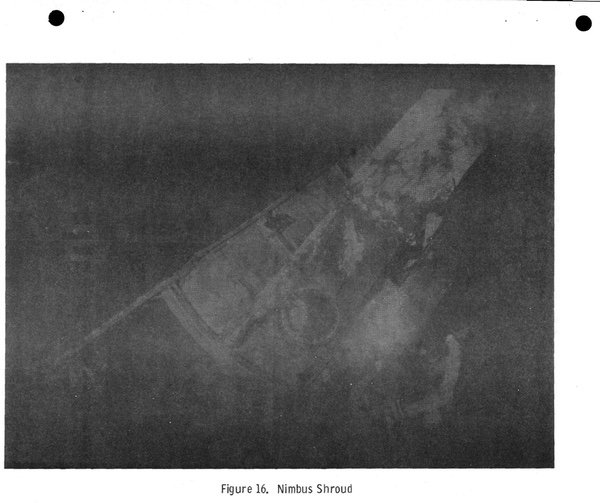 Wreckage of the Thor fairing on the ocean floor. (credit: Sandia) |
The next day diving continued and debris was again sighted. This consisted of shroud sections, spherical tanks, clamps, and assorted electronics. But observers also spotted what they described as a child’s “jungle gym.” This was the Nimbus portion of the payload and it was marked with an additional surface buoy, referred to as “Delta II.” The Swan’s position was also marked. The DOWB and Swan were also used to lay a cable on the floor to mark the location, but this was apparently dragged out of position by the Swan’s anchor.
On September 26, search operations resumed, but the DOWB could not locate the Delta II wreckage on the sea floor. On September 27, during continued search operations, the SNAP-19 was found and photographed. It was positively identified by representatives of NASA, the Atomic Energy Commission, and Sandia.
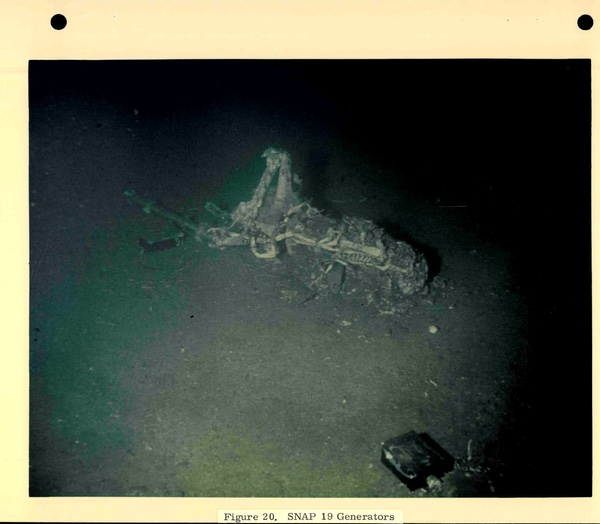 The SNAP generators were positively identified with photographs taken on the ocean floor. (credit: Sandia) |
But again on September 28 and 29, efforts to relocate the SNAP-19 were unsuccessful. According to a report, “It became evident that a strong wind and strong current, working in opposite directions, had moved the surface buoys.” The mission was terminated on the evening of September 29.
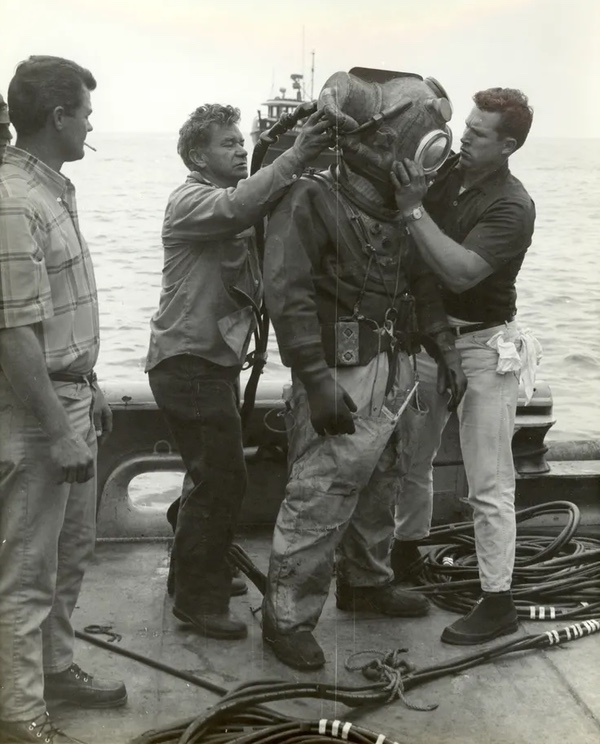 Deep sea divers were involved in the Nimbus recovery. The wreckage was at a depth of 91 meters. (credit: NASA) |
The Swan went out again the following week. The generators were re-located on October 4. The RTGs were recovered on the afternoon of October 9 using the DOWB and “hard hat” divers. The nuclear generators had no visible damage except for the loss of a small portion of graphite coating on one generator. They were placed in a steel drum containing fresh water. The drum was sealed and loaded on a truck and shipped to Mound Laboratories.
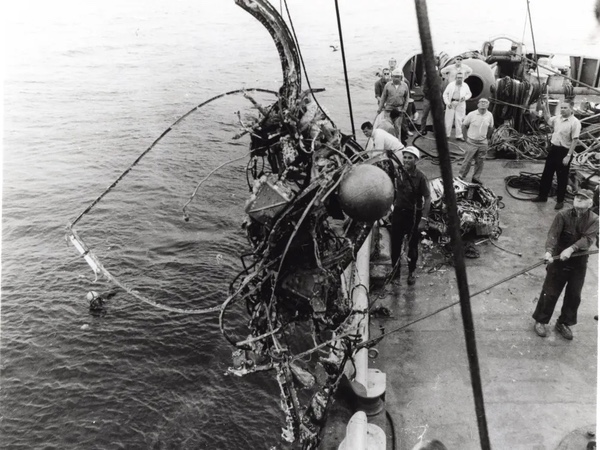 Recovery of the Nimbus debris in late 1968. (credit: NASA) |
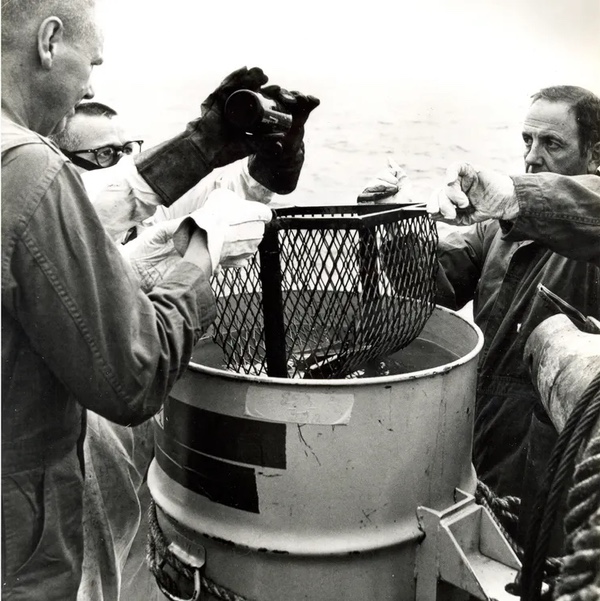 The SNAP generators being placed in a barrel on board the Swan recovery ship. No radiation was detected after the accident. (credit: NASA) |
Later examination found no radiation in the drum’s water. The RTGs had remained intact. Throughout the entire operation, no radiation leakage was detected. The new RTG design had been proven in the real-world crucible of a launch accident. At Mound Laboratories, the plutonium fuel was extracted and reused.
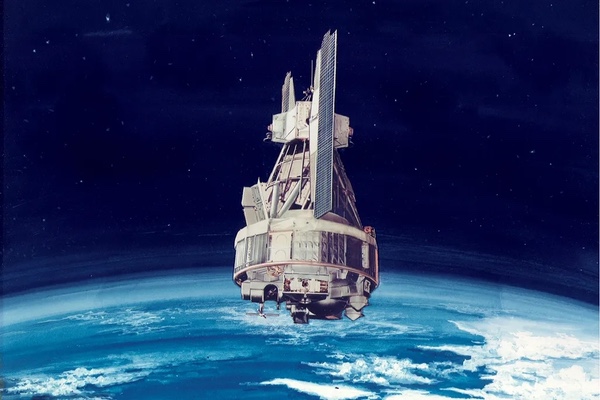 Several Nimbus Earth observation satellites were launched starting in the 1960s. They had a distinctive design. The third satellite was equipped with radioisotope thermoelectric generators in addition to its solar panels. (credit: NASA) |
Launching Nimbus-3
In April 1969, NASA successfully launched a Nimbus satellite, again carrying two SNAP-19B RTGs. This one reached orbit and was designated Nimbus-3. NASA later successfully used SNAP power sources on several Apollo surface missions, but the United States eventually adopted a policy of no longer placing them in Earth orbit.
Further reading:
Environmental Surveillance Southwestern Radiological Health Laboratory, Department of Health, Education, and Welfare, Public Health Service, National Center for Radiological Health, “NIMBUS-B/SNAP-19 Launch, May 18, 1968, Off-Site Radiological Surveillance,” December 1968.
Sandia Laboratories, “Underwater Search Operation: Nimbus B/SNAP 19 Generators,” November 1968.
Maya Wei-Haas, “The Day the Nimbus Weather Satellite Exploded,” Smithsonian Magazine, January 9, 2017, https://www.smithsonianmag.com/science-nature/day-nimbus-weather-satellie-180961686/
“SNAP 19 Radioisotope Power Supply: Operation and Maintenance. Technical Manual (Report).” January 1, 1967. doi:10.2172/4513086. OSTI 4513086.
Note: we are now moderating comments. There will be a delay in posting comments and no guarantee that all submitted comments will be posted.