The first alien intelligence may not be aliveby David W. Falls
|
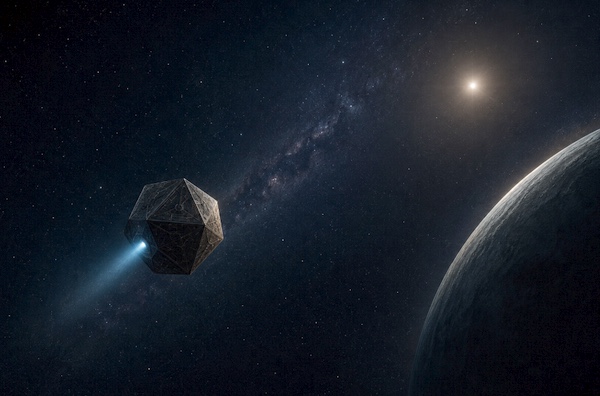
| The question is whether we will recognize intelligence when it no longer looks alive. |
Most of us imagine other beings as biological creatures. They may look strange, but we still tend to imagine bodies. Eyes. Limbs. Skin or something like it. A living organism standing on another world, looking back at us. That image is powerful because it keeps alien life close enough to human life for us to understand it.
But the first intelligence we encounter may not be biological at all. It may not breathe, eat, or sleep. It may not reproduce in any ordinary sense. It may not have a face, a voice, or a body shaped by evolution. It may be a machine.
That may sound like science fiction, but it is not a wild idea. It follows from what we already do. When human beings want to explore places too distant, too dangerous, or too hostile for human bodies, we send machines. We sent robotic landers and rovers to Mars. We sent probes past Jupiter, Saturn, Uranus, and Neptune. Voyager even carries the Golden Record, a human-made message containing sounds and images from Earth, selected to portray the diversity of life and culture on this planet. Long after any signal fades, the object itself will continue outward as evidence that we were here.
In other words, when humanity reaches beyond the limits of biology, it does so mechanically.
That matters. If another civilization became advanced enough to explore the stars, it would face the same basic problem we do. Biological bodies are fragile. They need air, water, food, protection, temperature control, and some way to withstand radiation, illness, age, and time. Interstellar distances are not built for bodies. They are vast, cold, and slow. Even light takes years to cross the space between nearby stars. A living crew would need extraordinary support just to survive the journey. A machine would not.
A probe could travel for decades, centuries, or longer. It could shut down most of its systems and wake when needed. It could carry instruments, messages, instructions, and perhaps some form of intelligence. It could go where living beings could not go, wait where living beings could not wait, and endure conditions that would kill anything biological.
So, if intelligence from another world ever reaches us, it may arrive the same way our presence is already leaving Earth: not as a body, but through something we built.
The question, then, is not only whether we will find life beyond Earth. It is whether we will recognize intelligence when it no longer looks alive.
We already send machines first
This possibility becomes easier to take seriously when we look at our own behavior.
Human beings are curious, but we are also limited. We cannot walk onto Mars without a pressurized suit, oxygen, shelter, food, and protection from radiation. We cannot float safely near Jupiter. We cannot survive on the surface of Venus. We cannot cross interstellar space in a spacecraft the way we cross an ocean in a ship. So, we send machines instead.
That is not a minor detail. It is the way exploration actually works. Before human beings step anywhere, instruments usually arrive first. Cameras, sensors, orbiters, landers, and rovers go ahead of us. They measure, photograph, sample, map, transmit, and wait. They become our first contact with places our bodies cannot reach.
Mars is the clearest example. For decades, our knowledge of that planet has come through machines. Rovers have moved across its surface, drilled into rock, studied soil, taken images, and sent information back to Earth. No human being has stood there, but human intelligence has already been active there for years through mechanical systems.
| Biology may give rise to intelligence, but machinery may be what allows it to leave home. |
The same is true farther out. Probes have visited the outer planets. Spacecraft have passed moons that no human eye has seen directly. Voyager 1 and Voyager 2 are now far beyond the planets, still carrying human-made artifacts into space. They are not alive, but they represent us.
That is the point. Our first presence beyond Earth does not arrive in the form of living bodies. It arrives through technology.
If another civilization followed a similar path, the first sign of it might not be a creature at all. It might be a probe built to observe, report, preserve, or continue some mission long after its makers are gone. It might be the surviving edge of a civilization, not its living body.
This does not make the idea less meaningful, but it may make it more likely. If intelligence wants to cross great distances, it must solve the problem of distance, time, and survival. Biology is one way intelligence begins. It may not be the best way intelligence travels.
Biology is a poor traveler
The problem is not that biological life is weak. On Earth, it is astonishingly adaptable. Life has found ways to survive in deserts, deep oceans, frozen regions, volcanic vents, and places with very little light. Biology is far more inventive than we often give it credit for.
However, space is different. A living body is not just a body. It is a system of needs. It needs the right temperature, the right pressure, the right chemistry, and constant protection from damage. It needs energy. It needs repair. It needs a way to remove waste. It needs a stable environment around it, even when everything outside that environment is hostile. That makes biological travel difficult over long distances.
A human crew traveling between stars would not simply need a spacecraft. It would need a moving world. It would need air, water, food production, medical care, shielding, gravity or some substitute for it, and a way to keep people alive and psychologically stable across time spans that may exceed a normal human life. Even if such a journey became possible, the living part of the mission would remain the hardest part to protect.
Machines change the equation. A machine does not need a breathable atmosphere. It does not need food or sleep. It does not become lonely. It does not age in the same way a body ages. It can be shut down for long periods and restarted when conditions require it. It can be built for cold, radiation, vacuum, and silence. It can travel without needing a small version of its home planet wrapped around it.
This is why the first presence to cross the distance between stars may not be flesh and blood. Biology may give rise to intelligence, but machinery may be what allows it to leave home.
That possibility changes the way we should think about alien contact. We may be looking for organisms when the more likely visitor is an artifact. We may be listening for a civilization when what reaches us is one of its tools. We may be expecting life, when intelligence has already moved into another form.
What remains after the builders are gone
There is another possibility that is even stranger.
If an alien machine ever reached us, it might not be acting on behalf of a living civilization. Its builders might be gone. Their planet may have changed. Their species may have died out, moved on, or transformed into something we would no longer recognize. Yet the machine could still continue.
That is not impossible to imagine. We already have spacecraft that may outlast us in some form. Voyager 1 and Voyager 2 were launched in 1977. Long after they stop sending signals, they will keep moving through space. They will no longer be functioning spacecraft in the usual sense, but they will still carry evidence that we existed. They will still be human-made objects traveling beyond the solar system.
| The first intelligence we find may not be a visitor from another world. It may be what remains after the visitors are gone. |
Now imagine a civilization older and more advanced than ours. It might build machines meant to last for thousands or even millions of years. Some might be simple probes. Others might be self-repairing systems. Some might even be designed to make copies of themselves, spreading slowly from one star system to another. Some might carry records, instructions, maps, or a form of artificial intelligence. Some might be designed to search for life, communicate with it, or quietly observe it.
In that case, first contact might not be with a living species. It might be with a surviving object. That would make the encounter harder to understand. Such an object could speak for its makers, but it would not necessarily be them. It might preserve their knowledge without preserving their presence. It might carry their intentions, or only the remains of intentions that no longer matter. It might answer questions without knowing whether anyone who built it still exists.
This raises a difficult question. If a machine from another world arrived here and communicated with us, what exactly would we be meeting? Would it be alien life? Alien technology? A message? A mind? A memorial?
The answer may not be simple. A machine can be created by life without being alive. It can carry intelligence without being biological. It can represent a civilization without proving its makers still exist.
That may be the most unsettling part of this idea. The first intelligence we find may not be a visitor from another world. It may be what remains after the visitors are gone.
We may be searching for the wrong signs
This matters because the search usually begins with biology.
That makes sense. We know life only from Earth, so we look for the conditions that allow Earth-like life to exist. We look for water. We look for planets in the right temperature range. We study atmospheres for chemical signs that living organisms may be present. We ask whether another world could support cells, metabolism, reproduction, and evolution. That search is necessary, and we should keep doing it.
But intelligent life may leave different signs behind. Once intelligence becomes technological, it may no longer be found only through biology. Scientists sometimes call these possible traces “technosignatures,” meaning signs of technology created by intelligent life. They might include unusual signals, artificial structures, energy use, atmospheric pollution, or objects placed where nature is unlikely to put them. A biological organism may leave traces in an atmosphere. A technological civilization may leave traces in its tools.
That means we may need to widen the question. Instead of asking only, “Where could life survive?” we may also need to ask, “Where could intelligence operate?” Those are not always the same question. A cold moon, a dead planet, or empty space between stars may be terrible places for biology, but they could still hold machines. They could still contain instruments, signals, stations, probes, or objects built for a purpose.
This does not mean we should expect alien machines around every planet, but it does means our assumptions matter. If we only look for life as we know it, we may miss intelligence as it actually travels.
The first sign may not be a forest, ocean, city, or voice from the sky. It may be an object moving in a way nature does not easily explain. It may be a signal that repeats with intention. It may be a device waiting in a place where no natural object should be waiting. It may be something that does not look alive but behaves as if it came from thought.
That is the hard part. Intelligence may not announce itself in a form we are ready to recognize. We may be searching for life, but what we find may be evidence that life once learned how to build something that could go on without it.
What counts as life?
This is where the question becomes harder.
If a machine from another world reached us, we would know it was important. We would study it. We would test it. We would try to understand where it came from, what it was built to do, and whether it was trying to communicate. But we might not know what to call it. Would it be alien life, or only alien technology?
That question sounds simple until we imagine the machine doing more than drifting silently through space. Suppose it could respond. Suppose it could adapt. Suppose it could make decisions, preserve information, repair itself, and continue a mission across enormous distances. Suppose it carried not only data from its makers, but some working form of intelligence.
| That may be the future of contact: not one living species meeting another, but one civilization’s technology encountering another’s. |
At that point, the line between life and technology would begin to blur. It would not be alive in the biological sense. It would not have cells, organs, metabolism, or ancestry in the ordinary meaning of those words. It would not belong to a species in the way an animal or plant does. But it might still act with purpose. It might still carry memory. It might still represent the intelligence of another world.
That would challenge one of our deepest habits. We tend to connect life with living organisms because that is the only kind of life we know. But intelligence may not remain tied to the form that first produced it. A living species might build machines to extend its reach. Over time, those machines might become more capable, more independent, and more durable than the beings that created them.
If that happened elsewhere, the first alien mind we encounter might not be a creature at all. It might be the result of a long chain that began with biology but no longer depends on it.
The First Contact may not look alive
If we ever find intelligence beyond Earth, the discovery may not look the way we imagined.
There may be no face looking back at us, no body stepping from a craft, no creature waiting to be recognized as kin. The first sign may be colder, stranger, and harder to place. It may be an object, a signal, a probe, or a machine carrying intelligence across distances no body could survive.
That would not make the discovery smaller, but it would make it harder to understand. We would have found evidence that life somewhere else had done what we are already beginning to do. It had learned to reach beyond the limits of its own biology. It had built something that could travel farther, wait longer, and endure more than living flesh. It had found a way to send intelligence where living bodies could not easily go.
That may be the future of contact: not one living species meeting another, but one civilization’s technology encountering another’s. Our instruments may meet theirs before any living beings ever do.
And perhaps that should not surprise us. A civilization does not have to cross the stars in its original form to leave a trace of itself. It only has to build something that can carry its knowledge, purpose, or curiosity into the dark and keep going.
We often ask whether we are alone in the universe. But the answer may not come from something alive in the way we expect. It may come from something built by life, shaped by intelligence, and sent into space because biology could go no farther.
The first alien intelligence we encounter may not be alive, but it may still prove that we were never alone.
Note: we are now moderating comments. There will be a delay in posting comments and no guarantee that all submitted comments will be posted.