America’s most exposed power projection platformsWhy United States Space Force installations must be treated as warfighting infrastructureby David G. Hanson
|
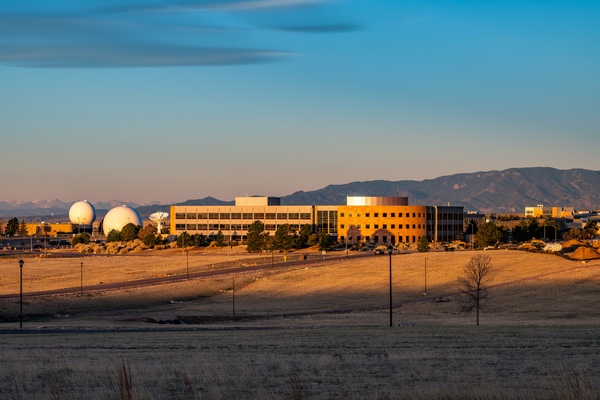
| Unlike a deployed airbase or naval forward operating location that supports a specific campaign, Space Force installations are the campaign. |
Space Force Bases such as Peterson, Schriever, Buckley, Patrick/Cape Canaveral, Vandenberg, and others are not rear area support hubs: they are power projection platforms, executing around-the-clock space control, satellite communications, missile warning, intelligence, navigation warfare, access to space, and command and control in real time. If these installations fail, space effects cease immediately, with cascading consequences across all domains of warfare. Yet, USSF installations are still too often resourced, protected, and governed as traditional military installations, rather than as critical nodes of continuous global combat operations. This mismatch poses a serious national security risk.
Why Space Force installations are operationally unique
Space Force doctrine explicitly distinguishes space forces from other services by emphasizing that space missions are predominantly executed from fixed locations rather than forward deployed units. The Space Force’s Space Force Generation (SPAFORGEN) model formalizes this reality, noting that most combat squadrons are “employed in place,” continuously providing effects to combatant commanders without physical movement of forces.
This means there is no rotational buffer between peacetime and wartime operations. Guardians perform some of the same operations to ensure peace as they do during conflict. Also, Space Force installations are in a constant commit phase posture for portions of the force. Outside of the operations centers, it looks the same. Food is served in the dining hall, ID cards are checked at the front gate, and personnel are seen at the medical clinics. However, inside those space operations center, strategic missions are performed and often against an enemy who never disappears. Finally, infrastructure, power, heating and cooling, and cyber connectivity are part of the weapon system, not mere enablers. When these are negatively affected, missions degrade.
The Space Force’s employed-in-place operational model fundamentally changes the meaning of “installation.” Unlike a deployed airbase or naval forward operating location that supports a specific campaign, Space Force installations are the campaign. From a single Space Force installation, Guardians provide continuous missile warning and tracking. They enable or deny global navigation and timing and support joint targeting and kill chains. They provide assured access to space. Further, they monitor and contest adversary space maneuvers. Finally, Guardians today maintain global command and control for space operations.
Adversaries, such as China and Russia, are increasingly pursuing strategies that target the terrestrial foundations of space power rather than satellites alone. Referred to as the “soft underbelly,” these targets include cyberattacks against ground systems and the lines to and from them, electromagnetic disruption against a terrestrial antenna or radar, supply chain interference, and energy grid denial.
How did we get here?
Applying legacy installation funding, protection, and governance models has created systemic risks. The underinvestment in energy resilience has led to a dependency on municipal power sources. Believe me, local power companies provide a valuable service and are patriots themselves. However, their systems are often not protected from outside intrusion. They are just not set up for that kind of defense or the cost of resilience.
Further, insufficient cyber-physical integration directly affects space operations. It is all about the 1s and 0s. Receiving data from terrestrial sensors and from spacecraft allow Guardians to do their jobs of analyzing this data and quickly responding to anomalies and adversary actions.
| When the priority is placed on exquisite weapon systems, the first things cut from budgets are mission support activities: projects and initiatives that keep the bases running in peacetime and resilient during conflict. |
Moreover, as space operations are constantly occurring, should an outage occur, slow recovery timelines are incompatible with combat operations. How do we recover from a power outage? What is the resolution to a damaged or cut fiber optic cable carrying sensitive data? What actions are taken when a cooling air system suddenly powers down causing equipment racks to heat up? Time is of the essence in all of these situations to not only respond to actions in the space domain but to prevent equipment damage resulting in mission degradation and failure.
When the priority is placed on exquisite weapon systems, the first things cut from budgets are mission support activities: projects and initiatives that keep the bases running in peacetime and resilient during conflict. No doubt, we need the best weapon systems to monitor adversary actions in space as well as to maintain the capability to strike. The US space enterprise does a fantastic job at designing and delivering these systems to our warfighters. Budgets are passed with these exquisite systems in mind.
What is lost, though, is focus on the systems that allow weapon systems to function day in and day out, without interruption. The assumption is that these support systems will always be there, providing power, cooling air, and cyber connectivity 24/7. We do have a fantastic group of civil engineers and communication professionals who maintain these systems. But they spend an inordinate amount of time and effort finding ways to keep aging systems alive way past their lifespans. And what happens when the enemy decides to degrade these systems with a cyberattack or a precise cut on a power or cyber line? We are not prepared for these attacks much less protecting these systems from these kinds of attacks.
The fallacy of “installations as rear areas”
Traditional US military installation models assume that bases are logistical hubs or training centers. These are places where warfighters and their families live, train, and practice their tradecraft. But when tensions rise or a conflict surfaces, those warfighters and their equipment move forward, closer to the conflict. Home bases exist to support missions that are sent elsewhere, where the conflict is or where the forces are required. This model assumes combat power is generated elsewhere. In these cases, mission degradation from base disruption is either delayed or recoverable.
These assumptions are invalid in the Space Force. Department of Defense instructions on installation resilience highlight that mission assurance must now account for energy, water, cyber, and extreme weather vulnerabilities. While keeping these aging systems operational during peacetime is a daunting and often losing effort, imagine fighting through adversary’s attempts to disrupt, disable, or deny critical infrastructure during escalated tensions. For the Space Force, these vulnerabilities directly affect combat capability.
Communication lines are the circulatory system of space weapon systems, both physical fiber lines and over-the air electromagnetic signals. They keep our satellites flying, ensure we are able to communicate, and carry data between sensors and operation centers. When these lines are interrupted, the mission is degraded. When they are sliced at key chokepoints, the mission stops.
| The most important person on the base was the HVAC technician. Usually without a backup, this lone technician was the lynchpin between the US providing space power and mission failure. Only they could diagnose, repair, and bring back online the chiller units in case of an outage. |
There is an ongoing argument about where mission communication lines end and where base-level communication lines begin. This in turn determines who is protecting them. When we consider all communication lines critical—from inside an operations center, traversing throughout the base, or extending across America and under the oceans—and protect them equally, we are protecting the entire mission. How many times did we have to react to a backhoe cutting a key fiber optic line in rural America? The answer is too many. The effects to space missions in Colorado were instantaneous, but the repairs were never fast enough. And what happens when those are not “accidental” cuts, but strategically planned by an adversary?
Chiller systems provide cooling air to equipment racks in server rooms. These are the backbone of space force weapon systems. When the chillers go down, temperatures in those server rooms rise, and these equipment racks are then systematically shut down to prevent overheating and permanent damage. The result is immediate mission failure.
A story I often told involved who I dubbed was the most important person on Schriever Space Force Base on a Saturday night. When the base was mostly quiet except for the Guardians on watch performing space operations, and a few Airmen and civilians providing base security, communication and infrastructure support, the most important person was the HVAC technician. Usually without a backup, this lone technician was the lynchpin between the US providing space power and mission failure. Only they could diagnose, repair, and bring back online the chiller units in case of an outage. This singular, and often junior, technician is a strategic asset.
Doctrine is clear: space is a warfighting domain, and Guardians must contest and control it continuously to protect joint force operations. Space Force installations are therefore forward combat nodes, even when located inside the continental United States.
Funding and protection priorities, now and in the future
Immediate and continual attention and prioritized funding to Space Force installations is necessary to keep them running today. But just as important is ensuring base resiliency when challenged by an adversary. Four “pillars” emerge as to where resources should be focused now. If Congress increases Space Force funding in fiscal year 2027, a share of this funding must be directed at these efforts.
The first of these is Energy Independence and Resilience. Power is life for Space Force weapon systems. Without it, they are a dark and cold network of components and wires. Backup power is also essential but providing clean, uninterrupted primary power is a primary concern. Analyzing current commercial power grids, the number of feeds on each base, and the state of backup power are strong first steps. Supplanting with microgrids, on site generation, and long-duration backup power cements the protection of power as a weapon-system dependency.
Next is Hardening and Redundant Infrastructure. When infrastructure facilities such as power production, chiller areas, server rooms, and accompanying control systems were designed, what thought was put into ensuring they are safe from outside interference? Physical protection is one consideration but so is cyber security, electromagnetic interference, and diverse fiber cable paths. These engineering facilities must be designed for continuous operations under attack. There must be geographic and functional redundancy for critical mission nodes.
This is important at all Space Force installations but consider the importance at our spaceports. There are only two major ones now. Degrading or shutting down even one of them prevents the US from launching new payloads into orbit today and reconstituting damaged or inactive satellites during a conflict. This call also supports the ongoing spaceport expansion and modernization initiatives.
| Failure to properly resource Space Force installations may not result in gradual degradation. Instead, it may result in sudden operational collapse as aged infrastructures crumble or when the adversary makes bad things happen by simply pushing the Enter button. |
Further, Cyber Physical Security Integration must continue to evolve and expand to counter threats. Our cyber professionals will tell you that we are in constant conflict in the cyber domain, warding off thousands of intrusion attempts every day. When these intensify during increased tensions, are we able to keep our weapon systems and infrastructure control systems safe? A well-rounded, unified defense of networks, facilities, and personnel can prevent this. We must treat Space Force installations as contested cyber terrain. The addition of AI data centers dedicated to missions and/or installations will assist in this effort.
Finally, Personnel Sustainability cannot be overlooked. Guardians and Airmen, both military and civilian alike, are the keys to making this work. They work long hours, create unique solutions to solve complex challenges, and are in a constant state of combat operations. Taking care of them and their families, including shift-work resilience, adequate staffing levels, housing, healthcare, and retention mechanisms, will help sustain their resilience now and into the future. These professionals are not deployable “surges,” but rather, enduring combat operators and must be treated as such.
Future investment priorities
And beyond FY27, investments in base resiliency cannot be a one-time fix. Installation design standards should be based on mission assurance, not peacetime efficiency. Will this facility, node, ot utility survive first contact with the enemy? Do we have the ability to develop rapid repair and reconstitution capabilities for when we are degraded or disabled? How can we get back into the fight now? Let us not shy away from fielded industry capabilities but instead, welcome a seamless integration of proven commercial infrastructure.
Finally, and just as important, is for future weapon systems and weapon system extension programs to mandate the inclusion of infrastructure considerations before they are fielded. Can the current power system support another weapon system, or does it need to be updated or enhanced? Are there enough infrastructure technicians available to support the additional power, chiller, and communication requirements? What other mission support activities need to be increased to support future enhancements?
The consequences of inaction
Failure to properly resource Space Force installations may not result in gradual degradation. Instead, it may result in sudden operational collapse as aged infrastructures crumble or when the adversary makes bad things happen by simply pushing the Enter button. This is a reality we face, despite the heroic efforts of today’s civil engineers, security forces, and cyber/communication experts who magically “duct tape and band-aid” these systems, keeping them operating way beyond their operational lifespan. If installations lose power, connectivity, cooling air, or cyber networks, joint force targeting becomes blind or delayed, space control operations falter, and deterrence fails without a shot fired. As Space Force Doctrine bluntly states, “Without space, kill chains do not close, operations are less synchronized, and we lose.”
During my time at Space Base Delta 1, we were fortunate to receive tens of millions of dollars each fiscal year to support the infrastructure we operated and maintained at the seven Space Force bases under our umbrella. But even with those funds, we were only able to replace, and usually just repair, a limited number of critical infrastructure systems at each base. Despite resources earmarked for infrastructure and our due diligence keeping them working, we still experienced unplanned power outages, chiller failures, cut fiber optic lines, and water main breaks. These infrastructure failures were the result of aging and insufficient systems. We need to be better and protect against not just “bad luck” but potential adversary intrusion.
A good news story
The selection of Buckley Space Force Base for a nuclear microreactor pilot program reflects a growing recognition that energy resilience is mission critical for space power projection, not merely an efficiency measure. This is the right first step towards ensuring uninterrupted space power projection. But this should only be the start. Equipping other Space Force bases (and other military installations) with this type of resilient power is the logical next step.
Let us not allow power resiliency to overshadow the other infrastructure needs that are just as critical. Secure data centers, resilient communication lines, and protected infrastructure control systems must certainly follow.
A call to action
The United States has rightfully invested billions of dollars in space systems, satellites, and architectures, yet these capabilities remain hostage to the resilience of a small number of terrestrial installations. Officially recognizing Space Force installations as forward warfighting infrastructure and resourcing them accordingly would start to right the ship. These installations must be protected as strategic assets. We must govern them with authorities aligned to global combat responsibility. Failure to act will not merely degrade space capabilities—it risks silencing them altogether at the moment they are needed most.
The fight for space superiority does not begin in orbit. It begins—or ends—at the installations on Earth that make space power possible.
Note: we are now moderating comments. There will be a delay in posting comments and no guarantee that all submitted comments will be posted.