Yesterday’s Future: space settlement and castles in the skyby Dwayne A. Day
|
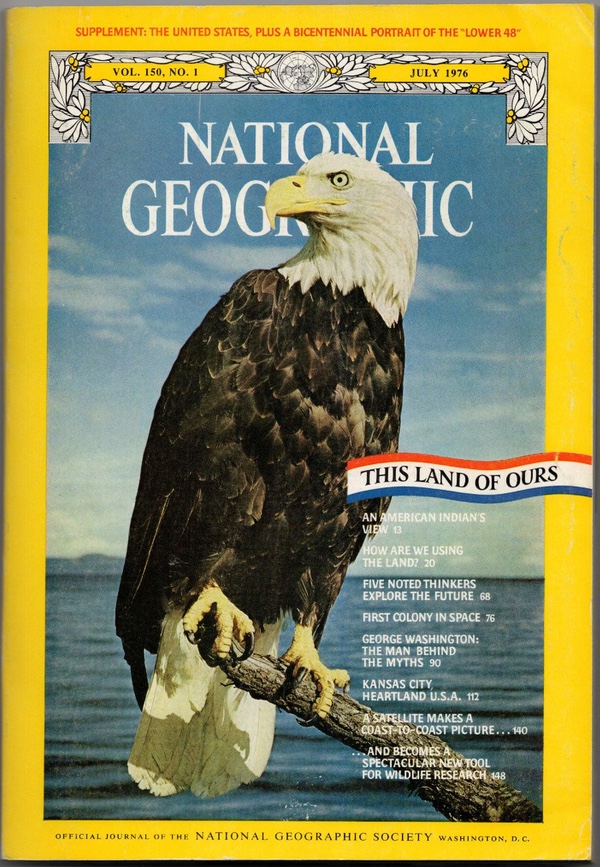 The July 1976 issue of National Geographic celebrated the United States Bicentennial. It featured a number of articles looking towards America's future, including the far-distant year of 2026. (credit: National Geographic) |
Asimov’s inspiration was clear: in 1974 Gerard K. O’Neill had begun organizing conferences on the subject of space settlements—then generally referred to as “colonies”—and servicing solar power satellites. Some of his enthusiastic followers formed the L-5 Society in 1975, and by early 1976 O’Neill had reached such prominence with the subject that he testified before the US Senate. His book The High Frontier was not published until 1977, however, and it seems likely that more people were exposed to the concept of space cities and solar power satellites by Isaac Asimov in the pages of National Geographic—whose subscription base was over six million in the mid-1970s—than were exposed to it via O’Neill’s book or other writings.
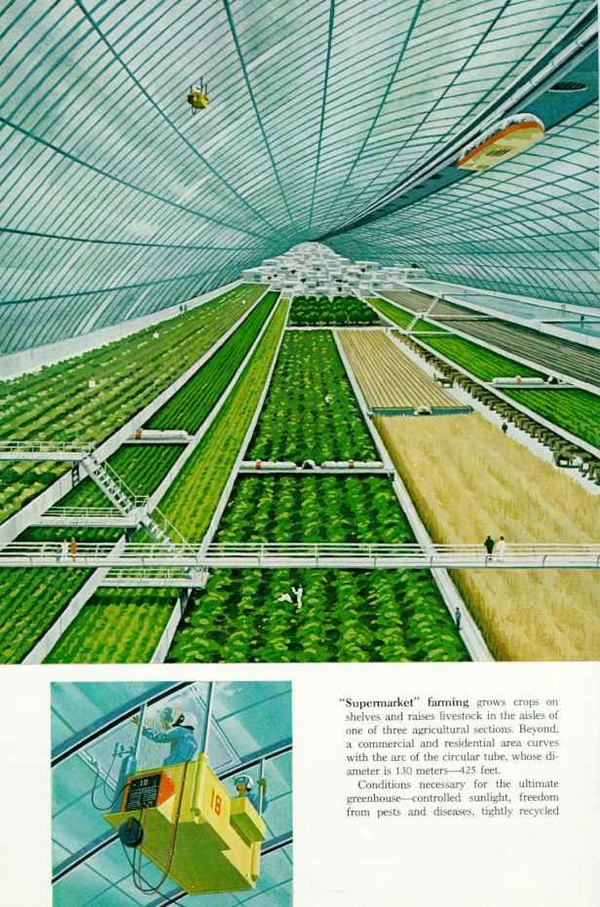 The space station was not fully self-sufficient, but grew much of its own food. (credit: Pierre Mion, National Geographic) |
Asimov’s article, “The Next Frontier?,” illustrated by Pierre Mion, was written as a first-person account of a visit to an L-5 colony in the far-distant future of 2026. The account is mostly description: the National Geographic reporter is met by the settlement’s director, George Fenton, who shows him around and explains how everything works. Asimov experiences the gradual onset of simulated gravity as he travels from the arrival hub down a spoke to the station’s rim. The space station is nearly 1,800 meters in diameter and houses 10,000 people.
Fenton shows him the farms and the industrial areas. He introduces the reporter to a rabbit meat hot dog and goat milk shake. He explains how the population is majority male, but they do have women, and families, and even a thousand children on the station. He shows the reporter a residential area and explains that the streets curve back and forth so that you cannot see them end and become disoriented. Fenton explains how the six segments of the torus are separated by airlocks in case of emergency. The space city is not completely self-contained but is working on it. They still import things from Earth, but most of their raw materials come from the Moon. They recycle everything that they can; the reporter declines Fenton’s offer to tour the sewage plant.
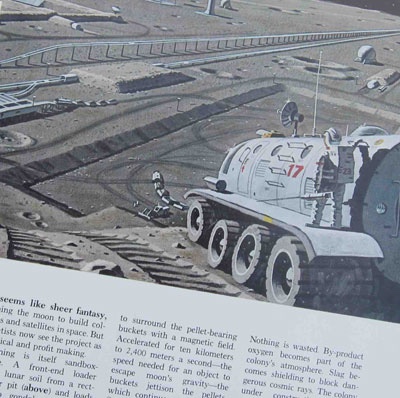 The giant cities in space were constructed with raw materials obtained from the Moon and flung into space with mass drivers. (credit: Pierre Mion, National Geographic) |
Then, of course, there is the explanation of how all of this is possible. The manufacturing of solar power stations to supply Earth is a major economic driver, but “old news” according to Fenton. Instead, their newest industry is the growing of crystals and the manufacture of microcomputer circuitry. But, Fenton adds, for a long time to come the primary activity of the settlers will be building other settlements. Asimov adds that it will be a long time, if ever, before the population of the space settlements exceeds the population of Earth. The article was fiction, and Asimov did not bother to delve into the economics. Who paid all the up-front capital costs to build all of this?
Although Asimov’s future reporter never made it to the manufacturing center, or the lunar mining facility, Mion’s paintings depicted them as well as the construction of the space station itself. The lunar mining facility came equipped with a linear accelerator that fires the collected material up to a manufacturing station. The mining is described in a caption as “sandbox simple” and the regolith is scooped up from open-face pits and sent on its way.
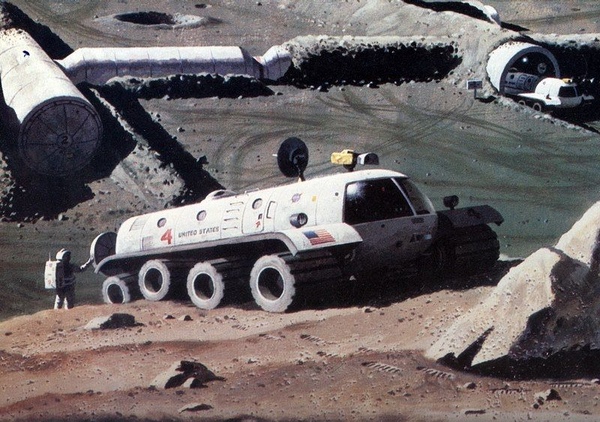 A massive lunar infrastructure supported the construction of cities and solar power stations. (credit: Pierre Mion, National Geographic) |
Lest anyone think that this article was “science fiction” (the editor placed that term in quotes, somewhat in the same way that you put a dead fish in a trash bag), a footnote declares that in only a month’s time NASA would publish a new report: “Space Colonization: A Design Study”. Clearly, space settlements were a probable part of America’s future. After all, a lot could happen by the time of America’s semiquincentennial.
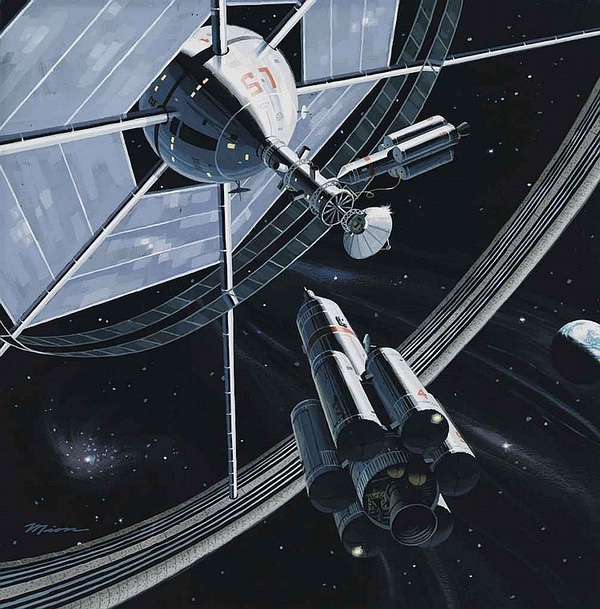
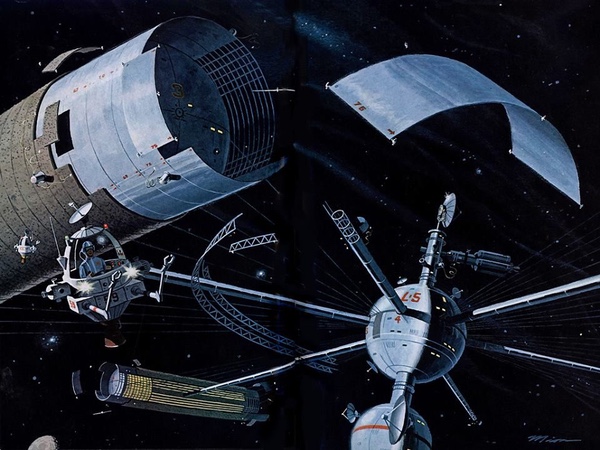 New stations were under construction. The concept of an expansive space infrastructure was inspired by Gerard K. O'Neill. (credit: Pierre Mion, National Geographic) |
The Future was wonderful
One of the common knocks against science fiction stories is that they do a poor job of predicting the future. Critics gloated that the year 2001 came and went and there were no spinning space stations, only terrorism and falling towers. Of course, the legitimate defense is that science fiction writers are not trying to predict the future, only tell a story (and sometimes to warn of a future to be avoided.) But in the case of Asimov’s National Geographic article, the famed author was trying to predict what looked—in that heady bicentennial year—to be a realistic possible future only a few decades away.
The July 1976 issue also included an article titled “Five Noted Thinkers Explore the Future”: interviews with experts, including Asimov, speculating about the turn of the century, only 25 years away. Their predictions were a mixed bag, but a common theme was a focus on the future of the city, at a time when American cities were in crisis. New York, after all, had nearly declared bankruptcy a year before and a few years later would be portrayed as a maximum-security prison in John Carpenter’s Escape From New York. In his interview, Asimov speculated that cities would either go down, or up. Weather might drive the creation of underground cities where climate could be perpetually controlled and inhabitants would never have to worry about pesky things like thunderstorms, snow, or beautiful spring days. Or the cities could go upward, with the creation of giant rotating space cities at L-5 points deep out in space. Asimov did not write about the spread of the suburbs, or the exurbs. After all, he wanted cities in space.
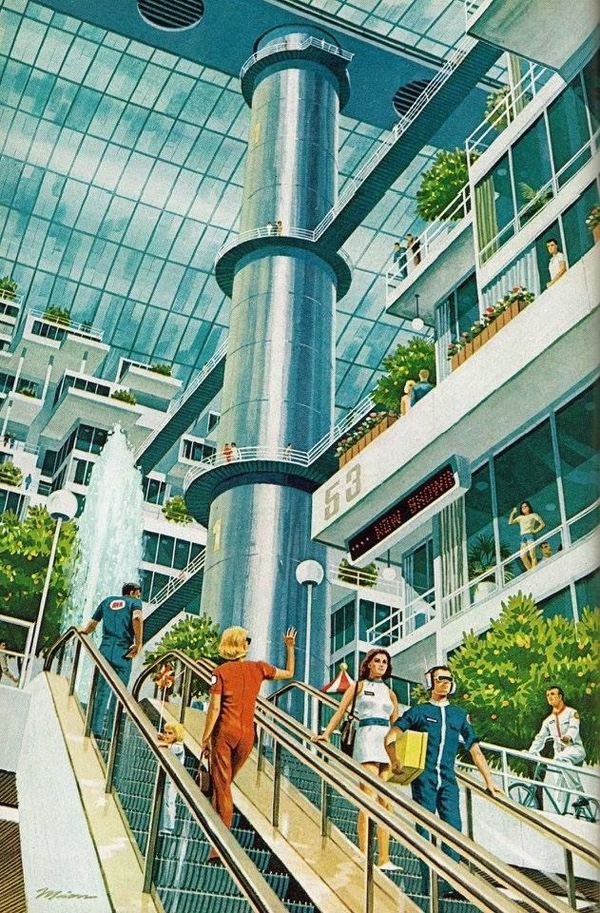 The giant space station housed 10,000 people. (credit: Pierre Mion, National Geographic) |
Although he never said it in his interview or the article, Asimov was writing about the ideas of an emerging American social movement. His article reflected the influences of people like Gerard K. O’Neill (who is not mentioned) and the then-exciting concept that normal people—construction workers, welders, farmers, rabbit-slaughterers—could soon live and work in space. Pierre Mion’s illustrations of the space station show a gleaming city street that looks much like a midwestern American city, or a shopping mall, where the dominant male fashion is the jumpsuit, and women still wear miniskirts and denim short-shorts.
Within a very short time after Asimov’s article, O’Neill would publish The High Frontier, the L-5 Society would gain more members, and the pro-space settlement idea would form into a genuine movement.
But then it died. Or less harshly, it never grew beyond a few thousand daydreamers.
Why did the space settlement concept fail to gain a mass following? And why didn’t space settlements happen? These two questions are linked. Space technology never moved as fast as some people hoped or wanted or predicted, so the dream was forever out of reach. But it also was never a very appealing dream to begin with.
| Space technology never moved as fast as some people hoped or wanted or predicted, so the dream was forever out of reach. But it also was never a very appealing dream to begin with. |
Looking back over five decades to a time when this movement was just forming, the most glaring conclusion is that the idea never really caught on. It never transformed into a true mass movement with broad appeal, millions of members, elected representatives in the government, and a clear legislative, social, and economic agenda that could push the technology harder and faster. Why was that?
Of course, many of the movement’s early members eventually blamed NASA. O’Neill’s space vision depended upon cheap spaceflight heralded by the Space Shuttle, and we all know how that worked out. Certainly, once the shuttles proved to be cranky and expensive, a lot of public enthusiasm for space settlement subsided. Some people stuck with it, and became bitter (taking their anger out on internet discussion groups and, later, social media). Many simply gave up.
The space settlement movement was, at its most basic, a utopian movement. Like all utopian movements, it had a short-term appeal that was more emotional than logical, and depended upon people being susceptible to the vision that it promised. It didn’t make many converts.
There was a problem with that vision: it was not inherently positive and uplifting. There were certainly many negative visions at the time: Malthusian predictions of doom, and the ever-present fear of nuclear annihilation. But the problem with the space settlement movement was that, absent the counterpoint of fear, it had little inherent appeal. Asimov’s portrayal of the L-5 future demonstrated the problem: what was so great about living and working in space compared to living and working on the ground? How was it any better?
Asimov didn’t have an answer to that. He never described the view from the settlement, nor did he claim that the working and living conditions were superior to Earth, for instance, a four-day work week and longer paid vacations. Asimov’s description of the food was not exactly enticing. What he described was a job and a bed to sleep in, not strange new worlds, new life, and new civilizations. If you were an ordinary American reading National Geographic in 1976, what was so great about that?
There is an old joke about a company that makes a new kind of dog food. It invests millions in advertising and getting its product in stores. But it doesn’t sell. Befuddled, the company president goes to a store and watches people buy other bags of dog food. He goes up to the store manager. “I don’t get it,” he says. “Our packaging is flashier than our competitors’ packaging. Our display is the biggest in the store. It’s the most attractive dog food there is. Why isn’t it selling?”
“The dogs don’t like it,” replies the manager.
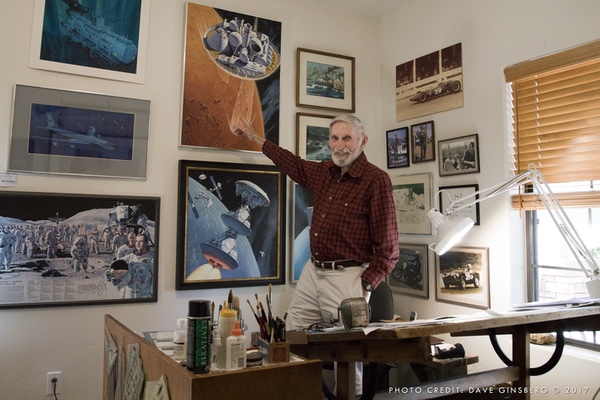 Pierre Mion, who died in 2021, in his studio (credit: Dave Ginsberg) |
The Future, it was wonderful, but what is it now?
Of course, many of the most strident advocates of space settlements will claim that the reason to go is to establish a new society with new rules and liberties, without explaining how this will be possible considering the survival requirements of a settlement in a hostile environment. The economics of a settlement naturally tend to require rather strict rules—the company or government that funds such an endeavor is not going to want surly employees who cannot stand authority figures and waste hot water. If your goal is to throw off unwanted rules and regulations, it is easier to achieve this by joining or leading a political movement—or simply moving to Alaska—than launching a million tons of payload into a hostile environment.
| At its best, the space settlement vision was sophisticated daydreaming, not a future that a large number of Americans wanted to make happen. The vision had its shot and never caught on. |
Space historian Emily Carney notes that O’Neill thought some other things might be important too. In his book 2081, which was published five years after The High Frontier, he wrote: “Here is my advice as we begin the century that will lead to 2081. First, guard the freedom of ideas at all costs. Be alert that dictators have always played on the natural human tendency to blame others and to oversimplify. And don't regard yourself as a guardian of freedom unless you respect and preserve the rights of people you disagree with to free, public, unhampered expression.” In other words, if you are concerned about liberty and democracy, protect it on Earth first. That advice is very prescient for 2026.
At its best, the space settlement vision was sophisticated daydreaming, not a future that a large number of Americans wanted to make happen. The vision had its shot and never caught on, despite appearing in the pages of a highly reputable magazine and gaining the attention of political decision makers. Gravity, weightlessness, radiation, and economics may all have ultimately made this vision untenable, but its biggest problem was that people didn’t like it.
Has that changed? A young Jeff Bezos was enticed by the vision of moving factories into space to preserve a blue Earth, but nobody really considers him to be a prophet more than a businessman. Some would argue that SpaceX is committed to establishing human cities on Mars. But how many people truly believe that anymore? SpaceX is about to hold an initial public offering, and the company has described itself as an AI company with a rocket business that loses money. SpaceX does not describe itself as a Mars settlement company and has been drifting off the space settlement goal for years, first creating Starlink, then focusing more on the Moon to serve a paying customer, now spending massive amounts on AI and investing in data centers
There’s little evidence that SpaceX is doing anything to establish cities on Mars. And even if they were, how many people actually want to live on Mars anyways? Mars settlement was the rage last decade but now seems to be going the same way as O’Neill’s giant spinning cities in the void.
| There’s little evidence that SpaceX is doing anything to establish cities on Mars. And even if they were, how many people actually want to live on Mars anyways? |
We are today—this very day—living in the future that National Geographic’s experts speculated about. The cities are all right. World War III is no longer looming overhead. But American democracy is increasingly in peril, and Americans are not turning to grand visions of space settlement.
Emily Carney added that she once interviewed astronaut Phil Chapman, who had been a contemporary of O'Neill's and knew him. Chapman said, “I thought Gerry was both charismatic and brilliant, but perhaps too imaginative for his own good.”
Chapman had an amusing story about O’Neill: “I remember attending a congressional hearing where Gerry talked about his ideas. The chairman of the committee expressed his deep thanks to Gerry—because, he said, he had been considering an item about space colonization in the NASA budget, and he was now persuaded that funding could be postponed for a century or two."
Maybe 2176 will be better.
Note: we are now moderating comments. There will be a delay in posting comments and no guarantee that all submitted comments will be posted.