Hello, Madison! A top-secret Cold War mission over Wisconsin’s capitalby Dwayne A. Day and Harry Stranger
|
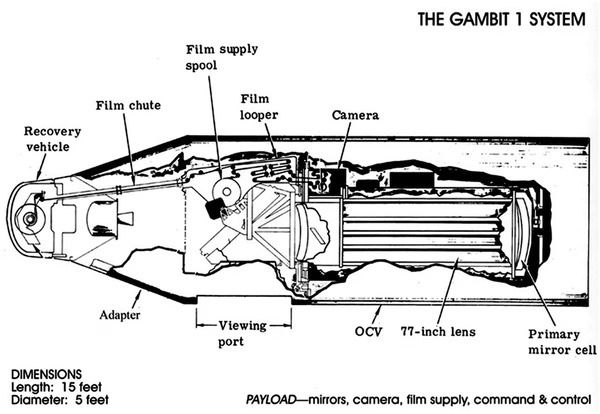 The GAMBIT reconnaissance satellite had an image reflecting mirror (center) that could be tilted forward, down, or aft, providing different imaging angles. (credit: NRO) |
GAMBIT worked in concert with another satellite program named CORONA, which first had a successful mission in August 1960. A CORONA satellite could photograph large amounts of territory during each mission, but CORONA’s photographs were low-resolution: capable of revealing airfields and construction sites and eventually vehicles but not providing much information about them. If something interesting was spotted in a CORONA photograph, a GAMBIT mission could follow it and take a higher-resolution photo. Both satellites used film, which was rolled up inside a reentry vehicle and returned to Earth for processing and interpretation. This was not a speedy operation, and every launch was in some ways a gamble that everything would work. But the operators would not know for several days until the film was on the ground and viewed by human eyes.
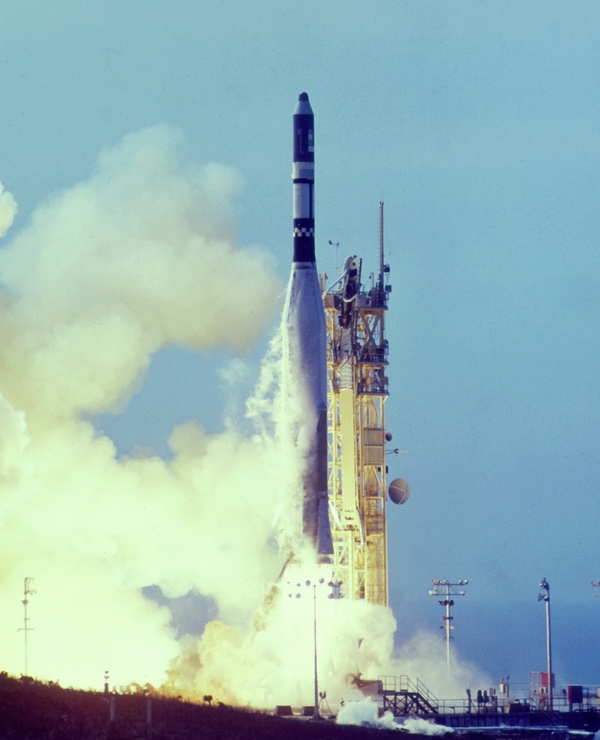 The sixth GAMBIT reconnaissance satellite mission was launched in March 1964 to photograph targets in the Soviet Union. It also conducted camera tests over the United States. (credit: Peter Hunter Collection) |
Mission 4006
Both types of satellites flew in polar orbits, crossing over the north and south poles as the Earth rotated underneath. The March 1964 GAMBIT launch headed south from its launch site as it climbed. Upon reaching orbit, the Agena second stage separated from the GAMBIT camera and its Orbital Control Vehicle (OCV). The OCV used gas jets to roll the satellite to either side of its ground track to take photographs off-nadir (meaning not straight down). The GAMBIT camera had an image-reflecting mirror that could be tilted to look down at different angles. In combination, the roll and the tilt provided multiple viewing angles of a target. Multiple views could be used to produce measurements of the height of a target like a missile on its launch pad, or a building or communications tower.
Every GAMBIT spacecraft included improvements, and Mission 4006 tested several new operational modes. The camera could now take three photos in rapid succession, looking forward 15 degrees, straight down, and aft 15 degrees. As a mission report noted, “the stereo triplet provides the evaluator with a normal (30 degree) stereo of a target, plus two 15-degree stereo pairs of the same target for purposes of comparison. Operationally, the triplet might prove useful in itself, as it requires no more time than a normal short burst stereo pair; however, the real value of the 15-degree stereo is that it would permit two adjoining targets approximately 40 miles (64 kilometers) apart to be taken in stereo.”
The GAMBIT mission tested three modes: the lateral triplet, angled triplet, and 15-degree stereo during several passes over the United States. During the satellite’s 15th orbit, as it headed north to south over the American Midwest, it tested out these new capabilities over the cities of Madison, Wisconsin; St. Louis, Missouri; and then Little Rock, Arkansas.
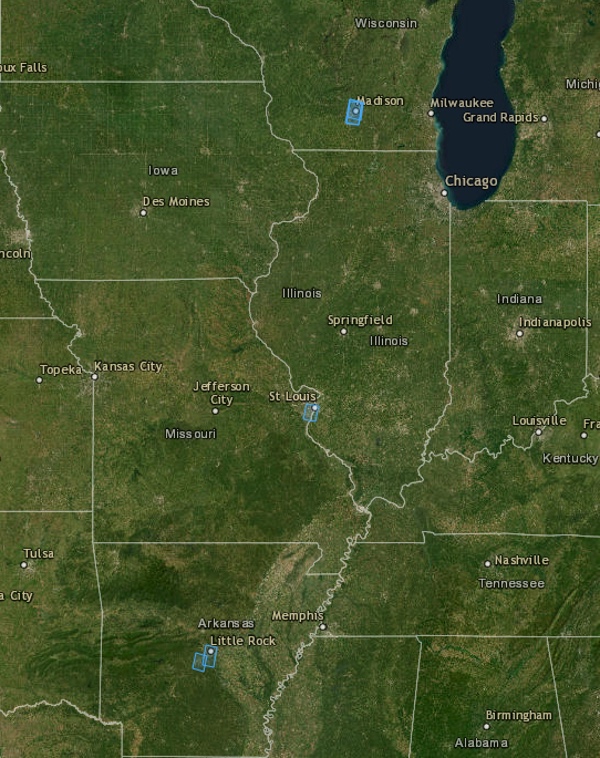 As the satellite from from north to south, it passed over Madison, St. Louis, and Little Rock, and tested new camera modes. (credit: Harry Stranger) |
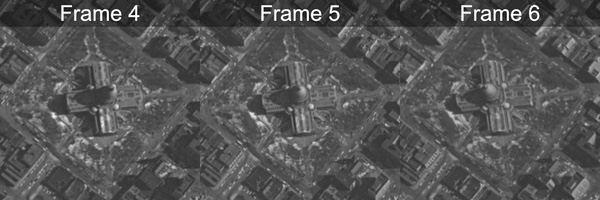
As the satellite passed west of Madison, it pointed its camera slightly to the east and quickly took three photographs in the 15-degree stereo mode, with each image almost completely overlapping the next. The city was only 16.7 degrees off to the side of the satellite’s ground path. The images were good quality, and Madison’s state capitol building can clearly be seen at several different angles from above. The lateral and angled triplet passes conducted of several other targets such as St. Louis and Little Rock were also successful.
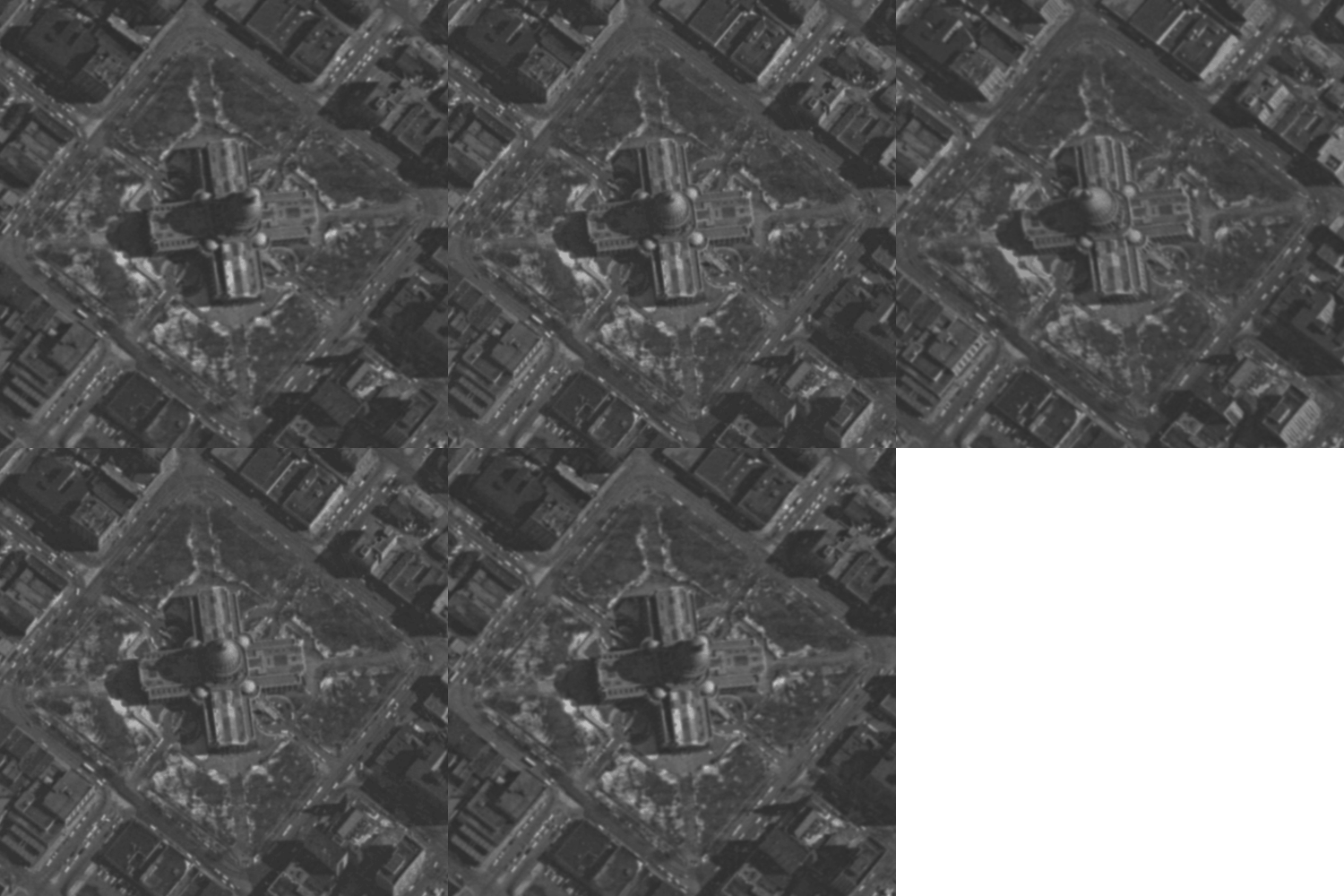 Madison was photographed from three different angles, enabling measurement of objects on the ground. (credit: Harry Stranger) |
During the satellite’s 31st orbit, it photographed the coast of Michigan; Chattanooga, Tennessee; Martin, Alabama; and Panama City, Florida. An angled triplet pass of Martin was unsuccessful because the satellite was limited to a medium roll rate for the pass. The plan was to repeat the experiment on a future mission without limiting the satellite to a medium roll rate.
The GAMBIT’s intelligence mission photographing the Soviet Union was highly successful. The photographic experiments over the United States expanded the operating envelope for the GAMBIT reconnaissance satellite, making it possible to gather more intelligence during future missions. The citizens of Madison, Wisconsin never knew that they were being looked down on from above.
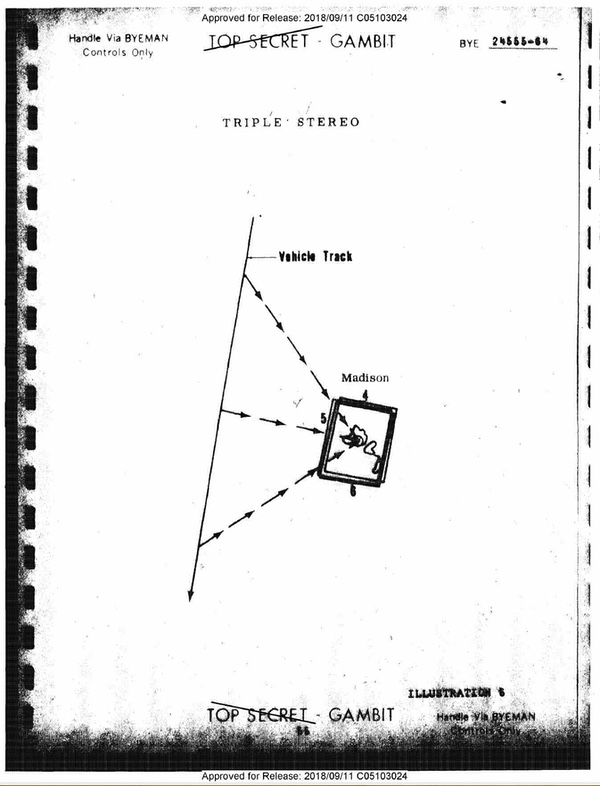 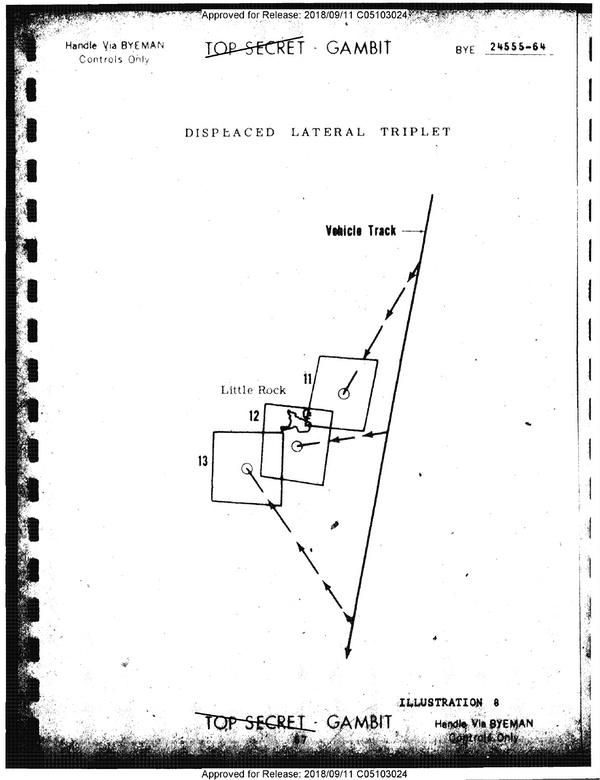 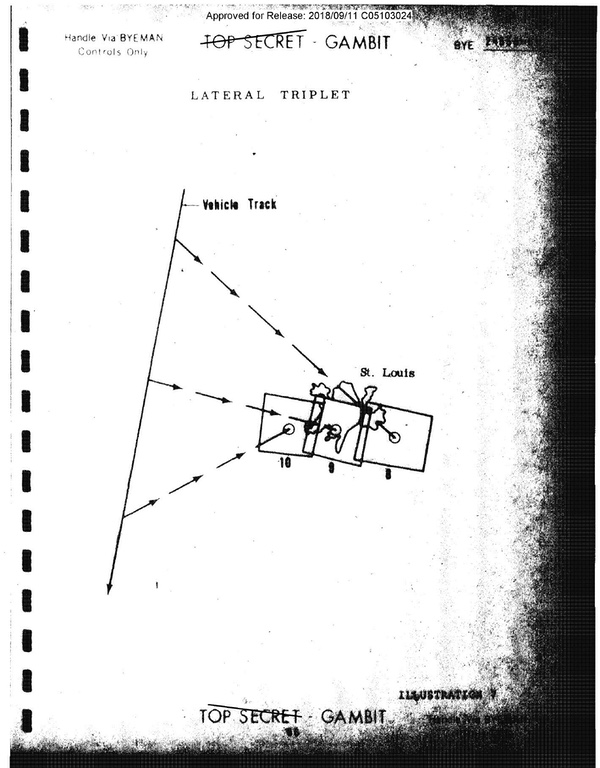 TThe new camera modes expanded GAMBIT's capabilities for future missions. (credit: NRO) |
Further reference: https://www.nro.gov/Portals/65/documents/foia/docs/FR-PETS/SC-2017-00011e.pdf.
Note: we are now moderating comments. There will be a delay in posting comments and no guarantee that all submitted comments will be posted.