A new age for astronomy enabled by space-based solar powerby Benjamin Calloway
|
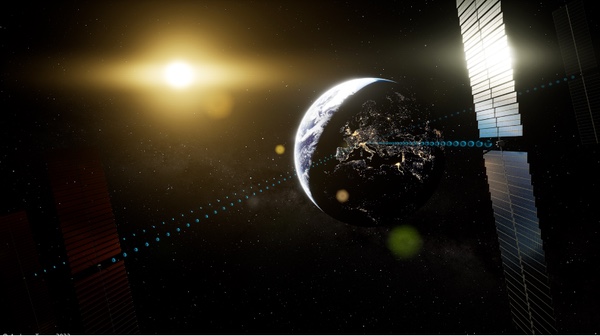
| Solar power satellites will have similar effects as megaconstellations, so astronomers are showing opposition. But this is only half the story. |
The technology was first proposed in the late 1960s, and it has only recently become feasible as a competitive renewable power source due to the convergence of falling launch costs, advances in satellite manufacturing (think Starlink), development of high-efficiency solar cells and other power-transmission components, and successes in wireless power beaming by governments, academia, and now by commercial players.
SBSP has vast benefits for the global energy landscape. It offers a source of power that is renewable and accessible 24/7, which mitigates the need to build costly and environmentally challenging storage facilities. Peter Garretson, an expert in SBSP and its role in global economics and policy, says an SBSP plant will displace many times the carbon it produces over its lifetime, and because it is designed to scale rapidly, it is one of the few energy sources that could meaningfully affect atmospheric carbon.
While the environmental impact of SBSP is small compared to other energy options, it’s not without its negative impacts. One community that will be affected by the implementation of SBSP is the field of astronomy. Megaconstellations like Starlink are affecting the imagery of telescopes, where satellites show up as bright spots or streaks and can also affect the image by diffuse reflected light. Solar power satellites will have similar effects, so astronomers are showing opposition. But this is only half the story.
Giant mirrors in the sky
Reflect Orbital, a California-based company developing orbital mirrors to deliver sunlight to Earth at night, has been under scrutiny from astronomers since applying with the Federal Communications Commission (FCC) in 2025 to fly their first prototype satellite in orbit, EARENDIL-1, sometime in 2026. Reflect Orbital intends to have thousands of these satellites in low Earth orbit (LEO) by the end of the decade. Collectively, this constellation of satellites can be termed a “heliostat swarm.” The initial application of the swarm will be to provide nighttime illumination (for example, to light city streets, construction sites, search and rescue missions, and large events), with the eventual intent of supplying power to ground-based solar panels once their technology is proven and a determined number of satellites are operating successfully.
Since applying with the FCC, Reflect Orbital has received negative attention from astronomers and organizations like DarkSky International, an Arizona-based nonprofit with over 4,000 volunteers advocating for the night sky to remain “dark and quiet,” in part to mitigate light pollution for the benefit of astronomers. Opponents to the satellite constellation are worried about the effects on sleep cycles (both of humans and animals), wildlife navigation, nocturnal pollination, aircraft piloting, and, of course, to astronomical observations.
In their letter to Reflect Orbital in December 2025, DarkSky said their “position is firm” against the implementation and that the study of the negative effects of spacecraft on the night sky are “well-established in peer-reviewed science.” A journal article published in Nature emphasizes that sunlight reflecting off ordinary satellites can be visible to the naked eye and can interfere with professional telescopes. Some companies, including SpaceX, have responded in the past by designing their satellites to be less reflective.
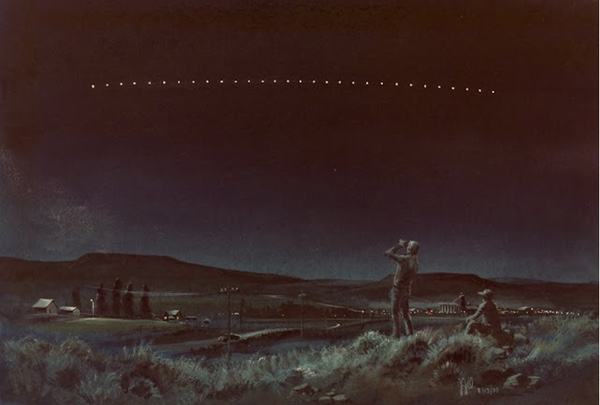 An illustration of what a heliostat swarm may look like in LEO. (credit: NASA) |
When astronomers are already dealing with reflections from ordinary satellites, it is no surprise for there to be outcry against satellites intentionally designed to be as bright as possible. After all, fans of Lord of the Rings would have recognized EARENDIL-1 as a namesake of the star used to make Galadriel’s gift to Frodo—the phial to light his journey’s way (there seems to be a curious amount of Tolkien references in industry these days).
While Reflect Orbital is initially applying its technology to illumination before renewable power, the opposition from astronomy still affects the SBSP community. Because the industry is nascent and largely unproven, negative attention on even one company or one satellite architecture affects the whole.
A comparison of solar-power satellite architecture
What Reflect Orbital is developing is very unlikely to be humanity’s primary method of collecting solar power in space and directing it to Earth. Their satellites can be better described as a multipurpose tool unrecognizable to what most of the industry is building. The two leading SBSP architectures being developed by companies today are the modular planar array (like John Mankins’ SPS-ALPHA and Ian Cash’s CASSIOPeiA) and the monolithic laser swarm (see Overview Energy).
| The unique proposition of being able to dispatch firm, clean, scalable power anywhere on Earth makes SBSP impossible to ignore. |
The planar array is a large, modular structure, often placed in a much higher orbit, like geosynchronous Earth orbit (GEO), with a much different method of directing sunlight to Earth’s surface than Reflect Orbital’s heliostats. Instead of mirrors reflecting the sunlight to Earth, many configurations of the planar array architecture are designed to direct the sunlight into an array of modular tiles that make up much of the satellite and which contain photovoltaic (PV) cells on one side and radiofrequency transmitters on the other. These radio waves are then directed to receivers on the Earth to be transformed into AC power, much like how traditional ground-based solar panels function.
The extra step of transforming the power into direct current (DC), then into radio waves, then back into DC when collected by ground-based receivers may seem inefficient at first glance. However, after considering that sunlight is nearly constant in space, without nighttime, clouds, weather, or atmospheric attenuation, the year-over-year power generation potential from SBSP hovers around an order of magnitude higher compared to ground-based solar. With rising power demand, data centers, geopolitical conflict, and billions still without reliable power, the unique proposition of being able to dispatch firm, clean, scalable power anywhere on Earth makes SBSP impossible to ignore.
The planar array architecture that most SBSP companies are focusing on will have a much lower effect on night-sky visibility than the heliostat swarm thanks to the lack of intentional solar reflection and a much higher orbit (up to 100 times higher). The US Department of Energy has studied this in detail (pp. 32-33; some values may be obsolete).
Since many companies are focusing on planar array architecture, the effects from their solar-power satellites will be much easier to mitigate, making far less of a worry for astronomers. Despite this, there is still stubborn skepticism because the satellites will be visible nonetheless. The next section is meant to turn that skepticism into excitement for what SBSP can enable for the field of astronomy.
Transforming astronomy through SBSP
When SBSP becomes implemented at scale, the enabling technologies will have matured, and the in-orbit energy generation model will be proven. Garretson says that an economy that has built a full-scale solar-power satellite has done the following:
- Lowered launch costs below $500 per kilogram (SpaceX’s Starship may bring costs as low as $200/kilogram)
- Begun launching into space nearly daily
- Scaled in-space logistics (like “space tugs”) to GEO and other high orbits
- Constructed multi-kilometer-scale satellites with kilometer-scale radiofrequency apertures, which can host other functional platforms
- Enabled the generation of tens of megawatts to tens of gigawatts from a single satellite array
- Proven it can take a significant piece of the global energy market (12%, or $14–15 trillion, of annual GDP and growing, compared to NASA’s $20 billion)
Many of these points assume the planar-array architecture previously mentioned. The implementation of a solar-power satellite kilometers wide would mean the maturation of modular architectures and autonomous ISAM (in-space servicing, assembly, and manufacturing), which themselves enable countless in-space operations that are currently economically unviable.
To elaborate on the note about global GDP (gross domestic product): NASA’s budget is roughly three orders of magnitude (1,000 times) lower than what the world spends on energy generation, transformation, distribution, and consumption each year. Second, advancements in in-space astronomy are limited largely by federal space science budgets, of which NASA’s is a large fraction. Third, implementing SBSP at scale cannot happen on NASA’s relatively meager budget, so a significant percentage of funding must come from elsewhere.
Putting these facts together, we realize that once space-based solar power is proven and implemented, the field of astronomy is no longer limited by shrinking federal science budgets: it can ride on the back of SBSP, taking full advantage of the matured technologies, established orbital infrastructure, and accelerating space economy to bring about a new age for space science.
According to Garretson, this enables “an industrial base that can build and deploy to deep space very large RF observatories and optical observatories.” Here, “very large” means platforms with apertures on the scale of kilometers wide, compared to the aperture of the current largest in-space observatory (James Webb Space Telescope) of just 6.5 meters wide.
| For the inconvenience of a few more satellites in orbit, the field of astronomy receives boundless opportunity for scientific advancement enabled by the technology, industry, and perception that comes with full-scale SBSP. |
Antoine Labeyrie, French astronomer and astrophysicist, proposed in a research article in 2021 that observatories at this scale and beyond could enable us to better study exoplanets, stars, galaxies, and black holes; support the search for extraterrestrial intelligence (SETI); and track potentially hazardous near Earth objects, complementing ground-based observatories like the Vera Rubin Observatory.
Astronomers, ask yourselves: “Are we thinking big enough?” Imagine a baseline interferometry array at the cislunar scale. Imagine Arecibo or Goldstone in space, or a swarm of them, providing next-generation observation without blind spots. Once the required industrial base and logistics are realized through the implementation of SBSP, systems like this could be placed anywhere in the solar system.
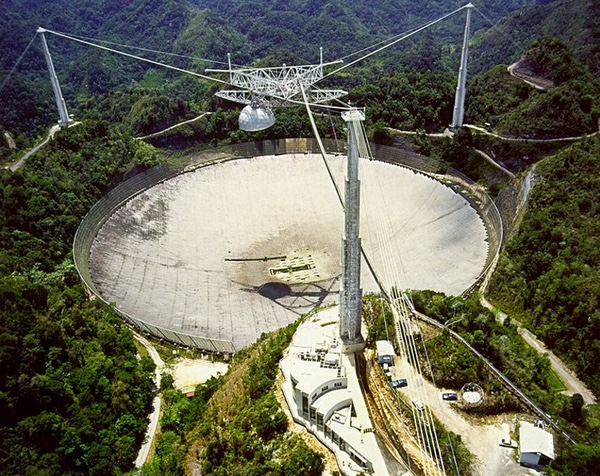 An aerial view of the 305-meter Arecibo telescope in operation. It later collapsed in 2020. (credit: H. Schweiker/WIYN and NOAO/AURA/NSF) |
Aerospace systems engineer and strategist Gary Oleson, a pioneering member of the Space Frontier Foundation, suggests that astronomers should take a reality check regarding their efforts to sustain the purity of the night sky. “If Western powers pay any attention to the astronomy community, be assured that China won’t. The global interests in play will roll over any feel-good considerations. Any mitigation the astronomers get will be as a courtesy and probably temporary. The night sky is going to fill with light. I don't have to like it, and I don’t, but that’s the way it is.”
Oleson advises astronomers to consider advocating for advantages like these before it’s too late: “We can’t stop the negative effects on our trade, so we might as well seek what benefits we can get from the new developments. Get those benefits locked in early while people are still listening to you. Once you become seen as a pest, you’ll get even less.” He suggests that while full-scale SBSP will not solve all of astronomy’s problems, the opportunity should be taken seriously.
After all, astronomers will get the platform to enable these opportunities for free. All it takes is time and a global community supporting the development of SBSP. For the inconvenience of a few more satellites in orbit, the field of astronomy receives boundless opportunity for scientific advancement enabled by the technology, industry, and perception that comes with full-scale SBSP.
Organizations like the Space Frontier Foundation are tirelessly advocating for the safe, successful implementation of space-based solar power as a key step in the acceleration of the in-space economy and eventual human settlement within the space frontier. With the close collaboration of governments, the private sector, regulators, nonprofits, and scientists, SBSP will be implemented at scale, delivering clean, firm, scalable power to those who need it. And the positive effects will travel even farther. If you’re an astronomer, you have the opportunity to SBSP to enable a new age for your field.
Note: we are now moderating comments. There will be a delay in posting comments and no guarantee that all submitted comments will be posted.