A swift effort to boost the prospects for satellite servicingby Jeff Foust
|
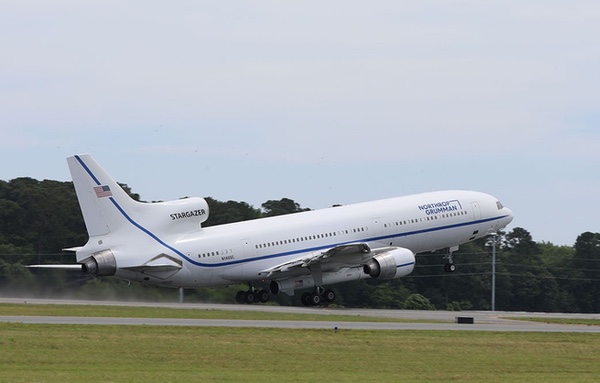
| “We gave them a really good price,” Northrop’s Kurt Eberly said last November of the Pegasus launch contract for the reboost mission. |
If so, it marks the conclusion of an extended goodbye for the air-launched rocket. In its heyday in the latter half of the 1990s, Pegasus launched five to six times a year, carrying a mix of commercial and US government payloads. The upcoming launch will be the first in five years for the rocket and only the sixth in the last 15.
Should this be the final Pegasus, though, the rocket will go out with an exclamation point. The rocket’s payload is Link, a spacecraft developed by satellite servicing startup Katalyst Space Technologies with a daring mission: attach itself to a NASA spacecraft in a decaying orbit and boost it to a higher altitude.
The NASA spacecraft is the Neil Gehrels Swift Observatory, or Swift, a gamma-ray telescope launched in 2004. Swift itself is in good condition, its instruments able to detect and quickly monitor gamma-ray bursts, but its low Earth orbit has been decaying because of atmospheric drag enhanced by the current peak in solar activity. With no ability to raise its orbit itself, Swift could reenter as soon as late this year.
Swift’s unusual orbit led Katalyst to select Pegasus to launch the 425-kilogram Link spacecraft. Swift was launched into an orbit with an inclination of about 21 degrees, allowing it to avoid a feature of the Earth’s magnetic field called the South Atlantic Anomaly that would have interfered with its observations. That limited the opportunities for launching it: rideshare missions to Sun-synchronous or mid-inclination orbits were not an option, for example.
Katalyst said it selected Pegasus because that vehicle could reach the desired orbit and because it has the “reliability and schedule capability” needed for this time-sensitive launch, Kieran Wilson, principal investigator for Link at Katalyst, said in November, when the companies announced the launch contract.
Price was also a factor: the Pegasus, reportedly built for another customer and in storage, was far cheaper than buying a dedicated Falcon 9 launch. “We gave them a really good price,” Northrop’s Kurt Eberly said last November, without disclosing the price.
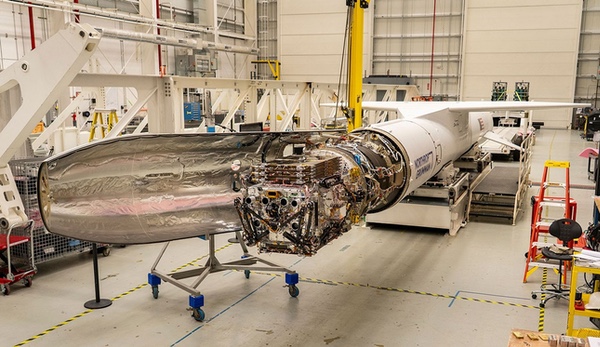 The Link spacecraft being integrated with its Pegasus XL launch vehicle. (credit: NASA/Ron Beard) |
A swift mission to save Swift
But the novelty of the launch pales in comparison to the unique nature of the mission and how NASA pursued it. Last August, NASA announced it awarded study contracts to Katalyst Space as well as Cambrian Works to study mission concepts for reboosting Swift, while asking another company, Starfish Space, to examine how it could repurpose another mission it was developing to raise Swift’s orbit.
| “I have to be honest, no one thought it was going to be possible. No one thought we would get as far as we’ve already gotten today,” said Domagal-Goldman. |
In late September, NASA said it selected Katalyst Space to develop the Swift reboost mission, awarding the company a $30 million contract through the agency’s Small Business Innovation Research. Katalyst planned to repurpose a technology demonstration spacecraft called Link already in development to raise Swift’s orbit.
Time, NASA emphasized, was of the essence: the reboost mission needed to launch before Swift’s orbit decayed to an altitude of about 300 kilometers. Below that, NASA believed the drag would be too much for the reboost mission and its electric thrusters to counter. Katalyst said it would be ready to launch around the middle of 2026, several months before Swift dipped that low.
However, early this year, new models of Swift’s orbital decay raised alarms. Instead of reaching the 300-kilometer threshold some time in the fall of 2026, the models suggested that the spacecraft might fall that low as soon as May, before Katalyst’s mission would be ready to launch.
“With this news in hand, we had to do something about it,” said Jamie Kennea, a research professor at Penn State University and head of Swift’s science operations team, at a National Academies meeting in March. What the project did was reorient the spacecraft to minimize drag, a move that slowed the orbital decay but also required shutting down most of its science instruments.
That bought the time the reboost needed, with models showing by March that Swift would not reach the 300-kilometer threshold until at least August. “We’re really maximizing our chances here,” Kennea said.
The project wanted to maximize its changes given what seemed like inevitable delays. Link, after all, would have approach and then grapple a satellite not designed for servicing, then raise its orbit. In addition, Link would be Katalyst’s first spacecraft. (In 2025, Katalyst acquired Atomos Space, which flew a satellite servicing tech demo mission in 2024 that suffered several technical problems, such as communications.) Surely, there would be issues.
However, by April Link was at the Goddard Space Flight Center for environmental testing, which it completed successfully in early May. After a trip back to Katalyst’s Colorado facilities for final work, the spacecraft was shipped to Wallops Flight Facility in Virginia, where Northop integrated it with the Pegasus rocket, and the rocket with its L-1011 carrier aircraft.
Completing Link within a month of its schedule—early this year the mission had a nominal launch date of June 1—was something NASA celebrated at the pre-launch briefing earlier this month.
“I have to be honest, no one thought it was going to be possible. No one thought we would get as far as we’ve already gotten today,” said Shawn Domagal-Goldman, director of NASA’s astrophysics division. “No one thought y’all would get here.”
The achievement, he added, was more than technical. “People didn’t think the agency itself could bureaucratically do something this fast, and yet we did.”
There is still, though, the actual boost mission to execute. That work will begin about 13 minutes after launch, when Link separates from the Pegasus upper stage and begins its commissioning process. That will take about two weeks, followed by two to three weeks to approach Swift.
“We still have to get spacecraft on orbit. We still have to operate the spacecraft there successfully, and as we’ve all seen before, that’s a very challenging thing to do,” Katalyst’s Wilson said at the prelaunch briefing. “We’re confident that as long as we have a spacecraft that can function at a fundamental level, that gives us the freedom and flexibility to work through any issues that we find during rendezvous and the more challenging dynamical operations.”
| “I feel like this is going to be a phoenix-from-the-ashes situation where the mission starts anew,” Kennea said. |
Swift is not designed for servicing, but Wilson said it helps that the spacecraft is still working well. “Swift is an unprepared but cooperative partner in the rendezvous,” he said, able to reorient itself to help Link survey the spacecraft and identify the best locations for the robotic arms to try and grapple. “We’ll be moving through a bunch of maneuvers as a tandem team between the Swift mission ops and the Link mission ops teams to perform those inspections at various ranges.”
Link has three robotic arms, but the reboost can work even if only one arm is able to attach to Swift. His biggest concern is the state of Swift’s multi-layer insulation, or MLI, which he says has likely degraded based on the experience with Hubble, where astronauts on servicing missions reported that the flexible MLI has turned brittle, complicating work.
“It’s likely that there are torn-off pieces of MLI on the spacecraft, that some things are no longer in the position that they were originally, or that the blankets have degraded to some degree, that makes it more challenging to capture,” he said. “That’s why we have multiple options for locations to capture, a very versatile approach, and a very flexible team.
If Link is able to grapple Swift, it will use its Hall Effect thrusters to raise their orbit over the next three months to an altitude of 550 to 600 kilometers, close to Swift’s original orbit. Link will then detach and use its remaining xenon propellant to lower its orbit and speed up its reentry.
Brad Cenko, principal investigator for Swift, said his mission will then work to quickly restore normal science operations. “In the best-case scenario, Swift could start resuming observations as early as the fall of this year, but we’ll have to play it by ear somewhat and see how all the various steps in the chain are going to go,” he said.
“I feel like this is going to be a phoenix-from-the-ashes situation where the mission starts anew,” Kennea said in March.
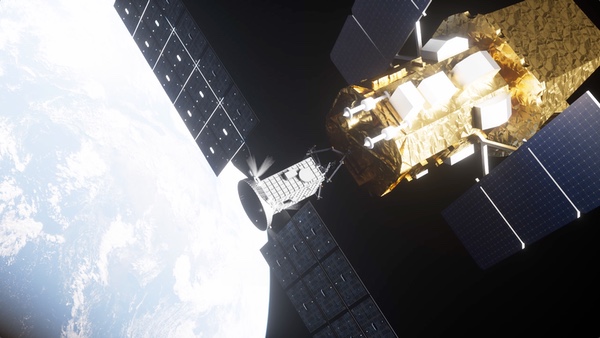 An illustration of the Link spacecraft grappling the Swift spacecraft to reboost it. (credit: Katalyst Space) |
Future servicing options
NASA has often described the Swift reboost mission as a “high-risk, high-reward” project. It is high risk in the sense that it is a complex, novel mission by a young company. Yet, if the reboost mission fails, little is lost beyond a few months of science that Swift could have performed if NASA made no effort to slow its descent, as well as the $30 million spent on the mission. (The agency has emphasized Swift’s reentry doesn’t pose a hazard to people on the ground.) By contrast, NASA spent more than $1 billion on a satellite servicing demo mission, OSAM-1, that was cancelled in 2024 before launching.
The high reward comes, in the near term, from the additional science Swift can do. “Last year Swift received five requests from the community to follow up newly discovered sources each and every day,” said Cenko. “That’s more annual community requests than any other NASA facility but JWST.”
He added that Swift, originally launched to study gamma-ray bursts, has evolved into a more general astrophysics mission, using its additional X-ray and ultraviolet instruments. “We call these our different eras for the Swift mission,” he said, deadpan.
In the longer term, a higher reward comes from demonstrating the ability to reboost and perhaps perform other servicing. Several companies are pursing work to reboost, repair, and refuel spacecraft, and a successful Swift reboost mission could help Katalyst’s prospects in the market.
It also raises the question of how NASA might use the technology. “We didn’t want to set the precedent that anything that comes out of orbit has to be boosted,” Domagal-Goldman said at the prelaunch briefing.
It made sense for Swift, he stated, because of its scientific utility, and with no plans for a successor for the foreseeable future. “This is an observatory with unique capabilities for astrophysics,” he said. “So we decided, yeah, we want to go save this one this time because of how special it is.”
| “We are open to a reboost of Hubble,” Domagal-Goldman said. “We have to first figure out how we’re going to bring down the operations costs.” |
He didn’t discuss how NASA might decide what future spacecraft would be worthy or reboost or servicing, but one other astrophysics mission comes to mind: Hubble. That venerable space telescope remains in high demand among astronomers, but its orbit is also decaying, with models indicating it could reenter in the first half of the 2030s.
At an advisory committee meeting in early June, Domagal-Goldman left the door open for a Hubble reboost mission. “These reboost things are now not just available to us as an agency, but the costs are lower than I think I anticipated,” he said. “That does make that return on investment more enticing.”
One issue he raised, though, was not the cost of the mission but of Hubble itself. NASA spent $98.8 million on Hubble in fiscal year 2025, second only to the James Webb Space Telescope among astrophysics missions. He said that operating cost would need to decrease for a reboost mission to be viable.
“We are open to a reboost of Hubble,” he said. “So, we have to first figure out how we’re going to bring down the operations costs.”
NASA is dealing more broadly with the costs of extended missions across its science portfolio. In recent months, agency officials hinted at potential changes to how it supports extended missions, which could include ending some missions and force others to find ways to reduce their costs to free up money for new missions. Domagal-Goldman did not say how much Hubble’s operating costs would need to be reduced for the agency to support a reboost effort.
Katalyst’s Wilson added at the briefing that Link would be too small to reboost Hubble. “Hubble is a much larger spacecraft and require something with far more propellant capacity,” he said.
Link, though, could provide both technical and programmatic proof of the value of reboosting satellites, enabling future missions like saving Hubble. All that on the final flight of the Pegasus rocket.
Unless it’s not the final flight. “We certainly are open to follow-on contracts or new opportunities for Pegasus,” said Northrop’s Collier, noting the L-1011 plane was still in good shape. “We think that it’s a great system for future responsive launch opportunities.” Maybe another spacecraft will urgently need a reboost mission.
Note: we are now moderating comments. There will be a delay in posting comments and no guarantee that all submitted comments will be posted.