The Mars Tax: Starship’s toll on American lunar ambitionsby Ethan Hicks
|
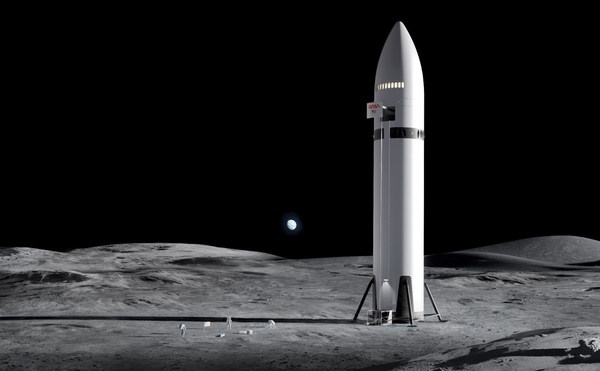
| NASA’s selection of Starship has effectively allowed for the imposition of a “Mars Tax” on Artemis, embedding the costs of SpaceX’s future Mars missions into a program that requires only a simple lunar lander. |
Though SpaceX will deliver a modified “lunar” variant of Starship, it will share a majority of its core components with the base, Mars-bound design, including its impressive size, standing at 171 feet (52 meters) tall on the lunar surface. An Artemis landing, in this sense, is as much a Mars test flight as it is a lunar one: a Starship HLS would help accumulate the operational experience SpaceX needs for the Red Planet. This has led to suboptimal design choices, including an 11-story-tall external elevator required to descend the length of massive propellant tanks intended for a Martian takeoff.
Additionally, the Starship program will include elements unnecessary for the scope of Artemis 4, including full reusability, a 100-metric-ton payload capacity, and in-orbit refueling. While essential capabilities for a sustained presence on the Moon and Mars, they are extraneous to a lunar landing first accomplished half a century ago. Starship’s payload capacity is designed for Mars colonization, where the nearest resupply is months away. For Artemis 4, the HLS will carry two astronauts, provisions, EVA suits, and scientific equipment— a fraction of that capacity.
Given Starship’s size, in-orbit refueling is necessary to achieve the fixed delta-V required for trans-lunar injection, but this solution creates additional challenges. Assuming SpaceX can successfully demonstrate ship-to-ship refueling, it would require additional Starship launches to sufficiently fuel just one Moon-bound Starship, increasing risk and complexity. Estimates vary depending on boil-off predictions, but NASA officials have put the number “in the high teens,” while in 2024 SpaceX vice president Jessica Jensen said “10-ish” refueling flights would be needed. In effect, NASA has contracted for a derivative of a Mars vehicle rather than a purpose-built lunar lander, to SpaceX’s specifications and timeline. While this could speed up a Mars mission in line with NASA’s stated Moon-to-Mars initiative, it comes at a steep cost as the Mars Tax imposes delays and safety risks onto the Artemis program.
NASA’s concerns
As part of their contract, SpaceX is required to complete an uncrewed Starship landing on the Moon before the 2028 landing. The technical hurdles to be met in two years’ time are substantial, with some imposed by Mars requirements. SpaceX must be able to reliably “catch” Starship’s returning upper stage, quickly refurbish it, perform cryogenic fuel transfers across multiple launches, and integrate lunar-variant modifications before successfully landing and lifting off from the Moon. As of now, none of these milestones have been attempted or scheduled.
In March of 2026, NASA’s Office of Inspector General released a report titled “NASA’s Management of the Human Landing System Contracts,” which provided a candid look at NASA’s risk assessment regarding HLS. Skeptical that Starship will be ready in time, OIG stated that SpaceX “will be challenged to complete required milestones ahead of the Artemis III mission.” (The report was written when Artemis 3 was to be the first lunar landing; just before the report’s release NASA added a low Earth orbit test of landers now designated Artemis 3, with the landing now planned for Artemis 4.) NASA attributes much of this challenge to the novel cryogenic propellant transfer capability, which itself has been delayed by far more than a year, with no test date announced. “NASA is tracking a top risk that some of the cryogenic technologies and capabilities SpaceX is developing will not be adequately mature ahead of the Artemis III mission… resulting in the potential for mission delays,” OIG stated.
The report also points out that “SpaceX has yet to demonstrate the required 12- to 24-day turnover of its launch pad,” a turnover rate necessary to support the ten or more Starship launches required. With little margin for error remaining, “should SpaceX experience any technical issues commonly encountered during development and testing of new technologies or any additional flight test mishaps, the resulting schedule delays could impact the Artemis III launch date.”
| The Starship-driven Artemis delays that the OIG and GAO mention would entail little more than congressional ire if not for the imminent Chinese landings. |
Beyond delay, the OIG detailed significant crew safety concerns in Starship. The aforementioned elevator, for example, is a top safety risk for NASA. As it stands, “there is no other method for the crew to enter the vehicle from the lunar surface in the event of an elevator failure,” potentially stranding the crew outside of the lander. This is a significant point of risk for NASA, which requires “single failure tolerance,” or “the ability of a system to sustain a single failure and not have it affect the design goal.” The elevator fails this requirement in its proposed form, and though SpaceX has committed to building a “robust” elevator system, NASA remains concerned.
Another critical safety issue lies in crew-accessible manual controls for the lander. “NASA’s human-rating certification requires vehicles provide the capability for crew to take manual control during all phases of flight,” explained OIG, pointing out that of the six crewed Apollo landings, backup manual controls had to be engaged for all of them. NASA and SpaceX disagree as to whether Starship includes enough manual control options for the crew. OIG notes that, despite promises from SpaceX, “NASA’s tracking of SpaceX’s manual control risk indicates a worsening trend” that could end with more automated procedures than NASA’s safety teams are comfortable with. This could “adversely impact the crew’s ability to intervene, potentially leading to the loss of the crew or mission.”
The Government Accountability Office (GAO), in a 2025 report to Congress on major NASA projects, raised several overlapping concerns with the OIG as well as a worry that the Artemis astronauts will not have the time or facilities to be adequately trained on the HLS controls due to Starship delays. At worst, “this could result in an increased probability of loss of the vehicle, crew, and mission during the landing phase.”
Former NASA Administrator Jim Bridenstine, in a Senate hearing last September, spoke plainly about the problems with a Starship HLS. While he is a Republican appointee criticizing a decision made during a Democratic administration, he echoed many of the same criticisms as NASA’s independent watchdogs about over-complexity before taking them a step further. He called NASA’s 2021 choice of Starship “a problem that needs to be solved,” adding that “instead of buying a Moon lander, we’re gonna buy a big rocket.” He then explained that it “puts us as a nation at risk” with regards to Chinese lunar ambitions: “It is highly unlikely that we will land on the moon before China.”
Geopolitical costs of delay
Bridenstine is far from the only person to raise the national security concerns that come with a Chinese lunar landing. The Starship-driven Artemis delays that the OIG and GAO mention would entail little more than congressional ire if not for the imminent Chinese landings, targeted for 2030. In a 2025 report to Congress, the US-China Economic and Security Review Commission concluded that China is fully dedicated to becoming “the world’s pre-eminent space power.” The Commission warned that “falling behind in space would not only diminish U.S. standing, [but] would also threaten U.S. national security, global influence, technological dominance, and commercial competitiveness in the growing space economy.” Artemis has the vital political task of preventing such a scenario, but it can only do so with a completed HLS, currently weighed down by the mission misalignment inherent in the Mars Tax.
China, meanwhile, has taken a more prudent approach to its lunar lander. Rather than betting on unproven technology, Beijing is opting for a lander comparable to the Apollo LM. Lanyue will be a two-stage lunar lander launched on a single Long March 10 rocket, and will rely on stored hypergolic propellant rather than in-orbit refueling. In a testament to its relative simplicity, Lanyue passed initial testing in August 2025, including validations of its takeoff and landing capabilities. Lanyue is a vehicle of first contact and the US currently has no answer for it, having prioritized new technology over mission readiness.
Congress and commercial space
The risks that came with a Starship HLS were not unknown to NASA when it was chosen, but in many respects its hand was likely forced. The space agency requested $3.4 billion for the HLS in fiscal year 2021, but Congress allocated only $850 million—25% of what it needed. When SpaceX was ultimately awarded the contract in 2021, over Blue Origin’s and Dynetics’ proposals, cost was perhaps the single biggest consideration. Typically, NASA awards contracts to two companies for initial development at this stage in the procurement process; however, the budget constraints imposed by Congress left only enough money for one winner. Though then-Acting Administrator Sean Duffy reopened the contract in October 2025, presumably to either incentivize faster development or hedge against a potential Starship failure, SpaceX already had four years of HLS development.
| If the United States is serious about beating China to the Moon, a priority realignment is necessary; pennies on the dollar from Congress and an ambitious Mars project will be no substitute for a purpose-made lander based on proven technology such as Lanyue. |
NASA was limited to the proposals submitted, rather than able to co-design a lander as it had during the Apollo era. Though it made all its mission requirements clear, the large variations between proposed landers shows the flexibility allowed. Under this fixed-price procurement approach, NASA had to rely on competition to deliver the best lander for the program. However, none of the other HLS proposals were able to truly compete with Starship’s proposal in 2021, either due to cost, technical ability, or procurement issues. Blue Origin’s Blue Moon proposal, for example, had a good enough design to be chosen for future Artemis missions, but higher cost and “development and schedule risks” removed it from this contract’s consideration. While the source selection authority acknowledged the significant risks inherent in Starship’s Mars-designed height and complexity, the vehicle offered superior payload and fuel capacity at the lowest cost from a reputable company.
Going into selection, SpaceX’s credentials were very strong. It had extensive experience working with NASA’s fixed-price human spaceflight program through Crew Dragon, as well as a history of groundbreaking technological advancement in Falcon 9 reuse. More than any faith in the company, however, was the price. Starship would only cost the taxpayer $2.9 billion over the life of the contract, significantly less than any other proposal, despite the program’s complexity. This is because SpaceX is self-funding most of Starship’s development. Total project costs for Starship have already exceeded $15 billion with years of progress remaining. This means that NASA will be paying for less than 20% of Starship’s maturation, making the space agency a minority stakeholder in its own HLS development.
This economic reality contextualizes SpaceX’s uncompromising design choices, with the government essentially relegated to funding source rather than mission partner. NASA’s contract dollars are inadvertently subsidizing a Mars program that constrains the agency’s decision-making ability. While some of this is inherent to fixed-price contracts, SpaceX’s ability to resist government pressure is largely a function of funding independence and divergent purposes.
Tax breaks
If the United States is serious about beating China to the Moon, a priority realignment is necessary; pennies on the dollar from Congress and an ambitious Mars project will be no substitute for a purpose-made lander based on proven technology such as Lanyue. A new approach freeing the HLS from the Mars Tax will give it the flexibility and leanness to compete.
Reportedly, a group of traditional “Old Space” companies have told NASA that they can build a simple Apollo-like lander “within 30 months”—a figure that, while unverified, reflects the relative predictability of developing a lander using heritage technology. In a statement, a Lockheed Martin official stated that the company “has been performing significant technical and programmatic analysis for human lunar landers … to return humans to the Moon as quickly as possible” should NASA call on them. The cost-plus contract this would entail, while significantly more expensive than Starship’s, would serve to effectively restore NASA’s design authority, diluted in part by Mars ambitions.
Additionally, Congress may be more willing to fund a more expensive lander given the growing likelihood of a Chinese landing, more imminent now than in 2021. While a simplified lunar lander started now would still push back a crewed landing, a more reliable path to the lunar surface is preferable to the uncertainty surrounding Starship’s development timeline. This option had support from within the agency, including from associate administrator Amit Kshatriya, who previously led NASA’s “Moon-to-Mars” program. The fact that someone as invested in the Mars vision as Kshatriya would favor a simpler lander over Starship speaks to how significantly the Mars Tax has weighed on the agency.
Under this scenario, the Starship and Blue Moon contracts could remain intact for their eventual use as large-payload and long-duration landers in constructing NASA’s Moon base, but this use will be years down the road when their development isn’t tied to a geopolitical deadline.
Congress still has the opportunity to make up for its 2021 shortfalls and create a hedge against a Starship failure, but that window is narrowing as China’s 2030 goal approaches.
Starship is undeniably an engineering marvel that will eventually redefine transportation to Mars, the Moon, and low Earth orbit. However, no amount of technical ability will make up for a lander that comes in second. If Lanyue touches down while Starship is still refining cryogenic refueling, the Mars Tax will quickly become more than NASA is willing to pay—it may have already. A Starship HLS may accelerate a journey to the Red Planet, but it does so at the expense of a timely and safe American return to the Moon when US space leadership hangs in the balance. NASA doesn’t need to deliver 100 metric tons to the lunar surface before China; it merely needs to land people. At this phase of Artemis, NASA doesn’t need Starship– it needs a lander.
Note: we are now moderating comments. There will be a delay in posting comments and no guarantee that all submitted comments will be posted.