“Vastly, hugely, mind-bogglingly big”: The Galaxy Garden as a Milky Way analogby Deana L. Weibel
|
| To quote a JPL engineer I interviewed, “the vastness of [the universe] is just so amazing and just terrifying with the powers involved, and the sizes of things involved.” |
In May 2026, I had the opportunity to visit an unusual window onto the Milky Way: the Galaxy Garden. This literal garden is included among a variety of beautiful botanicals at the Paleaku Gardens Peace Sanctuary in the town of Captain Cook on Hawai’i Island, not far from Kona. It was funded by the Change Happens Foundation (with additional seed funding by the New Moon Foundation) but was the brainchild of artist Jon Lomberg.[2]
Jon Lomberg has had an impressive career with a lot of achievements (including winning an Emmy Award for his special effects work on the television show Cosmos) but is probably best known as the Design Director for the Golden Record included on Voyagers 1 and 2, launched in 1977 to explore the outer solar system and continue far beyond.
A copy of the Golden Record was attached to each of the Voyager spacecraft, a literal phonograph record filled with sounds from our planet (natural sounds, human voices, machinery, music) but also audio signals that could be transformed (if ever found by intelligent extraterrestrials) into an array of visual images. Lomberg was the main person responsible for these images. He worked to obtain them or photograph them, determine how they might be interpreted by alien minds, and decide how to order them in a logical, even pedagogical, way. He also designed the iconic Golden Record cover, which, nearly 50 years later, continues to appear in popular culture, art, jewelry, and tattoos.
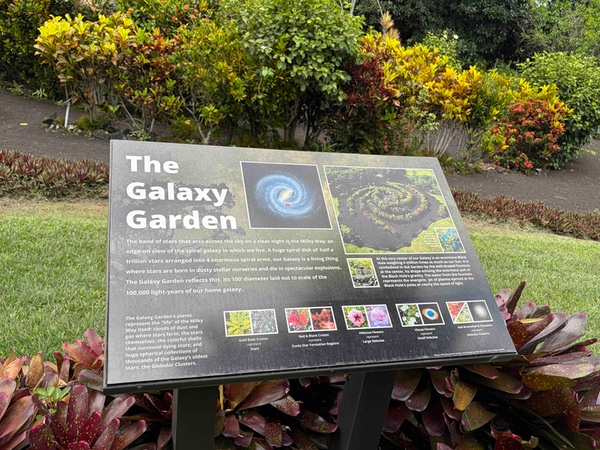 An interpretive guide to the Galaxy Garden, a scale model of the Milky Way. (credit: Deana L. Weibel) |
The Galaxy Garden, secluded on an island in the Pacific Ocean, is far less well-known, but being able to visit it with Lomberg himself made me want to bring more attention to this very original take on astronomy. It is a living planetarium, a walkable orrery. And it helped me understand, just a bit better, the scale of our galaxy.
The Paleaku Gardens Peace Sanctuary is an interesting hybrid of science and spirituality. It describes itself as “a botanical healing garden and learning center that provides a facility for educational, spiritual, and cultural programs.” There is a strong Buddhist undercurrent to the Gardens. During our visit Lomberg explained that there are two painstakingly made Tibetan Buddhist sand mandalas on display, both very rare to see. One is a Healing Mandala and the other a Mandala of Compassion.
Such mandalas are sometimes said to depict “cosmic realms”[3] and are normally brushed away after they are created in order to emphasize the ultimate impermanence of reality. The two mandalas at Paleaku were reportedly given special dispensation to remain intact by the Dalai Lama. Other spiritual elements at Paleaku include a Buddhist stupa, several statues, and even a replica of a Cretan labyrinth, which can be walked by the botanical garden’s visitors. Less overtly spiritual but even more profound, however, is the Galaxy Garden itself.
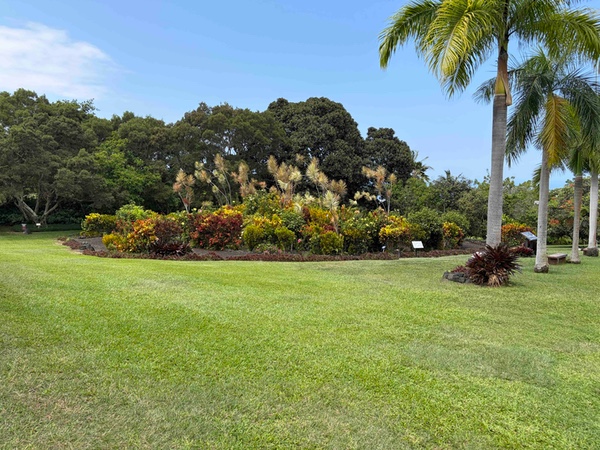
Lomberg’s Galaxy Garden opened to the public in 2007. It is a scale model of the Milky Way galaxy, its disk shrunk to 100 feet (30 meters) across, composed of an array of plants arranged into spiraling arms like the real Milky Way. Gold dust croton, a plant whose green leaves are dotted with gold spots, represents the galaxy’s stars. Regions where stars are being formed are identified by the presence of red and black croton, whose leaves are patterned in ebony and crimson. Hibiscus flowers represent the galaxy’s larger nebulae while vincas flowers stand in for its smaller nebulae. The Milky Way’s globular clusters appear in the garden as red bromeliad flowers and spiky dracaena leaves. At the very center of the Galaxy Garden is a black water fountain representing the supermassive black hole at the center of our galaxy, its water portraying relativistic jets shooting out into space.[4]
| It is a galactic analog, not because it recreates the physical conditions of the Milky Way, but because it makes galactic scale available to the body as something that can be entered, walked, measured, and felt. |
Jon Lomberg, who has painted many well-known galaxy images during his career, including his painting for the cover of Carl Sagan’s novel Contact as well as a famous portrait of the Milky Way housed at the Smithsonian’s National Air and Space Museum,[5] led the way to a galactic arm labeled the “Orion Arm.” A few yards in, he stopped and gently took a leaf of gold croton into his hands, being careful not to harm the plant. He then pointed out a golden dot approximately where our own Sun would be located. It was one dot among dozens, even on that single leaf. Lomberg gestured to the other leaves around it, and instead of literal leaves, I found myself seeing them as clusters of stars, of other suns. Pointing to a leaf on the Sagittarius Arm, Lomberg, the co-creator of a message sent out into the stars in 1977, asked why anyone who lived on one of these leaves would bother with those of us back on our own leaf. They’d have their own leaf to explore.
I understood in that moment that, at this scale, Alpha Centauri, Proxima Centauri, Barnard’s Star, Wolf 359, Sirius, and many other nearby stars would all be crowded almost unimaginably close to our own Sun. The stars that clustered near our own were really, really close, especially compared with other “leaves” on the same arm, let alone the leaves on other arms. I had certainly imagined the Milky Way galaxy before but there in this Hawaiian garden—near a labyrinth, a pair of mandalas, and a stunning view of the Pacific Ocean—the sheer massiveness of our home galaxy all by itself hit me in a new way.
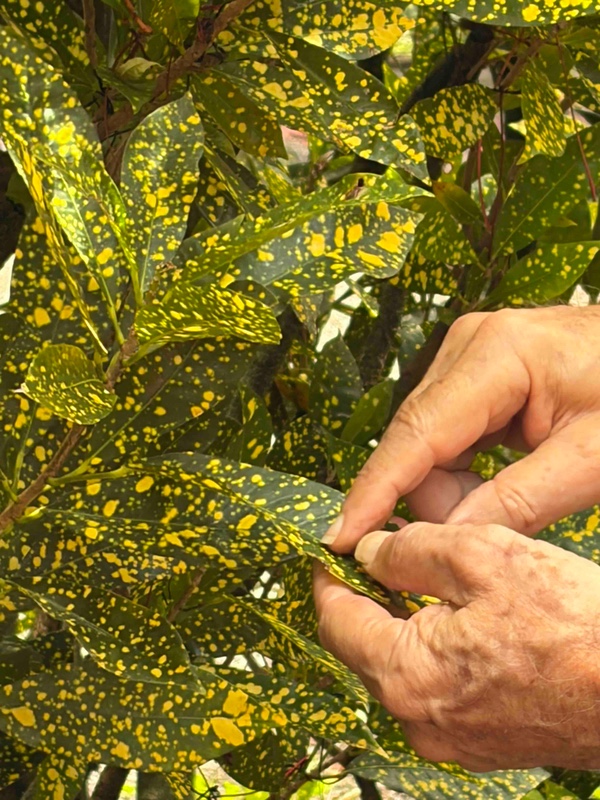 A gold dust croton leaf in the Galaxy Garden, where the yellow dots represent stars. (credit: Deana L. Weibel) |
We proceeded toward the center of the Galaxy Garden. Lomberg indicated nebulae and brightly-colored stellar nurseries along the way. Eventually we reached the supermassive black hole, whose place was marked by a well-like black fountain. The visit took place soon after the May 2026 Hawaiian earthquake, so the fountain wasn’t running, but even without the “relativistic jet” spraying, it was possible to see how the fountain was designed to show the event horizon, gravity well, and the black hole itself. Seeing the galaxy through a garden overlay was a strange experience but one that made me understand the Milky Way in a fashion I hadn’t before.
After we exited the “galaxy,” we contemplated the Pacific Ocean from a conveniently placed bench. I began to think of the “deep field” photos taken by the Hubble and Webb telescopes, the ones where what looks like a starfield at first has to be reevaluated as a field of galaxies instead. I imagined a whole deep field of galaxy gardens, wondering if they’d stretch to Japan or the US mainland or could even fit on Earth.
Children sometimes come to the Galaxy Garden on field trips, and it is certainly also visited by plant lovers and spiritual seekers. But it deserves to be a destination for scientists and space enthusiasts. There are lunar and Martian analogs all around the world, but the Galaxy Garden is something rarer. It is a galactic analog, not because it recreates the physical conditions of the Milky Way, but because it makes galactic scale available to the body as something that can be entered, walked, measured, and felt. It is a galactic analog that can be explored in an hour. Taken together with stargazing on Mauna Kea and a visit to Kilauea, it could complete an “itinerary of awe,” creating an awareness of deep time and deep space that is often hard to come by.[6]
A single inch of the Galaxy Garden is analogous to 83 light-years.[7] Voyager 1, which carries images created and curated by Jon Lomberg, has traveled for nearly 49 years. On November 18, 2026, it will have traveled the distance light can travel in a single 24-hour day.[8] Measured on a gold dust croton leaf, that’s 0.000033 inches, or 1/80th of the thickness of a single human hair. The great Douglas Adams once wrote, “Space is big. You just won't believe how vastly, hugely, mind-bogglingly big it is.”[9] Thanks to the Galaxy Garden I’m now able to believe it, understand it, more than I ever did before.
Works Cited
Adams, Douglas. The hitchhiker's guide to the galaxy. United Kingdom: Harmony Books, 1980.
Bedeaux, Rob. “The Tibetan Sand Mandala: A Short History.” Minneapolis Institute of Art. August 26, 2025.
Goldstein, J. J., M. Bicay, R. Gorchev, J. Lomberg, L. Blitz, and V. Neal. “A Portrait of the Milky Way: The Jon Lomberg Painting: Art and Science Working Together.” Bulletin of the American Astronomical Society 26 (1994): 1550.
Klaes, Larry. “The Milky Way as a Garden.” Centauri Dreams. November 14, 2007.
Lomberg, Jon. Galaxy Garden. Accessed July 1, 2026.
Mann, Marya. “The Galactic Interpretations of Jon Lomberg in Flowers and Other Media.” Ke Ola Magazine. June–July 2009.
NASA. “Where Are Voyager 1 and Voyager 2 Now?” NASA Science. Last updated June 30, 2026.
RECONS. “The One Hundred Nearest Star Systems.” Research Consortium on Nearby Stars. Georgia State University. Accurate as of January 1, 2012.
Weibel, Deana L.. The Ultraview Effect: What We Can Learn from Astronauts about Awe, Humility, and Exploring the Unknown. United States: University of California Press, 2026.
References
- Deana L. Weibel, The Ultraview Effect.
- Larry Klaes, “The Milky Way as a Garden.”
- Rob Bedeaux, “The Tibetan Sand Mandala: A Short History.”
- Jon Lomberg, Galaxy Garden.
- J.J. Goldstein et al., “A Portrait of the Milky Way.”
- Deana L. Weibel, The Ultraview Effect.
- Marya Mann, “The Galactic Interpretations of Jon Lomberg in Flowers and Other Media.”
- NASA. “Where Are Voyager 1 and Voyager 2 Now?”
- Douglas Adams, The hitchhiker's guide to the galaxy.
Note: we are now moderating comments. There will be a delay in posting comments and no guarantee that all submitted comments will be posted.