Rededicating a space museumby Jeff Foust
|
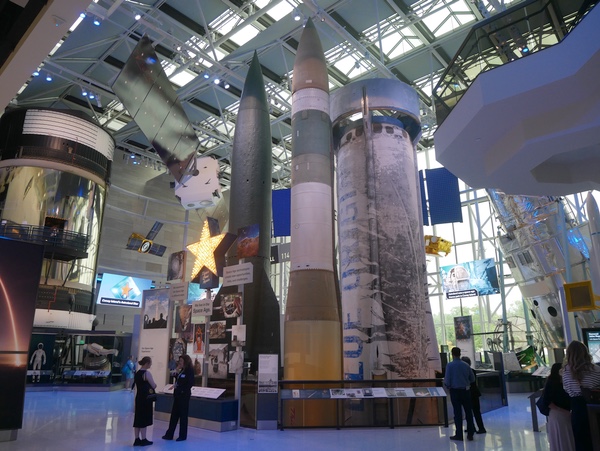
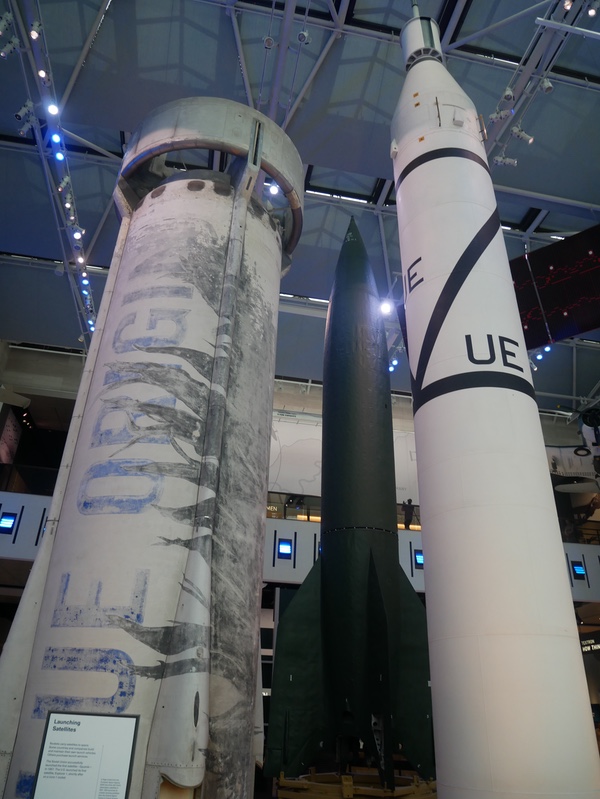 The New Shepard booster alongside missiles and rockets, including a V-2. (credit: J. Foust) |
The biggest of the five is the “RTX Living in the Space Age Hall,” RTX being the corporate sponsor of the exhibit. It features the return of two of the largest space artifacts in the museum’s National Mall location: the backup Skylab module and a full-scale model of the Hubble Space Telescope, along with several missiles.
They are joined by some new items. One of the most prominent is a Blue Origin New Shepard propulsion module that was used for several test flights of the suborbital vehicle more than a decade ago. It is placed alongside the missiles, including a V-2 rocket that had been previously on display but is now shown in its original drab olive paint scheme.
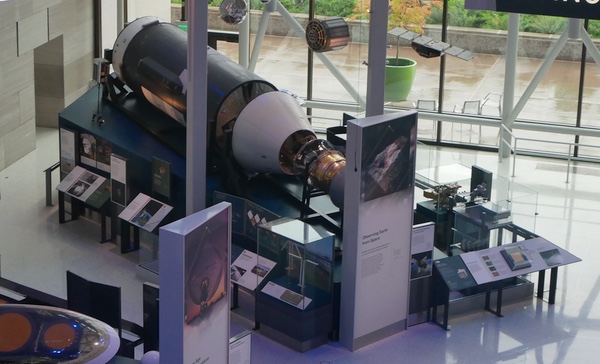 The GAMBIT 1 spysat on display. (credit: J. Foust) |
Another major new contribution is a GAMBIT 1 reconnaissance satellite from the 1960s. It is on display in an expanded view to show the capsule that would return the exposed film to Earth.
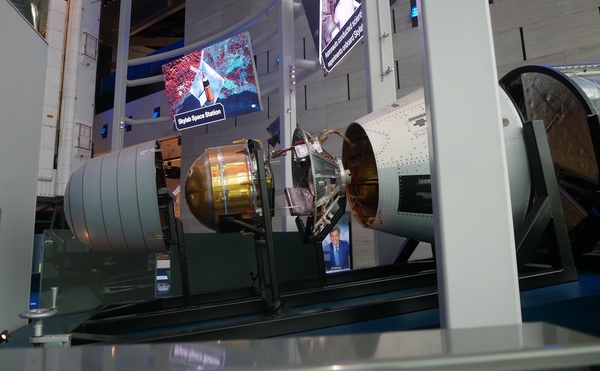 Closeup of the nose section of the GAMBIT 1 spysat. (credit: J. Foust) |
There are many more satellite models on display, many suspended from the ceiling above GAMBIT 1 and elsewhere, including an ITOS weather satellite from the 1970s and a more recent CYNGSS smallsat for monitoring cyclones. A model of a Boeing 702 communications satellite is up near the ceiling; despite its size it can be easy to miss when you’re on the first level unless you look way up.
One challenge with the display of the satellite models is that it can take some effort to identify each satellite: the placards for the models are sometimes not near the models themselves. The determined visitor will find them, but the causal guest may not.
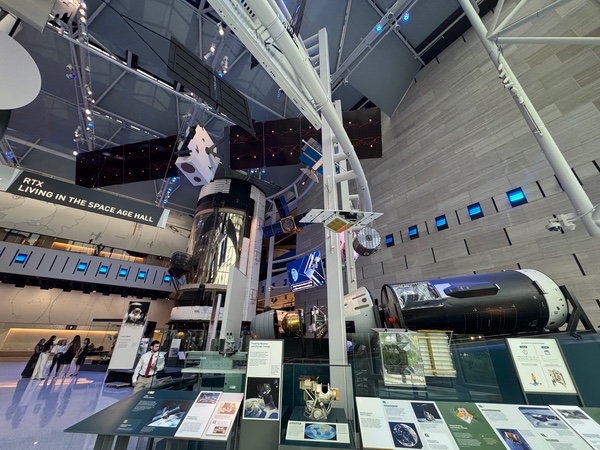 A menagerie of satellite models suspended above the GAMBIT 1. (credit: J. Foust) |
The gallery includes other items with space, or Space Age ties, from models of spacesuits to a Cold War-era fallout shelter sign and air raid siren. The spacesuits in particular are models of what might have been rather than what has actually flown: they include an Apollo-era hard suit concept, a design that Collins Aerospace had worked on recently before dropping out of a NASA commercial spacesuit development program, and the form-fitting BioSuit concept developed at MIT.
There are now several large video screens arrayed in the hall above (most of) the exhibits. They display information about some of the key items, part of relatively straightforward multimedia additions.
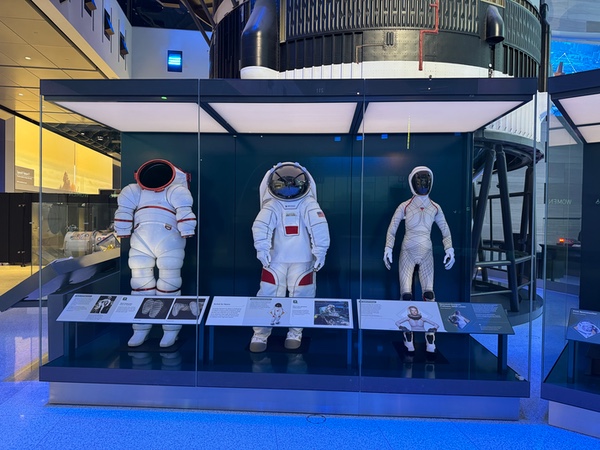 Spacesuits that could have been on display. (credit: J. Foust) |
Next to the Living in the Space Age gallery is Discovering our Universe, sponsored by the National Science Foundation. Its focus is on the tools used in astronomy, from a telescope used more than two centuries ago by William Herschel to equipment used in modern facilities, such as the Event Horizon Telescope and Laser Interferometer Gravitational-Wave Observatory.
The exhibit also includes models of astrophysics missions, including the International Ultraviolet Explorer and Wilkinson Microwave Anisotrophy Probe. Unlike the large Living in the Space Age gallery with natural light, this smaller exhibit is kept dark, keeping with the astrophysics theme but making it more difficult to fully appreciate it.
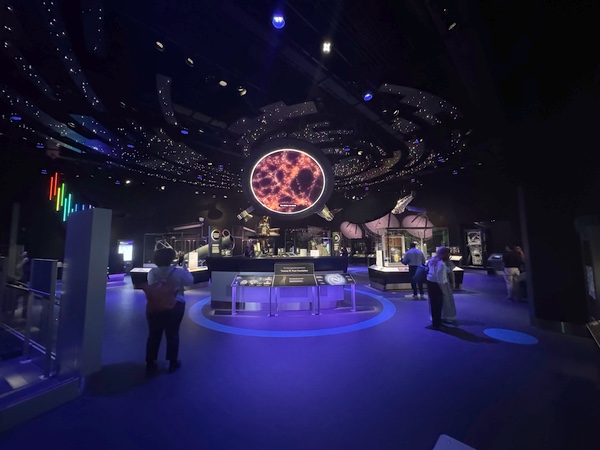 The “Discovering our Universe” exhibit. (credit: J. Foust) |
Space has cameo appearances in two other new galleries. The “Textron How Things Fly” gallery is largely a hands-on educational exhibit to demonstrate the principles of both aviation and spaceflight. A gallery upstairs includes air and space artwork, including an exhibit of the works of Robert Rauschenberg.
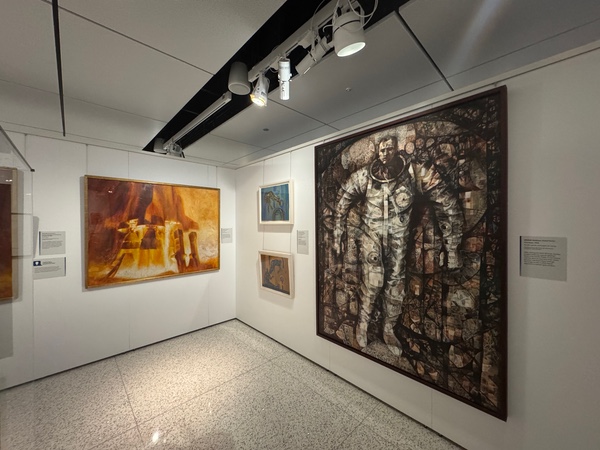 Space-related art on display in a new gallery a the museum. (credit: J. Foust) |
With the rededication, the renovation of the museum is nearly complete. Two more exhibits are slated to open this fall, including “At Home in Space,” which the museum promises to be an “immersive, highly interactive exhibition” on how living in space. During the media preview, it was possible to get a glimpse of the ongoing work there: above a barrier blocking the entrance to the gallery was a spacesuit on the end of a Canadarm robotic arm suspended just below the ceiling, along with a small model of the shuttle, among other items.
More items will come. At the rededication ceremony, NASA administrator Jared Isaacman announced that NASA will loan to the museum the Orion capsule from the Artemis 1 uncrewed mission. (The museum, presumably, will seek to swap that capsule at some point with the one on the later Artemis mission that returns NASA astronauts to the lunar surface, just as it has the Apollo 11 command module.) He also presented back to the museum a piece of fabric from the Wright Flyer plane; that swatch was flown on the Artemis 2 mission earlier this year.
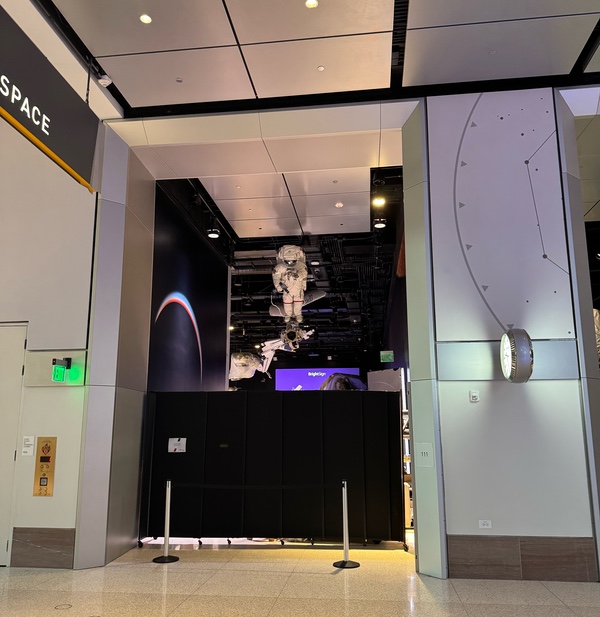 A hint of what is still to come: the “At Home in Space” exhibit set to open this fall. (credit: J. Foust) |
“This effort was never simply about renovating galleries or restoring a building,” said Ellen Stofan, a former director of the museum and current undersecretary for science and research at the Smithsonian Institution, at the rededication ceremony. “It was about ensuring that this institution can continue inspiring discovery, advancing science, and welcoming future generations of explorers and innovators for the next 50 years and beyond.”
That work is done, for now. But long before the museum needs another extensive renovation, perhaps in another half century or so, the exhibits will need more updates to continue inspiring discovery as humanity expands deeper into space.
Note: we are now moderating comments. There will be a delay in posting comments and no guarantee that all submitted comments will be posted.