Astropolitics and the post-Earth economyWhat holds civilization together when the speed of light is too slow?
Monday, July 6, 2026 |
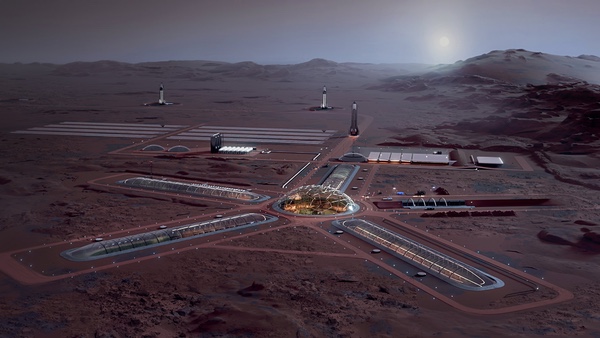
| When humanity moves beyond Earth orbit in sustained ways, delay returns as more than a mere inconvenience. A conversation becomes correspondence. Command becomes anticipation. |
Telegraph cables, radio, satellites, fiber-optic networks, and the Internet compressed distance until an entire species began to mistake speed for unity. Markets move in milliseconds. Weather, war, finance, entertainment, and rumor arrive everywhere at once. For a brief historical moment, modern civilization has behaved as though simultaneity were the natural condition of human affairs.
It is not. It is a local achievement.
When humanity moves beyond Earth orbit in sustained ways, delay returns as more than a mere inconvenience. A signal to Mars can take roughly 4 to 24 minutes one way, depending on orbital positions. A conversation becomes correspondence. Command becomes anticipation. Consent, adjudication, emergency response, and care must all survive the gap between event and answer.
This is the central problem of astropolitics. Space is usually discussed in terms of rockets, mining, propulsion, tourism, or flags. Those questions matter, but they sit on top of a deeper one: what holds civilization together when the speed of light is too slow?
Every moral order, empire, market, and faith tradition has operated within the limits of how fast information could move. When communication moved at the pace of runners and ships, time itself was local. Distant communities learned to accommodate uncertainty. Empires ruled by dispatch and delay. Merchants priced risk into voyages that might not return. Faith, law, and commerce evolved around the reality that a command could arrive after the facts had changed.
Each acceleration rewrote authority. Printing compressed theological time. The telegraph stitched financial markets together. Radio altered mass politics. Undersea fiber and satellite networks made near-real-time awareness seem planetary and permanent. By the early 21st century, humanity achieved global simultaneity without global coherence: awareness outpaced understanding, and speed became a substitute for wisdom.
Space reverses that illusion. The farther civilization extends, the more it must relearn the governance of delay. Distance will again become political. Latency will again shape legitimacy. The systems that keep people alive, moving, trading, praying, building, and deciding will have to function when no single center can see, judge, or command in time.
The first off-world settlements will not resemble the frontier cabins of national mythology. They will resemble logistics hubs, arbitration systems, communications relays, fuel depots, insurance registries, data centers, and closed-loop habitats. Their organizing principle will not be conquest but continuity.
Space was built by states, but will be run by systems
The first space age was born from fear. Between 1945 and 1989, rockets were instruments of deterrence and propaganda. The same laboratories, contractors, and military-industrial supply chains that perfected missiles and bombers pointed their work upward. Every launch was a diplomatic signal disguised as an engineering achievement.
NASA and other national space agencies bureaucratic reflections of Cold War states: hierarchical, secretive, expensive, patriotic, and deeply dependent on a narrow class of industrial partners. Boeing, Lockheed, North American Aviation, Grumman, McDonnell Douglas, Rockwell, Bell Labs, Aérospatiale, Dornier, and their equivalents supplied the material culture of the first space age. Space was not an open frontier. It was an extension of total war by other means.
| The Earth-Moon system will be the first real test of whether humanity can organize space as a system rather than a spectacle. |
The Cold War built launch capacity, but it also built a governance assumption: space would be entered, managed, and narrated by states. The Outer Space Treaty of 1967 reflected that world. In its older treaty language, it declared outer space the "province of all mankind" and rejected national appropriation, while presuming that states would remain the responsible actors behind space activity.
That assumption is now aging. After the Cold War, space agencies increasingly became commissioners rather than sole builders. Governments still funded and authorized missions, but contractors, consortia, telecom operators, insurers, launch firms, and data companies began to shape the pace and purpose of space activity. Space stopped being only a theater of state prestige and became a workshop of markets.
Commercialization began with paperwork: licenses, partnerships, frequency filings, launch approvals, insurance policies, and joint ventures. Reusable launch systems, miniaturized satellites, commercial imagery, broadband constellations, commercial space station plans, lunar payload services, and venture-backed launch firms have accelerated that shift. The state remains indispensable, but it no longer controls the entire rhythm. NASA buys services and funds programs through commercial providers. Regulators allocate launch permissions and spectrum. The International Telecommunication Union coordinates use of radio frequencies and, especially for geostationary satellites, associated orbital positions.
The result is a quiet migration of sovereignty. Power no longer rests only in flags, treaties, or speeches. It resides in launch manifests, underwriting models, spectrum coordination, compliance databases, navigation standards, docking schedules, and communication protocols.
This does not mean states disappear. It means states share practical authority with systems they cannot fully command. A satellite constellation, an orbital refueling network, a lunar communications relay, or a cislunar traffic-management regime may exert more direct influence over daily behavior in space than any constitution written on Earth.
In the first space age, sovereignty was symbolic: who planted the flag, who launched first, who orbited, who landed. In the next one, sovereignty will become operational: who routes the signal, verifies the transaction, authorizes docking, insures the payload, allocates bandwidth, maintains the clock, and keeps the system in phase.
Cislunar space as the first test
The Earth-Moon system will be the first real test of whether humanity can organize space as a system rather than a spectacle.
The coming cislunar economy will not begin as a self-contained civilization. It will begin as infrastructure: landers, relays, depots, navigation aids, power systems, payload services, private stations, surface robotics, resource prospecting, and traffic rules. The metaphor shifts from Apollo to the rail age. The decisive question is whether many actors can coordinate repeated movement, maintenance, finance, and risk across a shared operating environment.
NASA's Artemis campaign, Chinese and other international lunar programs, and commercial efforts all point toward the same reality: the Moon is becoming less an object of symbolic arrival than a node in a larger system. It is quarry, port, laboratory, staging ground, communications relay, and governance experiment.
Once regular activity begins, access will matter more than possession. A refueling depot at a Lagrange point, a reliable lunar relay, a docking hub, or a traffic-control system could quietly function like a government. It may set inspection norms, establish approach corridors, define emergency procedures, and create arbitration expectations. Jurisdiction will flow to whoever maintains the data feeds and controls the schedules.
That is not science fiction but instead an extension of existing infrastructure politics. On Earth, airports, shipping registries, undersea cables, cloud platforms, payment networks, and satellite navigation systems already shape sovereignty by determining who can move, communicate, settle, and verify. In cislunar space, that logic becomes more explicit because the margin for improvisation shrinks. A missed docking window, corrupted signal, failed relay, or denied insurance certification can become a political event.
| The actor that keeps the system reliable gains legitimacy while the actor that introduces disorder loses it. |
The outlines are already visible. Broadband constellations are not merely communications products. They are political infrastructure because they define where connectivity exists and under whose terms. GPS, Galileo, BeiDou, and other navigation systems do not merely help machines locate themselves, but also provide the timing that synchronizes finance, logistics, weapons, and more. As comparable communications, navigation, and timing systems extend toward the Moon, they will carry governance with them.
Cislunar space therefore becomes the place where space law, commercial practice, technical standards, insurance, national policy, and orbital mechanics begin to fuse. The first conflicts are unlikely to look like territorial wars. They may concern telemetry, frequency allocation, liability, debris, docking precedence, rescue obligations, safety standards, or the right to exclude an unsafe actor from a shared corridor.
That is why the politics of space will become the politics of coherence. The actor that keeps the system reliable gains legitimacy while the actor that introduces disorder loses it. In a hostile environment, maintenance is not a technical afterthought. It is the foundation of authority.
Law at the speed of light
Law has always been a function of reach. A statute is only as real as the channel that can communicate it and the power that can enforce it. Rome ruled through roads. Britain ruled through sea lanes. The Mongols ruled through horseback. Modern states rule through cables, airspace, satellites, databases, payment systems, and logistics networks. Every legal order is, at some level, durable logistics.
Space exposes that relationship by stripping it to physics. A rule issued from Earth means little if it arrives after the emergency has passed. A contract is only useful if the parties can verify compliance across delay. A court can only govern what its procedures can reach. Beyond Earth orbit, law will not disappear, but it will become less declarative and more infrastructural. It will travel through relays, ledgers, telemetry, docking permissions, insurance requirements, and executable protocols.
The basic space treaties were written in the era of Earth orbit and great-power symbolism. The Outer Space Treaty, the Liability Convention, the Registration Convention, and later frameworks such as the Artemis Accords create principles, responsibilities, and cooperative expectations. They are important. But they largely assume that Earth remains the center of decision, responsibility, and adjudication.
Beyond the Earth-Moon system, that assumption weakens as light travel times extend to dozens of minutes each way to Mars and asteroids. Farther out, communication delays become hours. When reply itself becomes slow enough for facts to change before instructions arrive, jurisdiction begins to decay with distance.
| When reply itself becomes slow enough for facts to change before instructions arrive, jurisdiction begins to decay with distance. |
This does not mean law disappears, but instead it changes form. Sovereignty will migrate from constitutions to control systems. Whoever manages docking queues, relay access, fuel corridors, orbital registries, sensor validation, and emergency protocols will exercise de facto authority. A station may formally belong to one nation, be financed in another, insured by a multinational syndicate, operated by a corporate consortium, and dependent on relay software maintained somewhere else entirely. Its practical citizenship may depend less on a flag than on whose systems keep it alive.
Maritime law offers a useful precedent. A vessel can be flagged in one jurisdiction, insured in another, financed elsewhere, crewed internationally, and bound by the rules of whichever port it needs next. Space will extend this diffusion until enforcement becomes a property of physics. That which cannot reach cannot rule directly.
Law will therefore evolve from instant interpretation toward deferred verification. Telemetry may become testimony. Smart contracts may release payment, insurance, access, or sanctions when predefined conditions resolve true. Embargoes may operate through expired access keys rather than naval patrols. Emergency authority may sit in code because no one can wait for Earth to respond.
This raises a difficult legitimacy problem. When law becomes executable, justice becomes partly a firmware parameter. Who audits the system that decides whether a habitat is safe, a docking maneuver lawful, a claim valid, or a rescue obligation triggered? Who appeals when telemetry is incomplete, corrupted, or late? Who has standing when an automated decision protects the system but harms a person?
The question once aimed at kings and parliaments—who rules?—becomes a new set of questions: whose code executes, whose data counts, whose clock is authoritative, and whose version of events survives synchronization?
In space, legitimacy will not be measured only by consent. It will also be measured by uptime, auditability, interoperability, and the capacity to correct error before error compounds into catastrophe.
Infrastructure becomes sovereignty
The first infrastructure of off-world civilization may not be cities but rather data. Before humans settle a world in large numbers, their machines will map, simulate, communicate, monitor, and prepare. Autonomous construction fleets, navigation systems, robotic logistics, environmental sensors, and AI-assisted planning will arrive before durable human society does. Information will precede habitation. Territory will first be claimed in code.
Every civilization centralizes its data near its energy. The industrial age built factories beside rivers and coal seams. The digital age builds data centers near cheap electricity, cold air, and water. A spacefaring economy will do the same under different conditions: solar flux, thermal stability, shielding, line of sight, and transmission delay. Relay hubs, computational nodes, archives, and traffic systems will become part of the political geography of the solar system.
These systems will not be neutral. The databases that coordinate supply and navigation will also define jurisdiction. Whoever controls them will control the rhythm of arrival, the allocation of access, and the hierarchy of response. Law will follow latency. Governance will optimize for propagation, verification, and resilience rather than simply population or territory.
| On Earth, insurers have long acted as quiet regulators. They set safety standards, require inspections, price risky behavior, and make certain forms of commerce difficult without coverage. |
This is already how much of Earth works, though we often fail to see it. International banking runs on messaging standards. Maritime commerce runs on bills of lading, insurance certificates, vessel registries, and port permissions. Trade depends on Incoterms, customs codes, and logistics protocols. These are not always laws in the legislative sense, but they function as law because everyone depends on them.
Orbital environments will accelerate this trend because real-time adjudication is often impossible and hesitation can be fatal. A habitat cannot pause life support while lawyers argue. A convoy cannot wait indefinitely for permission to alter course. A station cannot treat an airlock failure as a matter for leisurely review. Each node must carry some authority inside itself, encoded as procedure, automation, redundancy, and human stewardship.
This is where finance, insurance, law, and survival begin to converge. On Earth, insurers have long acted as quiet regulators. They set safety standards, require inspections, price risky behavior, and make certain forms of commerce difficult without coverage. A ship without insurance may still float, but it becomes difficult to dock, finance, or trade. A building may stand, but without coverage it becomes economically illegible. The G7 oil-price-cap regime for Russian seaborne oil showed this logic at geopolitical scale: access to maritime transport, financing, and insurance services became a mechanism of enforcement.
Off-world, this logic could intensify. Every station, convoy, mining operation, and habitat will depend on continuous validation from underwriters, regulators, sensor networks, and counterparties. Telemetry will feed the policy. Algorithms may release or withhold access to docking, credit, energy, or rescue priority. To be insured may be to be recognized. To be uninsured may be to operate as a shadow vessel, visible but illegitimate.
The result is a continuity stack: a shared data layer where law, finance, communications, and survival meet. A failed transmission can halt trade. A corrupted ledger can paralyze access. A broken relay can isolate a habitat. When authority, economy, and life support depend on the same streams of verified information, synchronization becomes sovereignty.
The danger is obvious. At its best, this architecture ensures coherence: no distress signal ignored, no unsafe approach unflagged, no habitat abandoned to silence. At its worst, it enables enclosure: a civilization where dissent is confused with desynchronization and where exclusion from the network becomes civil death. The task will not be to prevent infrastructure from becoming sovereign but to distribute trust well enough that autonomy can survive inside coherence.
Our polycentric future
Empire depends on simultaneity. When command and communication share the same clock, hierarchy can function. When they diverge, coordination becomes plural. Distance, not ideology, ends empires.
A post-Earth civilization will therefore become polycentric long before it becomes unified. No single capital can govern across light-speed delay in any ordinary sense. Earth will remain the cultural, financial, legal, and biological anchor for a long time. The Moon may become an industrial and logistical extension of that anchor. Mars may develop semi-autonomous political and technical rhythms. Asteroid operations may be governed by corporate, cooperative, or chartered systems. Outer solar system settlements, if they ever emerge, will be aligned more by habit, standards, and memory than by immediate command.
This does not mean fragmentation into chaos. It means integration without a single center.
History has rehearsed versions of this pattern. The Hanseatic League bound merchant cities through trade, protection, and shared commercial interest rather than imperial unity. Venice governed by convoy, contract, and maritime logistics. Chartered companies such as the Dutch East India Company, the British East India Company, the Hudson's Bay Company, and the British South Africa Company built quasi-sovereign systems across oceans. Even today, digital platforms, standards bodies, financial networks, and infrastructure providers exercise forms of power that do not map cleanly onto territory.
The International Space Station offers a small preview. It runs through agreed procedures, shared engineering standards, operational trust, and cooperation among nations that do not always agree on Earth. A Mars settlement would have to go further. It could not wait for Earth to decide every operational question. Its systems would negotiate, allocate, repair, and respond before instructions arrived. Authority would live inside the network, not above it.
That is what a polycentric post-Earth order means in practice: many nodes, many clocks, many authorities, held together by interoperability rather than obedience.
| The political challenge of the solar system will therefore be less about declaring independence than about preserving meaningful participation across delay. |
Legitimacy in such an order must be earned continuously. Institutions will be trusted because they remain available, comprehensible, secure, auditable, and capable of correction. Governance may begin to resemble open-source development: branches, forks, merges, standards, protocols, and reputations. Conflict may be managed less by conquest than by compatibility. Systems that cannot interoperate will drift apart.
This will produce new inequalities. Those closest to the best relays, most reliable clocks, safest trajectories, and most trusted infrastructures will live more fully inside civilization’s “now.” Others will live deferred. Delay can become disenfranchisement, and access to synchronization may become a form of class.
The political challenge of the solar system will therefore be less about declaring independence than about preserving meaningful participation across delay. Democracy may survive, but it may look less like a synchronized ritual and more like an audit function: a way of verifying whether institutions remain in phase with the people they claim to serve. Dissent, in such a system, is not merely opposition. It is diagnostic information, telling the system where synchronization is failing.
A civilization without a single capital can still remain coherent. But coherence will require continuous maintenance: shared standards, trusted archives, interoperable protocols, rescue obligations, open channels, and the humility to treat drift as a permanent condition rather than a temporary error.
Continuity, not conquest
The deepest question in space is not how far humanity can travel, but whether humanity can remain meaningfully connected after distance defeats simultaneity.
For tens of thousands of years, human beings lived beneath one sky, one planetary rotation, one rhythm of light and dark. That shared environment gave rise to law, markets, ritual, memory, and belonging. We called its pull home.
One day, dawn may circle many worlds at once. Each settlement will keep its own time. Each transmission will arrive a little late. Each institution will operate within its own tolerances of delay. The old gravity that held bodies together will become a problem of synchronization. Continuity will be the new mass.
No empire will outlast the speed of light. No doctrine will conquer delay. What may endure are the systems, memories, rituals, contracts, archives, and habits that allow distant human communities to recognize one another as still belonging to the same civilization.
| Space will not reward rugged individualism for long. Every breath, watt, meal, signal, repair, and rescue will depend on another system working as promised. |
That is why the post-Earth economy cannot be understood only as resource extraction, launch capacity, or technological ambition. It is a test of institutional temperament. Can we build systems that remain coherent without becoming authoritarian? Can we automate response without erasing judgment? Can we price risk without surrendering sovereignty to insurers and protocols? Can we tolerate many clocks without losing a common memory?
The frontier language of conquest is inadequate for this task. Space will not reward rugged individualism for long. Every breath, watt, meal, signal, repair, and rescue will depend on another system working as promised. Mutual reliance, not isolation, is the moral gravity of the vacuum.
The civilizations that endure will be those that master continuity: the discipline of staying in phase while changing, listening across delay, correcting drift, and remembering why the system exists. Every action is a small rehearsal of permanence.
The space industry calls this precision. Investors call it efficiency. Engineers call it uptime. Beneath those terms lies something older: the belief that the systems we build can outlast the fears that built them.
Continuity is the payload and coherence is the destination. The underlying imperative remains unchanged: humanity must learn to remain one species even when the signal takes minutes, hours, or longer to say hello.
Selected Sources
United Nations Office for Outer Space Affairs. Treaty on Principles Governing the Activities of States in the Exploration and Use of Outer Space, including the Moon and Other Celestial Bodies. 1967.
United Nations Office for Outer Space Affairs. Convention on International Liability for Damage Caused by Space Objects. 1972.
United Nations Office for Outer Space Affairs. Convention on Registration of Objects Launched into Outer Space. 1976.
U.S. Department of State. The Artemis Accords: Principles for Cooperation in the Civil Exploration and Use of the Moon, Mars, Comets, and Asteroids. 2020.
NASA. Space Communications: 7 Things You Need to Know. 2020.
NASA. Human Landing System.
NASA. Commercial Lunar Payload Services.
NASA. Commercial Space Stations.
International Telecommunication Union. Regulation of Satellite Systems.
International Telecommunication Union. ITU-R: Managing the Radio-Frequency Spectrum for the World.
U.S. Department of the Treasury. The Price Cap on Russian Oil: A Progress Report. 2023.
Lloyd's. Space risk.
OECD. The Space Economy in Figures: Responding to Global Challenges. 2023.
The White House. Space Policy Directive-3: National Space Traffic Management Policy. 2018.
McDougall, Walter A. ...The Heavens and the Earth: A Political History of the Space Age. Basic Books, 1985.
Launius, Roger D. NASA: A History of the U.S. Civil Space Program. Wiley-Blackwell, 2019.
Siddiqi, Asif A. Challenge to Apollo: The Soviet Union and the Space Race, 1945-1974. NASA History Division, 2010.
Virilio, Paul. Speed and Politics. Semiotext(e), 1977.
Note: we are now moderating comments. There will be a delay in posting comments and no guarantee that all submitted comments will be posted.