The whole world looking up: inspiration from the Moonby Richard T. Logue
|
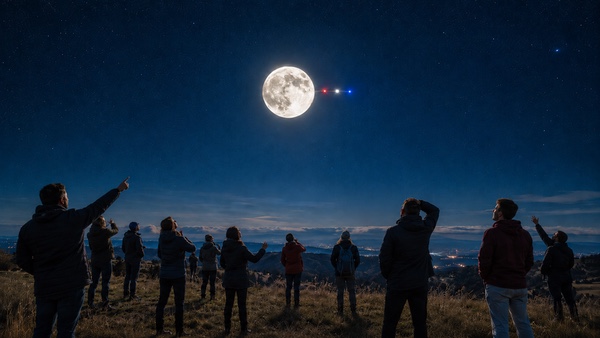
| In an age that struggles to agree on what is even real, what is it worth to have something at the distance of the Moon that anyone can confirm with their own eyes? |
Begin with the oldest answer: wonder. What does it do to people to look up together? A total eclipse rearranges the people standing under it: they weep, they cheer, strangers who will never meet again embrace. Psychologists who study awe find it leaves measurable traces such as more generosity, a diminished sense of self, a wider circle of concern. An eclipse delivers all of that by accident of orbital geometry, for two minutes, wherever the shadow happens to cross. What would it mean to deliver it on purpose, on a night chosen in advance, aimed at a chosen part of the world? Apollo 8 did not change how the species saw itself with an equation; it did it with a single photograph of Earth rising over the lunar limb. If one photograph could do that, what might a few hundred million people looking up at the same sky, in the same moment, do?
And whose moment would it be? Not a nation’s. A thing like this would belong to no one and to everyone at once: a shared human event crossing borders in a single instant, the rarest kind of common ground. Need the colors stand for anything in particular? Only what the world chooses to read into them; the same three reflectors could fly any palette, for any occasion that belongs to all of us. What matters is not whose colors hang beside the Moon, but that everyone beneath that stretch of sky sees them at the same time.
There is a quieter question underneath. In an age that struggles to agree on what is even real, what is it worth to have something at the distance of the Moon that anyone can confirm with their own eyes: no telescope, no press release, no trust in any institution required? One would not have to believe that people can build and operate in cislunar space. One would simply look up and watch them do it.
That is the case for wanting it. The surprise is how modest the how turns out to be.
The surprising part is the physics
Intuition says anything visible across the Moon's distance must be colossal. It is not, and the reason is the single most counterintuitive fact in the whole idea: a flat mirror does not throw a floodlight, but instead reflects an image of the Sun.
Sunlight striking a smooth mirror leaves as a narrow cone only about half a degree wide, the angular size of the Sun itself. Every photon the mirror collects is funneled into that thin cone instead of being scattered across the sky. Relative to a dull, diffuse surface, a mirror concentrates its light by a factor of roughly one hundred thousand. That concentration is the entire trick: it lets a small, light mirror outshine everything else overhead.
The effect has been seen for years, by accident. The old Iridium communications satellites carried flat antenna panels that occasionally caught the Sun and hurled a reflection groundward: the celebrated "Iridium flares," bright enough to cast shadows and brief enough to miss in a blink. Those came from panels a couple of meters across, in low Earth orbit. Move the mirror out to lunar distance and brightness is lost to the inverse-square law; enlarge it from a couple of meters to a few tens of meters and the arithmetic returns to the observer's favor.
A reflector roughly 20 to 35 meters across—a disc of metallized film that would drape a soccer field—shines at lunar distance at the brightness of Sirius, the brightest star in the night sky. Because the outgoing cone is fixed by the Sun’s width, the patch of Earth that can see it at any instant spans about 3,575 kilometers, or roughly from Houston to New York, about a quarter of the planet’s diameter. This is not a backyard light; it is continental.
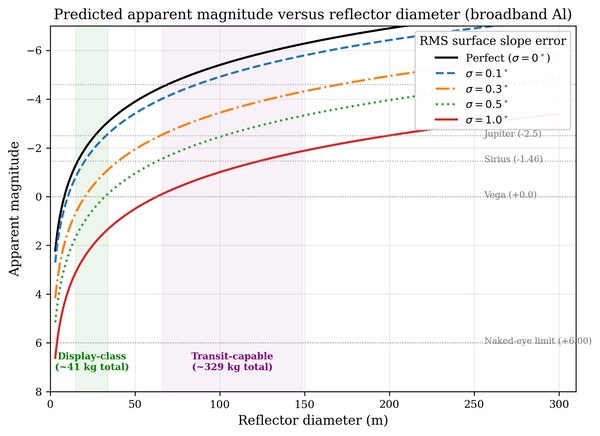 Figure 1. Naked-eye brightness vs. reflector diameter at lunar distance, against familiar stars. A 20–35 m film shines near Sirius — well above the naked-eye limit. |
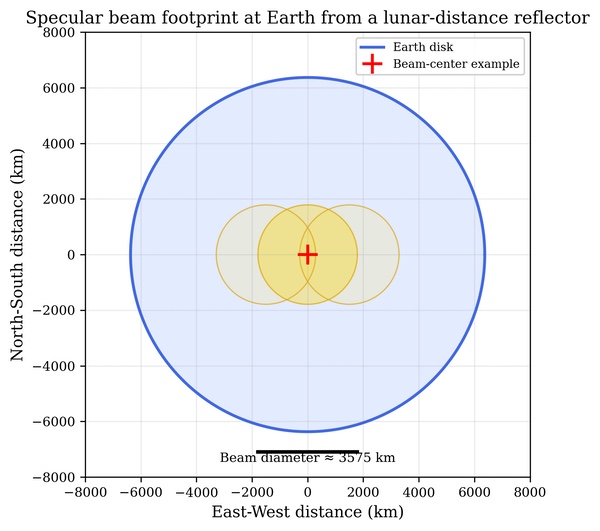 Figure 2. The beam's footprint at Earth — about 3,575 km, a quarter of Earth's diameter. Anyone inside it sees the light at full brightness. Earth's rotation (~0.46 km/s at the equator) carries an observer across the disk in up to 3,575 ÷ 0.46 ≈ 7,700 s — about two hours for a central pass. |
Color is the one place nature charges a toll. Sunlight is white, a broad mix of every wavelength, so to make one reflector shine red and another blue requires coating them with optical filters that pass only a slice of the spectrum. That discards most of the light, which is why the colored reflectors must be larger than the white one to match its brightness. But the penalty is a tax, not a wall: the colored discs grow to a few tens of meters, not hundreds, and three of them—red, white, blue—can shine together as a tricolor visible to the unaided eye even against a moonlit sky.
None of this requires inventing anything. The Soviet space program flew the crude version in 1993, when the Znamya experiment unfurled a 20-meter aluminized sheet from a cargo ship and swept a moving spot of reflected sunlight across nighttime Europe. What that era lacked was not the physics but everything around it: the photometry to predict brightness and color, the orbit, and a spacecraft built to do it deliberately rather than as a stunt.
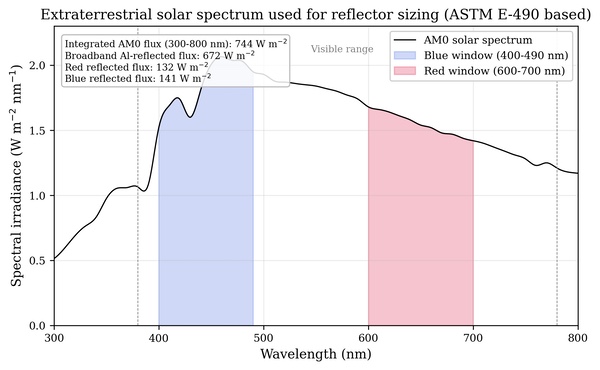 Figure 3. Where the colors come from. The Sun's spectrum is sliced by filters into a red and a blue channel; the white reflector stays broadband. Selecting color discards most of the light — the "color tax." |
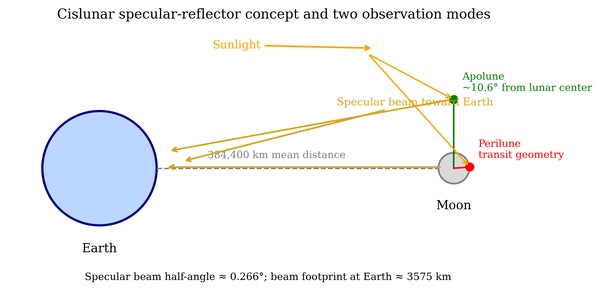 Figure 4. Mission geometry. Reflectors in a halo orbit around the Moon aim toward Earth's night side; near apolune they linger for days, far from lunar glare, for long viewing windows. |
Timing turns out to be generous rather than fussy. The reflectors would ride a near-rectilinear halo orbit—the same 6.5-day path CAPSTONE has flown around the Moon—which carries them far from the lunar disk for most of each revolution and lets them linger there, near the orbit's high point, for days at a stretch. That is precisely where the sky is darkest and the geometry kindest, so the display windows are long and predictable rather than fleeting.
How long the lights hang there is a choice, not a constraint, and it can be generous. Because the reflectors hover almost motionless near the orbit's high point, the Earth's own rotation sets the speed at which any observer is carried across the illuminated disk, and that speed is slow, so a fixed reflector can keep a color lit over a given place for up to a couple of hours, the same for all three, since color does not change the beam’s spread. So this need not be a fleeting flash.
The three lights could hang beside the Moon for much of an evening: the red, white, and blue holding steady while the turning Earth carries a broad band of its surface, in sequence, through the beam, so that hundreds of millions of people could step outside on their own time and still find the same three lights waiting. And the length of the show is set deliberately, not by chance: the flotilla shines only until a scheduled handover, when the same craft are converted, on cue, into the solar-sail experiment that is their second act, so how long the lights stay visible is fixed in advance by the date chosen for that conversion. The natural night to stage a public event is around a quarter-to-gibbous Moon:bright enough to anchor the eye, dark enough to let the colors read.
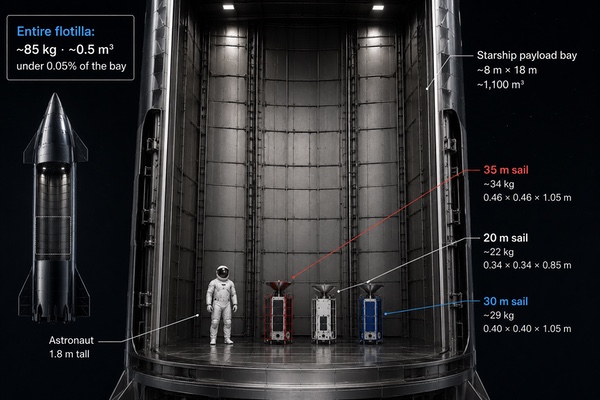 Figure 5. The whole flotilla, stowed, against Starship’s payload bay. Three satellites — ~22, ~29, and ~34 kg — total roughly 85 kg and half a cubic meter: under 0.05% of the bay. (Illustration; not to exact scale.) |
It fits in a corner of the rocket
Here is where most “giant space mirror” schemes collapse, and where this one does not. The reflectors are not glass. They are films of aluminized polymer about a tenth the thickness of a human hair, weighing some three and a half grams per square meter, or lighter than a grocery bag spread over the same area. They deploy the way a figure skater spins: the satellite spins up and centrifugal force flings the film outward into a taut, flat disc, with no rigid booms required. NASA’s ACS3 mission folded an 80-square-meter solar sail into a box the size of a microwave oven and flew it in 2024; Japan’s IKAROS deployed a 196-square-meter membrane by spin in deep space in 2010. The hard part has flight heritage.
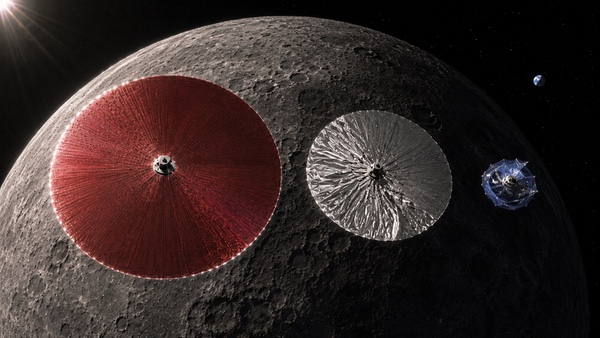 Figure 6. The deployment sequence: a large reflector fully unfurled by spin, a second opening, a third just beginning — gossamer films pulled flat by rotation alone, the Moon beyond. |
What rides to orbit, though, is not the sail but the satellite. Each reflector is a real spacecraft: a compact bus with thrusters to spin up and deploy the film, attitude control fine enough to hold the beam on target, power, communications, and propellant to steer itself onto a departure trajectory once the show is over. Sized against flown deep-space small satellites—NASA's 14-kilogram NEA Scout, itself a solar sail, and the 25-kilogram CAPSTONE that has been flying the exact lunar orbit this mission would use—each reflector satellite works out to roughly 22 to 34 kilograms fully fueled, carrying a conservative propellant reserve and a 30 percent mass margin. Three of them, with a dispenser, total under one hundred kilograms.
| Three sails of different sizes, flying together, would be the first in-space test of propellantless formation flying. |
The propulsion demands are gentler than they sound. The big maneuver, insertion into lunar orbit, is supplied by the launch vehicle, not the satellites. Maintaining a near-rectilinear halo orbit costs only a few meters per second of velocity change per year; departing it for disposal costs a few tens of meters per second more. The sail itself can perform much of that departure with no propellant at all—which is precisely the maneuver the technology demonstration exists to prove. The onboard thrusters are there to spin the film open, aim it, and guarantee a clean exit.
The comparison that makes the point: SpaceX's Starship carries a payload bay roughly eight meters across and 18 meters tall. The entire tricolor flotilla occupies around half a cubic meter and 85 kilograms: a rounding error against a vehicle that lifts a hundred tons. The hardware for a light a quarter of the planet could watch would ride to the Moon as an afterthought, tucked in a corner with room for thousands more. This is not a flagship with a flagship-sized budget. It is a rideshare payload.
More than a light
There is a fair objection to all this: isn’t it just an expensive stunt? It would be if the lights were all it produced. But the same gossamer films that make the light are, judged as solar sails, exceptional by the measure that counts, sail area per kilogram of spacecraft. Even fully fueled, the largest reflector carries close to 30 square meters of sail per kilogram, roughly double the highest ratio any sail has flown. This turns the flotilla into a serious experiment the moment the show is over.
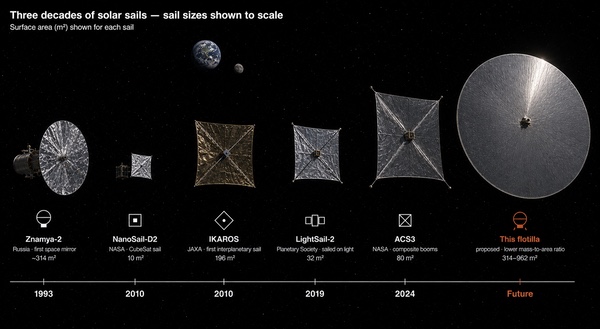 Figure 7. Sail areas drawn to scale, from Znamya-2 — the first spin-deployed space mirror (1993) — through the membranes flown by JAXA and NASA, to the proposed reflectors at 314–962 m², which would be the largest yet flown and the highest in area-to-mass. |
Three sails of different sizes, flying together, would be the first in-space test of propellantless formation flying: spacecraft holding and shifting their formation on sunlight alone, spending no fuel, a capability long studied on paper and never demonstrated. They would return the first measurements of solar radiation pressure in cislunar space, a regime no sail has sampled, with the red and blue channels even revealing how that faint push changes with the color of the light. And when they are done, they dispose of themselves, tilting to the Sun to steer toward reentry or escape, leaving no debris behind.
That dual purpose is also what makes the economics defensible: stripped of the spectacle, this is still a rideshare-class solar-sail demonstration worth flying on its own merits. So, the public event comes, in effect, as a dividend on an experiment the field already wants to run.
The objection that deserves a real answer
None of which dismisses the astronomers. The night sky is a commons, and humanity has spent the past century brightening it: first from the ground, where light pollution has erased the Milky Way for most of the world’s population, and now from orbit, as the number of satellites climbs into the tens of thousands. They have watched the sky fill with uninvited light, and they are entitled to ask why theirs should be the commons everyone else gets to scribble on. Who, if anyone, gets to put bright things above our heads is no longer a hypothetical question. The honest answer is not, “This is harmless.” It is that this is the opposite kind of thing from what they are fighting.
| A display whose whole purpose is to be seen has every reason to be seen considerately and every means to do it. |
The fair core of that worry is about permanence: a sky filling, steadily and irreversibly, with light that no one can switch off. A specular reflector is a different kind of object entirely. Off its narrow beam it is essentially invisible; a flat mirror seen edge-on returns nothing at all. It brightens a single beam-width of sky, on a published schedule, across one or several announced nights, and it can be turned off in an instant by tilting the film so the reflection slips past Earth. It is temporary, predictable, and steerable. The guidance that urges spacecraft to stay fainter than the naked-eye limit was written for permanent populations meant to fly for decades, not for a single scheduled event by three craft that then depart.
The asymmetry is one of kind, not degree. A permanent fixture in the sky is there every night, for every observatory, for as long as it flies. A three-reflector display would brighten a single beam-width of sky for the hours of one or several scheduled nights, on dates observatories would know weeks in advance—and then nothing, ever again. Outside the swept band the sky is untouched; inside it, a telescope loses part of a few long-announced evenings, and no more. One is a standing condition; the other is a single visit that ends.
Done thoughtfully, such an event would cost observatories almost nothing: announce the nights far in advance, publish the beam geometry so any telescope can plan around the hours it crosses their sky, confine the whole event to a few scheduled evenings, and bring the astronomical community in before anything flies. A display whose whole purpose is to be seen has every reason to be seen considerately and every means to do it.
The light we choose
Almost everything humanity has lifted into the sky, it lifted for a reason of use: to navigate, to broadcast, to sell, to defend. The rarest thing would be to put something up there for no reason at all except that it would move us.
The pieces are in hand. The films are gossamer and already flight-proven; the rocket has room to spare; the physics has held since a Russian mirror threw sunlight across nighttime Europe 30 years ago. What is missing is only the decision to do something beautiful on purpose—and to aim it not at a market or a flag, but at everyone.
Picture the night it finally happens. Across a continent, conversations stop mid-sentence. Strangers point. A child asks what it is, and for once the grownups don’t quite have an answer, only three colored lights burning beside the Moon, and the dawning understanding that we put them there. For an evening a quarter of the world is looking at the same sky, together, and feeling the same small lift. That is the whole idea: not to light the heavens, but to give the whole world a reason to look up at once—and to remember, looking, what we are capable of when we reach for wonder on purpose.
Note: we are now moderating comments. There will be a delay in posting comments and no guarantee that all submitted comments will be posted.