The Iranian use of space operations during Epic Furyby Matthew Mowthorpe, Markos Trichas, and Damian Terrill
|
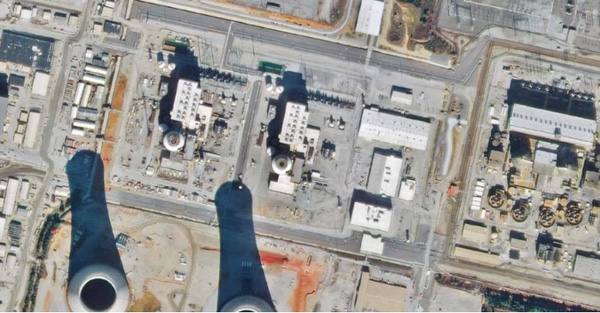
| It is highly likely Iran used this same imagery to target US military facilities in the region. |
It is likely that Russia operates the Khayyam satellite on behalf of Iran and prior to Iran’s data reception satellites being destroyed, its imagery could have been downlinked direct to Iran. It is highly likely that Russia supplies Iran with imagery, having a well established relationship with Iran.[5] The Russian space companies VNIEEM and NPK Barl built the Khayyam satellite.
Iran used space assets, be that commercially imagery obtained via China and/or imagery provided by China’s extensive fleet of EO satellites and Russia. These space assets were used to track the location where US/Israeli missiles were launched from, where they were projected to impact and their flight path.[6]
It is highly likely Iran used this same imagery to target US military facilities in the region. Some estimates suggest Iran caused $800 million in damage during the first two weeks of the conflict.[7] Iran was able to have a critical effect on air defense and satcom assets tied to intelligence and command and control capabilities. Critical facilities such as Al-Udeid (Qatar), Camp Arifjan, and Ali Al Salem Air Base (Kuwait), and Prince Sultan Air Base (Saudi Arabia), were also targeted.
An AN/TPY-2 radar system, which is used in elements of the THAAD missile defense system, were targets in the UAE and Jordan.[8] The image below of the US Navy’s Fifth Fleet HQ in Bahrain shows the destruction of AN/GSC-52B satcom terminals that played significant role in high-capacity and near-real-time communications for the US military. On March 27, a US Air Force E-3 Sentry AWACS was reported as damaged in an Iranian missile and drone attack on Prince Sultan Air Force Base, Saudi Arabia.[9] Multiple refueling aircraft were also reported to be damaged as a result of Iranian strikes.[10]
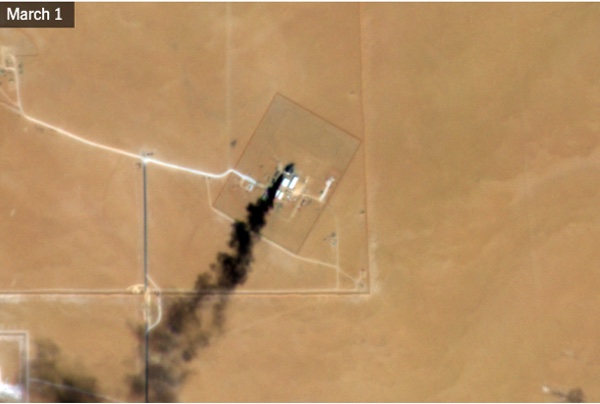 Satellite imagery shows an attack on a building at Prince Sultan Air Base in Saudi Arabia (Planet Labs)[11] |
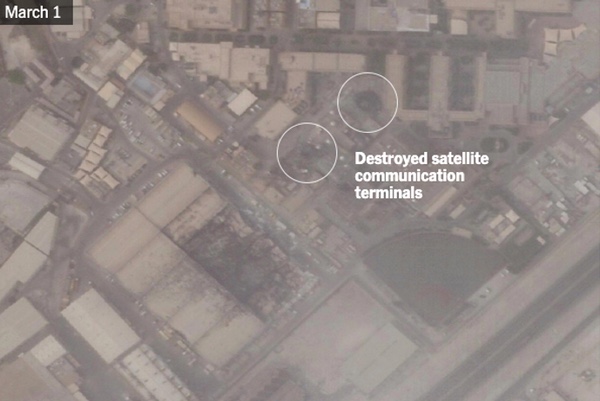 US Navy’s Fifth Fleet HQ in Manama, Bahrain (Planet Labs)[12] |
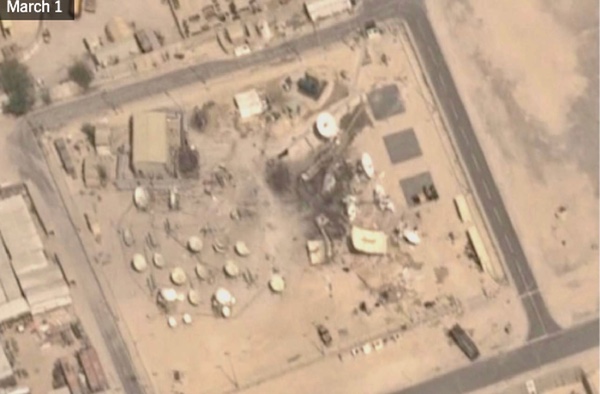 Al Udeid Air Base Qatar. (Airbus DS)[13] |
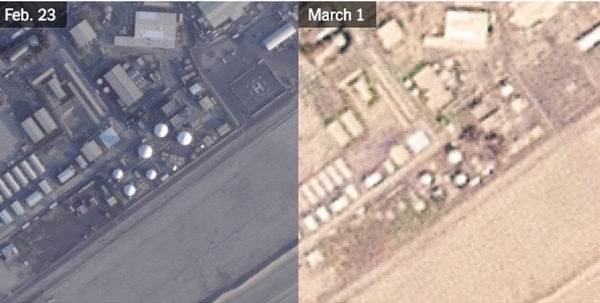 Camp Arifjan, Kuwait (Planet Labs)[14] |
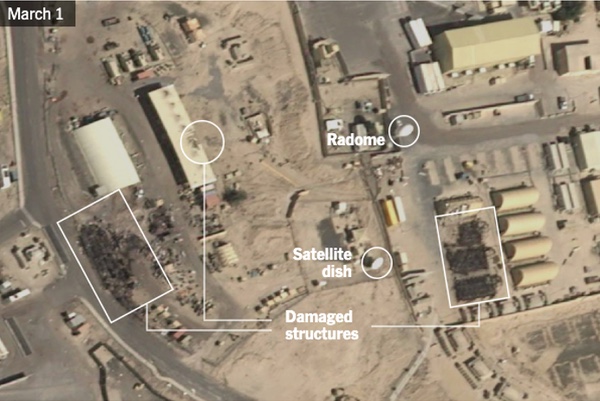 Ali Al Salem Air Base, Kuwait (Airbus DS)[15] |
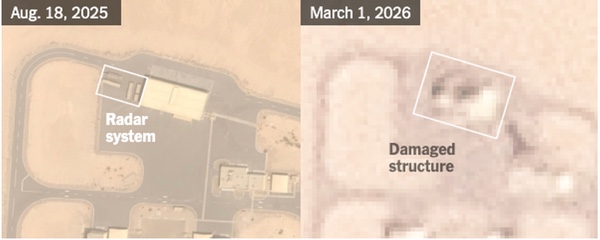 Military installation outside of Al Ruwais in the UAE. Airbus DS, Planet Labs[16] |
The US is heavily reliant on integrated networks, satellite communications, and distributed bases, which require the maintenance of the flow of data and geospatial intelligence. By attacking these nodes, Iran could have a greater impact than the actual destruction. It is unclear the operational impact of these Iranian strikes had on the US integrated network or the resilience this network contains.
Iranian electronic warfare and jamming during Epic Fury
The Iranians have long used jamming devices–GPS jamming, satellite jamming and GPS spoofing—along with sophisticated cyber-attack capabilities, which was evidenced during Epic Fury.[17] Iran significantly expanded its use of non-kinetic warfare since the start of the conflict. Its focus was on targeting space-based systems such as GPS, AIS, and SpaceX’s Starlink to disrupt and deny the US reliance and use of such systems. This provided widespread denial of service to navigation, communications and increased information control to military and civilian operators.[18] A total of 1,100 vessels were affected near the Strait of Hormuz with GNSS disruptions between February 28 and April 30, leading to a loss of navigation signals and false positioning.[19]
| Iran significantly expanded its use of non-kinetic warfare since the start of the conflict. Its focus was on targeting space-based systems such as GPS, AIS, and SpaceX’s Starlink. |
Iran is highly unlikely to have any space domain jammers and relies heavily on its ground-based electronic warfare (EW) infrastructure. Iran is likely to rely on Chinese-origin technologies to conduct jamming. It is highly likely that Iran has integrated Russian EW jammers such as the mobile Krasukha-4 jammer and the Murmansk BN long range communications disruptor.[20] Iran also reportedly developed the Cobra V8 Platform. [21]
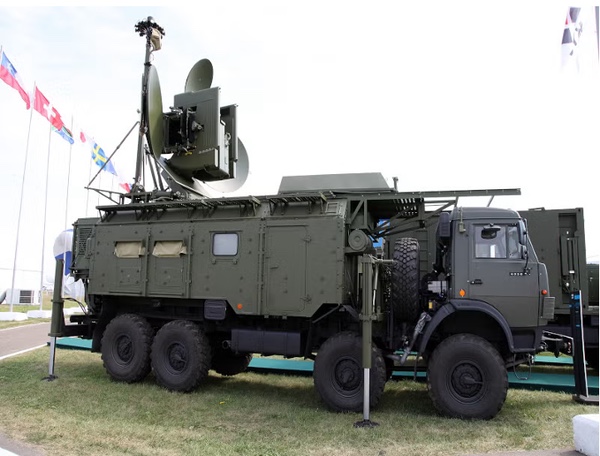 Russia’s mobile satcom jammer Krasukha 4[22] |
Iranian-aligned groups launched denial-of-service attacks, website infringements, and data wiping operations against US targets and organizations across the Gulf countries.[23] These attacks culminated in the March 2026 Iranian hacker group Handala disrupting operations and exfiltrating large volumes of sensitive data from the Stryker Corporation, a major US medical technology firm.
Endnotes
- Hudson Institute, The War Above the War: How Chinese Satellites Support Iran, 29 May 2026./li>
- US Department of State, Disrupting Iran’s Overseas Military Procurement Networks, 8 May 2026.
- US Department of State, 8 May 2025
- Iran’s Khayyam Satellite Captures Images of US Nuclear Facility, 20 November 2025.
- An ex-official quoted in Theresa Hitchens, How US military space operators are likely aiding the fight in Iran. Breaking Defence, 13 March 2026.
- Charles Galbreath, Director and Senior Resident Fellow for Spacepower Studies, The Mitchel Institute Spacepower Advantage Center of Excellence, Operation Epic Fury: Key Insights and Analysis, 7 March 2026.
- Qurat Ul-Ain Shabbir, Spatial Data has become a weapon of war in the US-Iran war. Space News, 29 May 2026.
- Qurat Ul-Ain Shabbir, Spatial Data has become a weapon of war in the US-Iran war. Space News, 29 May 2026.
- Chris Gordon and Stephen Losey, Key E-3 AWACS Damaged in Iranian Attack on Saudi Air Base, Air & Space Forces Magazine, 28 March 2026.
- Chris Gordon, US Forces at Saudi Air Base Suffer Iranian Attack, Air & Space Forces Magazine, 27 March 2026.
- Iran Strikes US Military Infrastructure in Middle East, 3 March 2026, New York Times.
- Iran Strikes US Military Infrastructure in Middle East, 3 March 2026, New York Times.
- Iran Strikes US Military Infrastructure in Middle East, 3 March 2026, New York Times.
- Iran Strikes US Military Infrastructure in Middle East, 3 March 2026, New York Times.
- Iran Strikes US Military Infrastructure in Middle East, 3 March 2026, New York Times.
- Iran Strikes US Military Infrastructure in Middle East, 3 March 2026, New York Times.
- Kari Bingen, Epic Fury: The Campaign Against Iran’s Missile and Nuclear Infrastructure. Center for Strategic & International Studies, 5 March 2026.
- Larissa Beavers, Iran Non-Kinetic Jamming since February 2026, ISR University Integrity Flash, 30 April 2026.
- Larissa Beavers, ISR University Integrity Flash, 30 April 2026
- See Matthew Mowthorpe, The Russian Space Threat and a Defense against it with Guardian Satellites, The Space Review, 13 June 2022, for further details on Russia’s EW capabilities
- Larissa Beavers, ISR University Integrity Flash, 30 April 2026
- Krashukha-4 is an electronic warfare system developed by Concern Radio-Electronic Technologies for the Russian armed forces and likely used by Iran.
- Soumya Awasthi, Signals Before Strikes: Electronic Warfare in the Iran War, Observer Research Foundation, 24 May 2026.
Note: we are now moderating comments. There will be a delay in posting comments and no guarantee that all submitted comments will be posted.