Behind Once Upon a Time in Space: James Bluemel on the human stories of spaceflightby Emily Carney
|
| “Astronauts can sometimes feel a little bit otherworldly in that way, almost superhuman. But to try and capture that vulnerability and what makes people tick was important.” |
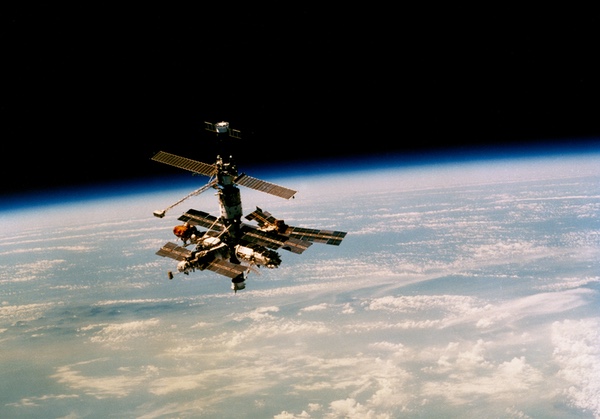
During the four episodes, filmmaker James Bluemel and his team, who also made the award-winning Once Upon a Time in Northern Ireland and Once Upon a Time in Iraq documentaries, also interview many of the main principals of Shuttle-Mir—the program that formed “phase one” of what we now know as the International Space Station‚and showcase one lesser-known effort to keep the erstwhile Soviet-era space station aloft with a “passenger” model, predating current commercial spaceflight efforts by decades. The series gives viewers an atypical, bracing look at the last 50 years of human spaceflight through its participants—not limited to just astronauts—and through the eyes of an ever-changing world and economy.
I recently caught up with Bluemel to discuss Once Upon a Time in Space, and its unique look at the last half-century of the ever-changing landscape of spaceflight and the world itself.
Emily Carney: So, one of the cool things about this series is that there’s more of an emphasis on personal stories and narratives versus just archival materials. You see documentaries, and they have a lot of archival footage, but this has a lot of personal stories in it. Were there any particular interviews or personality showcases that fundamentally changed your understanding of an event, whether it was something on Challenger, Mir, Columbia, or anything from the Shuttle-Mir era?
James Bluemel: I think the emphasis was on finding the human story behind the astronauts. And by doing that, that also requires you to look into their families and ask them to go into their attic and bring down some old home movie footage that they haven’t seen for ages either. All because you want to really capture the person, the human, and make that person very relatable. Astronauts can sometimes feel a little bit otherworldly in that way, almost superhuman. But to try and capture that vulnerability and what makes people tick was important.
Take something like Challenger, where I’m very used to; I know the emotions that are attached to that disaster. You know it’s going to be incredibly sad when the documentary finally hits that. But I didn’t want to dwell on some of the shots that have been seen hundreds of times before, especially when I don’t have those people in the documentary. I’m talking about the families of some of the crew. But seeing it from Anna’s perspective: Anna Fisher, who had just become a mother, who had taken the risk, she rolled the dice, it worked out, she came back, she was safe…to see it through her eyes and for her to realize, actually probably for the first time, realize the kind of risk that she was taking as a mother, that was a new way of unlocking an emotion about Challenger, I thought.
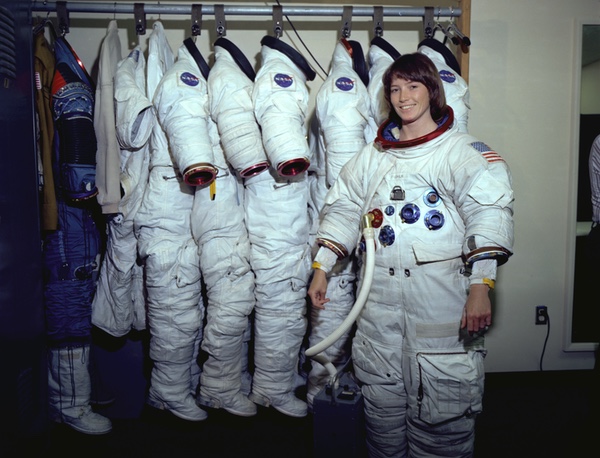 Anna Fisher suited up for training on a mockup of a modular section of the HST for an axial scientific instrument change out. (credit: NASA) |
Carney: So this series spans, I think, nearly seven decades of spaceflight history in just four episodes. That’s a lot of time. So how did you decide which moments deserved the most attention? And were there any pivotal events or things that you may have just reluctantly left out because they may not have fit the larger narrative?
Bluemel: Yeah, you can’t tell everything in only a four-part series. So, I really focused on the relationship and the collaboration between America and Russia, through the beginnings of competition to tentatively working with each other to see if they could work together, to trying it out on the Mir, to eventually creating the ISS. So that was my spine. And if things didn’t fall into that story, then I could ignore them because I thought, well, that’s for a different story. But even so, you’re still throwing things, not including things because time doesn’t allow.
| “Perhaps lazily, I thought that MirCorp was a bit of a joke when I first read about it… But when you sit and you talk to them about actually what their goals were and what they were trying to achieve, you realize that they were visionaries. They were just 25 years too early.” |
There’s a really fascinating program in Russia in the very early days of the Mir…they got civilians to come over and buy a seat and were taken up to Mir. It was run by the Russian government. So, it really bridges the gap between the very first ideas of commercial space and still just because they need to put the money into this. Anyway, that was a good story. There was a Japanese journalist, the first journalist to go up into space and things like that. But I just didn’t have time to get all of them in. So there are stories that fall by the wayside.
Carney: So, we talked a little bit about Shuttle-Mir. This series presents the arc of spaceflight as evolving from Cold War competition with Apollo, and then there’s international cooperation with Shuttle-Mir and the ISS later. But we know that history is rarely linear, especially in recent times. So how do you balance that hopeful narrative with the reality that geopolitical tensions have always shaped and even limited what’s possible in human spaceflight?
Bluemel: I mean, that geopolitical story is threaded throughout the film. And so it culminates in the fourth film with the Russian invasion of Ukraine and other geopolitical problems, which have made space collaboration between America and Russia much more challenging, and might also eventually be the one that stops it from continuing in the future. What’s remarkable, I think, is that NASA and Roscosmos managed to navigate an incredibly difficult minefield of geopolitics and still create something that was an amazing success, one of the biggest achievements in human history, which is the International Space Station.
It’s a testament to humans collaborating over the negative impacts of opposing ideologies and politics. It shows what people can do when they work together rather than fight each other. And for that, it’s an incredibly optimistic and hopeful symbol, I think, which is worth remembering, especially as we consider a future where that collaboration between Russia and America might not continue.
Carney: In Once Upon a Time in Space, you’ve included astronauts, cosmonauts, trainers, family, and even entrepreneurs, rather than just focusing exclusively on astronauts or people who flew in space. So, was that an intentional effort to broaden really the public’s understanding of who, and what, actually makes a human spaceflight possible?
Bluemel: Yes, it was. It was intentional because I wanted to get a more rounded understanding of what it takes to be an astronaut, and therefore, the families of astronauts can be very helpful for that. At the very beginning, astronauts were, I mean, they were incredibly…well, they were almost like super people, weren’t they? You had to score incredibly well on most things in order to become an astronaut. And most people don’t score incredibly well on all those things. So it really whittles down who can actually be an astronaut.
As we move towards the present day and look towards the future, that ability for the normal person to get into space is becoming more and more possible and more and more likely. So, I think there’s an intentional showing that the gatekeepers of who says what type of person can come into space are a lot less powerful than they used to be back in the Sixties.
Carney: Was there a moment during production when you found yourself unexpectedly rooting for somebody, or maybe reconsidering someone that you may have viewed differently previously?
| “I knew there was an International Space Station. I had no idea what the breadcrumb trail was in order to get us from a position of Cold War competition to creating this symbolic, unified multinational space station.” |
Bluemel: That’s a harder one because of all the research that goes on. I understand them quite well before I get them in the interview room. I suppose it’s the story of MirCorp, I think. Perhaps lazily, I thought that MirCorp was a bit of a joke when I first read about it, the idea that these venture capitalists want to buy a space station and turn it into a film studio, a hotel, and a destination. My initial thoughts were, oh, we should reach out to them. They sound funny. They sound quite wacky. I’m not the first person to think that: even at the time, they were called wacky and written off, I think, as being crazy.
But when you sit and you talk to them about actually what their goals were and what they were trying to achieve, you realize that they were visionaries. They were just 25 years too early. The future that they imagined is beginning to happen now. It couldn’t have happened when they were doing it. And if that makes them wacky and stupid, then, well, I disagree. I think it makes them pioneers and visionaries, and I changed my opinion completely after meeting them.
Carney: A lot of space documentaries revisit familiar milestones in spaceflight, such as the Apollo Moon landings, Challenger, Columbia, a lot of the things that really stick out in our memory. Sometimes audiences come away not having really learned much new. So what do you hope even long-time space enthusiasts and historians will discover in Once Upon a Time in Space that they may not have encountered before?
Bluemel: For me, it was the story of how America and Russia began this long road of collaboration. I knew it happened. I knew there was an International Space Station. I had no idea what the breadcrumb trail was in order to get us from a position of Cold War competition to creating this symbolic, unified multinational space station. And I found that story fascinating and strangely untold, certainly in the mainstream. The fact that the people who took part and made it happen are still alive and could sit in the chair and tell me about it was, I think, the great value of this documentary.
New episodes of Once Upon a Time in Space premiere on Tuesdays through August 4 at 9 pm Eastern. Check out your local PBS listings for more information.
Note: we are now moderating comments. There will be a delay in posting comments and no guarantee that all submitted comments will be posted.