Starship may become useful before it becomes reusableby Paul Almond
|
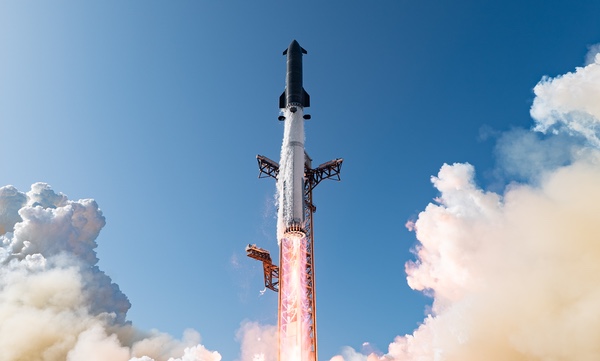
| The first commercially meaningful Starship may not be one that lands, survives inspection, and returns quickly to flight. |
The most plausible early use case is not crewed flight, lunar operations, or Mars, but Starlink deployment. Through Starlink, SpaceX has a large internal demand for mass to orbit and does not have to persuade an external satellite operator to accept the same level of risk from an immature launch system. The nearer-term question is therefore not only when Starship becomes fully and rapidly reusable, but when it can become a payload-first vehicle: one that can deploy Starlink satellites to useful orbits and then dispose of the ship safely, even if the ship is not recovered.
The first commercially meaningful Starship may not be one that lands, survives inspection, and returns quickly to flight. It may be one that delivers Starlink satellites to useful orbits and then comes down predictably.
The missing middle
The transformative Starship case still depends on full and rapid reuse. Recovering both stages, inspecting them quickly, refueling them, and flying again at high cadence would be a different kind of launch system from anything currently in routine service. Starship’s significance lies not just in its scale, but in its ambition to move orbital launch closer to transportation infrastructure than to bespoke expeditionary rocketry.
But a system does not have to achieve its final form before it has operational value. There is a possible middle ground between “test vehicle” and “fully reusable transport system.” In that middle ground, Starship’s upper stage might be expended, or recovery might remain an optional development objective rather than a condition of commercial mission success. The Super Heavy booster may reach operational reuse before the ship does. The ship might deploy payloads and then be deliberately disposed of over a remote ocean area. Reentry data could still be gathered, but the payload mission would not depend on the ship surviving.
This distinction matters because “expendable Starship” is not, by itself, a very interesting claim. Any launch vehicle can be expended. Expendability buys performance by removing the need to bring hardware back. The more interesting point is that Starship’s first useful commercial phase may be neither pure test flight nor full reuse. It may be Starlink deployment with secondary reuse testing attached.
That is different from simply “putting payloads on test flights.” A test-led mission chooses its trajectory, timing, and objectives mainly to gather vehicle data and manage public risk. If a payload is carried, it is opportunistic. A payload-led mission reverses the priority. It must reach a useful orbit or deployment condition, protect the deployment objective, and have a credible end-of-mission disposal plan. Reentry and recovery tests may still be attempted, but only within that mission envelope. The fact that the ship must reenter does not by itself justify turning the end of the flight into a landing experiment if doing so changes the trajectory, increases public risk, complicates licensing, or undermines the payload objective. That transition, from test-led to payload-led flights, may be one of the most important thresholds in the Starship program.
Why Starlink is the natural first customer
Starlink is what makes this intermediate case commercially plausible. SpaceX is developing Starship alongside a satellite network that can absorb large amounts of launch capacity, rather than relying only on external customers for early demand.
| Starship’s first useful commercial phase may be neither pure test flight nor full reuse. It may be Starlink deployment with secondary reuse testing attached. |
The current Falcon 9-based Starlink deployment system is already formidable. Falcon 9 has become the workhorse of modern orbital launch, and SpaceX has used it to build one of the largest satellite constellations ever deployed. But next-generation Starlink satellites are larger and more capable. Reuters reported that SpaceX was aiming to begin launching V3 Starlink satellites in the second half of 2026, likely on Starship, and that Starship’s payload bay was tailored for these upgraded satellites, with capacity for up to 60 in a single flight compared with roughly two dozen smaller Starlink satellites on Falcon 9. SpaceX has also begun testing this deployment path directly. On Flight 12, Starship successfully deployed 20 Starlink simulators similar in size to next-generation Starlink satellites, while also pursuing in-space and reentry test objectives. On last week’s suborbital Flight 13, it deployed 20 functioning Starlink V3 satellites for brief tests before the satellites reentered.
That does not prove that Starship will be ready on that schedule. It does show why Starlink is the obvious bridge case. A Starship flight that deploys a large batch of V3 Starlink satellites could be commercially valuable even if the ship is not recovered. It could add network capacity, test deployment systems, and provide operational experience with real payloads, while SpaceX continues working toward the more difficult goal of full ship reuse.
The regulatory filings around Starlink also show that the deployment problem is not abstract. Reuters reported that the FCC had approved another 7,500 second-generation Starlink satellites, bringing the authorized total to 15,000, subject to deployment milestones. The underlying FCC order also links certain orbital shells and inclinations to the possibility of Starship launches from Starbase, with alternative inclinations if the FAA does not allow particular Starship launch profiles.
That is a revealing detail: a payload-led Starship is not just a test vehicle with satellites bolted on. It must be able to reach useful Starlink orbits and inclinations under a flight profile regulators are willing to license.
The real threshold: safe disposal
If Starship is used in an early payload-first mode, it does not necessarily need to land. It may not even need to survive reentry intact. But it must not become a large object making an uncontrolled reentry.
| Test objectives and commercial deployment objectives can conflict. |
This is where the second stage’s size matters. A Falcon 9 upper stage can be disposed of or allowed to reenter in ways regulators and operators understand well. Starship is in a different class: it is much larger, carries more energy, and, if stranded in orbit, would present a more serious uncontrolled reentry problem.
Under the FAA’s commercial launch rules, operators must normally satisfy public-risk criteria for launch, reentry, and disposal, including limits on collective public risk. To fly its near-orbital Starship trajectory, SpaceX sought and received an FAA waiver, published in the Federal Register, from 14 CFR 450.101(a)(1)(i). In that waiver, the FAA stated that, at Starship’s then-current stage of development, the public risk associated with a random Starship reentry would be 40 to 50 times higher than the normal collective-risk threshold. The near-orbital trajectory, by contrast, allowed SpaceX to avoid random reentry risk and predict debris impact locations with high certainty.
That is central to understanding any intermediate commercial mode. Starship does not need to be reusable to be useful, but it does need a licensed end-of-mission state. For a payload-first Starlink mission, the minimum success condition would include not only launch and satellite deployment, but controlled disposal of the ship.
That disposal could in principle be achieved in several ways. The most straightforward would be to use Starship’s own propulsion and guidance systems for a controlled deorbit or targeted reentry over a broad ocean area. A transitional vehicle might carry additional disposal-assurance hardware, though that would add mass, complexity, and new safety questions. At this stage, the controlling requirement is not intact recovery but predictable disposal.
A stripped-down cargo Starship could discard systems needed for intact recovery, but not those needed for safe disposal. It would still require attitude control, power, command logic, tracking, telemetry, deorbit capability, and a credible failure analysis. Expendability would reduce the recovery burden; it would not remove the obligation to control where the vehicle goes.
Payload-led flights may conflict with test-led flights
This is why the intermediate regime is more subtle than simply adding Starlink payloads to Starship tests: test objectives and commercial deployment objectives can conflict.
A test flight may prefer a trajectory that maximizes engineering data while keeping debris in a known remote corridor. A Starlink deployment mission may require a different orbit, altitude, inclination, or phasing. A recovery test may consume propellant margin or impose reentry constraints that are not needed for the payload mission. A deliberately conservative disposal profile may be more attractive for an early commercial flight than an aggressive recovery experiment.
The FAA will not ignore optional post-deployment tests simply because the payload has already been released. If SpaceX deploys Starlink satellites and then attempts a demanding reentry, landing, or catch profile, that entire sequence is part of the licensed risk picture. A payload-led Starship mission may therefore need to treat recovery experiments as secondary. They may be useful when they fit within the same acceptable risk envelope. Once they begin to determine the trajectory, timing, disposal plan, or licensing case, the mission has become test-led again.
The analogy is not Falcon 9’s upper stage so much as Falcon 9’s early booster recovery attempts. Customers bought a launch service, and SpaceX then attempted booster recovery after the primary mission. Early Starship Starlink flights might follow a similar pattern: deployment is the mission; recovery or reentry testing is a SpaceX development objective layered on top.
What early usefulness would and would not prove
A payload-first Starship used for Starlink would be important, but it should not be confused with proof of the full Starship architecture. Such a mission would not prove rapid turnaround, cheap heat-shield refurbishment, ship catch, long-duration orbital operations, orbital refueling, crew safety, lunar landing, or Mars transport; those would remain separate milestones.
| The public debate around Starship often jumps from spectacular test flights to sweeping claims about Mars, lunar bases, or airline-like rocket operations. They are not necessarily the right benchmark for judging the first possible commercial threshold. |
It would prove something narrower but still significant: that Starship can move from experimental trajectories toward operational payload service. It would show that Starship can deliver useful mass to useful orbits, deploy payloads, and end the mission safely. For SpaceX, that could matter even before full reuse because Starlink creates a large internal demand for precisely that capability.
This is also why the intermediate mode should not be oversold. If an expendable or semi-expendable Starship launches V3 Starlink satellites, the economics may still be far from the final promise of rapid full reuse. Expending the ship would consume hardware and engines. It could reduce payload margin if additional disposal-assurance systems are needed. It could complicate the test program if a payload-optimized ship diverges from the reusable configuration SpaceX ultimately wants.
Yet the existence of those trade-offs does not erase the middle ground. A vehicle can be commercially useful before it is economically revolutionary.
Useful before reusable
The public debate around Starship often jumps from spectacular test flights to sweeping claims about Mars, lunar bases, or airline-like rocket operations. Those ambitions matter to SpaceX’s long-term story, but they are not necessarily the right benchmark for judging the first possible commercial threshold.
For Starlink, the relevant near-term question is simpler and harder: can Starship fly a payload-led mission to a useful orbit and dispose of the ship safely enough for regular use? If it can, then Starship may begin to matter commercially before it becomes fully reusable.
That would not be the final Starship vision, and it would not settle the question of rapid reuse or the economics of the complete system. It would, however, mark a transition from vehicle testing toward operational infrastructure.
Starship may become useful before it becomes reusable. The missing middle is not glamorous, but it may be where the program first becomes commercially real.
Note: we are now moderating comments. There will be a delay in posting comments and no guarantee that all submitted comments will be posted.