Orbiting Solar Observatories: Nancy Grace Roman and solar science from spinning spacecraftby Trevor Williams
|
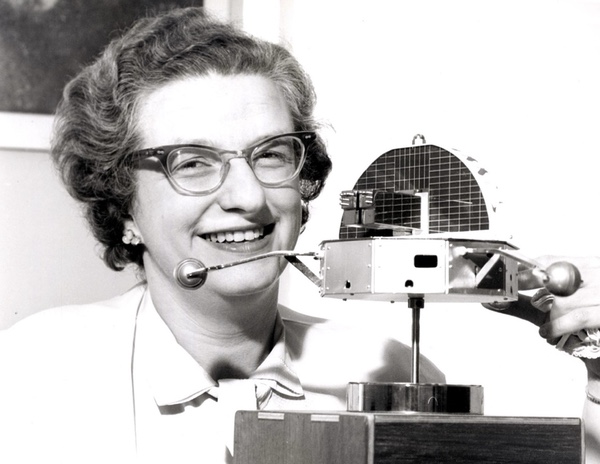
| There were significant obstacles to women having careers in science during the post-war period. Despite this, a key member of the early NASA science staff was Nancy Grace Roman. |
GSFC was initially intended to carry out all aspects of spacecraft design, even human spaceflight. Later, when the wide scope of space work became apparent, Goddard became focused on robotic missions, in particular those involving science: this has remained a key thrust of the center ever since. Surprisingly, given the difficulties that faced women when trying to enter scientific and technical fields in the 1950s and 1960s, much of the groundwork for this work was put in place by a woman.
Nancy Grace Roman
There were significant obstacles to women having careers in science during the post-war period. Despite this, a key member of the early NASA science staff was Nancy Grace Roman. Roman, an astronomer who obtained a Ph.D. from the University of Chicago in 1949, later described her early experiences in science in a 2016 essay as follows [2]:
When I was a girl, women were not supposed to be scientists. When I asked my high school guidance counselor for permission to take a second year of algebra, she sneered, “What lady would take mathematics instead of Latin?” The college environment was similar. If the dean of women could not dissuade a girl from majoring in science or engineering, she had nothing more to do with her.
My first bit of encouragement came in my third year of college, when the physics department chairman said to me, “I usually try to talk women out of majoring in physics, but I think maybe you might make it.” In graduate school, it was clear that the faculty did not like educating women.
This environment affected her employment choices: for instance:
I realized that, as a woman, I had little chance of getting tenure in an astronomy research department. So, to stay in astronomical research, I changed my specialization and accepted a position in the Naval Research Laboratory (NRL).
After working in radio astronomy at NRL, her move to NASA came about as follows, as she described in a 1980 interview [3, p. 41]:
One day Harold Urey was giving a colloquium at NASA, which was of course very young in those days. And as you know, a good percentage of the science staff in NASA in the early days did come from NRL. The old Vanguard group and the NRL rocket group were taken over en masse by NASA. I came down to hear him, just because it sounded like an interesting lecture, and Jack Clark, who had been at NRL, but was now with NASA, came up to talk to me afterward, and said, “By the way, do you know anyone who would like to come and work for NASA and set up a program in space astronomy?” Well, as I say, I'd been staying very far away from anything having to do with the rocket group or the Vanguard group at NRL, but the idea of coming in with an absolutely clean slate to set up a program that I thought was likely to influence astronomy for 50 years was just a challenge that I couldn't turn down.
Roman interpreted Clark’s question as an invitation to apply, and joined NASA in late February 1959 as Head of Observational Astronomy, becoming Chief of Astronomy in 1960. She was the first woman to hold an executive position at NASA, and was often referred to as the “Mother of Hubble” after advocating for the Hubble Space Telescope (HST) at NASA Headquarters for two decades. One of her key observations was that it was important for Hubble to be designed to support planetary science. To enable this, she had the vidicon imaging tubes that were originally baselined for Hubble, a 1950s technology, replaced by more modern charge coupled devices (CCDs) to gain improved performance [4, p. 248]. This led to the Wide Field/Planetary Camera that has been a key HST instrument.
Summarizing, as Dr. Roman pointed out: “I am glad I ignored the many people who told me that I could not be an astronomer. I have had a wonderful career in a field that I love.”[2]
Early NASA space science and the Orbiting Solar Observatory Program
There was early interest in performing stellar astronomy using spacecraft. However, the technical challenges were formidable, which led to solar astronomy being focused on first and carried out by the Orbiting Solar Observatory (OSO), a program which Roman oversaw at NASA Headquarters from 1961 to 1963. As described by Roman [3, pp. 46-47]:
The solar work went a little faster than the stellar in both rockets and satellites because pointing at the sun was an easier job. You could do it with two axis stabilization instead of three, and you had a bright object to lock onto. And as a result the pointing systems worked and worked satisfactorily much earlier than they did for the stars. I think that's why solar physics really became a valid observational technique earlier than stellar… I don’t think it was possible to do much in nonsolar astronomy, until you had the three axis pointing controls… Goddard was working very hard particularly to get pointing controls. Ames was also involved in this, at the time… Actually Ames probably had more pointing control and gyroscope experience at that time than Goddard did. There was a group there that was fairly active. In fact, they developed the first solar pointing system for rockets and were responsible for the solar pointers for quite a while, after Goddard was the main group for the other rockets.
Pointing in fact dictated the overall OSO configuration, which was quite novel. Specifically, OSO-1 was the first “dual-spin” spacecraft, where one section of the satellite spins and another does not, being despun by a motor at the bearing between the sections. In the case of OSO, a nine-sided “wheel” section spun to stabilize the spacecraft and allow a subset of the scientific instruments to scan the sky, while the despun “sail” section kept a solar panel and other instruments pointing towards the Sun to within 1 arcminute. Following launch, the sail was spun up (to 30 RPM for the case of OSO-1) by cold gas thrusters that were mounted, along with their associated tanks, on arms that were deployed from the spacecraft by its rotation.
| OSO-1 was the first “dual-spin” spacecraft, where one section of the satellite spins and another does not, being despun by a motor at the bearing between the sections. |
A key property of dual-spin spacecraft is that any damping that is present in the despun section will stabilize the spin, regardless of the geometry of the vehicle: departure from a pure spin would create nutation, producing a nodding motion of the despun section, which can be dealt with by a nutation damper. The situation is quite different from that for a simple spinner satellite, where internal damping stabilizes the spin if the body is oblate (“tuna can” shape), but destabilizes it if the body is prolate (“soup can” shape). This lesson was learned after the prolate Explorer 1, the first American satellite, went into a flat spin shortly after launch.[5] Following that experience spinning spacecraft were designed to be oblate, despite the fact that packaging these into a launch vehicle shroud became more challenging. The early OSOs had an oblate configuration, but later ones used a more efficient prolate packaging, once the lessons of dual-spin stability had been fully absorbed.
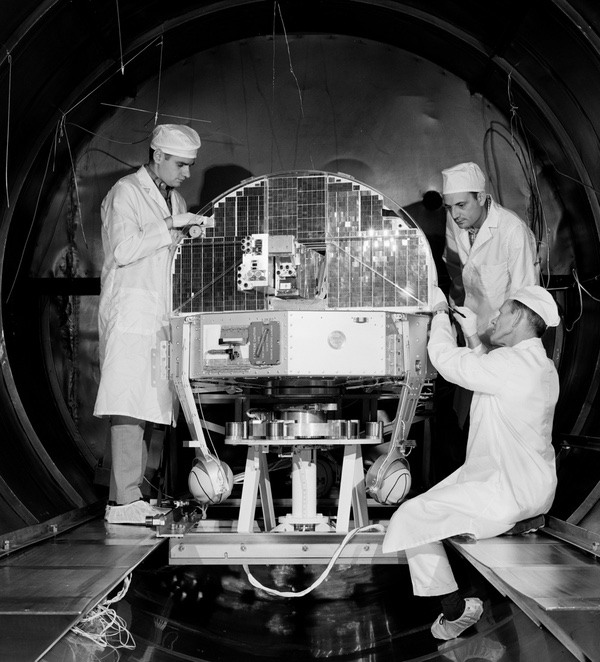 OSO-3 under construction. (credit: BBRC) |
As shown in the following diagram for OSO-5,[6] the pointing control hardware for these spacecraft included not only a nutation damper but also thrusters to control the spin rate of the wheel section, as well as “pitch control” hardware (consisting of sensors, thrusters, and a magnetic coil) to keep the spin axis correctly perpendicular to the Sun line and the sail pointed at the Sun throughout the mission.
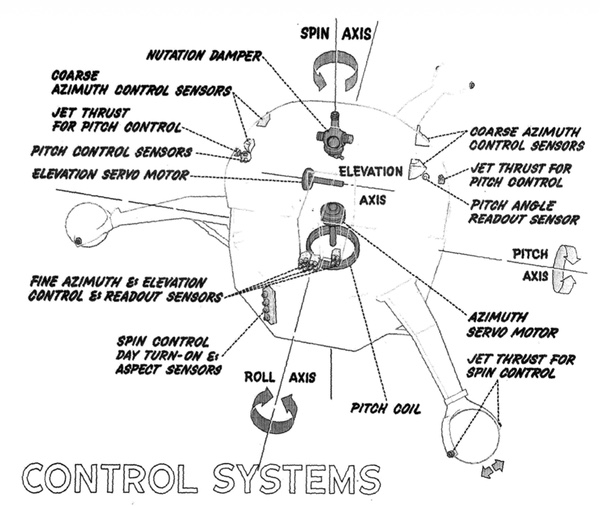 OSO-5 attitude control hardware. (credit: NASA) |
Key Orbiting Solar Observatory Program points
- The first spacecraft, OSO-1,[7] was launched on March 7, 1962; launch mass 458 pounds (208 kilograms), instrument mass 75 pounds (34 kilograms) on sail, 100 pounds (45 kilograms) on wheel. Spin rate 30 RPM.
- The final spacecraft, OSO-8, was launched on June 21, 1975; launch mass 2,350 pounds (1,066 kilograms). Spin rate 6 RPM.
- OSO-1 to 7 were built by Ball Brothers Research Corporation (BBRC); OSO-8 was developed by Hughes Space and Communications Company.
- The spacecraft were launched on Thor-Deltas into orbits of about 575 kilometers altitude and inclination 32.8 degrees. All launches were successful with the exception of OSO-C, which experienced a second stage failure and did not achieve orbit.
- Instruments included X-ray and gamma ray telescopes, coronagraphs and ultraviolet sensors. The study of solar flares was a focus for OSO. In addition, OSO-7 was equipped with a spinning occulting disk to produce an artificial eclipse and so enable studies of the corona.[8]
- Spacecraft design lifetimes were typically six months; these were usually greatly exceeded in practice.
- Specified pointing accuracy was 1 arcminute.
- The OSO program covered an entire 11-year solar cycle.
The OSO spacecraft carried many international experiments: for example, solar X-ray instruments jointly developed by University College, London (UCL) and the University of Leicester were flown on OSO-4 and 5, and a Lyman alpha instrument from UCL flown on OSO-6. These built upon the experience that these investigators had gained by flying experiments on the Ariel 1 satellite.[9, p. 348; 10; 11; 12]
Two significant unplanned incidents occurred during the OSO program:
OSO-7 deployment problems resulting from second stage failure:[13]
In the nominal OSO separation sequence, the sail section of the spacecraft is spun up to 40 RPM prior to the second stage burn in order to provide spin stabilization against tip-off torques. Then, after separation, the sail section is despun and the wheel spun up to its mission rate of 30 RPM.
However, a vehicle malfunction during the OSO-7 second stage burn caused the stage/spacecraft stack to tumble, reaching a rate of 55 RPM. The resulting post-separation spacecraft attitude motion was quite complicated and required a great deal of non-standard commanding to correct. The whole recovery sequence took several orbits longer than nominal: the battery reached a depth of discharge of 75%, but recovery fortunately occurred in time to avoid power problems. The only hardware impacts that were observed were additional attitude control gas usage, although there remained more than enough to cover the mission, and the failure of one of the two spacecraft tape recorders, thought to have been caused by the high accelerations (up to about 8 g) experienced during the launch sequence. In addition, the failure of the second stage led to a final orbit with lower than planned perigee: reentry therefore came three years after launch, somewhat earlier than originally planned.
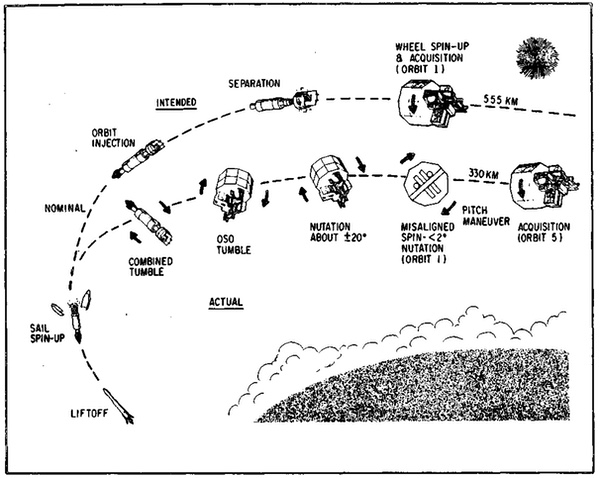 Intended vs actual launch sequences for OSO-7. (credit: BBRC) |
OSO-2 inadvertent ignition of solid rocket third stage during ground testing (an event referred to in a NASA report[14] as “The Disaster”):
On April 14, 1964, the solid rocket third stage of the OSO-2 launch vehicle was in the Spin Test Facility at Cape Kennedy with the spacecraft mounted to it. It was covered with a polyethylene shroud as a dust protector: when this was adjusted a crackle was heard and the rocket ignited. As a result, three men were burned fatally, and a further 11 had non-life-threatening burns. The only positive to come from this tragedy was that an extensive study was performed of the various mechanisms that could have contributed to it: it was found that a polyethylene cover could in some circumstances charge the spacecraft to 15,000 volts, and that the accident had been caused by an electrostatic discharge through the rocket igniter squib. This study led to measures being identified that were taken on future missions to prevent any similar occurrences.
The OSO-2 spacecraft was extensively damaged in this incident, but was rebuilt using flight parts, prototype parts, flight spares and new parts. This reconstituted spacecraft was launched on February 3, 1965 and operated successfully.
Advanced Orbiting Solar Observatories and Skylab
Soon after the launch of the first OSO spacecraft, planning began for a follow-on series of Advanced OSOs (AOSOs), also known as Helios.[15] Negotiations began in October 1963 [4, p. 249] between NASA Goddard and Republic Aviation Corp. for a series of four such spacecraft, with launches planned to start in 1966.[15, p. 27] This timing was selected in order to have the AOSOs operational during the next solar maximum in 1969, with operations continuing into 1971.
| Not only did the AOSO instruments need a new means for reaching space, but the Apollo Applications Program (AAP)—the Skylab space station—needed a high-quality science payload. |
The AOSOs were to have been larger than the OSOs, with better resolution and ten times the data storage: this would have allowed them to observe transients such as solar flares,[16, p. 69] although returning that much data would have been challenging. The pointing accuracy specified for AOSO was a considerable improvement over that of OSO: 5 arcseconds versus 60. Attitude control would have used a set of three orthogonal reaction wheels, with magnetic torque coils for desaturation; initial detumbling would have been performed using cold gas thrusters.[15, p. 36] Launch into Sun-synchronous orbit would have been performed by Thor-Agena, although a minor increase in launch vehicle performance would have been required.
Given the increase in performance of AOSO relative to OSO, its development would have been expensive. Furthermore, the NASA science budget experienced cuts, leading to AOSO being cancelled in 1965.[17, p. 70] To keep open the option of perhaps being able to fly the AOSO instruments on some future mission, their development was kept alive after cancellation,[17, p.74] and they were made general-purpose.[17, p. 167] The main modification to their design that was considered was the use of film for imagery return, given the large amounts of data generated. Studies were carried out of the feasibility of mounting these solar telescopes in either an Apollo Service Module (SM) or Lunar Module (LM) flying in Earth orbit, with the crew returning the film to Earth. A drawback of these concepts, however, was that the mission durations could not exceed about two weeks.
It was then recognized that not only did the AOSO instruments need a new means for reaching space, but the Apollo Applications Program (AAP)—the Skylab space station—needed a high-quality science payload. Flying the AOSO telescopes on Skylab solved both these problems: they were mounted in the Apollo Telescope Mount (ATM), which began as a derivative of the LM. Data was collected on film, with these canisters retrieved by astronauts during spacewalks and then returned to Earth in the Apollo Command Module.
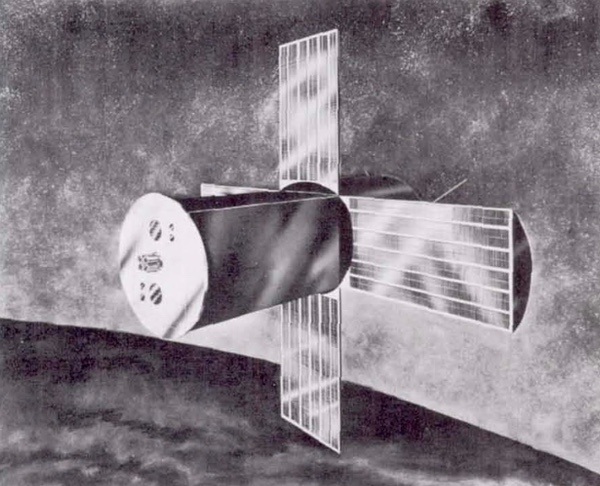 Advanced Orbiting Solar Observatory. (credit: NASA) |
In addition, collaborative research was carried out between Skylab (launched in 1973) and the final OSO, OSO-8 (launched in 1975). Specifically, OSO-8 studied energy transfer between different solar layers,[18] with Skylab data on chromospheric structure used to target these OSO measurements. So, OSO and AOSO data were eventually used in tandem to improve the study of the Sun.
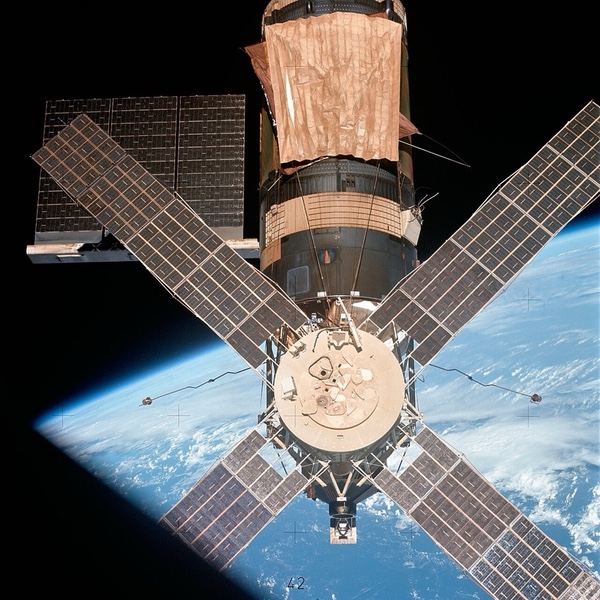 Skylab Apollo Telescope Mount. (credit: NASA) |
P78-1 Solwind: eventual anti-satellite test target
Following the end of the OSO program, the DoD Space Test Program P78-1 Solwind spacecraft was launched on February 24, 1979, from Vandenberg Air Force Base. An Atlas F launch vehicle placed the 2,934-pound (1,331-kilogram) Solwind into a 500 -kilometer altitude Sun-synchronous orbit with an inclination of 97 degrees. The spacecraft was designed to observe space weather by examining the solar corona and the upper atmosphere of the Earth. It was built by Ball Brothers Research Corporation (BBRC) from the modified OSO-7 flight spare. Using the same approach that was taken for the OSO spacecraft, Solwind was a dual-spin spacecraft equipped with a passive nutation damper for spin stability. P78-1 carried seven scientific instruments, including the flight spare white light coronograph from OSO-7. Solwind was the first satellite to observe comets, notably nine Sun-grazing comets of the Kreutz group, which were imaged between August 1979 and August 1984.
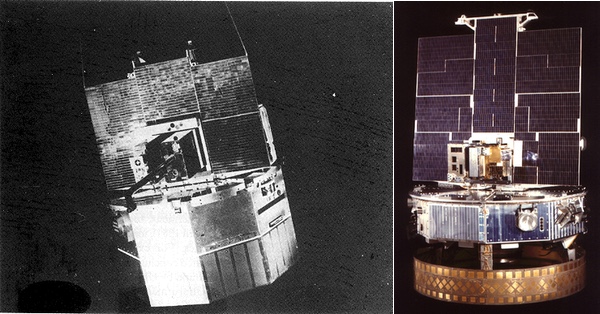 OSO-7 and P78-1 Solwind spacecraft. (credits: NASA and USAF, resp.) |
By early 1985, Solwind had experienced significant degradation of its batteries, and the last of its three onboard recorders had failed. These factors conspired to render further operations challenging, so discussions started on terminating the mission. Meanwhile, there was a desire to test the ASM-135A anti-satellite weapon, then under development, against an orbiting spacecraft: such a test had not been carried out to date. The ASM-135A, developed by LTV Aerospace, involved a three-stage missile launched at 38,100 feet (11,600 meters) altitude from an F-15A aircraft in a zoom climb. The 30-pound (13.6-kilogram) spinning Miniature Homing Vehicle (MHV) third stage used line-of-sight guidance based on an infra-red seeker to impact the target at a closing rate of around 15,000 mph (6.70 km/s), performing a kinetic kill.
| Given that Nancy Grace Roman proposed an early exoplanet study concept in 1959 based on using a space telescope, associating her name with the new telescope is certainly very fitting. |
The target satellite for a test of this system would have to be under DoD control, and there was too little time to develop one from scratch, as a congressional ASAT ban was expected in the near future (it actually took effect in October 1985.) Since Solwind was operating in a degraded state, it became a leading candidate for use as the ASM-135A test target. This test was authorized by President Reagan on August 20, 1985, and carried out on September 13.[19] It generated 285 trackable pieces of debris; only eight remained in orbit as of January 1998, with the last piece reentering on May 9, 2004. Despite this successful demonstration, the ASM-135A program was terminated in 1988 because of technical problems and significant cost overruns.
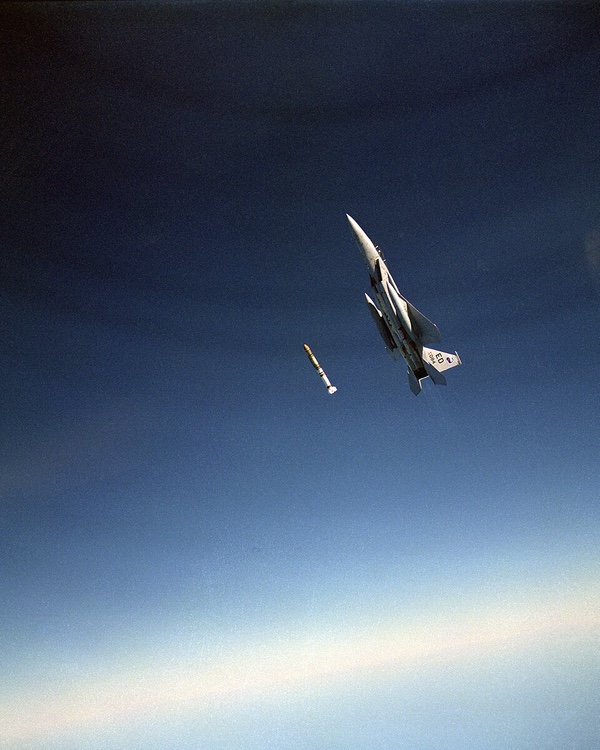 ASM-135A anti-satellite weapon test launch. (credit: USAF) |
The continuing space science legacy of Nancy Grace Roman
NASA is shortly to launch a major space observatory named in honor of Nancy Grace Roman. The Roman Space Telescope is an observatory sensitive to visible and near-infrared radiation, with resolution comparable to that of the Hubble Space Telescope (HST) but with a field of view roughly 100 times larger. The main instrument on Roman is the Wide Field Instrument (WFI), which will be used to study dark energy, the mysterious quantity that is believed to cause the acceleration of the expansion of the universe, as well as to observe exoplanets using the technique of gravitational microlensing.
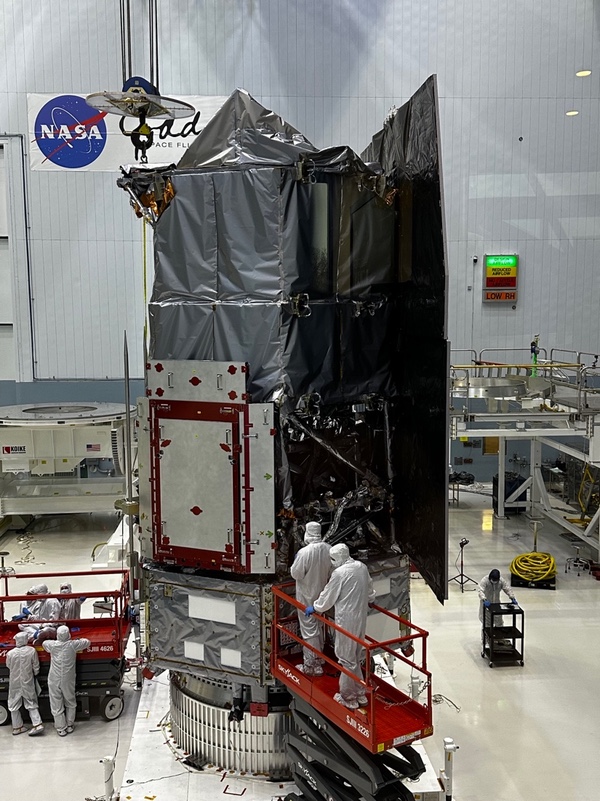 Roman Space Telescope undergoing final testing at NASA Goddard. (credit: Seth Shulman)
|
Roman makes use of a spare spacecraft primary mirror donated to NASA by the National Reconnaissance Office (NRO). It has a diameter of 7.9 feet (2.4 meters), the same as that of HST. Development of the spacecraft, originally called the Wide Field Infrared Survey Telescope (WFIRST) and renamed Roman in 2020, began in 2016, led by a team at NASA Goddard. Launch to a Sun-Earth L2 libration orbit, ahead of schedule and under budget, is planned for August. 30. The mission will continue the strong tradition of international involvement in Goddard science missions: organizations participating in RST are the European Space Agency, CNES in France, JAXA in Japan and the Max Planck Institute for Astronomy in Germany.
Roman is also equipped with a coronograph instrument for direct imaging of exoplanets. This will be used as a technology demonstration for the Habitable Worlds Observatory. Given that Dr. Roman proposed an early exoplanet study concept in 1959[20] based on using a space telescope—in her design positioned on the Moon—associating the name Nancy Grace Roman with the new telescope is certainly very fitting.
References
- Venture into Space: Early Years of Goddard Space Flight Center, A. Rosenthal, NASA Center History Series, 1968.
- “Following my Lucky Star”, N.G. Roman, Science, Dec. 9, 2016, Vol. 354, Issue 6317, p. 1346.
- N.G. Roman, interview with David DeVorkin, Niels Bohr Library & Archives, American Institute of Physics, Aug. 19, 1980 (transcription version July 16, 2025).
- The Space Telescope: A Study of NASA Science, Technology, and Politics, R.W. Smith, Cambridge University Press, Cambridge, 1989.
- “Rotation of Artificial Earth Satellites”, R.N. Bracewell and O.K. Garriott, Nature, Vol. 182, pp. 760-762, Sept. 20, 1958.
- OSO-5 Press Kit, Release 68-13, NASA, Jan. 20, 1969.
- “OSO to Study Sun in Quiet Period”, Robert R. Ropelewski, Aviation Week & Space Technology, July 26, 1971, pp. 34-36.
- “OSO Will Provide Own Eclipse”, Aviation Week & Space Technology, Sept. 20, 1971, p. 17.
- History of British Space Science, H.S.W. Massey and M.O. Robins, Cambridge University Press, Cambridge, 1986.
- Ariel 1: The First International Satellite – Experimental Results, NASA SP-119, 1966.
- “NASA Goddard and the Dawn of International Cooperation in Space”, T. Williams, The Space Review, Dec. 8, 2025.
- “British X-Ray Astronomy”, K.A. Pounds, Quarterly Journal of the Royal Astronomical Society, Vol. 27, 1986, pp. 435-444.
- OSO-7 Orbiting Solar Observatory One-Year Performance Summary, Report F72-10 (NASA CR-130184), Ball Brothers Research Corporation, Dec. 31, 1972.
- History of Orbiting Solar Observatory OSO-2, NASA TM X-55590, NASA Goddard Space Flight Center, Apr. 1966.
- The Observatory Generation of Satellites, Session II of Special Astronautics Symposium held at the Franklin Institute Dec. 27, 1962, NASA SP-30, Mar. 1963.
- Living and Working in Space: A History of Skylab, W.D. Compton and C.D. Benson, The NASA History Series, NASA SP-4208, 1983.
- “Helios to Relay More Accurate Solar Data”, Warren C. Wetmore, Aviation Week & Space Technology, Mar. 4, 1963, pp. 48-53.
- “OSO-8 Program Keyed to Skylab Data”, Aviation Week & Space Technology, June 30, 1975, pp. 45-47.
- “The First Space Ace – F-15 vs Satellite”, P. Glenshaw, Air & Space Magazine, Apr. 2018.
- “Planets of Other Suns”, N.G. Roman, The Astronomical Journal, Vol. 64, No. 1273, pp. 344-345, Oct. 1959.
Note: we are now moderating comments. There will be a delay in posting comments and no guarantee that all submitted comments will be posted.