Preserving the legacy of the ISSby Jeff Foust
|
| “I would love to see this thing in a museum, I really would,” Keaton said. “It’s just not possible in a fiscally responsible, I suppose, or technologically responsible way.” |
“It is the fulfillment of a decades-long dream and will stand as an enduring source of inspiration for generations of scientists, engineers, and explorers,” Jeffrey Rudolph, president and CEO of the museum, said in a statement about the new center, set to open to the public in November.
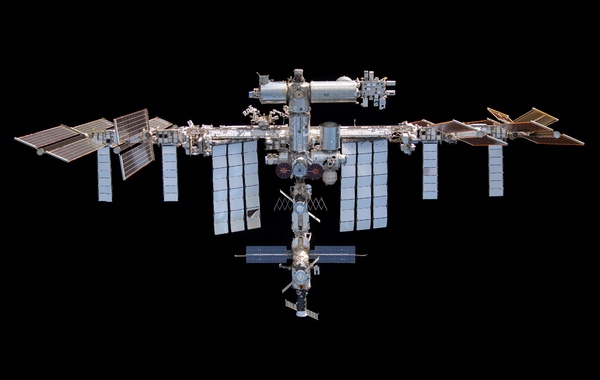
It also brings to mind another long-running program soon reaching its end: the International Space Station. NASA has maintained plans to retire the ISS at the end of 2030, although there have been some hints that it could be extended at least a couple years. A NASA authorization bill in the Senate, for example, would formally extend the station’s life to 2032.
Even if the station continues to operate into the early 2030s, it’s clear it’s time to start thinking about the end of the ISS. That includes not just how to deal with the end of life of the station and how to transition to commercial successors but also what to preserve from the station, and how.
Unlike the shuttle orbiters, which could be returned to Earth and put in museums much like aircraft, there is no way to bring the ISS back. NASA has also ruled out trying to preserve the station in orbit, perhaps at a higher altitude than it operates today.
“We have a paper on this,” Jacob Keaton, acting ISS director at NASA headquarters, said during a half-day series of panels about preserving the ISS at the AIAA ASCEND conference in May. That 2024 paper looked at several alternatives to NASA’s plans to deorbit the station at the end of its life, including boosting it into a higher, longer-lived orbit.
“It’s a lot of delta-V and the debris environment is pretty bad,” he said. That paper estimated that moving the ISS, currently in a orbit a little more than 400 kilometers high, to one between 640 and 680 kilometers, which would keep it in orbit for a century, would require between 18,900 and 22,300 kilograms of propellant. That higher orbit also has more debris, creating the risk of collisions that could cause “complete fragmentation” of the station and jeopardizing the safety of low Earth orbit.
The same analysis, he said, also ruled out the partial disassembly of the station to either deorbit pieces of it individually or return them to Earth. “Any disassembly effort to safely disconnect and return individual components (such as modules) would face significant logistical and financial challenges,” the NASA paper noted.
“I’ll just speak personally: I would love to see this thing in a museum, I really would,” he said. “It’s just not possible in a fiscally responsible, I suppose, or technologically responsible way, to preserve big chunks of this.”
“Though large modules are not feasible for return, NASA has engaged with the Smithsonian National Air and Space Museum and other organizations to develop a preservation plan for some smaller items from the space station,” the NASA paper stated.
“The Smithsonian has given us a list of desires,” said Ryan Landon, director of NASA’s ISS research integration office at the Johnson Space Center. She didn’t elaborate on the contents of that list.
| Cargo Dragon missions won’t be possible once the USDV is installed, Landon said. “So, our last cargo home will be about the middle of 2029.” |
One challenge will be finding the space to bring those items back. Today, only SpaceX’s cargo Dragon can return significant amounts of cargo from the ISS, with small amounts available on Crew Dragon and Soyuz. Other cargo spacecraft—Cygnus, HTV-X, and Progress—deliver cargo to the station but burn up on reentry.
The pace of cargo missions will also slow as the station nears retirement. A key milestone will be the launch of the US Deorbit Vehicle (USDV), a modified Dragon that will dock to the station about 18 months before deorbit. It will use one of the two docking ports available to both commercial crew vehicles and cargo Dragon spacecraft. With the other port used by a Crew Dragon or Starliner spacecraft for the crew, there will be no space for a cargo Dragon.
“Once those two vehicles are onboard,” she said of the USDV and commercial crew vehicle, “we will no longer have a vehicle that can return. So, our last cargo home will be about the middle of 2029.”
That adds to the urgency for decisions on what to preserve from the ISS. However, historians and curators will be competing for space on those cargo missions with scientists seeking to return experiments as they maximize the station’s research in its final years, along with engineers who need to bring equipment back for maintenance or reuse.
“That’ll be an interesting discussion,” she said.
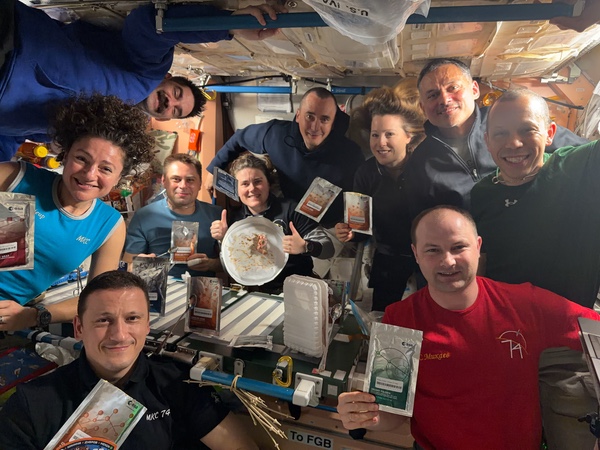 A ten-person crew on the International Space Station shares a dinner together earlier this month. (credit: NASA) |
Researchers have made clear they want to use the ISS as long as they can. “We seek to continue to utilize the International Space Station right up until that last moment when Ryan turns the lights out. So, there will be drivers to maintain as much science capacity on those final return vehicles as we can,” said Michael Roberts, chief scientist of the ISS National Lab.
“But, it’s not lost on anyone that there is tremendous scientific knowledge, as well as historical knowledge, that can be retained from the return of some of that instrumentation,” he added.
There is, at least, awareness of the need to start planning for preserving items from the ISS. “The ISS is coming on my radar,” said Brian Odom, NASA’s chief historian. “It is the history of the agency’s human spaceflight for a very long time.”
However, it’s not clear there is a formal process for determining what can be brought back and how. “There has to be a very concentrated, intentional effort by someone,” said Landon. That individual must be involved in discussions about cargo logistics and can thus advocate for bringing back items when space becomes available on a cargo return mission.
That includes “talking to the crews about things to look for and having crews think about heritage while they’re up there,” she said. “The crew is amazing at packing those bags. There is always space somewhere.”
“It will be a challenge” determining responsibility for preserving ISS heritage, Keaton said. “The space station program, as currently constituted, is focused on flying the space station.”
| Odom urged those working on the program “to be their own historian” and think about how to preserve records. “Your work could disappear forever.” |
“If protecting ISS heritage is something Americans or the US government, or certain portions thereof, care about, that has to be expressed though policy channels. It costs money, it costs time and effort not currently being given to those kinds of things,” noted Gabriel Swiney, director of the Office of Space Commerce’s policy, advocacy, and international division. “If people want to do that, there has to be some organized effort to do so.”
Preserving ISS heritage goes beyond hardware on the station today that could be brought back. A big focus will be on preserving physical and electronic records of the station’s development and operations, as well as the oral histories of those involved in the station.
That includes how crews actually used the station versus how it was designed to be used. “Archaeology is not necessarily about the distant past,” said Justin Walsh, a professor of art history, archaeology, and space studies at Chapman University. “It’s really about understanding human activity, understanding human culture, understanding adaptation to environments, and specifically doing that through the lens of material culture.”
Walsh is the co-principal investigator on an ISS archaeology project that included documenting six areas on the station daily for two months to see how those areas were used by crews, including in “unexpected and unanticipated” ways, such as one astronaut who stored their toiletry kit on a wall in a high-traffic area of the station, illustrating the challenges of storing items on the ISS. “Those kinds of things tell a story that is really important for us to understand about what it means to live in space at our current level of technology.”
That heritage can be documented in many ways. He pointed to the “ISS in Real Time” website that brings together photos, videos, transcripts of space-to-ground calls, and other documentation from nearly every day of ISS operations.
He added he’s looking for other ways to document the station, including working with NASA to sample smells in different parts of the ISS to understand the chemicals that create it. “We would actually be able to know what the chemical composition of the atmosphere is to a degree that we could recreate smells for exhibits in science museums,” he said.
(“Unfortunately, the first time I crossed over from STS-126, it even smelled like a submarine, which is not a nice thing to say about any place,” Stephen Bowen, a submarine officer who became a NASA astronaut, said of the station during another panel.)
Despite that rich record, though, historians like Odom are worried they will lose valuable insights into the ISS because of ephemeral electronic records and fading memories.
“We might know about Apollo at any minute than we’ll know about ISS in five years,” he said. “The way the bureaucracy created a record during Apollo was pretty substantial.”
He urged those working on the program “to be their own historian” and think about how to preserve records of the decisions they made. “Don’t think that somebody else is going to do it for you,” he said. “Your work could disappear forever.”
| “I’m not big person on holding things,” Bowen said. “The biggest legacy, and what we should be preserving, is to continue to fly similar missions.” |
Regarding physical preservation of the station, some panelists got creative and suggested that private astronaut missions might be able to help, “taking down that they can,” said Todd Mosher, scholar in residence at the University of Colorado Engineering Management Program. Roberts called on historians to buy a SpaceX Dragon mission “and load it up with whatever you want.” (Perhaps overestimating the financial resources of historians.)
Asked what one object from the ISS they would like to preserve, panelists offered answers ranging from the station’s cupola to the table that served as a communal dining space on the ISS to the station’s microbiome. Robert Pearlman, editor of collectSPACE, suggested something large enough that could be cut into small pieces and then mounted on cards or melted into medals “just so that everyone who remembers the space station, everyone who had a good memory of it over the last 25+ years, can have a piece of it if they want.”
And what about Bowen, who spent half a year on the ISS in 2023 after three short-duration visits during the final years of the shuttle program? “I’m not big person on holding things,” he said. “The biggest legacy, and what we should be preserving, is to continue to fly similar missions.”
Note: we are now moderating comments. There will be a delay in posting comments and no guarantee that all submitted comments will be posted.