Lemons to bitter lemonade: from the Samos E-5 to the LANYARD reconnaissance satellite (part 1)by Dwayne A. Day
|
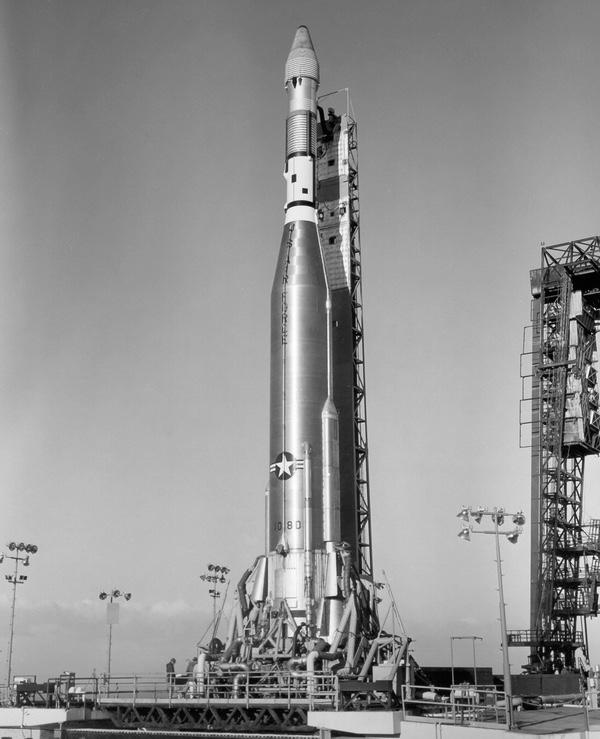
| The E-5 could be made to work, they argued, if they could redesign the camera to eliminate sources of image blurring, discard the camera rather than return it to the ground, and utilize the same proven recovery vehicle as the CORONA. All they needed was a chance. |
In the 1950s, the US Air Force had started the Samos program—originally named Sentry—to provide reconnaissance from space. The program was severely underfunded until after the Soviet Union launched Sputnik, at which time Samos expanded and sprouted numerous reconnaissance camera systems. One of the offshoots was a joint Air Force-CIA program named CORONA, which was designed to return its film in recoverable vehicles. The Air Force-led Samos projects—E-1, E-2, E-4, E-5, and E-6—suffered numerous problems. CORONA also had severe problems, but by August 1960 it had achieved initial success. By the time Levison and Herther went to see Din Land at the end of 1961, CORONA was already providing a wealth of intelligence data in the film that was recovered after each mission.
By fall 1961, the Department of Defense created the National Reconnaissance Office (NRO) to oversee development and operations of satellite reconnaissance systems. The NRO was so classified that even its name was secret. The NRO’s first director was Dr. Joseph Charyk, who also had an unclassified title as Undersecretary of the Air Force. Charyk was highly respected and had a good relationship with the CIA. Charyk was also skeptical of the remaining Air Force Samos programs, like the E-5, which he doubted would produce useful intelligence data.
Starting in early 1959, in addition to the CORONA camera, Itek also developed the Samos E-5 camera for the US Air Force. Unlike CORONA, the E-5 satellite had been a failure. Two diagnostic cameras had been launched in fall of 1961, with only one reaching orbit. Charyk lacked confidence in the project and canceled it, deciding that only one operational camera would be launched. That launch was currently scheduled for the spring of 1962.[2]
Levison and Herther had both designed the E-5 camera. They knew that it had some serious limitations, primarily forced upon them by the need to return the entire camera to Earth inside a large recoverable capsule rather than let it burn up in the atmosphere at the end of the mission, as was done with CORONA. But the E-5 was a more powerful camera than the other ones then in service. Higher resolution photos from space were important for providing scientific and technical information about targets on the ground; rather than simply counting planes, ballistic missiles, and other weapons systems, they could be used to determine their capabilities. Levison and Herther went to Land’s house late one winter evening to ask that Itek be given a chance to redeem their design. The E-5 could be made to work, they argued, if they could redesign the camera to eliminate sources of image blurring, discard the camera rather than return it to the ground, and utilize the same proven recovery vehicle as the CORONA. All they needed was a chance.[3]
“Do it,” Land said, and they left.
“Walt and I briefed one guy one night and the program was on,” Herther said in an interview many years later.[4]
Of course it was not that easy. No satellite project requiring the expenditure of millions of dollars and the mobilization of various government agencies could proceed simply on the word of a single individual unless that person was the President of the United States. Din Land was a successful inventor and a rich businessman, not a government official. But within the small satellite reconnaissance community he commanded a lot of respect. If he thought that a project had merit, then it would at least get a hearing from others, like Joseph Charyk. Land could talk to his contacts in the Air Force and CIA and tell them that they should seriously investigate the Itek proposal. That is undoubtedly what happened in the days after Herther and Levison met with Land, for within a few months Itek had a contract to modify the Samos E-5 and turn it into something useful. As one critic later commented, they were trying to make a silk purse out of a sow’s ear.
By January 1962, the silk purse was named the LANYARD, and it would rise from the dead Samos E-5. Soon afterwards, another program, named SPARTAN, would also begin to arise from another dead Samos project. Trying to turn lemons into lemonade.[5]
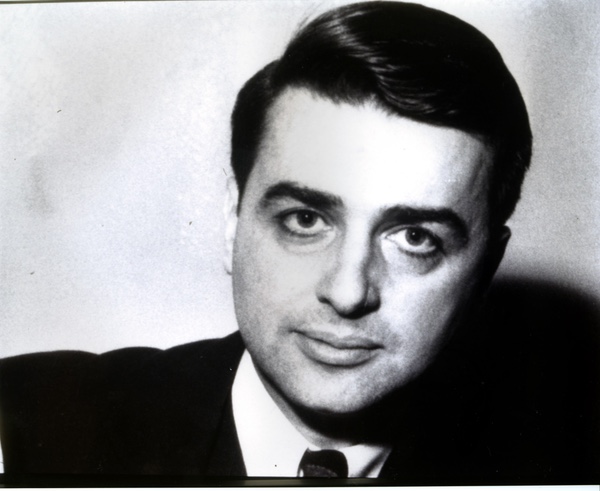 Edwin “Din” Land was the head of the Polaroid Corporation and a senior intelligence advisor to the government. He was widely considered to be a genius inventor. In December 1961 he agreed with a suggestion that the Samos E-5 reconnaissance camera be modified to use existing CORONA reconnaissance hardware to improve its chances for success. (credit: CIA) |
The E-5 dies a quick death
The Samos E-5 was the first American effort to develop a reconnaissance satellite with higher resolution than the existing CORONA or the film-readout Samos E-1 and E-2. Started in early 1959, but not getting truly underway until September 1959, the E-5 was a recoverable satellite designed to return imagery of objects on the ground as small as five feet (1.5 meters). No other satellite was even half as good when it came to resolution. Although seven spacecraft were initially planned—including two diagnostic and five operational vehicles—only the diagnostic vehicles and one operational payload were completed before the Samos E-5 was canceled.
| But by the time the Samos E-5 was ready to fly in late 1961, it was too limited to meet the intelligence requirements of the United States. |
The E-5 was a panoramic camera, which meant that rather than staring straight down at its target, it swept over it, panning back and forth along its ground track. This produced an image that was thin but long, covered much more territory, and had excellent resolution along its entire length. The E-5 had a 66-inch (168-centimeter) focal length compared to the 24-inch (61-centimeter) focal length of the CORONA. Focal length is the distance from the point where the light enters the lens, called the aperture, to where it focuses at the focal point, on the film. The bigger the focal length, the more powerful the camera. But one drawback of a longer focal length in general and the specific E-5 design was that the camera had a smaller viewing angle and therefore photographed far less territory on each sweep of the lens than the CORONA, albeit at higher resolution.
To compensate somewhat for this reduced viewing area—only 22 degrees verses 70 degrees for CORONA—the E-5 could also rotate slightly. The entire spacecraft rolled up to 15 degrees to either side to take pictures of targets that were not directly below.
But by the time the Samos E-5 was ready to fly in late 1961, it was too limited to meet the intelligence requirements of the United States. It did not view enough area on the ground, and there were indications that it would not achieve its resolution goals. Furthermore, nobody outside of the Air Force was all that enthusiastic about the large recovery capsule containing the E-5 camera, because its design had more to do with a secret desire among Air Force officials to develop a manned military spacecraft than it did with developing a reconnaissance satellite.[6]
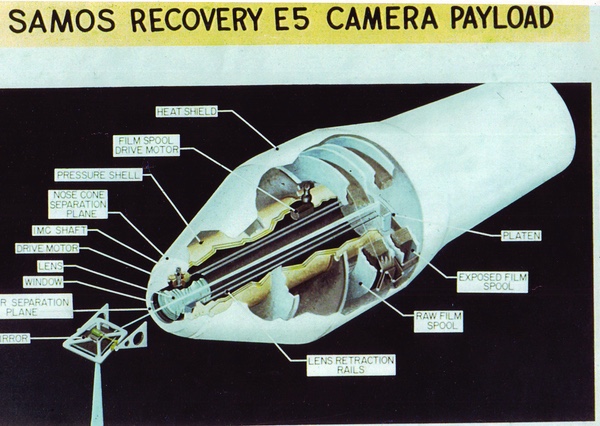 The Samos E-5 was a large spacecraft that was originally designed to carry an astronaut into space. The Air Force ordered that it be modified to carry a reconnaissance payload instead, but this led to a badly-compromised camera design. (credit: USAF) |
Rising from the ashes
Joseph Charyk canceled the E-5 program on Monday, December 4, 1961. Two days after the cancellation, Itek official Jack Carter proposed to Charyk that tests could be run on Itek and Perkin-Elmer lenses to determine if an improved lens could be substituted for the original in the last remaining Samos E-5 flight. Carter also soon suggested to Major General Robert Greer, who ran the Air Force office in Los Angeles that oversaw the development of the Samos satellites, that the E-5 camera could be adapted to CORONA hardware. Carter formally submitted this proposal on December 19.[7] On December 29—possibly soon after Levison and Herther had talked to Din Land in Boston—Charyk indicated to Greer that he was interested in the idea, but wanted more information on its feasibility.[8]
When Charyk canceled the Samos E-5, Itek had a considerable amount of camera hardware left over. By fall of 1961, after Charyk had acquired the additional title of director of the fledgling NRO, he ordered that the remaining hardware be placed in secure storage. Five incomplete E-5 camera systems were placed into a storage facility.[9]
Jack Herther remembered that the leftover hardware was not complete camera systems, but major components. “We had lenses,” Herther explained. “Lens blanks. And some partially finished lenses,” The lenses were big, heavy and expensive. The glass was special ordered from the Schott company in Mainz, West Germany, which insisted upon being paid up front. Itek had paid them for a set number of glass units. “When we first got the job it was a long-lead item,” Herther explained, meaning that the lenses had to be ordered far in advance of the rest of the equipment because they took so long to cut and polish.[10]
| Director of Central Intelligence John McCone agreed to LANYARD for an additional reason. He later wrote: “I personally insisted on pursuing the LANYARD because of worry that the GAMBIT might fail.” |
In Los Angeles, the Secretary of the Air Force Special Projects Office—usually referred to as SAFSP or simply “Special Projects”—was the NRO office that managed several space reconnaissance programs, such as the Discoverer satellite, which was in reality the cover story for the CORONA reconnaissance program. Major General Greer ran Special Projects. In January 1962, probably at the orders of Charyk, Colonel Lee Battle conducted a study of the feasibility of launching a simplified Samos E-5 satellite atop a Thor launch vehicle instead of the more expensive Atlas. This proposal was named LANYARD and instead of the big Samos E-5 pressurized spacecraft it would utilize the existing Discoverer/CORONA reentry vehicle to return its film. Battle was head of the Discoverer office and his people determined that this was feasible and that such a satellite could be placed in an orbit with an average altitude of about 140 nautical miles (259 kilometers), inclined 69 degrees to the equator.[11]
The original estimate for the new payload was 775 pounds (350 kilograms) and a two-day polar orbit.[12] The members of the Discoverer office determined that the satellite could carry about 40 pounds (18 kilograms) of film—far less than the 250 pounds (113 kilograms) of film carried aboard the Samos E-5. The camera could achieve a ground resolution of about four feet (1.2 meters). They assumed that CIA would procure the camera payload from Itek and a standard CORONA reentry vehicle from General Electric. Lockheed Missiles and Space Company would build a payload structure and conduct overall vehicle integration. The Air Force’s Space Systems Division would be responsible for the Thor rocket and Agena upper stage. The Aerospace Corporation would provide engineering support as an associate contractor. Assuming an immediate start, the study’s authors determined that the first payload could be delivered by August 22, 1962, with the first launch occurring in December 1962—a prediction that proved overly optimistic.[13]
There was enough existing equipment for five satellites. The only real problem would be obtaining Rocketdyne rocket engines to power the Thor. The Air Force anticipated having one spare Thor and two spare Agena B rockets at the end of 1962 capable of launching the first LANYARD. Colonel Battle also suggested that the Air Force procure an upgraded version of the Thor, known as the Thorad, with stretched fuel tanks. Using this more powerful booster, the LANYARD could be placed in orbit for up to six days.[14] By early February 1962, it appeared as if LANYARD could have up to 15 days in orbit.[15] Program officials also decided to use a new planned version of the Thor equipped with small solid rocket motors at its base and known as the Thrust-Augmented Thor (TAT). They also chose the more capable Agena D version upper stage/spacecraft, which was slated to soon replace the Agena B.
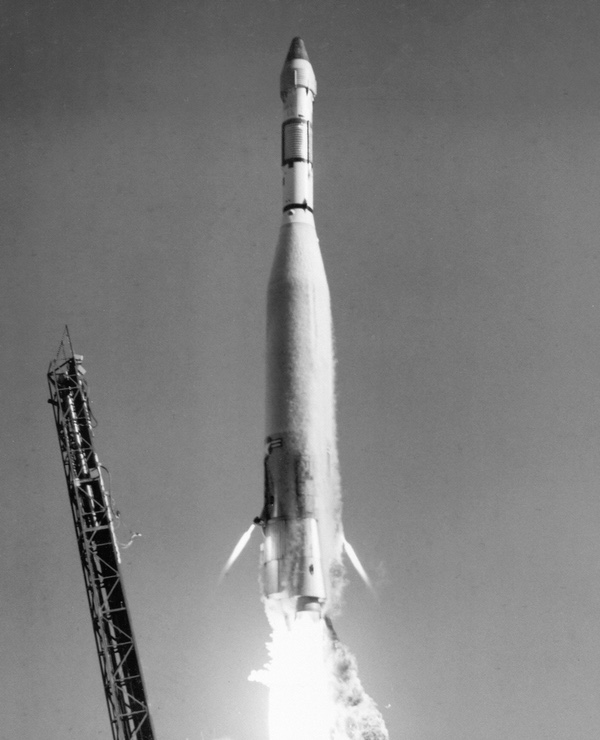 The second launch of a Samos E-5 payload took place in December 1961. The program was scheduled for cancellation by this time. The camera designers long had concerns about the overall system and began thinking about how the camera could be modified for greater success. (credit: Peter Hunter Collection) |
The Discoverer office had indicated that the plan was technically feasible, but that did not mean that the new satellite was necessary. By late January 1962 this question was taken up by a National Reconnaissance Office study team, which was asked to evaluate whether the LANYARD could add anything to the National Reconnaissance Program (NRP). The NRP referred to the overall reconnaissance effort: how many satellites would be procured and of what type, and how their launches would be scheduled to meet the country’s intelligence collection requirements. The term had been coined by NRO officials as part of an effort to centralize and coordinate the disparate intelligence satellite projects then being undertaken by the CIA and the Air Force.
The National Reconnaissance Office was technically a Department of Defense agency that consisted of several smaller component offices supplied by the Air Force, the Central Intelligence Agency, and the Navy. The Air Force’s component office in Los Angeles also included the Discoverer program office that was a cover for the CIA’s CORONA program. But in its early days the formal relationships of all these offices within the NRO were still unclear. NRO Director Charyk’s staff consisted primarily of Air Force officers operating under a cover story that they were performing an Air Force mission. This made other organizations, particularly the CIA, wary of the NRO. They viewed it as an Air Force Trojan Horse that could take over the entire satellite reconnaissance program.
The NRO group members based their LANYARD review on the results of a similar study they had undertaken in November 1961 that recommended the cancellation of the Samos E-5 system. They determined that there were about ten targets in the Soviet Union for which photography at five-foot (1.5 meter) resolution was necessary. They also determined that the probability of success for a LANYARD mission was 40%, meaning that five LANYARD launches should produce two successes.[16]
At the time of their study the Air Force’s Samos project office was winding down work on the E-5, continuing work on several signals intelligence satellites, and working on a major new high-resolution satellite, the KH-7 GAMBIT.[17] GAMBIT had been started in the wake of the shoot down of Gary Powers’ U-2 reconnaissance plane over Russia in May 1960. It carried a powerful camera with a 77-inch (196-centimeter) focal length compared to the 66-inch E-5/LANYARD camera. GAMBIT would be capable of photographing targets on the ground as small as four feet (1.2 meters) on a side, although this could be improved over time. Once GAMBIT was flying in summer 1963, it would photograph the highest priority targets in Russia: targets that required high resolution to determine their technical characteristics. At the top of this list were Soviet ICBM complexes. The intelligence community desperately wanted to photograph Soviet missiles at their launch facilities.[18]
The NRO study group determined that there were targets that had to be photographed before June 1963, when GAMBIT was supposed to become operational, and LANYARD was capable of accomplishing this task.[19] They recommended the procurement of five LANYARD satellites and their scheduling for earliest possible launch. LANYARD was an interim solution to the demand for higher-resolution imagery until GAMBIT started flying, not a permanent solution to the intelligence requirement.
Director of Central Intelligence John McCone agreed to LANYARD for an additional reason. He later wrote: “I personally insisted on pursuing the LANYARD because of worry that the GAMBIT might fail.”[20] GAMBIT used a large reflecting mirror design never flown in space and had high requirements for pointing accuracy and stability. It also used an untried spacecraft for guidance and control. LANYARD primarily used proven systems. Although its resolution would not be as good as GAMBIT’s, it would serve as an insurance policy.
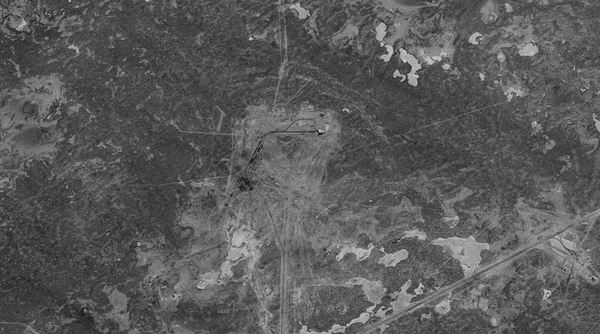 A CORONA reconnaissance photograph of the Soviet launch complex at Baikonur taken in December 1960. Although CORONA's images were relatively low resolution, the program was steadily improving in performance and reliability throughout 1961, when other reconnaissance programs were struggling. CORONA’s success led to a proposal to modify the more powerful Samos E-5 camera and launch it using upgraded CORONA equipment. (credit: Harry Stranger) |
Getting rolling
In March 1962, the third Samos E-5 satellite was launched and successfully reached orbit. But the vehicle malfunctioned and was not recovered. The loss only reaffirmed the decision to proceed with LANYARD instead of continuing E-5.
On April 3, 1962, the CIA issued a “Statement of Work” to Lockheed Missiles and Space Division. Barely a dozen pages long, it stipulated what equipment Lockheed would build for LANYARD and when it had to be produced.[21] By this time LANYARD had been expanded to eight payloads, with Lockheed scheduled to supply the last of the complete “payload systems” in September 1963.
Two days later, the CIA’s Deputy Director for Research, Herbert Scoville, Jr., sent a memo to Charyk agreeing to management procedures that they had both negotiated. CIA would handle security and some operations for LANYARD.[22]
| By this time the relationship between the CIA and the Air Force that had worked so well with CORONA was starting to deteriorate. This growing distrust was also reflected in the LANYARD program itself. |
The incorporation of CORONA elements into the LANYARD design, particularly the reentry vehicle, added the CIA to the discussion of how the program should be managed. Samos E-5 had been an Air Force program. But now that LANYARD was a covert program and the CIA was involved, it raised questions of who had authority to approve personnel access to the program. There were some uneasy discussions as it appeared as if CIA wanted to take control, but the arrangements were resolved without much difficulty. In February 1962, President John F. Kennedy directed that the CIA had the authority to approve who would be involved in LANYARD, and his directive had the side effect of approving the LANYARD program.[23]
But by this time the relationship between the CIA and the Air Force that had worked so well with CORONA was starting to deteriorate. There were numerous reasons for this, including the departure of legendary CIA figure Richard Bissell, who had worked closely with Charyk, as well as personality conflicts. In addition, satellite reconnaissance had now become the most important single source of intelligence information to the American government, and various people and organizations wanted to control it. None of the Air Force reconnaissance satellite designs had been successful, whereas CORONA was regularly returning low- to medium-resolution pictures of vast swaths of Soviet territory, producing a tremendous amount of intelligence information. Some CIA officials also began acting as if CORONA had been a CIA program from the start and belittling the Air Force’s contribution, further straining the relationship.
This growing distrust was also reflected in the LANYARD program itself. In early April, Scoville, who had overall responsibility for CIA reconnaissance projects, sent a letter to Charyk seeking to clarify the management relationship for LANYARD. Scoville agreed that all technical decisions regarding LANYARD would be made by Major General Robert Greer, the head of the NRO’s Los Angeles office.[24] A short time later Greer chaired a meeting of Air Force and CIA personnel to discuss the management arrangements.
Greer declared that he wanted the CIA’s procurement official—an Air Force officer on loan to the agency—to operate out of Los Angeles rather than Washington, DC, and to be directly responsive to him. He also wanted to evaluate using the electronic control unit for the Air Force’s canceled Samos E-4 mapping satellite aboard LANYARD. Although it was heavier than the Fairchild Company unit used for the E-5 satellite, Greer felt that it would be far more flexible because it could be programmed in orbit rather than on the ground before launch. But it would also require all satellite programming and control to be conducted from Los Angeles rather than Washington because the CIA did not have facilities for conducting these operations on the west coast. [25]
The chief of the CIA’s Office of Special Projects which was responsible for the agency’s reconnaissance programs saw Greer’s comments as a warning sign. “There is evidence that General Greer regards the LANYARD program as one in which the Central Intelligence Agency has a supporting rather than a joint role,” he wrote. He viewed Greer’s proposals as an attempt to gain control over LANYARD. “It then remains to be seen if such control becomes retroactive and includes CORONA,” he wrote. Clearly the tension between the groups was increasing, although LANYARD was not the major source of disagreement.[26]
Next: Building the LANYARD
Endnotes
- Victor K. McElheny, Insisting on the Impossible: The Life of Edwin Land (New York: Perseus Books, 1998).
- Jonathan Lewis, Spy Capitalism: Itek and the CIA (Boston, MA: Yale University Press, 2002); Dwayne A. Day, “A Sheep in Wolf’s Clothing: The Samos E-5 Reconnaissance Satellite, Part One,” Spaceflight, October 2002, pp. 424-431; Dwayne A. Day, “A Square Peg in a Round Hole, The Samos E-5 Reconnaissance Satellite, Part Two, Spaceflight, February 2003, pp. 71-79; Dwayne A. Day, “From Cameras to Monkeys to Men: The Samos E-5 Reconnaissance Satellite, Part Three,” Spaceflight, September 2003, pp. 380-389. See also: Robert Perry, “A History of Satellite Reconnaissance, Volume IIB – SAMOS E-5 and E-6,” October 1973.
- John (Jack) Herther, interview by Dwayne A. Day, Waltham, Massachusetts, September 26, 2002.
- Ibid.
- This article is intended to expand upon and correct my earlier article concerning the LANYARD reconnaissance satellite that was developed from the Samos E-5. Since that time, a considerable number of documents on the KH-6 have been declassified. That earlier article contains inaccuracies, such as the claim that LANYARD was specifically built to spot the Tallinn ABM site. See: Dwayne A. Day, “A Failed Phoenix: The KH-6 LANYARD Reconnaissance Satellite,” Spaceflight, May 1997, pp. 170-174.
- As historian Robert Perry noted in his official history of the program, the original E-5 capsule was essentially the same spacecraft that Lockheed had proposed for the Man-In-Space-Soonest program. Robert Perry, p. 365.
- Ibid., pp. 343-344.
- Ibid., p. 346.
- Available records indicate that only five operational Samos E-5 flights were planned and one flew in early 1962. It is unclear why there were five and not four camera systems left over at program termination. It is possible that Itek had built a non-flying camera that was included in this count.
- John Herther interview.
- [DELETED] Major, USAF, Memorandum for Record, “Simplified 66’’ System (SSD black code word: LANYARD),” January 11, 1962. National Reconnaissance Office Reading Room CORONA/ARGON/LANYARD Collection 3/A/0063. (Hereafter CAL. Note that these records were subsequently placed on the internet on the NRO’s website after the reading room was closed. The easiest way to find them is to search that collection.)
- Perry, pp. 346-347.
- Ibid.
- Ibid.
- Ibid., p. 350.
- Memorandum for [DELETED], “LANYARD Program,” February 2, 1962. CAL 2/6/0022.
- The spacecraft was initially named “GAMBIT” (sometimes in all caps, sometimes not). After the updated KH-8 GAMBIT-3 began flying, the KH-7 GAMBIT was referred to as the GAMBIT-1.
- According to an official CIA history, a suspected Soviet anti-ballistic missile (ABM) site at Tallinn, Estonia was the primary target for the LANYARD. However, the timelines do not match. The suspected ABM site at Tallinn was detected by a CORONA satellite in July 1964, after the LANYARD program had ended. See: Donald E. Welzenbach, “Science and Technology: Origins of a Directorate,” Studies in Intelligence, Vol. 30, Summer 1986, p. 24, RG 263, National Archives and Records Administration. For information on the Tallinn site, see: Chris Manteuffel, “An enigma behind the curtain: the Tallinn anti-ballistic missile system and satellite intelligence,” The Space Review, March 18, 2019.
- Memorandum for [DELTED], “LANYARD Program,” February 2, 1962. The group made several other assumptions, including continued Thor production of four rockets per month, Agena D production of five spacecraft per month, easy interchangeability with ARGON mapping or CORONA spacecraft Thor boosters, use of the CORONA Mark VA recovery capsule, and use of the new Kodak SO 132 film.
- John A. McCone, Director of Central Intelligence, to General Carter, Dr. Wheelon, September 20, 1963.
- LMSC Statement of Work: Development of a Satellite Reconnaissance & Recovery System CORONA “L” Program, 3 April, 1962. CAL 7/B/0069.
- Herbert Scoville, Jr., Deputy Director (Research), Memorandum for Under Secretary of the Air Force, “Management of LANYARD,” April 5, 1962. CAL 1/B/0064.
- Perry, pp. 351-352.
- Ibid.
- [DELETED NAME], DPD/SPB/C/COR, Memorandum for the Record, “Current State of Project LANYARD,” April 18, 1962. CIA Records Search Tool, National Archives and Records Administration (hereafter “CREST).
- [DELETED NAME], Chief, Special Projects Branch, DPD, Memorandum for Acting Chief, DPD, “Operations in the LANYARD Program,” April 19, 1962. CREST. In July 1962, the groups met to discuss creating a “flight-following” center so that officials could monitor the status of a spacecraft in flight from Washington. Stanley W. Beerli, Colonel, USAF, Assistant Director (Special Activities), Memorandum for Deputy Director (Research), “Operational Control of Satellite Programs,” July 16, 1962. CREST.
Note: we are now moderating comments. There will be a delay in posting comments and no guarantee that all submitted comments will be posted.