International lunar consultations: future-looking developments at the Committee on the Peaceful Uses of Outer Spaceby Giorgio Cardile
|
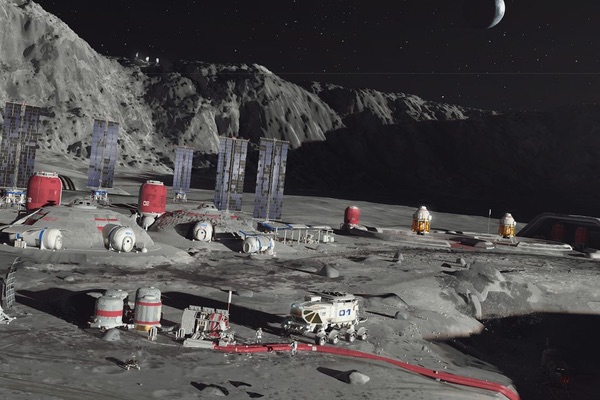
| While private enterprises advance landers and extraction technologies, UN delegates linger over terminology. |
Operating on a 2025–2027 workplan, ATLAC’s work matured into substantive policy debates by mid-2026, with a final report expected next year. This April, a coalition of ten states submitted a joint Conference Room Paper urging ATLAC to formally discuss an “international consultation mechanism.” It recommended dedicating meeting time to this framework, conducting tabletop simulations to test it in practice and incorporating perspectives from civil society, academia, and emerging spacefaring nations.
During COPUOS plenary, debates continued over this mechanism’s scope versus an alternative “International Lunar Environment/Locations” (ILEL) framework, focused on definitions and information exchange. These discussions culminated in a negotiated draft report.
At the final informal meeting on June 17, member States agreed to continue discussions on
whether to establish a potential international mechanism for information sharing and exchange, as well as consultations related to lunar activities in accordance with applicable national regulatory framework and international law. The Action Team would continue such discussions, including on the potential scope and mandate of such a mechanism. The Action Team had noted a conference room paper prepared by the Co-Chairs (A/AC.105/2026/CRP.39), a background paper prepared by the secretariat (A/AC.105/2026/CRP.33) and a presentation by the representative of Mexico relevant to such discussion
and further agreed on three paragraphs to be included in the final 2026 report of ATLAC to COPUOS.
Deliberative, or too slow?
Compared to rapid commercial lunar developments, ATLAC may seem slow. While private enterprises advance landers and extraction technologies, UN delegates linger over terminology.
Technical challenges are daunting: an analysis compiled by the ATLAC Co-Chairs in 2026 highlighted that lunar operations face unique risks like landing plumes, dust ejecta, and electromagnetic interference. Notably, methane from lunar landings can travel and contaminate pristine Permanently Shadowed Regions (PSRs). Furthermore, without atmospheric re-entry, orbital debris will accumulate indefinitely without proactive disposal guidelines.
Achieving diplomatic consensus is also inherently difficult. During informal meetings, delegations spent considerable time debating the difference between information “sharing” and information “exchange,” arguing that “exchange” implies necessary reciprocity and consultation, whereas “sharing” is mere unilateral action. Others expressed concern that continuously adding layers of legal language to draft recommendations slows down substantive progress.
An international “mechanism”
The central ATLAC debate concerns the proposed mechanism’s design. A background analysis by the Co-Chairs identified five core functions: pre-mission information-sharing, managing harmful interference, coordinating end-of-mission disposal, prioritising operational alignment (e.g., common docking/communication standards), and developing shared scientific baselines.
States lack architectural consensus. One proposal suggests a “Coordination body for Lunar workstreams” leveraging existing UN resources to coordinate space debris (IADC) and space resource expert groups, avoiding new bureaucracy. It also proposed adapting, from the Antarctic Treaty System, Antarctic Specially Protected Areas (ASPAs) to safeguard sensitive lunar sites like PSRs and far-side radio-quiet zones without claiming sovereignty.
This debate has also exposed underlying geopolitical tensions regarding lunar resource utilisation. One state presented a proposal based on the BBNJ (Biodiversity Beyond National Jurisdiction) agreement, arguing that the Moon, like the high seas, is an area beyond national jurisdiction where no state can claim sovereignty.
| ATLAC’s most significant achievement may be maintaining open diplomatic channels between established and emerging spacefaring nations, ensuring lunar competition remains a matter of regulatory divergence rather than geopolitical confrontation. |
However, others highlighted a fundamental legal fracture: unlike seabed resources treated as the “common heritage of humankind,” the legal status of space resources is contested. Some stressed the mechanism requires answering fundamental questions regarding who holds lunar obligations and the legal characteristics of extracted resources. Others insisted any mechanism must be strictly bound by existing international law (lex lata), while noting ATLAC’s work overlaps with the Working Group on Space Resource Activities and discussions on safety zones.
Predictions for ATLAC
Heading into its 2027 final reporting phase, ATLAC’s trajectory suggests a cautious evolution, potentially becoming a long-lasting COPUOS working group serving as a central lunar coordination hub. Upcoming ATLAC meetings are scheduled for September 30, October 31, and November 18.
In the near term, ATLAC is well-positioned to prevent operational and technical conflicts. By facilitating information sharing, establishing life-support and communications compatibility standards, and implementing practical frameworks like Antarctic-style management zones, ATLAC can help actors avoid physical interference and operational disputes.
However, ATLAC may struggle to resolve political conflicts over lunar resource rights. The international community may be heading toward a bifurcated lunar future: technical coordination managed by a UN-backed ATLAC mechanism, alongside resource extraction governed by a patchwork of national laws and bilateral agreements.
Ultimately, ATLAC’s most significant achievement may be maintaining open diplomatic channels between established and emerging spacefaring nations, ensuring lunar competition remains a matter of regulatory divergence rather than geopolitical confrontation.
Note: we are now moderating comments. There will be a delay in posting comments and no guarantee that all submitted comments will be posted.