Commercial space is not an endless field of innovation: an assessment of the good, the bad, and the uglyby Charles S. Galbreath
|

| Commercial space should not be viewed as an endless field of wildflowers perpetually blooming with innovative, inexpensive capabilities. It is better understood as a garden that requires cultivation, shaping, and occasional weeding. |
However, unrealistic expectations of what commercial solutions can achieve—and overreliance on that path—could undermine the US ability to maintain a spacepower advantage. Acquisition leaders and Congress must consider risk allocation, mission performance, and industrial-base health as they implement these initiatives. Commercial integration is neither a panacea nor an “easy button” for every military capability problem. It is one option among many and requires skillful cultivation by experienced acquisition professionals. No single solution fits every mission. Identifying and implementing the right mix requires a full understanding of the relevant factors and a foundation of collaborative, rather than merely transactional, relationships. To find the right mix, senior leaders must understand the intended and unintended consequences, benefits, limitations, and pain points of commercial strategies within a hybrid military-commercial architecture.
As with any acquisition decision, successful commercial integration turns on three factors: cost, schedule, and performance. Leaders must understand how commercial approaches affect each as they evaluate available options.
Cost includes not only the upfront expense but also the system’s full lifecycle cost, spanning development, procurement, sustainment, and disposal. Schedule concerns timely delivery, including initial delivery; the pace from first item through full-rate production to final delivery; and the time required for testing, training, integration, and exercises. Performance encompasses how well a system meets mission and technical requirements and integrates into the existing architecture to deliver consistent, reliable warfighting effects. The long-standing “iron triangle” of cost, schedule, and performance remains a central framework for program managers, who must prioritize the attributes most important to system and mission success while managing the associated risks. Senior leaders likewise must weigh these variables when choosing how to field an operational architecture that incorporates commercial solutions.
Before integrating commercial solutions, leaders must define “commercial.” The term is used frequently but inconsistently, with meanings that vary by speaker and context. The Federal Acquisition Regulation (FAR) defines commercial through two relevant terms:
A commercial product is a type of product customarily used by the general public or by nongovernmental entities for other than governmental purposes.
A commercial service includes installation services, maintenance services, repair services, training services, and other services or types of service offered and sold competitively in substantial quantities in the commercial marketplace.
The FAR also defines commercially available off-the-shelf (COTS) items as commercial products supplied by a commercial entity and sold in substantial quantities in the commercial marketplace. Such items may then be offered to the government, a contractor, or a subcontractor at a fixed price.
These technical definitions are useful, but they do not capture the full range of colloquial meanings assigned to “commercial.” As the Space Force’s Commercial Space Office (COMSO) explains, commercial space integration exists along a continuum. At one end is a system custom-built for the government: researched, developed, and procured to meet a specific government requirement. At the other is a contractor-owned and -operated system from which the government simply purchases an end product or service.
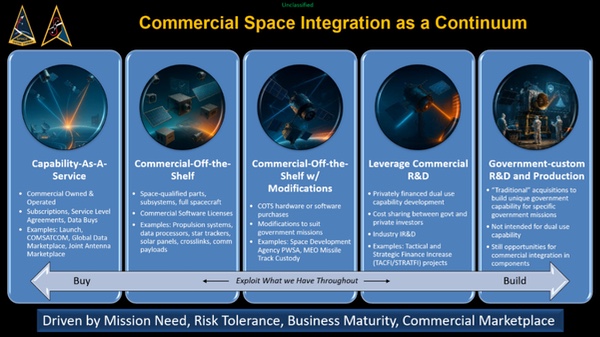 Figure 2: Commercial solutions span a continuum of government integration options. The examples in each category are illustrative, not exhaustive. (credit: US Space Force Commercial Space Office.) |
Between these endpoints lies a broad mix of technologies, capabilities, and services that may leverage commercial research and development, components, or subsystems, with or without modification. Importantly, this middle ground is not the exclusive domain of small startups. Traditional prime defense contractors also invest their own resources through independent research and development (IRAD) to develop new technologies, components, and capabilities. Senior officials often overlook this reality and overemphasize VC-backed startups when discussing commercial solutions.
| Not all government missions are suitable for fully commercial end systems or services. Yet commercial components and subsystems may provide needed capability or capacity within a government system. |
Another critical aspect of commercial integration is respecting companies’ intellectual-property (IP) rights. When a company uses its own funds or venture capital to develop a new technology or product, it owns the resulting IP. That IP—the concept, design, or technological innovation—may be what makes the company competitive and viable in a new market. Failing to respect those rights risks appropriating the technology and undermining the company’s viability.
In some cases, the government may negotiate government purpose rights, allowing it to use technical data or software as needed for mission success. These rights may include modifying, using, reproducing, or releasing defined elements of technical data or computer software to facilitate mission execution. The relationship among intellectual property, government purpose rights, and commercial integration must be carefully managed to support both operational requirements and continued market growth.
Planting the right seeds: applying commercial solutions to the right missions
Not all government missions are suitable for fully commercial end systems or services. Yet commercial components and subsystems may provide needed capability or capacity within a government system. Looking across the commercial space integration continuum helps explain Col. Timothy Trimailo’s conclusion: “Commercial integration is no longer an ‘either/or’ decision.”
A few examples illustrate the point. Commercial satellite communications (SATCOM) services have long been integrated into the broader architecture, but some communications are so sensitive or “no-fail” that they must remain government-owned and operated. Nuclear command, control, and communications (NC3), for example, must rely on government systems that are secure, jam-resistant, and hardened; commercial systems and services cannot form the core of the NC3 architecture. Yet commercial solutions can still contribute. If a commercially developed thruster meets all mission requirements, there is no reason not to integrate it into a government satellite.
Some mission sets have been performed by the government for so long that an independent commercial market is unlikely to emerge to meet all requirements or provide an alternative. For more than 30 years, the government has provided positioning, navigation, and timing (PNT) signals through the Global Positioning System (GPS) at no cost to users worldwide. A commercial alternative PNT service may therefore struggle to establish a viable market. Similarly, government weather systems, including the Defense Meteorological Support Program (DMSP) and the civil Geostationary Operational Environmental Satellite (GOES) program, have provided weather data at no cost for so long that a commercial service would likely depend on the government as its predominant anchor customer for the business case to close. Would such a service be truly commercial? Government decision-makers must understand when commercial markets exist—and when they do not.
More important is understanding the strengths, weaknesses, and constraints that can accelerate or impede commercial solutions—in other words, recognizing the good, the bad, and the ugly. By assessing these factors pragmatically, the government can exploit commercial solutions’ strongest attributes while developing alternatives for their shortcomings.
The good
Five major strengths stand out: three directly affect cost, schedule, and performance, while two provide broader benefits that can secondarily improve the iron triangle.
Leveraging private investment: In a fiscally constrained environment, using nonfederal funds to advance national security objectives is attractive. Commercial items, systems, and services often embody investment from VC and corporate IRAD, reducing the government’s development costs. By reducing or eliminating early development costs and associated non-recurring engineering (NRE), the government can lower acquisition costs and shift some early risk to industry. When these solutions are technically mature, fixed-price contracts may be feasible instead of cost-plus contracts whose costs to the government can grow as development or other issues arise. VC and private funding can also insulate development from government shutdowns and continuing resolutions. Reliable early funding can sustain development and production, enabling faster delivery than programs that depend exclusively on government funding.
Speeding delivery: Commercially available items, systems, and services can shorten fielding timelines. Widely available products can often be purchased promptly, accelerating delivery to operational users.
Increasing capacity and force structure: Integrating commercial capabilities with government and international assets in a hybrid architecture can significantly expand the capacity and force structure available to meet warfighting and national security needs. That additional capacity can substantially improve mission performance.
For decades, the military has used commercial SATCOM to augment dedicated military systems and dramatically expand bandwidth. Approximately 90% of the SATCOM bandwidth the US military uses each day comes from commercial providers. A larger number of communications pathways can also improve mission assurance.
| The “startup mindset” is often associated with creativity and unconventional approaches that can lower costs and improve performance. |
The rapidly expanding commercial imagery and sensing sector is also reshaping the intelligence, surveillance, and reconnaissance (ISR) architecture by increasing capacity and revisit rates. When space-based ISR relied on a small number of exquisite satellites, adversaries could identify and exploit gaps in coverage. Hundreds of imaging satellites providing data around the world are shrinking those gaps and the sanctuary they once afforded adversaries. Although commercial systems may offer lower resolution than exquisite national systems, their higher revisit rates from the quantity of sensors create a quality of their own.
Expanding the industrial base: Commercial integration can broaden the pool of providers. Although this does not immediately improve cost, schedule, or performance, greater competition can reduce prices, accelerate innovation, and improve products. The more credible options the government has, the stronger its buying position and its ability to assemble capabilities for military operations.
Increasing innovation: Broadening the industrial base brings in nontraditional defense companies eager to establish themselves with novel solutions. The “startup mindset” is often associated with creativity and unconventional approaches that can lower costs and improve performance. But innovation is not exclusive to startups: traditional defense companies also use IRAD to advance technologies and position themselves for future competitions.
The bad
As with any approach, commercial integration presents issues that must be mitigated. Acquisition and political leaders must understand them to maximize benefits and manage risk.
Challenges in scaling: A commercially available item, system, or service may still be unavailable at the scale required for national security. Many startups and small companies cannot ramp production at the pace and volume the Pentagon requires. Aligning supply chains, production equipment, and skilled labor for volume production can be as difficult as achieving the technological breakthrough that first attracted military attention.
Overpromising technological breakthroughs: Suppliers may overestimate their ability to deliver advertised capabilities and effects, or the ease of doing so. This challenge is unique neither to space nor to commercial firms. The Gartner Hype Cycle illustrates the consequences of bold claims and reminds buyers to distinguish hype from reality.
Poor communication has likewise derailed acquisition programs. In the case of the A-12, conditions discouraged partner companies from candidly sharing problems with one another or the government. The risk can be especially acute among startups whose passion for their ideas may outpace their recognition and resolution of the technical and business obstacles to delivery. The government needs a clear-eyed assessment of whether providers can deliver what they promise at the pace and scale they advertise.
Company discretion over commercial services: A commercial entity may withhold a product or service based on its view of the intended use. For example, Starlink was providing communications to Ukraine; however, reportedly when Elon Musk learned that it was also being used to support strikes against Russia, he ordered some services curtailed. Any Space Force agreement with a commercial provider should clearly state the intended uses and the conditions under which the provider may limit or deny service. The Ukraine-SpaceX case is acute. US companies may show greater tolerance in a US national security context, but the government cannot assume a blank check. Contracts must define terms, conditions, and penalties before disagreements cause operational harm.
The ugly
The expanding use of commercial capabilities for space operations exposes several ugly truths that require leadership vigilance: cost, schedule, and performance remain tightly linked; most startups fail; the government is not always a reliable customer; many commercial capabilities are shaped and funded by the government; and security classification remains a persistent barrier.
| One key challenge to integrating both commercial and traditional capabilities is inconsistent government demand. A healthy space ecosystem requires stable requirements and funding. |
Cost, schedule, or performance: Advocates of greater commercial integration cite lower costs through VC and corporate investment, faster delivery through infrastructure unburdened by government bureaucracy, and higher performance through commercial innovation. Yet, with few exceptions, expecting simultaneous gains in all three is inconsistent with decades of practice. Reusable launch boosters are an important exception: they have reduced costs and increased launch cadence while modestly improving payload capacity and mission success. Such transformations are rare, though, and not the default. History shows that “faster, better, cheaper” generally requires prioritizing one or two attributes, not all three. The current emphasis is clearly on schedule and cost. The shift from exquisite architectures toward warfighting minimum viable products has been consistent since the public recognition of space as a warfighting domain and General Hyten’s “big, fat, juicy targets” statement in 2017.
Most startups fail: Roughly 90% of startups fail. Technologies may not mature as projected, companies may lack the materials or personnel needed to deliver, or the business case may prove unsustainable. The government must account for this failure rate when integrating commercial solutions into a hybrid warfighting architecture and gauge long-term sustainability. Conversely, industry must have confidence in follow-on purchases; the government must prove itself a reliable customer. That confidence can reduce industry risk and help build a more robust commercial infrastructure.
The government has been an unreliable customer: One key challenge to integrating both commercial and traditional capabilities is inconsistent government demand. A healthy space ecosystem requires stable requirements and funding. As Clay Mowry, president of the American Institute of Aeronautics and Astronautics, emphasized in a recent podcast, industry values that stability more than many other factors. His comments echo an earlier CSIS report urging the government to be a better customer. Shifting warfighting priorities and budget uncertainty have eroded industry confidence. Companies need credible expectations of future procurement—and sufficient scale—to justify their IRAD and VC investments.
VC investors seek returns, not donations. Without a substantial government contract at the end of the process, they will pursue other markets to earn a return on their investments.
Government policy and funding shape commercial space growth: Defining “commercial” is complicated by the reality that many firms and services depend on government funding. Policy changes have also been necessary to enable some commercial space markets to grow. Commercial markets that the government expects to support military capabilities rarely emerge unaided. The commercial space ecosystem requires deliberate cultivation through investment and policy reform.
Commercial remote sensing, or ISR, illustrates the point. Many current commercial ISR providers received early government investment, including through the Central Intelligence Agency’s In-Q-Tel, to advance their capabilities. VC and other private capital also supported their growth, but government support was substantial. The government also had to relax policy restrictions related to resolution for the ecosystem to thrive. Government contracts, combined with changes to laws and policies, have been essential to sector growth. A recent report by the Potomac Institute identified a preliminary list of more than a dozen laws and policies that pose risks to a hybrid space architecture. Streamlining those measures could support both commercial firms and traditional defense companies.
SpaceX, often cited as a premier commercial capability, also received significant government funding, including from the Air Force, NASA, and DARPA, to get off the ground. Without deliberate government cultivation, promising commercial capabilities may die on the vine or never blossom.
The security-classification dilemma: Startups seeking classified work face a circular barrier: they need security clearances and accredited facilities to win contracts, but they often need a government contract to obtain them. This paradox restricts access and competition regardless of capability quality or the likelihood of success.
Cultivating the garden we need for space operations
Distinguishing the good from the bad and overcoming the ugly begins with trained, experienced acquisition professionals. The Pentagon can also pursue a series of initiatives to improve the delivery and integration of commercial solutions. These recommendations can strengthen the commercial sector and create a more stable industrial base spanning new entrants and legacy prime contractors.
Expand the trained and experienced acquisition cadre: An acquisition effort needs the right team to succeed, including program managers, financial experts, and contracting officers. That team must conduct rigorous market research to determine the commercial sector’s maturity and identify where providers may be overpromising. Significant acquisition workforce cuts resulting from Department of Government Efficiency (DOGE) initiatives have left these professionals at a disadvantage. The government must regrow the space acquisition workforce to meet growing demands for speed and capacity.
Training for this workforce should include techniques specific to commercial integration, including innovative contracting approaches such as other transaction authorities (OTAs) and commercial solutions openings (CSOs), as well as methods for synchronizing government processes with faster business cycles. Aligning government and commercial incentives and methods makes hybrid solutions more achievable.
Emphasize past performance: Commercial-vendor evaluations should give greater weight to past performance to reduce the risk of unfulfilled deliverables. Greater emphasis on past performance has been urged by the Secretary of the Air Force and defense experts for months. With the surge in commercial space providers, distinguishing real capability from fiction or “PowerPoint-deep” claims is increasingly difficult. Past performance should be central to these decisions.
| Delivering a lower-performing capability sooner may be more valuable than waiting for a system that meets every performance measure. |
Plan deliberate pruning and weeding: A holistic view of the commercial ecosystem enables timely, informed decisions about narrowing the vendor pool. Early in a program, the government may need to evaluate multiple vendors through a series of small contracts. The Small Business Innovation Research (SBIR) and Small Business Technology Transfer (STTR) authorities are critical tools for making these small bets and downselecting companies from Phase I through Phase III. Strategic and Tactical Funding Increases (STRATFI/TACFI) help transition selected SBIR/STTR Phase II efforts into Phase III. The government can also use OTAs and CSOs to onboard more mature technologies rapidly for prototyping. Later, Indefinite Delivery, Indefinite Quantity (IDIQ) contracts can retain a robust pool of proven vendors. As a program advances toward production, the field should narrow while retaining enough competition to prevent vendor lock. Leaders must determine when to continue investing in a viable company and when to pursue an alternative.
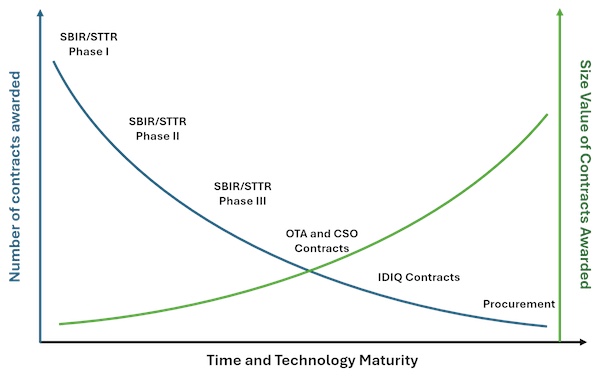 Figure 3: Notional contract-funneling process. The shape and rate of compression depend on mission, cost, industrial-base performance, and technology maturity. Projects and programs may enter at different points based on those factors. (credit: Mitchell Institute.) |
This funneling approach inevitably funds some efforts that never become programs of record, but it is essential when speed is the priority. Demanding that a high percentage of seed efforts become full programs would increase early scrutiny and review, slow contracting, widen the gap between government and industry development cycles, and risk missing short-lived opportunities to exploit innovations backed by nongovernment funding.
Make decisions and follow through: Once a capability is mature and the vendor field has narrowed, the government must award procurement contracts. This is necessary to deliver warfighting capability at scale and rewards vendors that meet cost, schedule, and performance expectations. Reliable follow-through demonstrates government commitment and justifies earlier VC and corporate IRAD investments.
First, the government should stabilize funding against the ebbs and flows caused by continuing resolutions and government shutdowns. The Space Force, Congress, and the Pentagon should shift toward funding mechanisms that extend execution periods, including multiyear contracts. IDIQ contracts can support multiple years of execution if funding transitions from research and development to procurement. The three-year execution window for procurement funds will be pivotal regardless of the contract mechanism.
The government can also become a better customer by stabilizing requirements. The Space Force can signal its needs and commitment through a durable strategic roadmap. Details may change, but the broad direction must remain consistent. The service should focus on operational outcomes rather than prescriptive system specifications. Defining broader needs can open the field to a wider range of solutions and is a first step in transforming the requirements process.
Transform requirements: The requirements process frequently delays capability delivery. Reform would benefit new entrants, traditional companies, the government, and warfighters. End users must define clear performance thresholds, but requirements should not be so restrictive that they foreclose delivering a 70% or 80% solution much sooner than a full solution.
Delivering a lower-performing capability sooner may be more valuable than waiting for a system that meets every performance measure. Operational utility diminishes as the wait lengthens. Program managers and warfighters must therefore weigh threshold performance against the urgency of the demand.
Ultimately, the choice is a risk decision: field a lower-performing system today or delay for a more capable system tomorrow. That decision belongs neither solely to acquisition nor operations. Both communities must reach an informed agreement that maximizes utility and manages risk to warfighters, the acquisition process, and industry.
Reform laws and policies to cultivate growth: As the ISR market demonstrates, the government must sometimes remove obstacles that prevent companies from developing commercial solutions. To expand commercial integration, it should reevaluate laws and policies written for an earlier era, when most space activity was government-directed and today’s proliferation of space technologies did not exist. Modernizing that guidance can create a more competitive marketplace in which space companies, large and small, can thrive.
Reform security classification: The government must create on ramps for companies to access classified work. One option is to establish shared facilities accredited for classified processing. These hubs could enable startups to access information and develop the detailed plans and proposals needed to compete for government contracts and eventually establish their own accredited facilities. Similar work hubs exist nationwide at the unclassified level. Classified hubs could materially advance security-classification reform and commercial integration.
DARPA’s Bringing Classified Innovation to Defense and Government Systems (BRIDGES) initiative offers a potential model for breaking through this long-standing challenge. By forming consortia of innovative companies around discrete areas of effort, DARPA accelerates the delivery of new ideas. Companies first demonstrate their ability to contribute, giving DARPA a basis to establish a “need to know” before contract award. Access to classified facilities and discussions then allows them to focus on specific government challenges. The Space Force is considering a similar approach and should assess whether to expand it to special access programs.
| To maximize the good, overcome the bad, and move beyond the ugly history of acquisition and commercial integration, the government must actively cultivate the commercial sector and reap the benefits of the hybrid architecture it seeks. |
Integrate operations early: Acquisition matters only when warfighters can employ the resulting effects, so operational integration is essential from the outset. End users must define requirements and work shoulder-to-shoulder with acquisition personnel on what to continue, cancel, or accelerate. Joint decisions improve risk management. Exercises and wargames, such as US Space Command’s APOLLO INSIGHT, will be invaluable for integrating commercial capabilities into future operations.
Build collaborative teams: Commercial integration requires innovative teaming within the government and between government and industry. The relationship can no longer be purely transactional. Both new entrants and established prime contractors can benefit from mechanisms that jointly develop capabilities, refine requirements, and deliver what warfighters need.
Novel industry teaming may also be necessary. A traditional prime contractor could provide scaling capacity to a startup with an innovative technology and serve as a subcontractor to the smaller firm. Such agreements must protect the small company’s IP so that its competitive advantage is not inadvertently transferred and its viability undermined.
These arrangements require clarity and transparency between government and industry. Setbacks and challenges must be communicated quickly, and negative feedback must be delivered directly and supported by facts. Such candor is necessary to build the trust required to operate differently.
Test rigorously: Capabilities must be stressed and validated through robust testing, which again requires acquisition professionals. A recent GAO report identifies significant cuts and reorganization within the Department’s Office of the Director, Operational Test and Evaluation (DOT&E) that are undermining the integration and assurance of warfighting capabilities. Test professionals are as critical to capability delivery as program managers, contracting officers, and financial specialists.
Commercial solutions must be tested and evaluated for government missions. Even unmodified COTS capabilities require verification that they interface with other systems and perform in operational environments that may exceed commercial design assumptions. Testing must confirm expected performance in warfighters’ hands and ensure that a capability does not introduce unanticipated vulnerabilities. Inadequate testing raises the risk to warfighters and military operations. The government should discover system limitations and failures during testing—not during combat, when lives and missions are on the line.
Reaping the benefits of a well-cultivated garden
Integrating commercial solutions into a hybrid warfighting architecture holds considerable promise, but challenges must be identified, understood, and overcome so that warfighters do not assume unnecessary risk in combat. Clear definitions, disciplined acquisition processes, and informed tradeoffs among cost, schedule, and performance are essential, as is a trained and experienced acquisition workforce. To maximize the good, overcome the bad, and move beyond the ugly history of acquisition and commercial integration, the government must actively cultivate the commercial sector and reap the benefits of the hybrid architecture it seeks.
Note: we are now moderating comments. There will be a delay in posting comments and no guarantee that all submitted comments will be posted.