The Junkers spaceplaneby Hans Dolfing
|
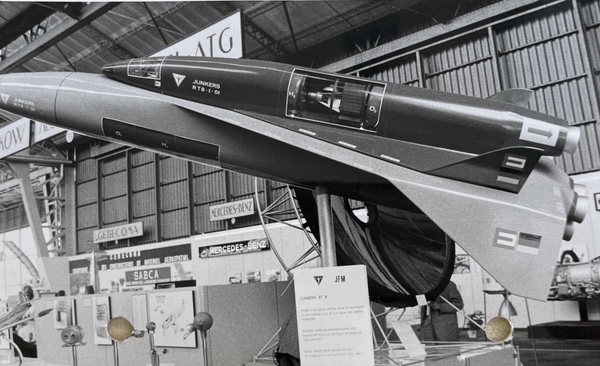
| The spaceplane was perceived as an opportunity for West Germany and Europe to innovate compared to the mostly ballistic efforts in the United States and Soviet Union. |
The Junkers company studied the spaceplane between 1961 and roughly 1968. After the start with company money, other funding sources were explored from 1962. Eugen Sänger helped to engage the Eurospace industry organization culminating in a pivotal spaceplane conference in Brussels in January 1964. [1.xviii.xix, 3] Industry and technology cooperation with Britain and France would have helped the project forward, but European projects have a tendency to be like a horse cart drawn by a dozen horses in different directions. After Sänger’s death early in 1964, the Eurospace spaceplane initiatives in subgroup III/3 lost their momentum in favor of traditional ballistic launchers such as ELDO, Diamant, and Blue Streak. [1.xvi.xviii.xix.xxi, 3]
The West German government was interested to help bootstrap the aerospace R&D. From 1962, there was the German Forschungsprojekt 623 or 62-3 (FPK 623) with Junkers, ERNO, and Bölkow to study the reusable spaceplane.[4] Even within West Germany, coordination was a challenge. Much progress was made in the two years 1962 and 1963. The transition from concept to prototype and development did not happen as the German government was blunt and made clear there was no money for development.[1.i ] In total, 5.39 million marks was received by Junkers between 1962 and 1965 to study the spaceplane.[1.vi ] After that, the West German government suggested to research more generic aerospace topics instead for which there might be some money left after other commitments to the more conventional ELDO.
Sänger
Eugen Sänger worked as consultant for JFM from 1961. Between 1961 and his death in 1964, he wrote 307 pages in 32 chapters. They were handwritten drafts in a noteworthy mixture of modern and old Sütterling handwritings.[15] He discussed the pros and cons of West German cooperation within Europe via the fledging Eurospace consortium, the lessons learned via a US trip in early 1961, spaceplane designs, aerodynamics, costs, propulsion, nuclear engines, the military in space, and a lot more.[1.iv.xxi, 2.iii.v] A subset of this seminal consultancy work was published in a book.[7]
Based on the consultancy from this eminent source, the spaceplane team at Junkers grew ultimately to about 87 people and produced about 100 technical reports on all aspects of the spaceplane.[1.i.xvi.xvii ] At Junkers, the main people were project lead Jürgen Lambrecht and director Julius Henrici coordinating with Dr. Sänger.
In his first advisory chapter in August 1961, page 5, Sänger wrote to Junkers, “While the USA is currently forced to prove its competitiveness in the space through short-term crash programs with the help of left-over ballistic rockets and possibly with the use of solid-based missiles with thrusts of up to 10,000 tons, without regard to economic outlay, Europe can favor the quiet path of long-term planning of economic equipment of the described type.”[1.iv, 2.iii ]
Sänger had a lifelong interest in flying to space. He studied the air-launched X-15 in detail and in person after a successful first flight in 1959. Figure 2 shows him in March 1961 discussing the ejection system of the X-15 during a visit at NASA Flight Research Center at Edwards AFB (now Armstrong Flight Research Center). He also paid attention to the public information on the American X-20 Dyna-Soar, the Douglas Astro and the Aerospaceplane concepts in his Chapter 13.[1.iv.x, 2.ii.iii.v.vii ]
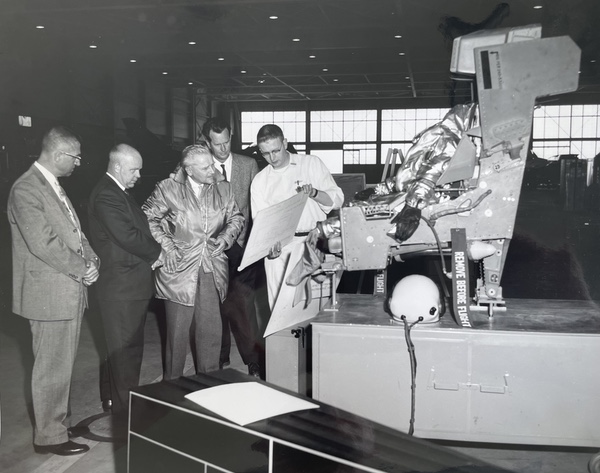 Figure 2: Eugen Sänger at NASA Flight Center AFB Edwards inspecting designs and the X-15 ejection seat. Left-to-right James Hancock, Paul Bikle (NASA AMES), Eugen Sänger, Thomas Toll (NASA AMES), Garrison P. Layton, Jr. (credit: NASA AMES) [2.v.vii ] |
In his Chapter 1 advice to Junkers in April 1961, he made a clear note that an early SSTO spaceplane would be sufficient for hypersonic transport on Earth but would initially have a questionable payload fraction to orbit. Therefore, a boost from a catapult was investigated as a pragmatic option based on earlier German work at the Sänger’s FPS institute. The speed boost at takeoff was roughly estimated between 300 meters per second and a supersonic 500 meters per second. However, this only improved the payload fraction by 1% for a 100-ton gross take-off weight (GTOW) spaceplane with a big catapult sled.
Chapter 2 calculated the necessary catapult pressures, speed, GTOW in detail. A 3.5-kilometer-long rail with a 20-second boost for a 100-ton spaceplane provided 300 meters per second.[1.iv, 2.iii ] In spite of these concerns, his advice included the clear vision of a better propulsion to solve the initial, minimal payload. Concepts like Liquid Air Cycle Engine (LACE)—in German “Luftzumischung”—were discussed to ease the way to orbit but not actively studied as they were complex and delays would be almost certain.[1.iv.xii.xvi, 2.iii ]
Nuclear propulsion
Sänger envisioned the engine generations in the early 1960s in his Chapter 1 as Generation 1, chemical, Isp with 280 seconds, followed by Generation 2, advanced chemical with an Isp of 450 seconds. Following that would be a Generation 3 with an Isp between 800 and 3,000 seconds, and then by a futuristic fourth generation with an Isp of 3,000 to 30,000,000 seconds via ion, fusion, and photon engines. [1.iv.xiii, 2.iii, 7]
The Junkers spaceplane studies were pragmatic at the start and concentrated on the second generation of chemical engines with an Isp of around 450 seconds, mostly liquid hydrogen/liquid oxygen (LH2/LOX) engines. The nuclear third generation was studied in parallel as these engines were the perfect fit for the initial SSTO designs. While there was no nuclear reactor prototype in Germany to study, the potential of the nuclear technology was too great to be ignored. [1.iv.xiii.xvi ]
| Sänger was on the right track with his advice to Junkers and large Isp improvements via nuclear engines. |
Based on Sänger’s trip to the United States in 1961, a ROVER-like engine was studied for the Junkers spaceplane in 1963. The initial study target was an open-cycle nuclear engine similar to ROVER with liquid hydrogen as propulsion medium envisioned to flow through the reactor to provide enough thrust. Based on a reactor temperature of 2,500 kelvins, the propulsion speed would be three times higher than a chemical engine and therefore provide three times more thrust.
The nuclear engine would take the shape of an oil-drum-like device with a 5 -on reactor, 20 tons of shielding, 50 to 100 tons of thrust, 4,000 megawatts power, Isp 800 seconds, and a gross takeoff weight between 100 and 200 tons. Five hundred seconds of sustained propulsion would be enough to get a SSTO or first-stage TSTO to space. [1.xiii,12,13]
Sänger calculated the advantages of an increased exhaust velocity on March 20, 1963, Chapter 18, page 200 of his advice to Junkers. He wrote that an increased exhaust velocity vex is a particularly effective means to improve economic efficiency because of its strong effects on the payload ratio with respect to the GTOW as a result of a reduced fuel ratio. [1.iv, 2.iii ]
During the flight into orbit and a target speed of 9,100 meters per second, the fuel ratio was calculated as t=1-e-v/v_ex. Using the exhaust speeds vex of 4,500, 10,000, and 30,000 meters per second, this gave a fuel ratio of 87%, 60%, and 26%, respectively. As Isp is directly related to the rocket’s exhaust velocity via Isp = vex / g, this would result in an Isp of 458 seconds, 1,019 seconds, and 3,058 seconds, respectively.
Even when the dry mass ratio in these three example cases increased from 12% to 16% and 18%, the payload ratio increased dramatically with the exhaust velocity from 1% to 24% to 56%. Therefore, a nuclear engine was seen as the key to success. [1.iv, 2.iii ]
One uncertainty was how to deal with the environment. The nuclear pollution potential was estimated based on the use of 50 grams of uranium during a ten-minute ascent. This was estimated to be between 0.1% and 1% of one nuclear, atmospheric explosion. Whether such pollution was acceptable was considered an open question.
The nuclear engine was also studied in the context of Eurospace, in particular the subgroup III/7. They studied a nuclear second stage for the ELDO and DIAMANT rockets. A ground level thrust of 50 tons, a U-235 reactor, and thermal power of 2,600 megawatts with liquid hydrogen as medium.[1.xxi ] The Eurospace subgroup III/8 also had an interest in nuclear engines but in the context of nuclear electric propulsion, such as ion engines.[1.xx]
Reactors as in “Project Pluto” were studied as well. If it was possible to run on air as the propulsion medium straight through the reactor, then the weight savings would considerable. Beryllium oxide and graphite reactors were studied. However, air as a medium would lead to unacceptable erosion in the reactor, which is why the ROVER-like liquid-hydrogen reactor was the preferred propulsion option.
Sänger was on the right track with his advice to Junkers and large Isp improvements via nuclear engines. After his death, innovations such a closed-cycle gas core nuclear engine were studied by NASA and United Aircraft Corporation. In principle, such closed cycles would not release any nuclear waste product into the atmosphere and would potentially allow the use of nuclear engine to be launched from planetary surface without nuclear pollution. [14]
Designs
In 1961, Junkers started work on the manned spaceplane. In the next five years, many variants and RT model numbers, from 1 to 20, were discussed and designed and a sequential, mostly chronological overview of these concepts follows. All RT variants were planned as manned spaceplanes with one or two pilots for the SSTO and double that for the TSTO. Cabin designs for the pilots are discussed after these structural spaceplane concepts.
| Similar to work in the United States, all of these RT-1 to RT-7 SSTO approaches were a step too far and never left the drawing boards. |
The first version was designated Raumtransporter-1 “RT-1”. It looked like a conventional delta-fighter airplane with large wing sweep of about 75 degrees. The goal was a SSTO spaceplane with the help of a catapult start and a target speed of roughly 7,800 meters per second. The catapult would boost the velocity by about 300 to 500 meters per second. Takeoff weight was 128 tons. The RT-1 engines were designed to run on LH2/LOX. With a tank volume of about 283 cubic meters, split 30:70 for LOX/LH2, the mass of the LOX/LH2 fuel was listed as 98 tons and 14 tons, respectively. [1.xvi ]
By the middle of 1963, several spaceplane models were designed. One version was the RT-4, a flying wing, with roughly the same gross takeoff weight as the RT-1 with 128 tons and similar fuel ratios. Figure 3 shows the RT-1 and RT-4 outlines for comparison.
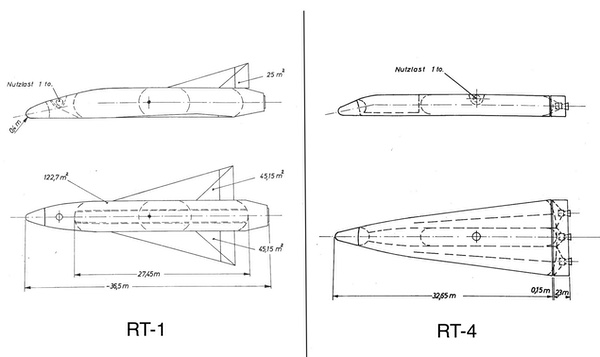 Figure 3: Outlines RT-1 and RT-4. [1.xvi ] |
Between the extremes of a delta-wing fighter shape of the RT-1 and the flying wing of the RT-4, there were the RT-2 and RT-3 with progressively flatter and more elliptical tanks and body shape. Figure 4 shows the cross sections for comparison. All of these had the same GTOW and payload fractions.
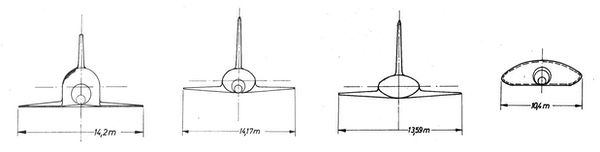 Figure 4: RT-1,2,3 and 4 cross-sections, left-to-right. [1.xvi ] |
After his earlier USA trip in March 1961, Sänger wrote in Chapter 1, page 2, August 1961 that while LOX/RP2 and LOX/LH2 were the contemporary rocket fuel combination for rocket engines in production, the second and probably final chemical engine generation might use LOX/LH2 or liquid fluorine/hydrazine (LF2/N2H4) to increase Isp to about 450 sec. [1.iv ]
Sänger’s advice to Junkers led to the RT-5 concept in early 1963 as in Figure 5. With a gross takeoff wright of 87.3 tons, the fuel was 54 tons of liquid fluorine and 24 tons of hydrazine with the same one ton payload as the RT-1. This version was designated the RT-5. The combination LF2/LH2 was found to be slightly cheaper but not significantly. [1.iv.vii, 2.iii ]
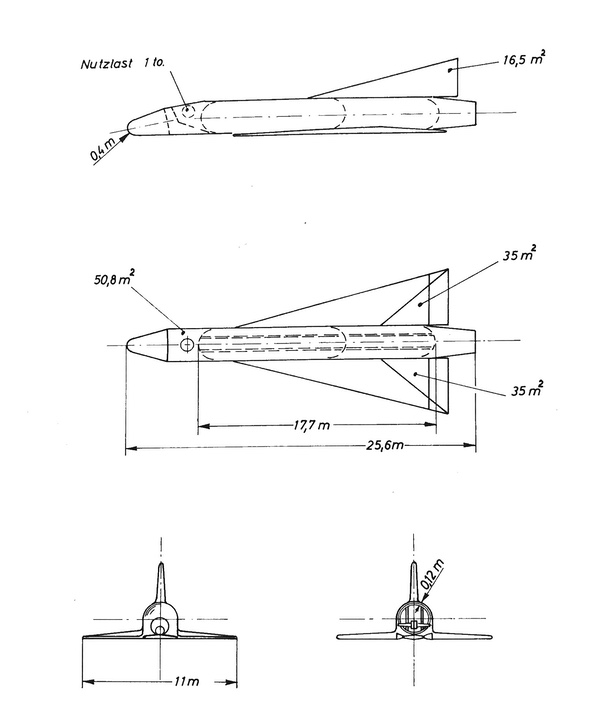 Figure 5: Outline RT-5. [1.xvi |
In principle, the use of LF2 as more energetic oxidizer could lead to an up to 30% higher Isp compared to the RT-1 with LOX/LH2 engines. A downside was, of course, the significant issues in handling fluorine in the first place. In Figure 6, Sänger inspects such a fluorine engine at Bell Aerosystems.
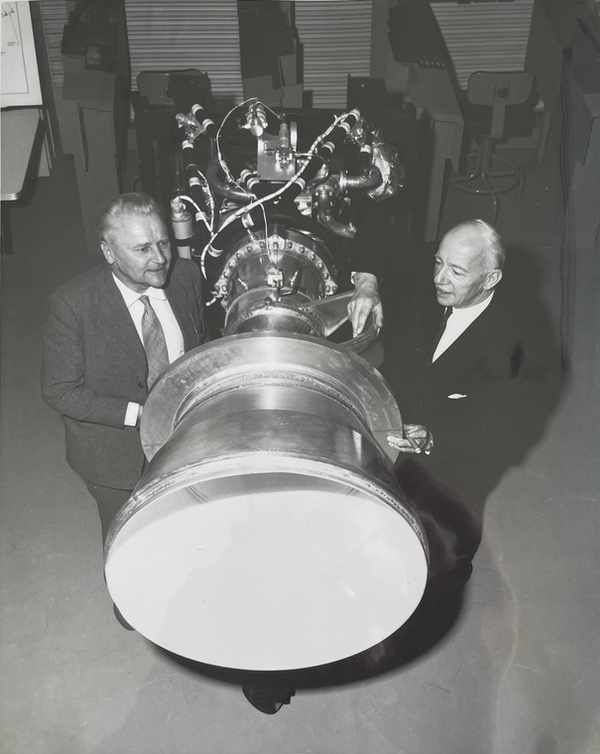 Figure 6: Sänger (left) inspects a fluorine engine at Bell Aerosystems in March 1961. [2.v] |
The RT-6 and RT-7 were two studies based on the RT-1 to answer questions on how a much smaller or larger size would change the spaceplane performance. The wing surface, fuel volume, and aerodynamics were important study parameters as well as performance to and from low Earth orbit (LEO). The RT-6 GTOW was only half of the RT-1 GTOW at 64 tons while the RT-7 was projected to be about 200 tons. Compared to the length of the RT-1 at 36.5 meters, the RT-6 was only 29 meters long and the RT-7 42.3 meters. [1.v]
Similar to work in the United States, all of these RT-1 to RT-7 SSTO approaches were a step too far and never left the drawing boards. More energetic engines or catapults were not going to bridge the gap to space. Nuclear engines with an Isp of 800 would do the trick but they were not available. Additionally, there were lingering doubts about environmental pollution by nuclear engines and its regular use.
The RT-8 was the first two-stage-to-orbit (TSTO) design by Junkers. The precise start date is not known but there are construction drawings dated October 10, 1963. Figure 7 shows the basic shape. This particular version is RT8/11 with at least 13 variants of the RT-8 alone.
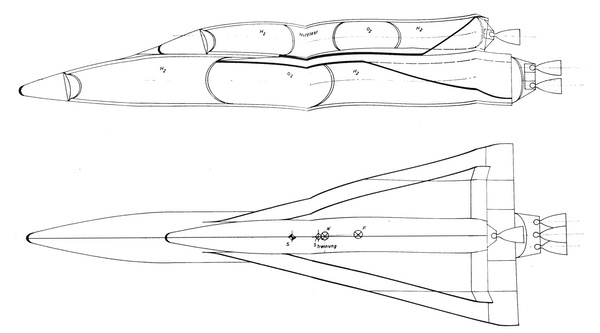 Figure 7: The RT-8/11 outline in October 1963. [1.xvi ] |
The RT-8 gross takeoff weight was projected as 100 tons with 79 tons for the first stage and 21 tons for the second stage. There would be 69 tons of fuel for the first stage and 13 tons for the second stage. The LH2 and LO2 tank positions are marked in Figure 7. This particular RT-8 version had the payload “(German) Nutzlast” in the middle of the second stage but there was considerably discussion whether it should be in the nose or middle of the stage. As this was a manned system with two pilots, discussion parameters were center of gravity, pilot views, heat shields, and more. The RT-8 was projected to bring a larger payload of 3.7 tons to LEO. Just like the earlier versions, the catapult start was still under consideration as shown in Figure 8. [8,9]
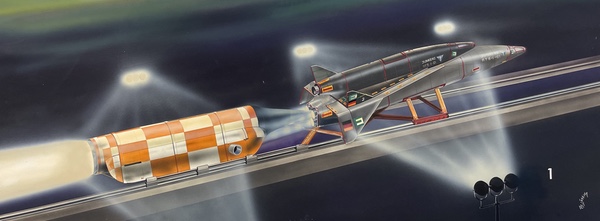 Figure 8 : RT-8 with catapult start. [6] |
After the pivotal spaceplane conference in Brussels in January 1964, with participation of all relevant French, British, German, and even American companies, the loss of the visionary Eugen Sänger early in the year 1964 changed the spaceplane dynamics and concepts. The Brussels conference was the high point of the European spaceplane dream.[1.xviii.xix, 3]
Via international cooperation within Eurospace, the industry partners from group Eurospace/III all participated. The French were interested in hypersonic research and planes. The British had Bluestreak as well as ideas about air-augmented turbojets. The Germans had their FPK 623 industry project on a reusable spaceplane going on in the years 1962 and 1963. The Americans were going full speed ahead with the Apollo project and were well aware of various concepts like the Dyna-Soar X-20, the Bell Astro rocket, the X-15 ,and others.
Followed by the Brussels conference highlight, there was the success of the Junkers exhibition at Paris airshow in June 1964 at Le Bourget. High fidelity models of the RT-8 generated lots of industry interest as shown in Figures 1 and 9.
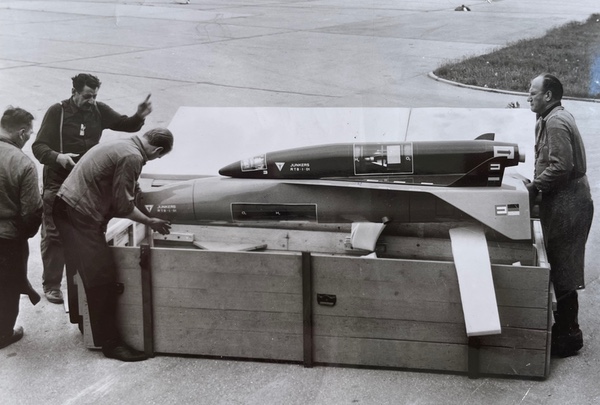 Figure 9: The Junkers RT-8 model on its way to “Le Bourget” 1965. [1.xxiv] |
In 1964 and 1965, government and international funding to develop the concept was not coming through in the large amounts necessary. At one government meeting about FPK 623, Junkers was steered away from spaceplane development as that was projected to be way too expensive and there were “not nearly enough” funds for the spaceplane development. In April 1964, only a quarter of the expected government funds came through. They were requested to plan for more basic research projects instead.[1.i ]
In April 1964, the numbering scheme for the RT changed.[1.viii ] The two stages of the RT-8/xx were now known as RT-8 I and RT-8 II, initially with version “A”. The “B” model is mentioned in July 1964.[1.xi ]
One final RT-8 model was the RT-8-II F in November 1964. Unlike most cylindrical body shapes, this second stage in Figure 10 is more like a flying wing based on an idea earlier explored with the RT-4 in Figure 3. It is possible that the “F” version was chosen to indicate the flying wing shape (German “Flunder”) [1.viii.xi ] A detailed chronology of memoranda and notes about the spaceplane by Lambrecht is available from 1963 to 1967.[1.xxiii ]
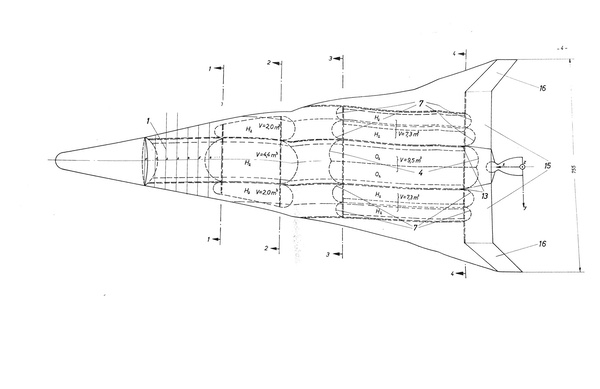 Figure 10: Second stage RT-8-II-F. [1.viii ] |
The RT-9 concept appears in early 1965 in technical notes and drawings as in Figure 11. The outline of the two-stage system looks similar to the final RT-8 iterations as in Figure 7 and 8. [1.vi.xiv.xxvi ] An increased payload of three tons to orbit was envisioned. At this time, the cockpit for the two astronauts was in the front. It is explicitly noted that that a one-stage SSTO system would not be economical at that time.[1.vi ] It is also reported that “metal was bent” and several construction experiments were done, such as to test the layered skin composition and heat transfer.[1.vi ] The movable heat shield for cockpit window was tested in flight to assess fluttering.[1.xxvi ]
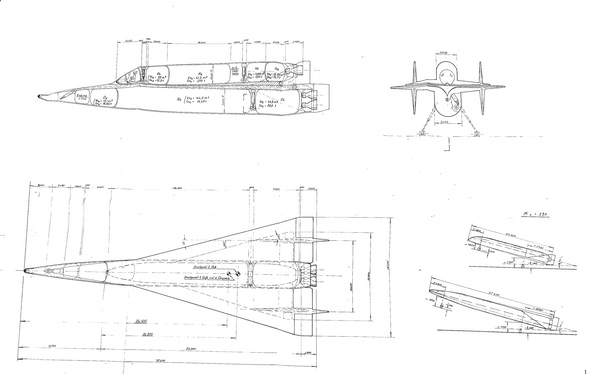 Figure 11: RT-9. [1.xxvi ] |
Both RT-8 and RT-9 were envisioned to be launched by catapult. That would add roughly an initial subsonic velocity of 250 meters per second to boost the spaceplane to orbit. [1.vi ]
Contemporary in 1964-65, a concept was developed to add a third stage and use air-launch similar to the X-15. A modified B-52 would lift the two stages to an appropriate altitude and speed. Such a three-stage system would get a velocity boost of about 300 meters per second, which was an attractive feature. The gross takeoff weight was projected at 250 tons for a total of three stages split into 140 tons for the carrier airplane plus 110 tons for the TSTO payload. However, it would also add complications with an additional stage, which would compromise the reusability vision. [1.ii.vi.xxv ]
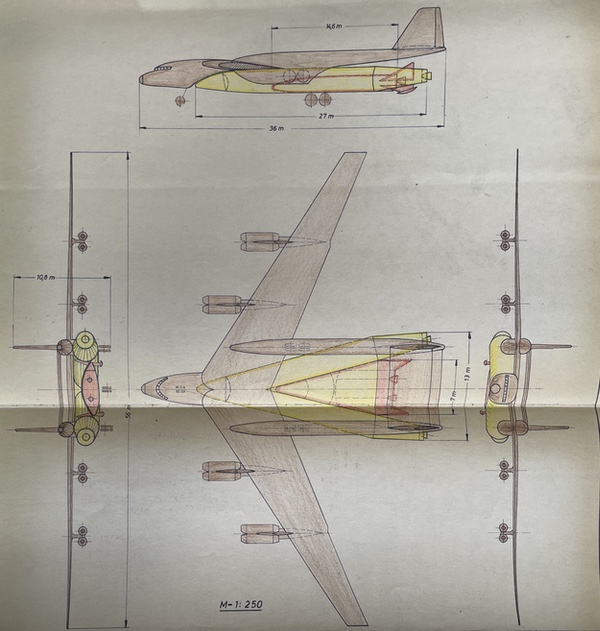 Figure 12: The RT-10 concept. [1.xxv] |
The RT-10 concept from August 1964 is shown in Figure 12 and 13.[1.xxv] It was reported that this air-launched concept was proposed for funding in 1965 but not accepted. In a later Junkers study, it was reported that a three-stage spaceplane did not provide any significant economic advantage over the TSTO spaceplane.[1.vi.xxv]
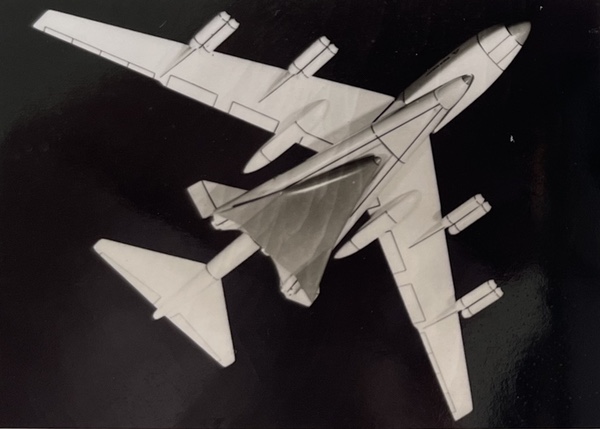 Figure 13: The RT-10 concept. (credit: Airbus Heritage) [1.xxv] |
The two-stage RT-20-I and II with gross takeoff wright of 150 tons appeared in a technical drawing of May 1965 and looked similar to the two-stage RT-9 in Figure 11. [1.iii ] An exact description RT-20 or its objectives was not located. No reports about any tentative RT-11 to RT-19 models were located.
Spaceplane cabin
At the start of the spaceplane project in 1962, computer technology was not advanced enough to do automated landing and rendezvous. Therefore, there was a need for typically two pilots. As this aerospace transporter would leave the Earth atmosphere, like Mercury and Gemini, a pressurized cabin with climate control system was needed to keep the two pilots alive in vacuum all the way to LEO as shown in Figure 14.
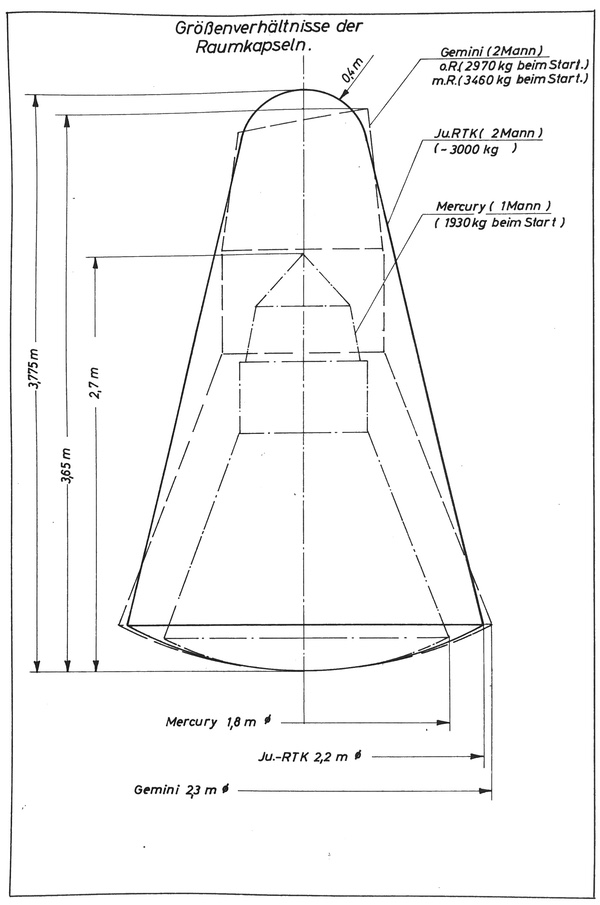 Figure 14: Cabin size comparison of Mercury, Gemini and Raumtransporterkabine (RTK) [1.xvi ] |
A rescue system during all phases of the flight was mandatory. Figure 2 showed Eugen Sänger inspecting the X-15 escape system and those lessons were passed on to the Junkers spaceplane. Ejection seats would work airplane-like in the lower atmosphere and speeds while an ejectable cabin was a solution during higher speeds and altitude. Ejection seats also were a solution for the RT-8 with its ground based rocket-sled accelerator in Figure 8.[1.xvi ]
| This 1960s design for a spaceplane had some remarkable similarity with the US Space Shuttle a decade later. |
Ejection pods or capsules were not new in West Germany. They were previously built in Nazi Germany during World War II 20 years earlier and their application to an even higher flying device such as the spaceplane was a natural solution. While two separate rescue systems added mass, rescue opportunities should exist in all stages of flight. Even Kelly Johnson admitted that, “I have never been convinced that a capsule ejection is required for anything other than high velocity re-entry from outer space”.[11] The mass of the spaceplane cabin was projected to be between 1,767 and 3,000 kg. [1.xv.xvi ]
Two of the Junkers spaceplane cabin designs are shown in Figure 15. These are from 1965 for the RT-8. The cabin had a graphite nose like the Space Shuttle a decade later. The cabin had Martin-Baker ejection seats for both pilots. Earlier designs had Junkers’ ejection seats. The cabin could be separated from the second stage and had a parachute in the nose behind the heat shield. The parachute would hold the capsule in a stable position during descent and land on the cabin backside with the backs of the pilots towards the ground. To facilitate maneuvering and braking in high-speed phases, the cabin had several engines at the back. Various setups were evaluated for G-forces, mass, and center of gravity.[1.xvi ]
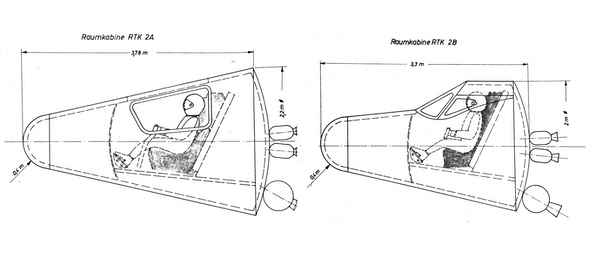 Figure 15: Spaceplane cabin designs 2A and B. [1.xvi ] |
As pilots needed a good view in the landing and rendezvous phases there was considerable discussion on the positioning of the windows as shown in Figure 15. The windows were a risk as they were not as heat resistant as the graphite nose shield. Therefore, erectable window shields were designed, measured, weighed, and even flight tested to verify the absence of fluttering.
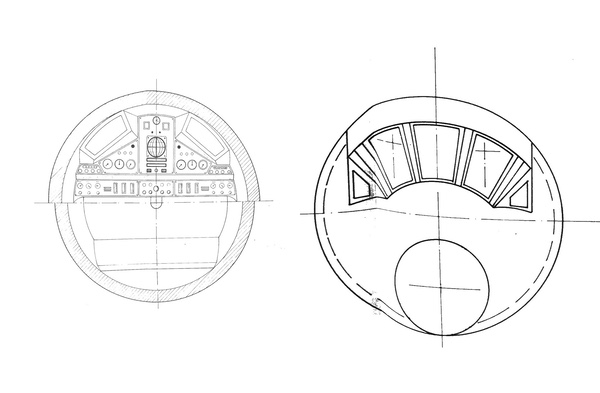 Figure 16: Concept RT-8-II frontal view and instruments. [1.xv.xvi ] |
As indicated in Figure 15 and 16, the window views for last phase and minute of the glide landing approach towards the runway looked similar compared to the US Space Shuttle descent a decade later. Window setups and angles were evaluated to verify that the pilots would have enough situational awareness. [1.xvi.xv]
Conclusion
The lack of success of the Junkers spaceplane project can be attributed to several factors. In the 1960s, the German aerospace industry was in a tough spot. While they had a large number of engineers at the end of World War 2, many left or were forced to leave for the US and Soviet Union. Seventeen years after the end of the war, the spaceplane was a great opportunity to start something new and innovative and to educate a new generation of engineers in West Germany.
| Sänger’s death in 1964 meant the loss of the principal investigator of the spaceplane project, and his significant international contacts and standing was something that the project never recovered from. |
The first problem was money. The private company money got the spaceplane project started and research money from the West German government via FPK 623 helped it progress. However, development funding never materialized. Some projections were 100 times more than the DM 5 million in research funds and the German government passed on that as they had other spaceflight commitments with ELDO.[1.i.xxi.xxii ] The funding shortfalls may have contributed to the loss of the JFM independence as between 1965 and 1969, the various parts of the JFM company were gradually acquired and absorbed by Messerschmitt A.G. and Messerschmitt-Bölkow-Blohm (MBB).
The second problem was politics. European money never materialized in enough quantities despite the Eurospace lobbying in France and Britain. France and Britain effectively prioritized their own aerospace interests in the form of ELDO, ballistic rockets, and defense. Venture capital would have helped to expand Junkers and the project but VC capital in West Germany was effectively not available at the time. Sänger’s death in 1964 meant the loss of the principal investigator of the spaceplane project, and his significant international contacts and standing was something that the project never recovered from.[2.i.ii ]
Another contributing factor was that business with the USA was mainly through postwar partnerships, not direct funding. There was an active exchange of people and ideas. Eurospace fostered relationships in the United States. As an example, there were offers like from The Aerospace Company to do “design reviews” instead of investing money.[10]
The third problem was engineers. It was not that the German engineers were bad. On the contrary, the United States was actively poaching aerospace engineers as they were having a hard time to find enough qualified engineers to go to the moon with the Apollo project.
On his trip to United States in 1961, Eugen Sänger talked with Hugh Dryden, NASA deputy director, and reported, “In a very personal exchange with Dr. Dryden, he mentioned several times that he and a large number of American spaceflight scientists who had travelled in West Germany described the classical reconstruction of the West German aerospace R&D as ‘a tragedy’. We would be happy to help in any way possible also because of the egoistic perspective that the American spaceflight research suffers from the lack of innovative engineers and scientists which is why a close cooperation with the corresponding German thinking institutes would also generate new perspectives and impulses for the American spaceflight R&D.”[2.vi ]
There were lessons learned. Despite initial construction experiments, no prototypes ever flew. The most that was produced was a scaled exhibition model. Today, there is the mantra of “fly early and often”. Similarly, the IT industry has an attitude of “do not specify but prototype.” There are spaceplane companies like Polaris Spaceplanes in Germany and Dawn Aerospace in New Zealand who seem to have learned these lessons. The prototype argument is strengthened by lessons from organizations Lockheed Skunkworks who were active around same time as Junkers. They built some planes in two or three years from scratch instead of studying a plane for three years.
While European trade and industry are vital, not all projects should run on European money and complicated cooperation. Sweden and France show that you can build an independent aerospace capability in a national way while being part of Europe. Vertical integration and VC funding to scale up are financial means which are under appreciated in Germany.
The engineering at Junkers in the early 1960s delivered on fantastic knowledge, experience and capabilities. However, the stars never aligned, and the lack of development money and the loss of the visionary leader leaves us with one of the great “What ifs?” of spaceflight history.
References
- Deutsches Museum, Archiv, Museumsinsel, Munich (Germany), Luft- und Raumfahrtdokumentationen (LRD), 13,000+ folders.
- LRD 04900, “Raumtransporter Angebote; Verträge; Kosten Laufzeit: 1964”, “Besuch bei Bundesministerium für wirtschaftliche Forschung wegen RFT32”, 3 pages, 10 March 1963, “Angebot 51/1964 zum Forschungsprojekt 623 - Technische Studien über ein Raumfluggerät”, 2 pages, 11 May 1954.
- LRD 05019, “Junkers [Junkers Flugzeug- und Motorenwerke JFM]: Berichte Hofmann, Raumtransporterberichte”, Laufzeit: 1964 - 1967, incl. “Das Flugzeug als Starthilfe für Raumtransporter-Systeme”, 19 pages, Ju. Bericht Nr. 064-188.
- LRD 05050, “Junkers Flugzeug- und Motorenwerke JFM: Raumtransporter RT”.
- LRD 05832, Sänger, E., “Vorläufige Vorschläge zur Entwicklung eines Europäischen Raumflugzeuges”, 32 chapters, 307 pages, 18 August 1961 - 10 February 1964.
- LRD 06926, “Junkers Flugzeug- und Motorenwerke JFM: Forschungsprojekt 623”, “Untersuchungen einer Außenhaut des Raumtransporters aus übereinandergeschichteten Wellblechen. Junkers Bericht 063-075”, “Ermittlung der Gewichte der tragenden Struktur der Raumtransportervarianten RT 1, RT 6, RT 7 als auch RT 6’ und RT 7’, Junkers Bericht Nr. 063-080, 39 pages, Sep 1963.
- LRD 06234, “Junkers Flugzeug- und Motorenwerke JFM: Raumtransporter Entwicklung Laufzeit: 08.1965 - 12.1965”, incl. “I. Aufgabenstellung für die Raumtransporter-Arbeiten, bisherige Mittel”, December 10, 1965, Lambrecht et al.
- LRD 06342, “Junkers Flugzeug- und Motorenwerke JFM: Raumtransporter: Entwicklung Laufzeit: 1963/64” , Lambrecht, “Gewichte und Abmessungen des Raumtransporters mit F2/N2H4”, 1 page, 28 May 1965.
- LRD 06343, “Junkers Flugzeug- und Motorenwerke JFM: Raumtransporter: Entwicklung Laufzeit: 1964/65”.
- LRD 06589, Lambrecht, J., “ÜBER DIE VERWENDUNG DER ELDO-A-TRÄGERRAKETE FÜR VERSUCHE MIT AERODYNAMISCHEN WIEDEREINTRITTS-MODELLEN, Ein EUROSPACE-Beitrag zur Problematik der Raumflug-Systeme”, Brighton, symposium. UK, May 23-25, 1966.
- LRD 06909, “Junkers JFM: Raumtransporter RT: Vorträge A-Z”, Laufzeit: 1964, Janik, “Kosten und Entwicklungsprogram eines Raumtransporters”, 18 pages, Lambrecht, “Auslegungskriterien der Raumtransporter”, 32 pages, 24 Mar 1964, Lambrecht, “Anforderungen an eine Europäisches Raumfahrtprogram”, 9 pages, 24 Mar 1964, Stöckel, K., “Triebwerke für Raumtransporter”, Bölkow, 11 pages.
- LRD 06910, “Junkers JFM: Junkers Raumtransporter RT-8/IIB, 2. Stufe. Laufzeit: 10.03.1964”.
- LRD 06922, “Junkers JFM: Raumtransporter RT, Tagung zur europäischen Zusammenarbeit”, 18 Aug 1965, 7 Sep 1965, Antrieb mit Luftbeimischung, Bristol Siddeley Engines (BSE), Laufzeit: 1965.
- LRD 07605, “Nuklearthermischer Antrieb NTA-Notiz Nr. 1.” “Ergebnisse der Voruntersuchungen über den nuklearthermischen Antrieb eines Raumtransporters.”, 13 Nov 1963.
- LRD 07607, “Ermittlung eines Projektgewichtes und einer Massenverteilung für die tragende Struktur des Raumtransporters Raumtransporters”, 18 pages, 18 January 1967.
- LRD 07640, “Junkers JFM: Untersuchungen einzelner Komponenten der Kabine in der Spitze des Raumtransporters und Gewichtsbilanz.”, Junkers-Bericht 065-217, 22 Sep 1965, 105 pages.
- LRD 07739, “Junkers JFM: Raumtransporter RT Intern Laufzeit: 01.07. - 31.12.1963”, incl. “Inhaltsübersicht für den Jahresendbericht 1963”, 3 pages, 1963, “Internationale Zusammenarbeit am Raumtransporter”, 2 pages, 1964, Letter, Edward N. Hall, United Aircraft, w.r.t Raumtransporter, 2 pages, 13 Nov 1963, “Besprechung über das EUROSPACE-Symposium über Raumtransporter”, 3 pages, Berlin, 16 Dez. 1963, “Projektbezeichnungen der Besatzungskabinen”, incl. Illustrations, 11 pages, 02 Dec 1963, “List of Junkers reports 1963”, J. Lambrecht, 2 pages, Nov 1963, “Praktische Versuche fur Raumtransporter”, 2 pages, 26 Aug 1963, “Nuklearer Antrieb für den Raumtransporter im Rahmen des nationalen Raumfahrtprogramms.”, 3 pages, “Luftzumischung zu Raketenstrahlen “, 1 page, 17 Oct. 1963.
- LRD 07742, “Junkers JFM: Raumtransporter RT Intern”.
- LRD 07746, The Eurospace Conference on the Space Transporter, 23-24 January 1964, Part 1, Palais des Congrés, Brussels, Belgium.
- LRD 07752, The Eurospace Conference on the Space Transporter, 23-24 January 1964, Part 2, Palais des Congrés, Brussels, Belgium.
- LRD 07895, “Junkers JFM: Eurospace III, Laufzeit: 02.1962 - 12.1962”, incl. “Space transporter and associated projects III/3”, Nov 1962, Protokolle der Arbeitsuntergruppe III/8 “Propulsion électrique”, 1961 -1962.
- LRD 08080, EUROSPACE publications. “EUROSPACE Aerospace Transporter”, 58 pages, in English, French and German, N64-32878#, 1964, “EUROSPACE Memorandum zur Frage der Durchführbarkeit eines Raumtransportersystems”, 7 pages, March 1965, “EUROSPACE Memorandum No. 1”, “Laboratory Test Methods and Facilities”, N65-21439#, June 1964, 21p, N64-32878#, EUROSPACE Memorandum No. 3”, “Fundamental Studies”, Sep 1964.
- LRD 08092, “Junkers JFM: EUROSPACE Raumtransporterbericht”, Comments by Martin. Co. on spaceplane”, Laufzeit: 31.12.1964.
- LRD 09975, “Raumfahrt: Entwicklung Raumtransporter; Junkers JFM Raumtransporter RT-8, RT-9”.
- LRD 09976, “Raumfahrt: Junkers JFM Raumtransporter RT-8 / Sänger, RT-9 1964”.
- LRD 020281, “Beiträge Kurt Reinigers zu Raumgleiterkonzepten, “Gedanken zum Startverfahren eines Raumtransporters”, “Das Trägerflugzeug als Startbasis für Raumflugkörper”, 2 Fassungen, Laufzeit: 06.1963 - 12.03.1968.”, “Der Flugzeugstart eines Raumtransporters unter dem Gesichtspunkt neuerer System-Untersuchungen.”, Junkers Bericht Nr. 064-162, 11 pages, “Das Flugzeug als Starthilfe für Raumtransporter-Systeme”, 19 pages, Ju. Bericht Nr. 064-188.
- LRD 06043, “Junkers Flugzeug- und Motorenwerke JFM: Verschiedene Zeichnungen und Berichte Raumtransporterentwicklung”, “Die Atmosphäre der Pilotenkabine der 2. Stufe”, “Junkers Bericht Nr. 065-191, Untersuchung der Rettungsmöglichkeiten der Kabine”, “Aktennotiz: Fenster”, “Aktennotiz: Landestoss-Dämpfung”, “Gewichtsabschätzung des Fahrwerkanteiles beim Raumtransporters RT-9”, “Schutzklappen für die RT 9 -Kabinenfenster”, Hautkonfiguration.
- Deutsches Museum, Archiv, Nachlass (NL) 230 Eugen Sänger, 4140 folders. https://www.deutsches-museum.de/assets/Forschung/Archiv/Download/Findbuecher_PDF/NL_230_Saenger.pdf
- Roy, M., “Das Luft- und Raumtransportsystem”, Eugen-Sänger-Gedächtnisfeier, 20 pages, Stuttgart, 10 February 1965, NL 230 / 0159.
- Roy, M., “Das Luft- und Raumtransportsystem”, “Zeitschrift für Flugwissenschaften”, Vol 13, Iss 8, 10 pages, Aug. 1965, NL 230 / 0835.
- Sänger, E., “Vorläufige Vorschläge zur Entwicklung eines Europäischen Raumflugzeuges”, 32 chapters, 307 pages, 18 August 1961 - 10 February 1964, NL 230 / 1311 - 1333.
- Sänger, E., “Vorläufige Vorschläge zur Entwicklung eines europäischen Raumflugzeuges. 1. Teil”, Deutsches Museum, NL 230 / 1321.
- “Amerikareise durch die US-Raumfahrtforschungszentren im Februar-März 1961 über Einladung des US-State Department.”, NL 230 / 1848.
- “Erfahrungen aus einer Studienreise durch die US-Raumfahrtforschung Administration zur Zusammenarbeit mit einer deutschen Raumfahrtforschung”, 7 pages, May 1st, 1961. NL 230 / 2472/1-2.
- “Fotodokumentation zu Eugen Sängers Besichtigungsreise durch Luft- und Raumfahrteinrichtungen von Forschung und Industrie in den USA”, NL 230 / 3783.
- The Eurospace Conference on the Space Transporter, 23-24 January 1964, Palais des Congrès, Brussels, Belgium. [1.xviii.xix ]
- N65-23958#, Maurice Roy, “Minutes of the Technical Meetings held during the Eurospace conference in Brussels on the Space Transporter”, also called “Aerospace plane transporter systems engineering, structural designs, and cost estimates”, Eurospace Report-6525, Eurospace, Paris (France), 32p.
- N65-23959#, M. Kaufmann,”HIGH PRESSURE ROCKET POWER UNITS FOR SPACE TRANSPORTERS”, Bölkow Entwicklungen K. G.. Munich. (West Germany), 14p.
- N65-23960#, D.G. Thomas,”PERSONNEL SUB SYSTEMS”, Martin Co., Baltimore, Md., 23p.
- N65-23961#, M.B. Dunn, “STRUCTURES PROBLEMS OF SPACE SYSTEMS”, Boeing Co. Seattle Wash, Aero-Space Div, 27p.
- N65-23962#, T.W. Smith, “ENGINEERING PROBLEMS OF NEAR FUTURE HYPERSONIC VEHICLES”, British Aircraft Corp., London, England, Preston Div, 18p.
- N65-23963#, J.C. Peters, “SPACE LAUNCH VEHICLE COST CONSIDERATIONS”, United Aircraft Corp.. Farmington, Conn. Corporate Systems Center, 17p.
- N65-23964#, Max A. Hauzeur, “THE SPACE TRANSPORTER--GENERAL MISSION ANALYSIS”, Sociétés Anonyme Belge de Constructions Aéronautiques (SABCA), 8p .
- N65-23965# George Mounis, “OUTLINE OF METHODS AND DATA REQUIRED FOR HEAT SHIELD CALCULATIONS”, Sud-Aviation, Paris (France), 31p.
- N65-24024# R.J. Lane, C.J. Austin, and M. J. Welch, “COMPARATIVE METHODS OF SPACE BOOSTING”, Bristol Siddeley Engines, Ltd. (England). Advanced Propulsion Research Group, 25p.
- N65-24027# J. Tubeuf and J. Bedel, “CONSIDERATIONS ON ROCKET PROPULSION FOR AN AEROSPACE VEHICLE”, 29p.
- N65-24031# J. Lambrecht, “COMPARED COSTS OF SPACE TRANSPORTERS AND OF BOOSTER ROCKETS”, Junkers Flugzeug- und Motorenwerke A. G.. Munich (W. Germany), 15p.
- N65-22883#, P.O. Hawkins, “ELECTRONIC ASPECTS OF SPACE TRANSPORTER”, Elliot Bros. Ltd., London (England), 8p.
- N65-23324# H. Deplante and P. Perrier, “ABOUT A CONCEPT OF AN AEROSPACE TRANSPORTER”, Dassault (Marcel) Aeronautique-Electronique (GAMD), France, 10p.
- E. Sänger, “The Historical Background and Motivation for a European Aerospace Transporter Proposal”, 10p.
- “Junkers Arbeitsbericht 1963: Band 1,2 and 3. Forschungsprojekt 623 Raumtransporter”, RFT 32, 537 pages, Bundesarchiv BArch B 228/2985, 228/2986, 228/2987”.
- J. Lambrecht, E. Schäfer, “A West-German Approach to Reusable Launch Vehicles”, Junkers FMW, Space Technology Conference, SAE 670387, pp. 144-148, February 1967.
- Deutsches Museum, Archiv, Museumsinsel, Munich (Germany), Nachlass (NL) 209 Theodor Lässig, Nr. 075/1 Plan.
- Sänger, E., “Raumfahrt heute-morgen-übermorgen”, Deutsches Museum, Archiv, Sänger Nachlass NL-230/1297, 428 pages, Econ Verlag Gmbh, 1963.
- Koelle, D.E., Sacher, P., Grallert, H., “Deutsche Raketenflugzeuge und Raumtransporter-Projekte”, in “Die deutsche Luftfahrt (34)”, 243 pages, ISBN 978-3-7637-6126-5, 2007.
- Kuczera, H., Sacher, P., “Reusable Space Transportation Systems”, Springer Praxis, ISBN 978-3-540-89180-2, 251 pages, 2011.
- Weyer, J., “Akteurstrategien und strukturelle Eigendynamiken - Raumfahrt in Westdeutschland 1945-1965”, 376 pages, Chapter 2 & 4, ISBN 3-509-01604-1, 1993.
- “Escape Crew Capsule”
- Day, D. A., “Atoms for space: Past US space nuclear power and propulsion programs”, July 13, 2026.
- Dewar, J., “To the End of the Solar System”, ISBN 0813122678, 438 pages, 2004.
- “The nuclear lightbulb - a brief introduction”, Beyond Nerva, 2020.
- “Die Sütterlinschrift (‘deutsche Schrift’) als Handschrift”.
Note: we are now moderating comments. There will be a delay in posting comments and no guarantee that all submitted comments will be posted.