An analysis of Ukraine’s missile strike on the Progress rocket factoryby Bart Hendrickx
|
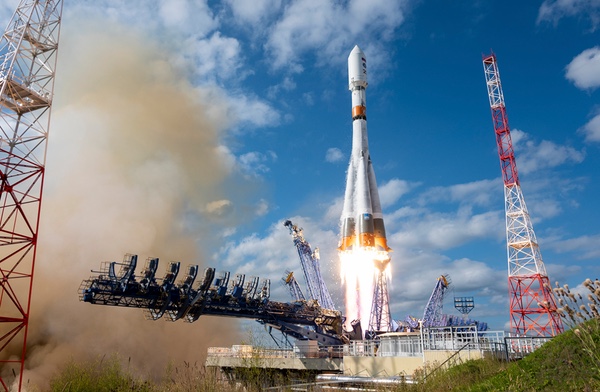 Launch of a Soyuz-2.1b rocket from Plesetsk. Credit: Russian Ministry of Defense. |
The Progress Rocket and Space Center (RKTs Progress in Russian) is the descendant of a design bureau set up in the early 1960s. Originally a branch of Korolyov’s OKB-1, it was placed in charge of the further development and production of R-7 based launch vehicles. It was also tasked with building the country’s optical reconnaissance and remote sensing satellites, a mission it also continues to perform today. The organization became an independent entity in 1976 and adopted its current name in 2014.
Initial reports on the attack
On the night of August 14–15, social media users reported massive explosions during an aerial attack on Samara, with initial eyewitness accounts pointing to RKTs Progress as a likely target. Footage circulating online showed plumes of thick smoke rising above the city's industrial district, sparking early speculation that one of Russia’s critical aerospace assembly lines had been hit. In response, regional Russian officials offered downplayed and vague statements, confirming that air defenses had repelled a “massive missile attack” but acknowledging that an unspecified “industrial facility” had sustained localized damage.
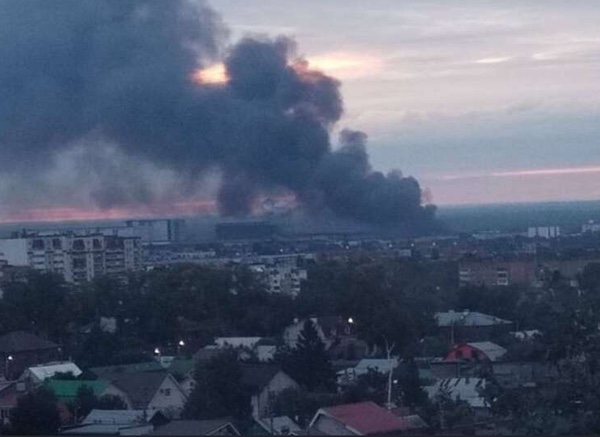 Smoke billowing from the impact area the morning after the attack. Source |
The General Staff of Ukraine’s Armed Forces soon confirmed that the target of the attack had been RKTs Progress. One of the center's facilities had reportedly sustained a direct hit, which sparked a major fire. Full damage assessment was still underway at the time. The official statement noted that the Soyuz rockets produced by the enterprise are used to launch “military, reconnaissance, and communications satellites” and specifically singled out the Rassvet broadband satellites, the Russian equivalent of SpaceX’s Starlink satellites. Although not explicitly mentioned in the statement, the Rassvet constellation is widely believed to provide communication and coordination support to Russian forces operating in Ukraine.
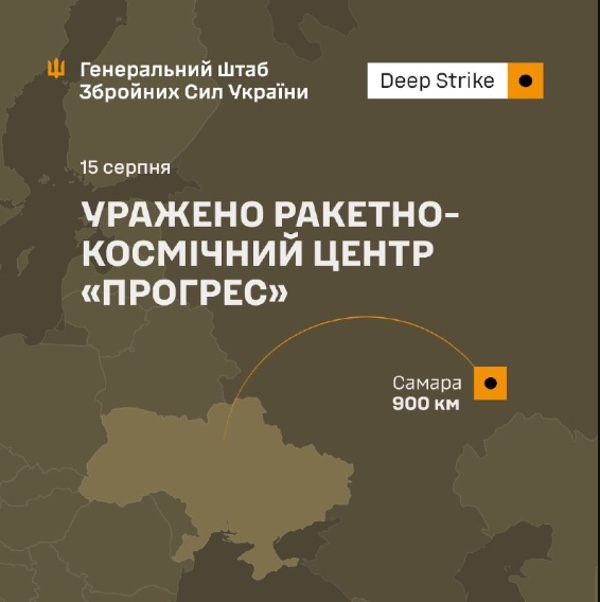 Map published by Ukraine’s General Staff showing the distance covered by the Ukrainian missiles to Samara. Source |
Ukrainian President Volodymyr Zelenskyy posted on X that the attack had been carried out using FP-5 Flamingo missiles: domestically produced, ground-launched subsonic cruise missiles. With a maximum operational range of 3,000 kilometers, these missiles have enabled Ukraine to conduct deep-strike operations far into Russian territory. They carry a massive 1,150-kilogram warhead (more than twice the payload capacity of American Tomahawk cruise missiles) and are capable of obliterating heavy industrial infrastructure and military targets. In his statement, Zelenskyy characterized Progress as “a key enterprise within Roscosmos, involved among other things in electronics production.” The statement was accompanied by a compilation of footage of the attack that had spread across Russian social media channels.
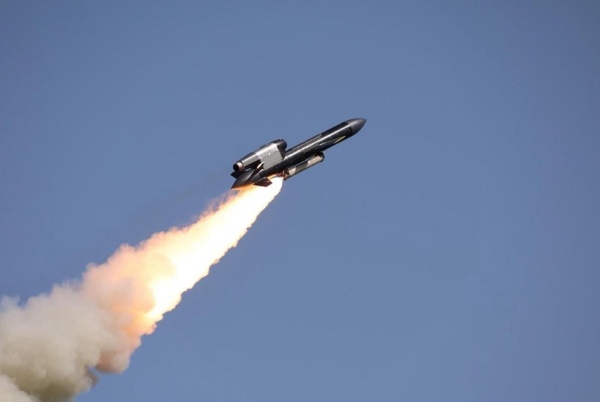 Launch of a Flamingo missile. Source |
Ukrainian analysis of the attack
An initial analysis of the attack was posted only hours after the event by analysts of a Ukrainian open-source intelligence group called CyberBoroshno. This was before any post-strike satellite imagery had been released. According to their assessment, the strike had most likely hit a critical segment of the Soyuz-2 production complex, which they identified as Building 106A. They described this as a building with a high cleanroom standard where electrical systems, instruments, and printed circuit boards were installed—“essentially the nervous system of the launch vehicle,” as they put it. CyberBoroshno estimated that repairing the structure and requalifying its clean zones would be an arduous process taking months rather than weeks. Compounding the problem, the analysts said, was the fact that Soyuz onboard electronics heavily rely on imported components, a supply line severely constrained by Western sanctions and nearly impossible to replenish. They added that the Soyuz-2 final assembly building, which they called Building 106B, was located nearby, but refrained from speculating whether it had also been targeted.
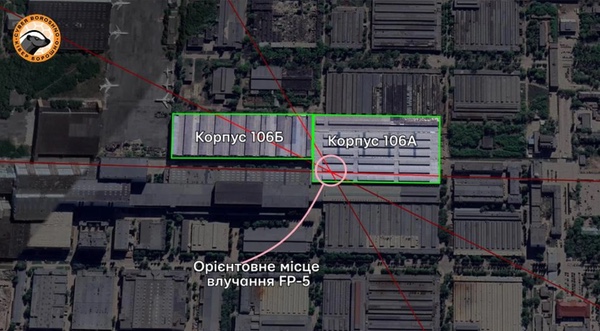 FP-5 Flamingo impact area as initially mapped by CyberBoroshno. Source |
On August 19, Ukraine’s General Staff released a follow-up assessment based on post-strike satellite intelligence. The imagery revealed two distinct impact areas, indicating two Flamingo missiles had been used in the attack. A smaller impact area was located inside the building CyberBoroshno had identified as 106A (the suspected Soyuz-2 electronics facility), and a larger one in a structure on the very edge of that same building (see video comparing imagery before and after the strike). The building identified by the OSINT group as 106B (the suspected final assembly building) was shown to be completely undamaged. The updated intelligence showed that the initial OSINT building identifications were incorrect and that the strikes had instead impacted structures belonging to two separate companies situated on adjacent plots.
The structure identified by CyberBoroshno as the Soyuz-2 electronics facility was clarified by the General Staff to be “a workshop for the assembly of engines for Soyuz-type rockets.” The second, larger strike hit a neighboring facility owned by an aviation plant called Aviakor. No building numbers were given in the military update. The numbers 106A and 106B are not found in Russian sources, leaving it unclear where CyberBoroshno obtained them.
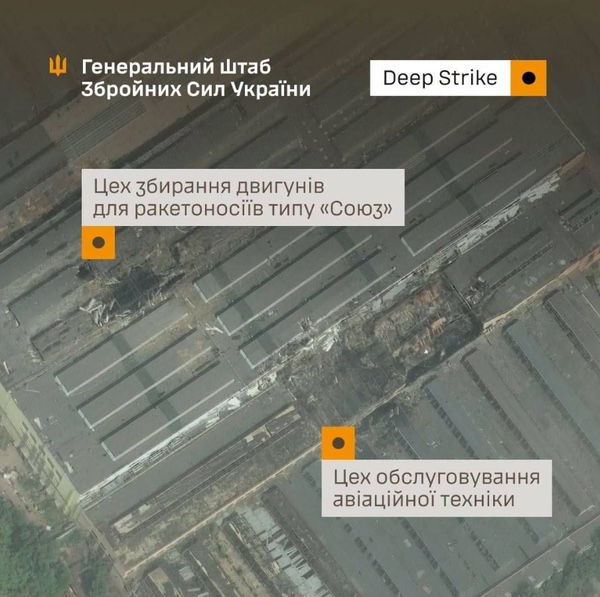 Identification of damaged areas by Ukraine’s General Staff. Source |
The strike on Aviakor
Aviakor is an aviation company situated immediately adjacent to Progress that specializes in aircraft maintenance. It is co-located with an airfield known as Bezymyanka. Both enterprises comprise a vast number of buildings scattered across a large industrial area. There are no publicly available maps identifying these specific structures or marking the precise boundary between the two territories. Nevertheless, Google Earth imagery does appear to show a fence line separating the complexes. Based on this and the Ukrainian General Staff’s identification of the larger impact zone, the probable borderline between the two territories is indicated by the yellow line on the map below. The main entrances for both companies (geolocated using ground-based imagery) are also marked.
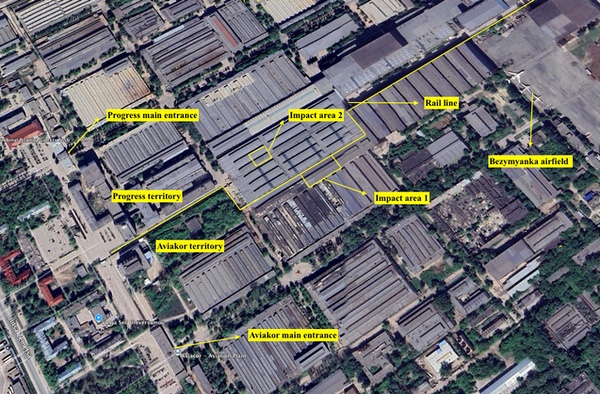 Map showing Aviakor and Progress territory and the two impact areas. |
The more significant damage was sustained by a structure situated on territory owned by Aviakor (indicated as impact area 1). While this structure directly borders Progress territory, it has no relation whatsoever to the production of Soyuz-2 rockets. However, there are several reasons to believe that Aviakor was not an intentional target and that both Flamingo missiles were, in fact, aimed at Progress. First, in their initial announcements of the strikes—before post-attack satellite imagery became available—neither the General Staff nor Zelenskyy mentioned Aviakor, naming Progress as the sole target. Second, in its subsequent damage assessment, the General Staff offered no explanation for why Aviakor had been hit, although it did reiterate its original justification for targeting Progress.
| All these factors taken together strongly suggest that one of the two Flamingo missiles missed its intended target at Progress. |
Aviakor is a company that services various types of aircraft. The only military aircraft known to have been handled by the company in the past decade is the Tu-95MS bomber, which Russia regularly deploys for cruise missile strikes against Ukraine. After securing a modernization contract in the 2015–2016 period to install underwing missile pylons on the aircraft, Aviakor continued minor electronic and navigation updates for the bomber through 2019 and into early 2020. While recent media reports on the Flamingo strikes have highlighted its role in the modernization of the Tu-95MS, there are no indications that Aviakor is still engaged in that work today. Defense procurement leaks from 2025 show that this work has shifted entirely to the 360th Aircraft Repair Plant in Ryazan and the Beriev Aviation Scientific and Technical Complex in Taganrog (both of which have also been attacked by Ukraine). Instead, Aviakor’s current operations are limited to maintaining civilian transport planes and manufacturing components for civilian turboprops.
Furthermore, there are signs in the satellite imagery that the struck Aviakor building was likely no longer operational. Also, it sits suspiciously close to Progress territory relative to the vast acreage occupied by the rest of the Aviakor plant. All these factors taken together strongly suggest that one of the two Flamingo missiles missed its intended target at Progress.
The strike on Progress
The second Flamingo missile did hit a building owned by Progress. However, the Ukrainian General Staff’s claim that the facility was used for Soyuz-2 “engine assembly” is clearly inaccurate, as Progress does not manufacture or assemble rocket engines. Instead, the plant receives fully assembled engines from external suppliers and integrates them into the various rocket stages. This leaves the true function of the struck building open to question.
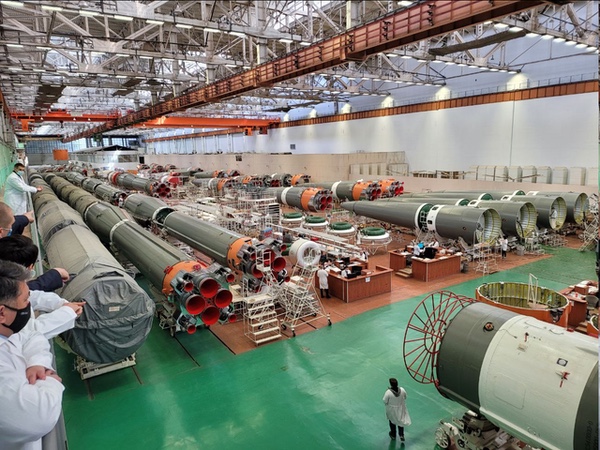
Progress has never published any detailed information about the Soyuz-2 production cycle and the specific buildings involved in it, let alone their exact location. The best descriptions of the manufacturing process and the infrastructure have been given in journalistic accounts published in February 2019, April 2019, and November 2019, and later in 2021, 2023 and 2024. Accompanied by extensive photo documentation, they show that the complex houses separate workshops to fabricate distinct components, including the structural rocket bodies, propellant tanks, and payload fairings. Most attention is focused on what some of these sources literally call “the general assembly and testing workshop,” further referred to here as the final assembly building.
This facility, roughly the size of a soccer field, features specialized workstations where the various rocket stages undergo their final integration and testing before being transported to the various cosmodromes by rail. Inside the hangar, a system of overhead traveling cranes is utilized to lift and move hardware around the floor. Most of the publicly available interior images of the Progress plant depict this specific hangar (see the picture heading this article). Since it is the heart of the Soyuz-2 production complex, it would have been the most logical target for the Ukrainian attack.
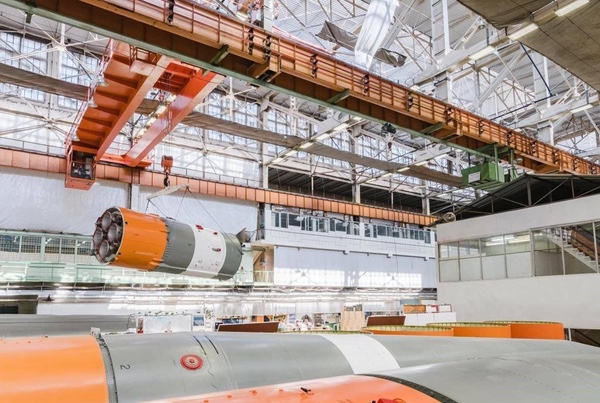 Soyuz-2 third stage being transferred between workstations by an overhead crane. Source |
In their initial analysis of the strike, the OSINT analysts of CyberBoroshno mistakenly geolocated the final assembly building (which they designated 106B) to an area that seems to be on the neighboring premises of Aviakor. Its true location may very well be where the second Flamingo landed and which the analysts had identified as the Soyuz-2 electronics building. Apart from the fact that the struck building is roughly the size of a soccer field, there are two other factors pointing to this conclusion. Most significantly, satellite imagery confirms the presence of a rail line connecting the building to the local railroad network. This is, of course, essential for shipping the rockets to the launch sites.
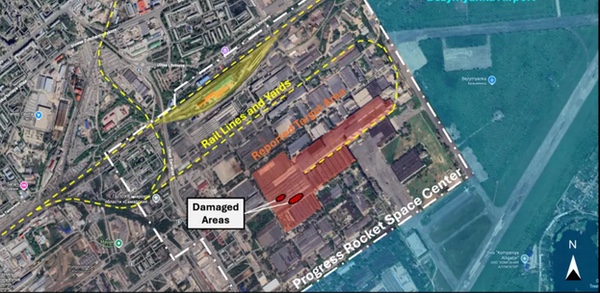 Map showing rail lines leading to the struck building. Credit: Integrity ISR |
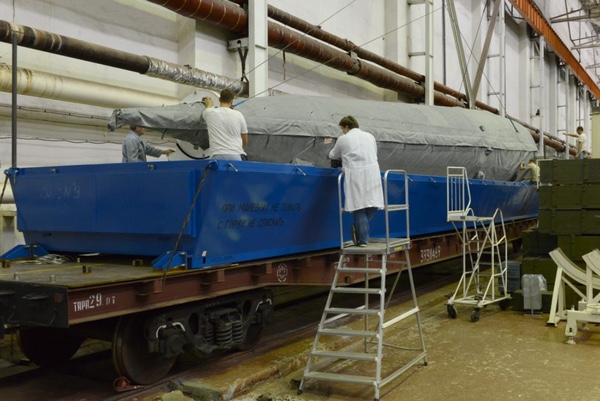 Soyuz-2 first-stage strap-on booster being loaded onto a railcar. Source |
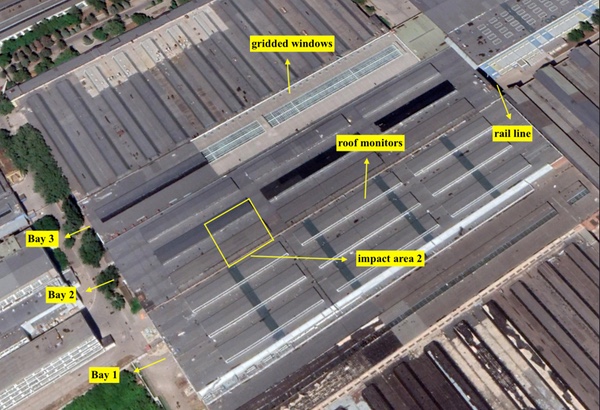
Satellite imagery of the struck building also reveals six parallel rows of roof monitors: raised structural ridges equipped with vertical window panels designed to flood the massive integration bay with natural daylight. These external features correlate with the multi-tiered window layouts seen in interior photographs of the assembly building. However, because only three rows of roof monitors are visible in those interior views, the facility appears to comprise two identically sized bays running parallel to each other and at least partially separated by an internal wall. Any functional or structural differences between these two bays (provisionally labeled Bays 1 and 2 in the picture below) are indistinguishable in available internal photographs.
 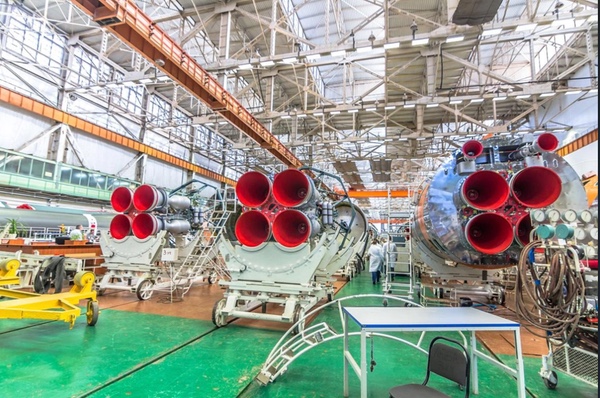 Inside view of the final assembly building showing three rows of roof monitors. Source |
Next to the damaged building is a somewhat narrower building featuring a distinct grid of white window panels across its roof. This matches internal views of a building that also houses a number of assembled rocket stages and may therefore serve as a third assembly bay. Logically, this would be located right next to the main hangar.
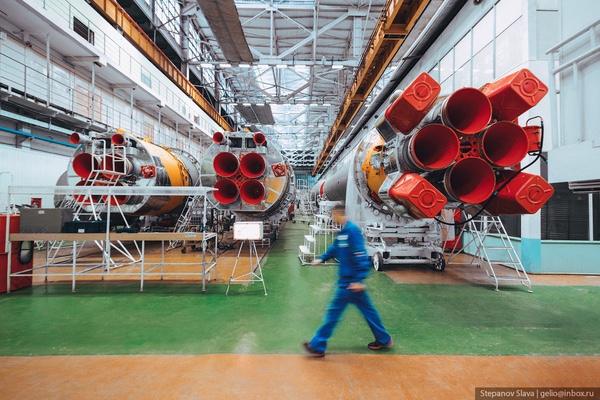 Possible third assembly bay. Source |
Damage assessment
All in all, indications are that both Ukrainian Flamingo missiles used in the attack on Samara were headed for the Progress plant. The missile that wreaked most of the havoc accidentally landed on a neighboring, possibly abandoned facility owned by Aviakor. While it seems to have caused some superficial damage to what is believed to be Bay 1 of the Soyuz-2 assembly building, this should have no significant effect on Soyuz-2 production. The second missile punched a hole through the roof of what appears to be Bay 2 of the building, with some scattered debris also visible on other parts of the structure. If Bay 1 is totally isolated from Bay 2 by an internal wall, then it should not have been affected by the strike. However, it is possible that there is an internal passageway between the two to allow hardware to be moved from Bay 1 into Bay 2, which is the sole hangar with an exit to the railroad network.
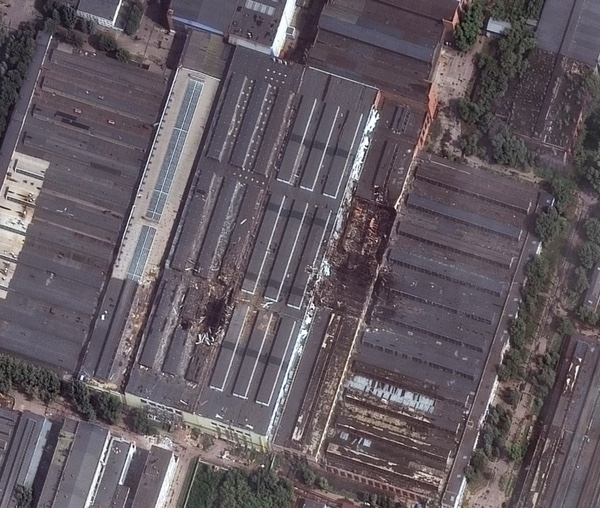 Image of the impact area obtained by US space intelligence firm Vantor on August 16. Source |
Apart from inflicting structural damage on the bay, the strike may also have substantially damaged any rocket stages or other hardware stored inside at the time. Although the affected area looks relatively small compared to the total footprint of the building, the damage could easily extend to other sections, especially if internal fires broke out. Additional complications are likely to arise from dust and soot contamination settling on sensitive hardware. Yet, contrary to some early claims, this facility is not a high-class cleanroom dedicated to electronics manufacturing. Rocket assembly facilities traditionally operate under fairly low cleanroom standards, and the Soyuz-2 assembly hall is no exception. Employees work inside the building without wearing cleanroom “bunny suits.”
Whatever the exact extent of the damage, it would no doubt have been far worse had both Flamingo missiles hit the assembly building. From the Ukrainian perspective, the operation was therefore likely only a partial success.
Downstream consequences
The attack on the Progress plant will definitely not impact the next Soyuz-2 launches planned from Baikonur and Vostochny. These are the launches of a Progress cargo ship from Baikonur in November and two Russian remote sensing satellites from Vostochny early next year. The Soyuz-2 rockets assigned to both these missions have already been shipped to their launch sites. However, no Soyuz-2 rockets have yet been delivered to Baikonur and Vostochny for further launches next year, and all of these vehicles are understood to still be in storage or undergoing final assembly at the Progress plant. This backlog includes five rockets designated for Soyuz and Progress missions to the International Space Station in 2027.
| Whatever the exact extent of the damage, it would no doubt have been far worse had both Flamingo missiles hit the assembly building. |
It is much harder to assess the immediate consequences for operations at the military Plesetsk cosmodrome, since launch schedules for that site are not publicly announced. Plesetsk launches not only dedicated military satellites for the Ministry of Defense but also the dual-use Rassvet broadband satellites built and operated by the private firm Bureau 1440. After Russian forces were denied access to SpaceX’s Starlink constellation in February this year, Rassvet satellites could play an essential role in filling that gap. Their potential value on the battlefield may have been one of the main motives for Ukraine’s attack on Progress, which would explain why Ukraine’s General Staff explicitly mentioned Rassvet in one of its statements on the strike.
So far, only two operational batches of 16 Rassvet satellites have been launched (in March and July this year), whereas a high launch rate is required to meet the target of roughly 300 satellites by the end of 2027, scaling up to a full constellation of 900 by 2035 (many of which will probably also be launched from Vostochny.) Speaking in January this year, Roscosmos’ launch vehicle director (and former Progress director) Dmitriy Baranov noted that the high demand for Rassvet missions was already exceeding Progress’ production capacity by 30–50%, though he added that a “sufficient stock” of rockets was available at the plant. Since the Russian cosmodromes have a fairly limited storage capacity for Soyuz-2 rockets, one must assume that most of the Soyuz-2 rockets scheduled to fly from Plesetsk in the coming months are also still waiting for shipment at Progress.
| Russia's once-insulated space infrastructure has become a contested and highly vulnerable front line in the ongoing Russian-Ukrainian conflict. |
One location where additional Soyuz-2 vehicles may be stockpiled is a military complex situated roughly 30 kilometers south of Tambov in central Russia. This is the 28th Arsenal of the Space Forces, also known by the names Znamenka-1 and Military Unit 14272. Constructed during the Soviet era, its primary mission was to store and service space launch vehicles that did not require immediate delivery from the manufacturer to the launch sites. This extensive storage capacity was vital to support the high cadence of Soviet space launches, a tempo largely driven by the short operational lifespans of Soviet satellites. During its peak operations in the 1970s and 1980s, the Arsenal routinely housed several dozen rockets simultaneously, including both Soyuz-class variants and other specialized booster families.
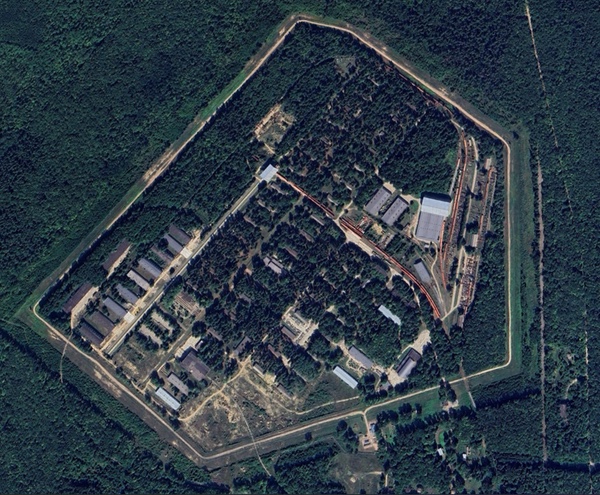 The 28th Arsenal in the Tambov region. An area in the southwest of the complex was cleared of trees to construct storage facilities for the Burevestnik anti-satellite project, but these were ultimately never built. Source: Google Earth. |
One usually reliable source on a Russian space forum recently claimed that the Arsenal should be able to absorb any delays in Soyuz-2 production caused by the strike on Progress. Still, it is highly questionable that many rockets are still stockpiled there today. When a team of Russian space journalists got a rare opportunity to visit the top-secret facility in 2011, they were told that the majority of launch vehicles were transported directly from factories to the cosmodromes. With the current Russian launch rate not significantly differing from that fifteen years ago, that situation is unlikely to have changed.
Fire at rocket engine plant
The Russian rocket industry was dealt another setback on September 2, just two weeks after the attack on Progress, when a major fire broke out in a new facility operated by rocket engine manufacturer Proton-PM. Located in Perm near the Ural Mountains, the complex was opened in February 2025 to take over the serial production of RD-191(M) engines from NPO Energomash in Moscow. These engines power the first stages of the Angara-1.2 and Angara-A5 rockets, the only other operational launch vehicles currently at Russia’s disposal apart from the Soyuz-2 family.
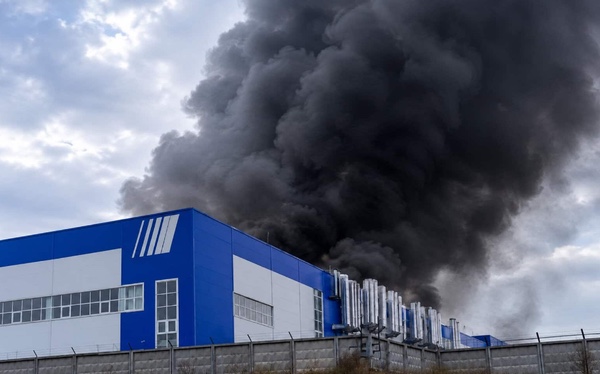 Fire at Proton-PM plant in Perm. Source |
As far as can be determined, full-scale production of the engines at the complex was not slated to begin until next year. If NPO Energomash can extend the serial manufacture of the engines, the long-term consequences may not be severe, the more so because the launch rate of the Angara rockets remains very low. All indications are that the fire was an accident and not the result of a Ukrainian attack. Still, it came at a particularly inconvenient time for Russia’s space sector in the wake of the attack on Progress.
Space infrastructure as a new front line
Although the Ukrainian attack on Progress may not have achieved all its objectives, it will undoubtedly have at least some impact on the company’s Soyuz-2 production capacity in the coming months. It has also exposed the risks of the nation’s critical satellite constellations being highly reliant on a single family of launch vehicles. As the sole manufacturing hub for these vehicles, Progress represents a single point of failure that is impossible to replace in the short term. Any further attacks on its facilities could have far-reaching implications for Russia’s space program, grounding a wide array of military and civilian satellites and jeopardizing both Soyuz and Progress missions to the ISS. The latter would also affect international partners, since these vehicles transport non-Russian crew members to the station and deliver critical propellant for station re-boost maneuvers.
Compounding these supply-side issues, Ukraine has also attempted to target the operational side of Russia's space program by executing drone attacks on the Plesetsk cosmodrome. At least three waves of such attacks have taken place since December, all strategically timed to disrupt final launch preparations. While all of these attacks were apparently repelled by the cosmodrome's dense anti-aircraft defenses, it remains entirely conceivable that future drone waves could penetrate this shield and inflict severe damage on critical launch infrastructure, such as assembly buildings and launch pads. In this way, Russia's once-insulated space infrastructure has become a contested and highly vulnerable front line in the ongoing Russian-Ukrainian conflict.
Note: we are now moderating comments. There will be a delay in posting comments and no guarantee that all submitted comments will be posted.