The orbit is the territory: rethinking spacepower in a domain where nothing stays stillby Michael Uhall
|
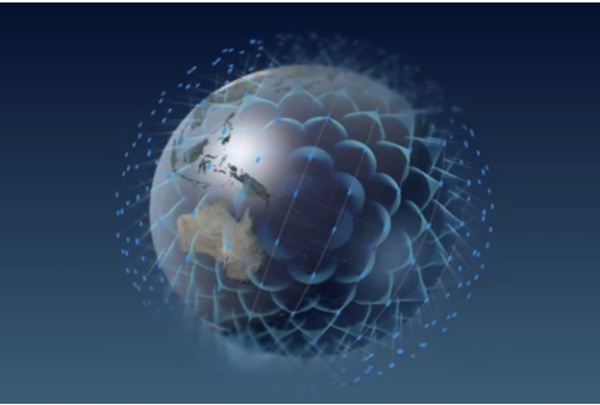
| Spacepower operates through infrastructures whose recurrent movements help constitute the usable geography of the domain itself. Spacepower, put bluntly, builds the territory it occupies. |
Since the beginning of the Space Age, strategists and theorists have understandably tried to extend these traditions upward, comparing outer space to the sea, sometimes to the air, occasionally to the ultimate geographical “high ground.” The analogies remain useful, but they also carry assumptions inherited from terrestrial geography that may not survive the trip. Outer space has its own physical and operational structure, and that structure changes what occupation, access, control, and territory can mean.
My suggestion is that what distinguishes spacepower lies in a peculiar relationship between movement and territorial order: spacepower operates through infrastructures whose recurrent movements help constitute the usable geography of the domain itself. Spacepower, put bluntly, builds the territory it occupies.
From sea power and air power to spacepower
Alfred Thayer Mahan’s classic theory of sea power is the obvious point of departure. For Mahan, maritime power was considerably more than possession of a strong navy. It linked battle fleets to commerce, merchant shipping, overseas bases and coaling stations, lines of communication, coastal geography, national productive capacity, and the policy focus of government. Command of the sea meant that one’s own maritime activity could proceed while an adversary’s was constrained or throttled. This was, in fact, a theory of an entire spatial system. In it, shipping routes connect ports and markets, bases sustain fleets across distance, and straits and chokepoints acquire strategic weight because geography concentrates movement through them. As such, sea power means the capacity to protect these circulatory systems and, when necessary, to block an adversary’s. The current standoff over the Strait of Hormuz offers an unusually stark example: naval power is being used simultaneously to preserve access through one of the world’s most important maritime chokepoints and to restrict the movement of designated adversary shipping.
Air power theory developed around a different set of geographical possibilities. Giulio Douhet and Alexander de Seversky both emphasize that aircraft could pass over the obstacles constraining armies and navies, and Seversky in particular argue—with an enthusiasm for strategic bombing that the historical record has not always been kind to—that air power could simply bypass the defensive and logistical “tentacles” of traditional military systems and strike directly at the industrial and political centers on which those tentacles depended. Whatever the fate of the strongest version of that claim, the broader conceptual point holds: access to the air introduced a new vertical dimension into strategy, so that range, altitude, speed, overflight, air superiority, and the projection of force across terrestrial barriers all became central strategic considerations.
Spacepower theory inherited elements of both sea power and air power theory. James Oberg’s Space Power Theory emphasizes the distinctiveness of the space environment, the planetary vantage available from orbit, the importance of orbital positions, and the value of situational awareness, while Colin Gray stresses continuity among the forms of strategic power. Geography changes from one domain to another, but strategy remains bounded by political purpose, physics, logistics, and the requirement to secure freedom of action.
| Geography changes from one domain to another, but strategy remains bounded by political purpose, physics, logistics, and the requirement to secure freedom of action. |
Other theorists have turned explicitly toward maritime theory. John Klein’s “Corbett in Orbit: A Maritime Model for Strategic Space Theory” draws on naval strategist Julian Corbett to think about celestial lines of communication and the necessarily situational character of any “command” of space. Bleddyn Bowen describes contemporary spacepower as littoral, meaning that near-Earth space remains closely tethered to the surface, to terrestrial infrastructure, and to Earth-based vulnerabilities. Further still, Brad Townsend pushes the terrestrial connection furthest, treating space primarily as an enabling domain for military operations whose consequences remain on Earth.
Each of these approaches captures something important about spacepower. Sea power theory directs attention toward communications, circulation, command, infrastructure, and strategic position; air power theory highlights access, altitude, speed, and the consequences of opening a new dimension of movement; the largely terrestrial orientation of Gray, Bowen, and Townsend serves as a standing reminder that most existing space systems remain deeply connected to political purposes and infrastructures on Earth. The difficulty starts when these similarities stop functioning as heuristics and start functioning as substitutes for examining the domain and its constraints and prospects on its own terms.
Strange geographies of orbit
Outer space is a peculiar geographical environment, and even near-Earth space is already heavily structured by gravity, the Earth’s rotation, orbital mechanics, radiation, atmospheric drag, and the delta-v cost of moving from one trajectory to another. Low Earth orbit, medium Earth orbit, geosynchronous regimes, and cislunar space each present different combinations of accessibility, persistence, usefulness, and exposure, so that what appears from the ground to be an undifferentiated void is in fact patterned throughout by physical relationships. Low Earth orbit is comparatively accessible and increasingly crowded. Medium Earth orbit hosts the major navigation constellations. Geostationary orbit allows a spacecraft to keep a persistent relationship to a particular region of the surface. Lagrange points and other cislunar positions carry their own advantages and constraints. Hohmann transfers, launch windows, maneuver costs, communications delays, and stationkeeping burns that hold a geostationary satellite inside its assigned slot round out the practical geography through which spacecraft actually move.
Nearly every politically meaningful interaction within this environment is also heavily mediated by technology: rockets for access, tracking networks for position, ground stations and relays for communication, computers and propulsion systems for modeling and altering trajectories, and sensors for making remote objects visible and usable at all. Extraterrestrial geography therefore has an unusually strong infrastructural character. The environment supplies the physical topology, while technical systems transform portions of that topology into usable pathways, positions, and relationships.
The upshot is a domain in which movement itself becomes unusually important to spatial order as such. A ship can stop in a harbor, an aircraft can land at an airfield, and a state can draw a boundary on a map and claim jurisdiction over what lies inside it. But orbital spacecraft operate under different conditions, in which remaining usefully “in place,” in fact, means remaining in motion. Howard Kleinberg captures the strangeness of this well. “Just being in space,” he observes, “requires nonstop motion at extremely high velocities and altitudes,” along paths that take a spacecraft around the whole globe. In other words, outer space hates you: “It is a domain where speed alone can kill.” Orbital infrastructure survives by continually falling around the Earth, and our usual image of territory becomes inadequate at exactly this point.
Territory as a pattern of movement
Territory ordinarily evokes bounded land—a state, a border, a parcel, a jurisdiction—but political geographers have already complicated that image considerably. Stuart Elden, for example, treats territory as a kind of political technology, produced through practices of mapping, measurement, surveying, regulation, administration, and enforcement that make physical space legible and governable. A border by itself does very little, and asserting and maintaining territorial order requires continuous activity. This broader conception becomes especially useful once we leave the ground, the surface of the Earth.
| Taken together, these systems produce a political geography whose most durable feature may be the recurrence of movement, and this is where spacepower becomes decisively different from its terrestrial predecessors. |
Territorialization can be understood as the process through which movements, access, activities, and relationships are organized into a persistent spatial order, so that territory consists partly of trajectories. Terrestrial territory already works this way more than we usually notice, since roads organize movement, shipping lanes channel commerce through Malacca and Suez, borders impede or regulate passage, infrastructure connects some places and bypasses others, and military positions shape who can safely move where. Territory is sustained through routines and repeated practices more than through lines printed on maps (although, in fact, the maps and the practices coproduce each other as often as not). Orbit simply makes the kinetic character of territory much harder to ignore.
Consider a single satellite. The object continually changes position while its trajectory remains highly predictable, and that trajectory creates recurring relationships with particular places and other objects. A remote sensing satellite periodically returns over the same regions. A communications satellite establishes recurring windows of connectivity. A navigation constellation coordinates many moving spacecraft so that users on the ground experience a service that is, for all practical purposes, continuous. The object moves and the pattern persists and recurs, which suggests a useful way of expanding the concept.
Territory can be understood as a persistent spatial order generated through recurrent movement, access, and use. In orbital space that persistence depends more on the repetition of trajectories than on the fixedness or immobility of anything. A territory in this sense becomes a processual map of access cycles: who can reach a Sun-synchronous orbit, and at what cost; how often a spacecraft passes over a given area; which geostationary slots the ITU has already coordinated, and with whom; and how fast a constellation absorbs the loss of a node, as Iridium did after the 2009 collision with Cosmos 2251. These are territorial questions once territory is understood as an organized regime of movement.
These questions also help clarify a distinction between territorialization and legal sovereignty that is easy to blur. Describing orbital space as territorialized does not necessarily require treating orbital shells as national property or proposing sovereign ownership of outer space, and political ordering can occur without converting a domain into conventional sovereign territory. Access can be structured, routes maintained, infrastructure defended, and forms of exclusion can arise even where formal national appropriation remains legally prohibited, which is why outer space may become increasingly territorialized while remaining quite unlike the territorial system familiar on Earth.
Spacepower as the production of orbital order
This expanded conception of territory suggests a correspondingly broader definition of spacepower.
Spacepower is frequently discussed in military terms—space superiority, freedom of action, denial, surveillance, communications, targeting, force projection—and these are in many ways the determinative capabilities. But each also depends on a much larger spatial order. A functioning satellite system requires access to launch infrastructure, communications links, tracking by something like the US Space Surveillance Network, command systems, supply chains, and terrestrial users. Constellations depend on coordinated patterns of movement. Navigation systems depend on timing and geometry. Remote sensing depends on predictable relationships among sensors, targets, and ground stations. Political and military power in space therefore arises partly from the ability to create and sustain these patterns, and spacepower can be understood as the capacity to produce, maintain, alter, exploit, defend, or disrupt the spatial orders through which activity in the extraterrestrial domain becomes possible in the first place.
That definition places orbital infrastructure near the center of the concept.
As examples, Starlink produces a territorial effect through the coordinated movement of thousands of satellites across a handful of low-orbit shells. A launch complex at Kourou, five degrees off the Equator, a site inherited from the French penal colony, creates cheaper access to geostationary transfer than Baikonur’s higher latitude and constrained azimuths permit .NASA’s Deep Space Network, its antennas spaced roughly 120 degrees apart at Goldstone, Madrid, and Canberra, connects moving spacecraft to a particular national state. These tracking architectures make otherwise inaccessible regions of space legible, and the communications links join widely separated nodes into an actionable whole.
Taken together, these systems produce a political geography whose most durable feature may be the recurrence of movement, and this is where spacepower becomes decisively different from its terrestrial predecessors. Mahan’s ocean exists as an element before the fleet sails across it. Hence, sea power organizes and exploits maritime geography through fleets, bases, commerce, and communications. Similarly, air power exploits a preexisting atmospheric medium whose relationship to the surface remains comparatively direct. Spacepower, by contrast, encounters a domain in which the usable political geography is extraordinarily dependent upon the infrastructure operating within the void of the extraterrestrial domain. Orbital routes, constellation architectures, communications systems, launch cycles, and positional relationships all help create the practical territory through which spacepower operates, with the result that territory and infrastructure become unusually difficult to separate.
This condition will only grow more pronounced as activity moves further beyond near-Earth orbit. Cislunar operations will depend increasingly on transfer trajectories, rendezvous points like the near-rectilinear halo orbit that would have been used for the lunar Gateway, relay satellites like Queqiao at Earth-Moon L2 (without which Chang’e-4 could not have operated on the far side at all), and carefully timed departures and arrivals. Farther out into the solar system, distance and maneuver costs will privilege pre-positioning, timing, and sustained infrastructure over anything resembling fixed position, and movement will continue to generate structure.
Persistence in motion
Strategic analogies are indispensable, since nobody begins thinking about a new domain from scratch.
The history of sea power provides concepts of command, communications, strategic position, commerce, and circulation, while the history of air power shows how access to a new spatial dimension can transform military imaginaries and political possibility alike. Analogy works well as a heuristic but becomes dangerous when the inherited concept starts to obscure the environment it was supposed to explain.
| Spacepower builds the territory it occupies through its very exercise, and understanding that territory requires learning to recognize persistence in movement. |
If orbital territory is constituted partly through recurrent movement, then several familiar strategic questions shift in emphasis. Control depends increasingly on the ability to maintain, modify, or interrupt patterns. Strategic position involves relationships among trajectories, timing, infrastructure, and access. Persistence can mean preserving a functioning architecture even while every individual component moves or is eventually replaced. The question “who controls this area?” thus gives way to a different set of questions: who can reach it, how frequently, along which trajectories, with what supporting infrastructure, who can sustain that access, who can deny it, and how quickly a disrupted pattern can be reconstructed. They reflect the distinctive geography of a domain in which presence usually means motion. Here we see a transformation of the classic political questions of “who should govern?” and “who can govern?” into something materially novel.
Accordingly, the lesson extends beyond military doctrine. Politics has always involved the production, occupation, and contestation of spatial orders, and entering the extraterrestrial domain expands the range of spatial orders available to political action while placing pressure on concepts that developed under terrestrial conditions. Spacepower theory—and, indeed, thinking about outer space in general—should take that pressure more seriously.
Outer space resembles the sea in some ways and the air in others, and each comparison illuminates part of the picture. But the extraterrestrial domain presents its own combination of scale, motion, gravity, technological mediation, and infrastructural dependence. The Space Age, in fact, has already begun to transform portions of that domain into politically structured space. What results is a territorial order whose stability resides, more often than not, in motion itself. Spacepower builds the territory it occupies through its very exercise, and understanding that territory requires learning to recognize persistence in movement.
Note: we are now moderating comments. There will be a delay in posting comments and no guarantee that all submitted comments will be posted.