Coming to terms with the end of the Falcon 9by Jeff Foust
|
| “Without naming names, we all know who the go-to easy button was for many years” when it came to launch, said Crain. |
This year, there were few contracts to announce since the conference was preempted by the International Space Summit, held the preceding week also in Paris. The French government, which organized the summit, encouraged French and other European space companies to make their major announcements there, ranging from launch contracts by Arianespace to satellite manufacturing awards for IRIS², the European secure connectivity constellation.
There was, though, plenty to talk about at World Space Business Week beyond contracts. The biggest theme to emerge from both onstage and offstage discussions was that the launch constraints the industry was facing, with demand for launches outstripping supply, may soon get much worse before it gets better.
“It seems like all anyone is talking about this week is access to launchers,” said Jeff Thornburg, CEO of Portal Space Systems, a company developing highly maneuverable spacecraft, on one conference panel.
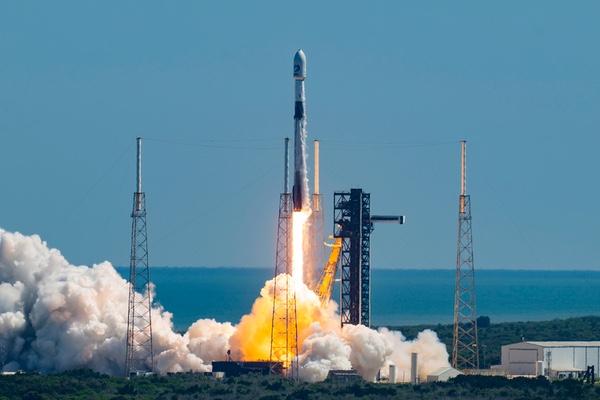
The reason it was a hot topic in Paris was not just the problems with existing vehicles, like Blue Origin’s New Glenn and ULA’s Vulcan, which remain grounded, or new vehicles whose first flights keep getting delayed (see “Wishing for rockets”, The Space Review, August 17, 2026.) It was the realization that the rocket that has been the workhorse for the commercial space industry in recent years, SpaceX’s Falcon 9, is going away.
SpaceX has not made a formal announcement about the future of the Falcon 9. Earlier this year, though, companies said that SpaceX had stopped taking reservations for rideshare launches beyond late 2028 or early 2029. At World Space Business Week, executives said privately that it was now effectively impossible to buy a Falcon 9 for any commercial mission, either for a rideshare flight or a dedicated launch of a larger satellite or constellation of spacecraft.
That is becoming a problem for an industry that had relied on the Falcon 9 as much for its availability as for its price. The Falcon 9 flew 165 times last year and SpaceX executives has previously said they were willing to balance its own demand on the rocket for the Starlink constellation with commercial customers.
“Without naming names, we all know who the go-to easy button was for many years” when it came to launch, said Tim Crain, senior vice president and chief technology officer of Intuitive Machines, at the conference. His company has used the Falcon 9 for launching its lunar landers while customers of its satellite manufacturing unit, the former Lanteris Space Systems acquired last year, turned to Falcon 9 for launching large GEO communications satellites.
Access to space is “the critical supply chain issue” for the industry, he added.
| “If we don’t obsolete our own products and services, someone’s going to find a way to obsolete them for us,” Shotwell said. “Look at what we did to the market, right?” |
That leaves companies worried about where they’ll go for launch when that easy button no longer works. “It would be very undesirable that the key launch service provider for us disappears from the market, so we obviously don’t want to see that,” said Peter Olsen, CEO of Space Norway Satcom, an operator of communications satellites that has previously used the Falcon 9 with a contract for an upcoming launch as well.
While the withdrawal of the Falcon 9 from the commercial launch market was something of a revelation at the conference, it was, to some, not a surprise. “This situation was totally predictable. Everybody knew it was going to happen,” said Jean-Luc Maria, CEO of Exotrail, a French company developing orbital transfer vehicles.
“You could really see this coming a few months ago. At least, we did,” said Thornburg, whose company announced last month it signed a contract for a Falcon 9 launch of its first Supernova spacecraft—perhaps one of the last commercial Falcon 9 contracts. Portal is working with launch aggregator Maverick Space Systems to sell excess capacity on the launch for rideshare payloads, including a deal announced at the conference to fly ten satellites for Kepler Communications’ data-relay constellation.
SpaceX has dropped hints that it would phase out the Falcon 9 in the coming years. “While we have steadily increased our Falcon 9 launch cadence over recent years, we expect Falcon 9 launches to decrease over time,” the company said in May in the prospectus for its initial public offering.
That document also suggested that commercial launches would be the first to be wound down for the Falcon 9 while the vehicle continues to fly for government customers. “As Starship progresses toward full operational utilization, the Falcon 9 and Falcon Heavy platforms will remain key assets for specialized missions, including NASA crew rotations and national security payloads,” it stated.
SpaceX was absent from launch discussions at World Space Business Week, skipping the conference’s traditional launch panel. Gwynne Shotwell, president and COO of SpaceX, instead appeared at the All-In Summit where she suggested the company was willing to disrupt itself by ending Falcon 9 to focus on Starship.
“If we don’t obsolete our own products and services, someone’s going to find a way to obsolete them for us,” she said. “Look at what we did to the market, right? The analogy is there. They were caught flatfooted. We crushed them. Now we want to make sure we are not flatfooted.”
The simplest answer is that customers who had used the Falcon 9 will shift to Starship, which is expected to make its first orbital launch as soon as next Monday. However, there remain several concerns in the industry about that, including how available Starship will be for commercial customers. The vehicle will be busy launching next-generation Starlink satellites and Starmind orbital data center spacecraft, as well as supporting NASA’s Artemis missions.
There are also issues about the compatibility of commercial satellites with Starship, which initially will have a unique slot-shaped payload bay door. That works well for the “flatsat” designs SpaceX has developed for Starlink and Starmind, but not for more traditional commercial satellites. The company has offered a version with a larger clamshell payload bay door for larger spacecraft, but it’s unclear how available that will be.
Starship also does not help on the smaller end of the market, those smallsats that had relied on Falcon 9 rideshare missions for regular and relatively inexpensive access to Sun-synchronous and mid-inclination orbits. SpaceX has hinted in the past it might offer a similar rideshare program for Starship, although the vehicle would likely be oversized for that application.
Another simple answer is for other launch companies to step into the gap created by the departing Falcon 9. That has proven to be easier said than done, though, as companies face delays with the first launches and challenges scaling up launches.
| “There’s two years to go displace what Falcon 9 did, and there’s a couple providers out there trying to do that,“ said Jenkins. “I think they need to hit the gas pedal on it.” |
He did not, though, disclose a timeline for getting to 100 launches a year or intermediate steps along the way, other than reiterating that the company was still working to resume New Glenn launches by the end of this year after a pad explosion in late May.
Other launch companies have more modest goals. Arianespace is seeking to reach the current limit of nine to ten Ariane 6 launches a year in 2027, as it works with ESA on studies of potentially increasing that launch rate to as high as 20 per year.
“Currently, we are looking at the investment required and, let's say, the overall business case for a cadence increase,” Arianespace CEO David Cavaillolès said on the panel. That would require investments in increased production of vehicles, including solid-propellant boosters, and potentially upgrades to the launch site in French Guiana.
“We'll see if we go to 11, 12, 15, or beyond,” he said. “But clearly, we want to be there for our clients.” (Arianespace set a goal this year of seven to eight launches, but has done only four to date, with engine issues reportedly limiting the company to just one or two more launches this year.)
At the conference there was a desire by some launch customers, bordering on impatience, for Falcon 9 alternatives. “We have launch vehicles that have not met the timelines they originally promised to be competitive with Falcon 9,” said Thornburg.
“There’s got to be a lot of advancement in the next two years,” said Matt Jenkins, chief space systems officer at Vantor, an Earth imaging company previously known as Maxar Intelligence. “There’s two years to go displace what Falcon 9 did, and there’s a couple providers out there trying to do that. I think they need to hit the gas pedal on it.”
There are some signs of progress. Earlier this month, Stoke Space announced it raised $1 billion to advance work on its fully reusable launch system called Nova. The company also announced it would scale up the original Nova, now called Nova Pathfinder and capable of placing several tons into low Earth orbit, to the larger Nova Block 2, with a capacity of 15 metric tons.
“What we’ve seen in the last year is an explosion in demand for more capable and higher quantities of satellites,” said Stoke Space CEO Andy Lapsa. “We think that we can fly at rate and fly full payloads at the 15-ton capacity.”
However, the Nova Block 2 won’t be ready until 2029, with Nova Pathfinder making “multiple” launches in 2027 and 2028 ahead of Block 2’s debut. Based on the experience of past vehicles, it will take several years for Nova Block 2 or other new vehicles in the same payload class—Relativity Space’s Terran R, Rocket Lab’s Neutron, or the joint Firefly Aerospace-Northrop Grumman Eclipse—to start flying at a useful cadence.
The problem is worse for smallsat customers who had relied on Falcon 9 rideshare launches, with few options open to them. In an earnings call earlier in the month, Giulio Ranzo, CEO of Avio, said his company has seen a steady stream of smallsat customers interested in his company’s Vega C.
“We have a whole bunch of customers coming to us and saying, ‘Oh my God, can you fly us? Because SpaceX no longer gives us a chance to launch,’” he said. “Guess what? The party is finished, and they don’t do that anymore.”
However, Avio’s ability to serve those customers is limited. The Vega C has flown twice this year, including a launch of two Earth science satellites for ESA and the European Commission last week, with one more launch expected this year. At the International Space Summit, Ranzo said Avio was looking at ways to increase Vega C’s launch rate to six per year, and then to nine, but did not offer a schedule for doing so.
The SpaceX rideshare missions also helped undermine the business case for many small launch vehicles. “What’s happened over the last decade is that one company has dominated this market and it has chilled investment,” said Chris Kemp, CEO of Astra, during one conference panel.
Astra had a small launch vehicle, Rocket 3.3, but withdrew it from the market in 2022 after several failures. Kemp argued on the panel that Astra ended that Rocket not because of its checkered flight history but because it was too small to serve a market that had shifted from cubesats to larger spacecraft.
He said Astra’s larger Rocket 4, capable of putting up to a ton into LEO, will make its first launch early next year from Wallops Island, Virginia. Astra is planning quarterly launches of Rocket 4 next year as it works to ramp up to weekly launches “within five years.”
| “What’s happened over the last decade is that one company has dominated this market and it has chilled investment,” said Kemp. |
In Europe, Isar Aerospace successfully reached orbit for the first time September 5, when the German company’s Spectrum rocket launched for the second time from Norway’s Andøya Spaceport. At a briefing during World Space Business Week, company executives said they are ready to begin commercial launches of the rocket, with a capacity of up to one ton to LEO.
Stella Guillen, Isar’s chief commercial officer, said at the briefing that Spectrum’s manifest is fully booked for 2027 and 2028. The company is planning four launches next year and “a little bit more than doubling” that in 2028. Isar’s new factory near Munich can produce up to 40 Spectrum rockets a year.
“The market is there and demand is super high,” she said. “What we’re trying to do is scale up as much as we can.”
She said that customers are increasingly worried about how they will get their satellites to orbit as the Falcon 9 phases out. “Now there is suddenly this panic mode for 2028 and 2029,” she noted.
Others, though, said companies that once pressed the easy button of SpaceX should avoid now hitting the panic button. “We seem to see a lot of panic in the industry over the lack of capacity,” said Portal’s Thornburg. “That’s what gets written, but I don’t believe that’s really the case. I think it’s the lack of ability of the current capacity to meet the growing demand.”
“Realistically, people are going to jump into that opportunity and come in to replace that Falcon 9 capacity,” he predicted.
That capacity, most in the industry expect, will eventually be replaced, either by SpaceX itself with Starship or competing vehicles. However, they also expect a crunch around the end of the decade as Falcon 9 exits the commercial market while those replacements are still working to fly at sufficient rates to replace that capacity.
“Don’t panic. I don’t think this is a structural problem. I think it’s a temporary gap,” said Renato Panesi, chief commercial officer of D-Orbit, which develops orbital transfer vehicles that have flown on many SpaceX rideshare missions.
“The critical moment will be 2029 and 2030, and maybe 2031,” he predicted. “That specific window is risky because I think new entrants will not have the launch cadence needed to meet the market demand.” D-Orbit has worked to mitigate its risk by buying launches from others, including Isar Aerospace and Spanish small launch company PLD Space.
“I’m really confident that there will be just a small period of time where it will be difficult to have access to space,” Exotrail’s Maria said. “For me, the problem will be solved.”
The solutions that emerge, though, may not be everyone. “You have the very small players, cubesats. I think some of them are in trouble because it will be very difficult to access space,” he said.
The industry left Paris last week less hopeful about the future than hoping that alternatives will emerge in time. “There’s a lot of development going on,” said Intuitive Machines’ Crain. “What we’re seeing now is the opportunity for the rest of the market to step up and expand and fill the gap.”
Note: we are now moderating comments. There will be a delay in posting comments and no guarantee that all submitted comments will be posted.